- The paper provides closed-form analytic results on noise and fidelity properties in star network entanglement distribution.
- It compares the factory and piecemaker protocols, revealing the latter’s significant fidelity advantage in many-user regimes.
- The methodology enables fast protocol optimization via deterministic cut-off strategies, bypassing intensive Monte Carlo simulations.
Exact Noise Characterization of Entanglement Distribution in Star Networks
Introduction and Motivation
Multipartite entanglement is crucial for quantum internet applications such as conference key agreement, secret sharing, distributed sensing, and clock synchronization. These protocols often require the distribution of high-fidelity GHZ-type entangled states to multiple users. In practically motivated architectures, such as star-topology networks with a single central node connected to multiple end users, stochasticity in link generation and quantum memory decoherence are fundamental sources of noise.
The work "Exact noise characterization of entanglement distribution in star networks" (2606.07043) provides rigorous analytic results on the noise properties during entanglement distribution in homogeneous star networks. It focuses on two state-of-the-art multipartite entanglement distribution protocols: the "factory" and "piecemaker" protocols. The analysis yields explicit closed-form expressions for both average and full distributions of noise and fidelity under dephasing and depolarizing memory noise, enabling fast and precise protocol optimization and parameter sweeps without recourse to computationally intensive Monte Carlo simulations.
Noise Models and Protocols
The core noise mechanism considered is quantum memory decoherence at the central node, which accumulates while waiting for all elementary links (entangled pairs between center and end users) to succeed. Two types of quantum channels are analyzed:
- Dephasing: Parameterized by λ, the channel preserves diagonal Pauli terms and contracts off-diagonal terms, directly affecting the fidelity of GHZ states.
- Depolarizing: More general, it uniformly contracts all non-identity Pauli terms.
The protocols are:
- Factory protocol: All Bell pairs are generated in parallel; the central node waits until every link is established, and then performs a collective GHZ-basis measurement. This maximizes wait times and thus decoherence.
- Piecemaker protocol: Measurement and fusion operations are performed as soon as possible, allowing early arrival links to be fused before all others are ready, minimizing waiting time for (most) memory qubits.
Both protocols model the entanglement distribution as a stochastic process determined by geometric wait-time distributions for link successes and memory noise accumulation as a function of these waiting times.
Analytical Results for Noise and Fidelity
The authors derive closed-form expressions characterizing the expected effective noise parameter E[Λ] and its full probability distribution. For dephasing noise, the average state fidelity for both protocols can be written explicitly as polynomials and sums of n+1 terms (where n is the number of end users), dependent on memory coherence parameter λ and link success probability q.
A key result is the rigorous quantification of the protocol performance gap: for equal hardware constraints, the piecemaker protocol yields much higher fidelities than the factory protocol as n increases.
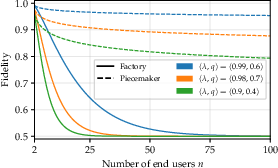
Figure 1: Fidelity as a function of the number of end users n, for both the piecemaker and factory protocol, with several experimental parameter settings (λ,q).
The analytic approach is extended to uniform depolarizing noise, yielding closed-form results for the action on arbitrary target pure states by decomposing noise effects in the Pauli basis and exploiting the homogeneity of the star network.
The full distribution of the noise parameter can also be extracted as a series expansion (using the probability generating function), allowing insight into not just mean fidelity but variance and higher-order moments as well.
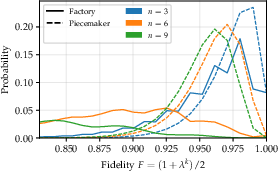
Figure 2: Distribution of the fidelity for the factory and piecemaker protocol for various n, E[Λ]0, and E[Λ]1.
Protocol Optimization with Cut-Offs
The work addresses the standard trade-off between yield rate and fidelity by introducing a global time cut-off E[Λ]2: a protocol run is aborted and reset if not all links succeed within E[Λ]3 timesteps. The analytic framework provides exact expressions for the average fidelity, key generation rate, and average waiting time as functions of E[Λ]4, which enables fast deterministic optimization over the cut-off parameter.
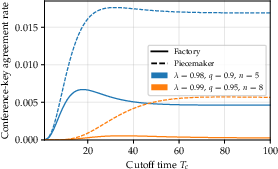
Figure 3: Conference-key agreement rate as a function of the cut-off time E[Λ]5 for the factory and piecemaker protocol.
Furthermore, in cases involving depolarizing noise or large E[Λ]6, there exist sharp thresholds for E[Λ]7 beyond which key rates collapse, necessitating the introduction of a cut-off for secure key distribution (especially in the factory protocol).
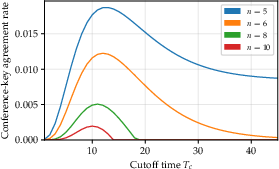
Figure 4: Conference-key agreement rate as a function of cut-off time E[Λ]8 for the factory protocol under depolarizing noise. For E[Λ]9, a cut-off is mandatory for nonzero key rates.
Implications for Conference Key Agreement and Binning
The analytic noise distributions allow fine-grained management of conference key agreement (CKA) protocols. Rather than processing all samples together, noise binning techniques can group states by fidelity, enabling convexity-based post-processing to achieve higher overall secret key rates.
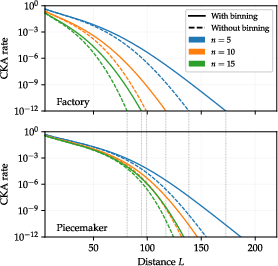
Figure 5: CKA rate with vs. without binning for both protocols, as a function of channel distance for multiple n+10. Binning significantly boosts achievable distance and key rate, especially under the piecemaker protocol.
Strong Numerical Trends and Claims
- Quantitative fidelity advantage: For moderate parameter values, the piecemaker protocol supports up to six times as many end users at a fixed fidelity threshold as the factory protocol.
- Key rate optimization: Application of the analytic expressions enables deterministic optimization of cut-offs for maximal conference key rate per distance and parameter setting, replacing slow and noisy Monte Carlo approaches.
- Noise distribution analysis: The non-unimodal, "jagged" structure of the delivered state noise/fidelity is analytically predicted, which is essential for advanced protocol design strategies that leverage measurement and post-processing conditioned on noise realization.
Broader Theoretical and Practical Implications
This work delivers a robust toolkit for:
- Protocol selection and hardware benchmarking: Immediate application to experimental design and resource estimation for near-term, many-user quantum networks.
- Generalization to arbitrary topologies: The analytic approach scales (with increased computational effort) to more complex networks, as further detailed in the authors' subsequent work employing tensor network contraction techniques.
- Full-stack, device-aware simulation: Closed-form analytics substantially reduce the computational load for simulation and optimization in nontrivial quantum networking stacks, accelerating both protocol research and deployment.
The main theoretical implication is that many foundational multipartite quantum network protocols can, at least in symmetric regimes, be analyzed to a much greater depth than previously thought, enabling new benchmarks for future, increasingly complex network scenarios.
Practically, analytic control of noise and key rates paves the way for real-time optimization in field-deployed quantum networks, especially as memory errors and link stochasticity become dominant in scaling regimes.
Future Directions
Anticipated future developments following these results include:
- Extension to inhomogeneous and dynamically routed networks, using tensor network mappings for network-level analytic/numeric optimization [goodenough2026optimization].
- Co-design of quantum hardware and protocols: Joint optimization of memory times, link attempt rates, and protocol cut-off policies using these closed-form models.
- Integration with full-stack quantum network control for dynamic, hybrid strategies that adapt noise mitigation policies in real time.
- Binning and error tagging for near-term quantum key agreement: Implementation of data-driven post-processing leveraging full noise distribution knowledge.
Conclusion
This work provides a comprehensive analytical foundation for multipartite entanglement distribution in star networks, introducing tractable closed-form results for noise/fidelity statistics and actionable optimization strategies for practical protocol deployment. The rigorous performance advantage of the piecemaker protocol over the factory protocol is established, especially in the many-user regime. The analytic machinery developed is widely applicable to a broad range of quantum networking problems and sets the stage for more advanced, hardware-aware, and topology-agnostic quantum network engineering.