- The paper demonstrates that interference-induced phase dynamics driven by frequency detuning governs the spatial extent of Bohmian chaos in a 2D anisotropic oscillator.
- Numerical integration and Lyapunov exponent analysis reveal that near-resonance conditions expand chaotic regions relative to strong detuning cases.
- The introduction of a coherence parameter (χ) provides a quantitative framework to distinguish between localized and extended chaotic regimes in quantum systems.
Frequency Detuning and Bohmian Chaos in a Two-Dimensional Anisotropic Harmonic Oscillator
Introduction
This work analyzes chaotic behavior in Bohmian trajectories resulting from a minimal three-mode superposition in a two-dimensional anisotropic quantum harmonic oscillator. The primary focus is the interplay between frequency detuning and interference structure, which spontaneously induces chaos in the deterministic Bohmian framework. The study isolates the effect of interference-induced phase dynamics from dephasing due to irrational frequency ratios by restricting attention to rational and near-rational ratios. This enables a precise analysis of the emergence and spatial extent of chaotic motion as a function of the system's spectral parameters.
Theoretical Framework
The system considered is governed by a Hamiltonian with inequivalent oscillator frequencies along the x and y axes. The wavefunction is constructed as a superposition of the ground state and two first excited states with tunable complex coefficients. The essential interference structure is encoded in the reduced amplitude Φ(x,y,t), a sum of spatial polynomials multiplied by time-dependent complex exponentials associated with the different oscillator frequencies.
The Bohmian velocity field is determined by the spatial gradient of the phase S of the wavefunction, with velocity singularities at nodes of Φ. Interference between the first excited states is modulated by the beating frequency Ωb=∣ωx−ωy∣, and the spatiotemporal organization of the phase field generates phase-gradient structures that control the emergence and localization of chaos in the Bohmian trajectories.
A key construct is a dimensionless coherence parameter, χ, given by the ratio of the beating period Tb to a characteristic transport time Ttr across the central interference region:
χ=L∣ωx−ωy∣2πv0,
where y0 is a representative Bohmian speed and y1 is the oscillator length scale. Large values of y2 indicate extended temporal coherence (near resonance), while small values correspond to strong detuning and rapid temporal decorrelation.
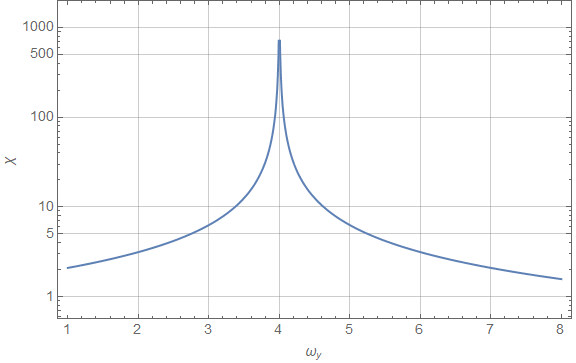
Figure 1: Coherence parameter y3 as a function of y4 (for fixed y5), demonstrating divergence near resonance where detuning vanishes.
Numerical Methods
Numerical integration of the Bohmian equations is performed in dimensionless units, employing adaptive time stepping. Trajectories are initiated in various regions of the configuration space to probe the onset and localization of chaos as a function of frequency ratio. The finite-time Lyapunov exponent is used to quantitatively diagnose chaotic behavior, with separation of nearby trajectories renormalized at fixed intervals. Poincaré sections provide a global portrait of the regular and irregular regions in phase space.
The principal cases investigated involve strong detuning (y6) and near-resonance (y7), examining their distinct influences on spatial structure and phase coherence.
Results: Frequency Detuning as a Control Parameter
Strong detuning confines chaotic motion to narrow channels near the central interference region, while regular motion dominates elsewhere. Near resonance, the chaotic region broadens, with trajectories from a larger fraction of initial conditions becoming irregular upon entering the interference zone. This transition is apparent in the qualitative structure of the Poincaré sections and in the temporal evolution of Bohmian velocity and Lyapunov exponents.
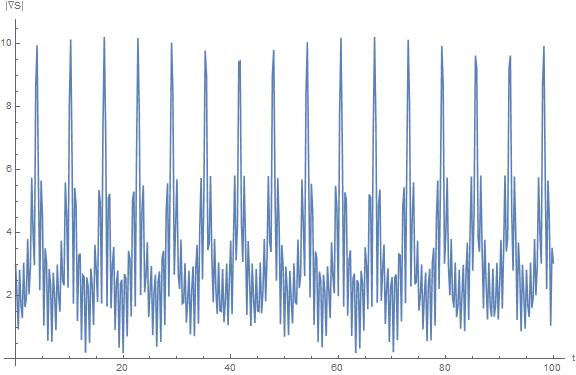
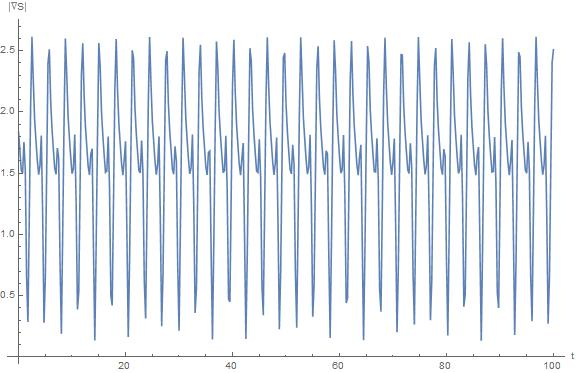
Figure 2: Poincaré section for y8 (left, strong detuning) and y9 (right, near resonance), highlighting the expansion of chaotic zones as Φ(x,y,t)0 increases.
The spatial and temporal organization of the phase-gradient field—directly shaped by interference beating—fundamentally controls the trajectory structure. In the near-resonant regime, phase-gradient structures persist for times longer than the Bohmian transport time, producing repeated stretching and folding. In the strongly detuned case, rapid decorrelation causes phase-gradient-driven instability to remain short-lived and localized.
Analysis of Interference and Phase Dynamics
The emergence of chaos is not solely attributable to the presence and motion of nodal points but is governed by the persistence and spatiotemporal structure of the interference-induced phase-gradient field. Both the phase-gradient magnitude and phase maps demonstrate that near resonance, high-gradient regions and branch cuts persist and drift slowly, while for strong detuning, these regions appear and vanish rapidly, consistent with localized, spike-dominated instability. The time series of Φ(x,y,t)1 at fixed probe points further corroborate these differences in temporal correlation and amplitude.
Implications and Future Perspectives
The study demonstrates that, for the considered three-mode superposition system, interference coherence measured via Φ(x,y,t)2 determines not just the presence but the spatial extent of Bohmian chaos. The results strengthen the interpretation that phase-gradient structures—dictated by the beat frequency of interfering modes—control whether chaotic transport remains localized or becomes spatially extended.
The implications are significant for the general theory of Bohmian chaos: phase structure, and in particular the temporal coherence of interference patterns, can act as effective organizing principles for trajectory complexity beyond the nodal and vortex-centric perspectives. This suggests direct routes to controlling chaotic dynamics in low-dimensional quantum systems through parametric modulation of spectral detuning.
A limitation is that the validity of Φ(x,y,t)3 as a universal diagnostic outside this minimal model remains to be assessed. For more complex or higher-dimensional systems, the influence of additional modes, rational versus irrational spectra, and varying interference geometries warrants further investigation. Nevertheless, the explicit connection between time-dependent interference and chaos localization provides a valuable framework for the rational design and analysis of quantum transport and trajectory-based quantum control protocols.
Conclusion
Through a detailed trajectory-level and interference-based analysis, the paper demonstrates that the spatial extension of chaos in Bohmian mechanics for a two-dimensional anisotropic oscillator is governed by interference coherence, with the detuning frequency serving as an explicit control parameter. The coherence parameter Φ(x,y,t)4 unifies the characterization of localized versus extended chaos, with potential implications for future research in identifying phase-structure-based diagnostics for chaos in broader classes of quantum systems.
[See also: "Frequency Detuning and Interference-Induced Bohmian Chaos in a Two-Dimensional Anisotropic Harmonic Oscillator" (2606.07011).]