- The paper presents a single-loop second-order framework that regularizes Newton methods to eliminate the inner maximization bottleneck in NC-SC minimax optimization.
- The paper develops an adaptive cubic-quadratic majorization technique that ensures global convergence with local superlinear rates and robust performance even under ill-conditioning.
- The paper extends its method to stochastic settings, achieving improved oracle complexities and resolving gaps in previous analyses of stochastic cubic regularization.
Single-Loop Regularized Newton Methods for Nonconvex-Strongly-Concave Minimax Optimization
Problem Formulation and Context
This work addresses nonconvex-strongly-concave (NC-SC) minimax optimization problems of the form minxmaxyf(x,y), where f is smooth, nonconvex in x, and strongly concave in y. Such structures are central in adversarial learning, generative modeling, distributionally robust statistics, and as subproblems in bilevel optimization. While first-order methods are scalable, they suffer from the inefficiency and sensitivity to ill-conditioning common in minimax landscapes. Second-order methods, particularly double-loop approaches involving inner maximization via first-order solvers, mitigate some issues but critically degrade superlinear local convergence and introduce severe dependence on conditioning, especially in stochastic regimes.
The authors introduce a single-loop second-order framework by leveraging a regularized minimization reformulation. Instead of minimizing the value function Φ(x)=maxyf(x,y) (which is nonsmooth and not directly accessible), they propose minimizing hβ(x,y)=f(x,y)+2β∥∇yf(x,y)∥2 with β>μ−1, where μ is the strong concavity modulus in y. Crucially, this reformulation preserves the first- and second-order stationary structure of the original minimax problem but admits direct computation of hβ and its gradient/Hessian, eliminating the inner maximization bottleneck.
Adaptive Cubic-Quadratic Majorization
The paper’s methodological core is an adaptive cubic-quadratic (ACQ) majorization, which enables efficient second-order steps without requiring Lipschitz continuity of the third derivative (which is typically violated in NC-SC settings). Instead, the authors ingeniously construct a majorizer that absorbs the non-Lipschitz third-order terms into an adaptive quadratic regularization, ensuring each cubic subproblem only involves first- and second-order information in f0. They show this leads to valid descent with provable guarantees under standard smoothness assumptions.
Algorithmic Schemes
Deterministic Setting
The resulting method, termed ACQRN, updates f1, where f2 minimizes a cubic-regularized model:
f3
with f4 a tractable surrogate Hessian and f5, f6 set adaptively based on problem-dependent quantities, ensuring sufficient descent.
Global iteration complexity matches double-loop second-order methods: f7 for achieving an f8-SOSP in the f9 formulation. Critically, ACQRN achieves local superlinear convergence when entering neighborhoods of nondegenerate solutions—a property unavailable to methods with inner-loop subproblem error bottlenecks.
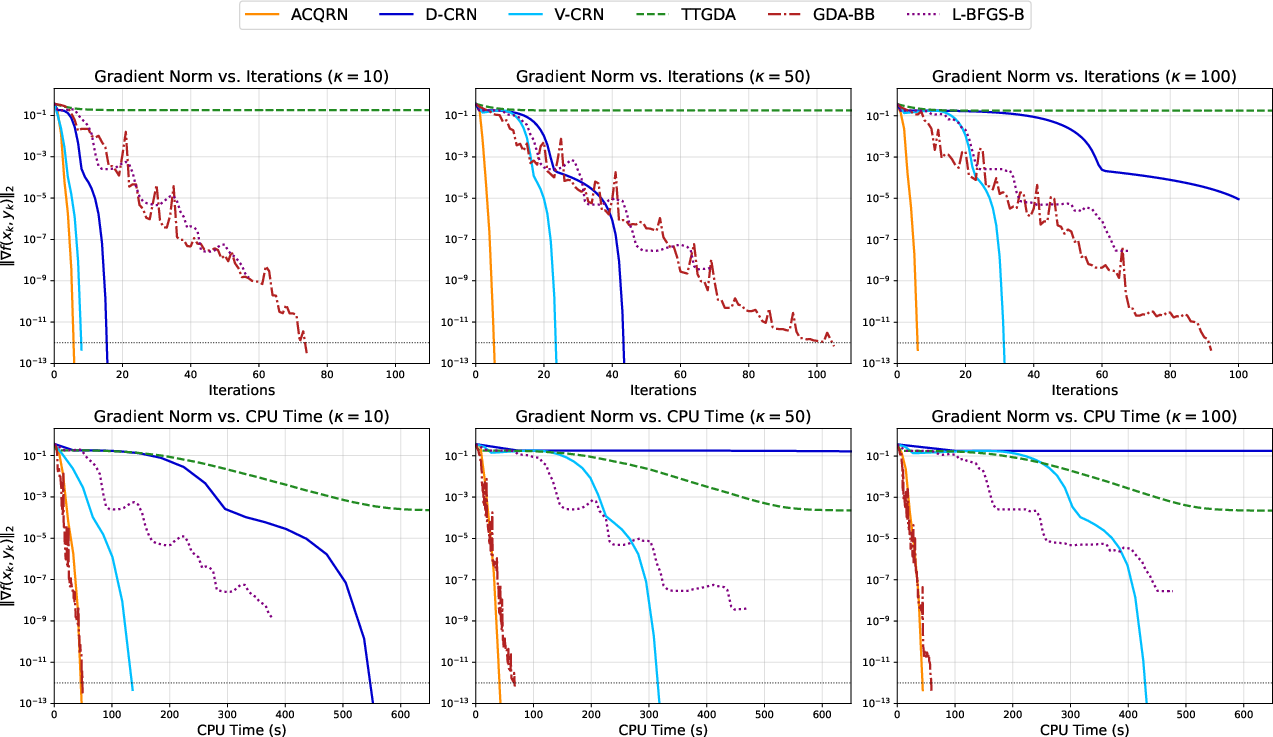
Figure 1: Deterministic robust-regression experiments for x0 quantify convergence profiles; ACQRN shows robust performance across condition numbers.
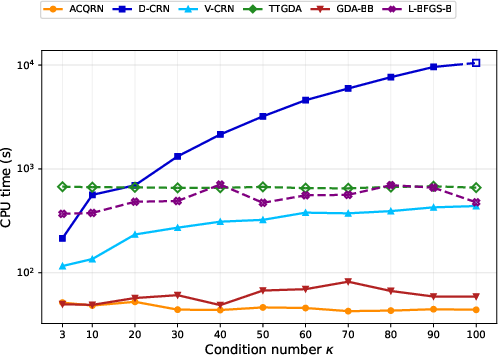
Figure 2: CPU time versus condition number; ACQRN remains nearly insensitive to ill-conditioning, outperforming double-loop and first-order baselines.
Stochastic Setting
A stochastic ACQRN (S-ACQRN) variant is defined for objective functions x1, using unbiased estimators and recursive variance reduction. Batch sizes are coupled to iterate progress, with careful control of estimation error via the Burkholder-Davis-Gundy inequality, improving upon prior methods that require high-probability martingale arguments (which, as the paper notes, contain latent errors in prior literature).
Complexity guarantees strictly improve over double-loop stochastic cubic regularization: Achieving in-expectation gradient complexity x2 and Hessian complexity x3, both gaining a x4 factor over previous approaches reliant on inner stochastic subroutines. The analysis only requires bounded third moments and mean smoothness of the stochastic oracles, dropping incompatible “bounded gradient” assumptions present in earlier works.
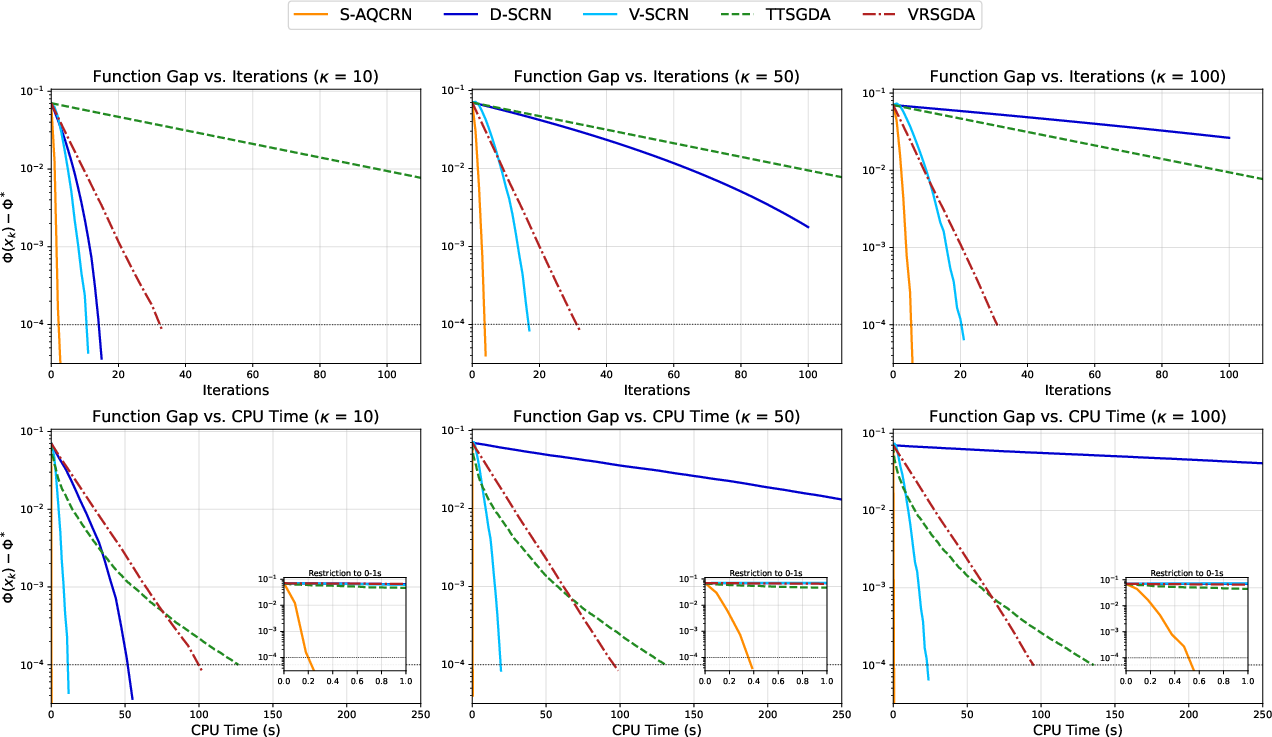
Figure 3: Stochastic robust-regression results for x5; S-ACQRN reliably reaches target accuracy faster than stochastic double-loop and first-order methods.
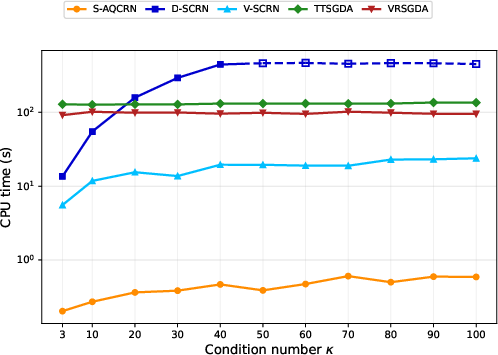
Figure 4: CPU time versus condition number in stochastic experiments; S-ACQRN maintains scalability across a range of ill-conditioning.
Numerical Results
Experiments on robust nonlinear regression (with adversarially perturbed targets) using high-dimensional real datasets substantiate the theoretical claims:
- In deterministic settings, ACQRN consistently outpaces both double-loop cubic regularization (D-CRN) and vanilla CRN (V-CRN), especially as the condition number x6 increases.
- Time-to-accuracy and iteration counts are essentially constant for ACQRN over a wide range of x7, while comparative methods deteriorate rapidly or fail to converge within practical time budgets.
- In stochastic settings, S-ACQRN delivers strictly shorter wall-clock times and iteration count to target optimality gaps compared to double-loop stochastic CRN and strong first-order baselines.
Theoretical Implications
The reformulation and associated theory establish equivalence between the regularized x8 minimization and the original minimax formulation at both first- and second-order stationary structures, under moderate smoothness and strong concavity. The adaptive majorization technique renders higher-order methods practical by removing dependence on unavailable Lipschitz constants of third derivatives. Furthermore, the work resolves theoretical gaps in the stochastic cubic regularization literature: the authors identify a fundamental error in previously popular martingale analysis for the stochastic setting and provide a corrected in-expectation approach applicable to both minimax and minimization problems.
Practical Impact and Future Directions
The ACQRN and S-ACQRN algorithms provide practical, scalable, and theoretically sound pathways for high-accuracy NC-SC minimax optimization, particularly in medium-scale and ill-conditioned applications where first-order methods or inner-loop heavy schemes stagnate. The modular regularization and majorization approach can, in principle, be generalized to other high-order and structured minimax problems.
Possible extensions include:
- Application to large-batch/sparse structure stochastic settings;
- Integrating curvature exploitation mechanisms (e.g., negative curvature directions) to accelerate escape from high-order saddle points in broader classes of nonconvex-nonconcave minimax problems;
- Development of parameter-free variants that automatically adapt regularization/majorization terms.
Conclusion
This work advances single-loop second-order optimization for nonconvex-strongly-concave minimax problems via a regularized Newton framework with novel adaptive cubic-quadratic majorization. The resulting methods achieve global convergence rates on par with double-loop schemes, but uniquely attain local superlinear convergence and exhibit robustness to ill-conditioning, both in theory and empirical evaluation. The stochastic algorithm offers the strongest known oracle complexities under natural moment assumptions, with a theoretically rigorous analysis that also resolves gaps in prior nonconvex minimization work. The regularization and majorization strategies introduced position this line of research as a robust foundation for future high-order algorithms in optimization over complex saddle-point landscapes.
Reference:
"A Single-Loop Regularized Newton Method for Nonconvex-Strongly-Concave Minimax Optimization" (2606.07003)