- The paper demonstrates that asymmetry in Fabry-Perot cavities yields both classical nonreciprocal transmission and robust quantum optomechanical entanglement.
- It employs quantum Langevin equations and Lyapunov analysis to quantify entanglement and identify optimal parameter regimes.
- The study reveals that forward-drive entanglement remains robust against thermal noise up to 71 K, promising enhanced performance in quantum devices.
Nonreciprocal Optomechanical Entanglement in Asymmetric Fabry-Perot Cavities
Introduction
Nonreciprocal photonic devices are core components in both classical and quantum technological platforms, enabling functionalities such as unidirectional transmission, isolation, and noise-resilient information transport. Traditional approaches to nonreciprocity often require magnetic fields, posing severe integration challenges for chip-scale photonics. The development of magnet-free nonreciprocity using optomechanical systems has emerged as a promising solution, leveraging radiation-pressure-induced coupling between light and mechanical modes to break symmetry. While classical nonreciprocal effects in asymmetric Fabry-Perot (F-P) optomechanical cavities have been established, the quantum analog—especially the realization and characteristics of nonreciprocal optomechanical entanglement—remains largely unexplored. The paper "Nonreciprocal optomechanical entanglement in an asymmetric Fabry-Perot cavity" (2606.06988) thoroughly addresses this gap by demonstrating theoretically the simultaneous existence of classical and quantum nonreciprocities in such a platform, elucidating their interplay, and identifying parameter regimes for robust, enhanced entanglement.
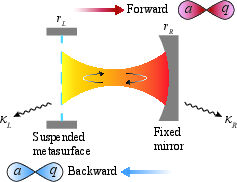
Figure 1: Schematic of the asymmetric Fabry-Perot optomechanical cavity with a movable mirror (reflectivity rL) and a fixed mirror (reflectivity rR).
The system considered is an asymmetric Fabry-Perot cavity comprising a fixed end mirror and a suspended metasurface acting as a movable mirror. The optical cavity field, with resonance frequency ωc, interacts via radiation pressure with the mechanical oscillator (frequency ωm) formed by the movable mirror. The cavity is driven by a continuous-wave laser of frequency ωd, with parameters such as the spring constant K, mirror reflectivities rL,rR, driving power P, and environmental temperature T as external controls.
Both classical and quantum dissipations are addressed using quantum Langevin equations (QLEs), allowing simultaneous investigation of transmission spectra and quantification of optomechanical entanglement via logarithmic negativity. The input-output formalism supports the calculation of both forward (left-incident) and backward (right-incident) transmission rates, while stability and quantum covariance are handled through Lyapunov equations for Gaussian systems.
Classical Nonreciprocity and Parameter Dependence
The transmission spectra reveal strongly nonreciprocal behavior, controlled by both the spring constant K of the movable mirror and the reflectivity rR0. Decreasing rR1 increases the shift between transmission peaks for forward and backward drive, amplifying nonreciprocity. Notably, as the cavity approaches symmetry (rR2), nonreciprocal effects vanish, demonstrating the necessity of asymmetry for classical nonreciprocity.
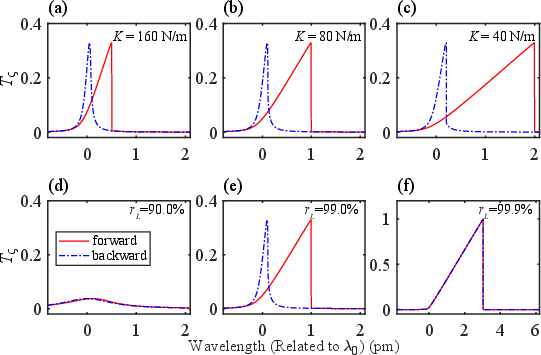
Figure 2: Transmission spectra showing dependence on spring constant rR3 and reflectivity rR4 for forward (red) and backward (blue) incidences; asymmetry induces strong nonreciprocity in specific regimes.
The system displays optical bistability under certain drive and detuning conditions, which correlates with the emergence of regions of strong nonreciprocity.
Nonreciprocal Quantum Entanglement
Optomechanical entanglement is quantified using logarithmic negativity rR5, evaluated from the steady-state covariance matrix. The entanglement is found to exhibit marked nonreciprocity: for the same parameter set, rR6 (forward drive) can exceed rR7 (backward drive) by more than an order of magnitude. However, nonreciprocal entanglement is typically confined to narrow regions of laser detuning and can be weak when not optimized.
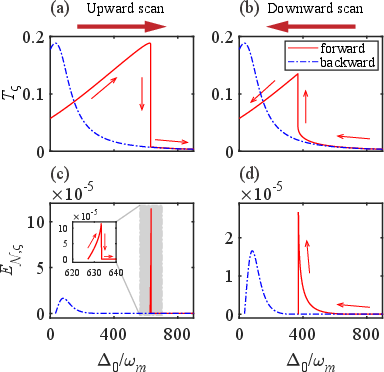
Figure 3: Nonreciprocal transmission spectra (upper panels) and logarithmic negativity rR8 (lower panels) versus normalized detuning for forward and backward driving directions, showing nonreciprocity in both observables but nonidentical parameter dependence.
Optimization across mechanical frequency, reflectivity, drive power, and temperature is performed. Maximum rR9 is achieved at specific reflectivities (ωc0 around ωc1) and mechanical frequencies (ωc2 MHz), but this is offset by system stability considerations and the onset of bistability.
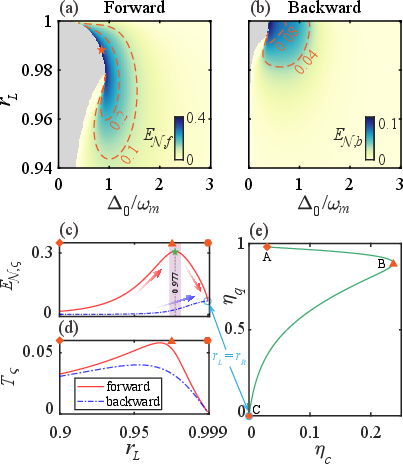
Figure 4: Logarithmic negativity ωc3 versus detuning and reflectivity, showing peak entanglement at nontrivial ωc4 values for forward drive and a monotonic increase for backward drive; the quantum nonreciprocity does not track classical nonreciprocity for all parameter regimes.
Crucially, quantum and classical nonreciprocities are not positively correlated: regimes of large nonreciprocal transmission do not necessarily coincide with regimes of large nonreciprocal entanglement. For instance, as ωc5 increases, classical nonreciprocity can peak where quantum nonreciprocity diminishes, and vice versa.
Robustness and Parameter Regimes
The paper demonstrates that in asymmetric cavities, the forward-drive entanglement is significantly more robust against thermal noise compared to symmetric configurations. At an optimal detuning, entanglement persists up to ωc6 in the forward direction, while backward and symmetric configurations decohere at much lower temperatures.
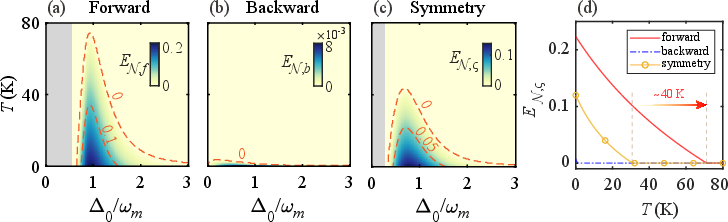
Figure 5: Thermal robustness comparison: Logarithmic negativity ωc7 for asymmetric (forward/backward) and symmetric cavities as a function of temperature, showing superior robustness in the asymmetric forward-driven regime.
This significant robustness and enhancement are linked to optimal choices of reflectivity and drive power that place the system away from instability yet maximize optomechanical coupling.
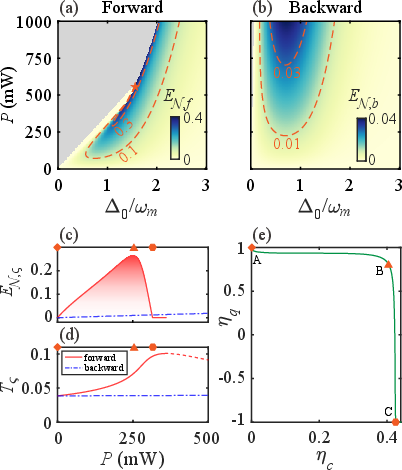
Figure 6: Dependence of logarithmic negativity ωc8 on drive power and detuning, illustrating potential for large quantum nonreciprocity within stable operation ranges.
Practical and Theoretical Implications
The findings advance the understanding of quantum nonreciprocity in photonic systems, highlighting the nuanced and sometimes counterintuitive relationship between classical and quantum signal flow asymmetry. For quantum technologies—including noise-tolerant communications, backaction-immune sensors, and chip-scale quantum processors—exploiting cavity asymmetry enables the engineering of parameter regimes for robust, high-fidelity optomechanical entanglement even under elevated thermal noise, which is significant for operation beyond cryogenic environments. The work suggests that engineered asymmetry can be a powerful lever not just for signal flow control but for dissipation engineering and quantum resource distribution.
The absence of positive correlation between quantum and classical nonreciprocity points to independent optimization strategies for quantum functionalities, making asymmetric optomechanical architectures compelling even if classical nonreciprocal performance is modest.
Conclusion
This study provides a comprehensive analysis and protocol for achieving nonreciprocal optomechanical entanglement in asymmetric Fabry-Perot cavities, with detailed identification of parameter regimes yielding strong, robust quantum correlations and nonreciprocity (2606.06988). The work establishes the nontrivial relationship between classical and quantum nonreciprocal metrics, with clear guidelines for exploiting cavity asymmetry to attain highly robust entanglement. These developments position asymmetric optomechanical systems as versatile platforms for quantum information processing and sensing technologies, with the potential for implementation in realistic, thermally noisy environments. Future directions include experimental realization, integration into complex chip-scale circuits, and extension to multi-partite and hybrid quantum systems.