- The paper demonstrates that pure leptonic and hadronic models alone cannot self-consistently reproduce the full spectral energy distribution observed in LHAASO J1849–0002.
- It introduces a hybrid model that leverages realistic parameters such as suppressed diffusion and balanced CR energies to explain the X-ray to PeV gamma-ray emissions.
- The study implies that evolved PWNe in dense environments may serve as Galactic PeVatrons, offering testable multi-messenger signatures via neutrino fluxes.
LHAASO J1849−0002: A Hybrid Lepto-Hadronic Interpretation of PeV Gamma-Ray Emission
Introduction
The origin of Galactic cosmic rays (CRs) up to the knee at ∼1 PeV remains an unresolved problem in high-energy astrophysics. The detection of γ-rays up to multi-PeV energies from sources such as LHAASO J1849−0002 by the LHAASO array has prompted detailed investigation of possible Galactic PeVatrons associated with middle-aged pulsars and their nebulae. This study provides a comprehensive multiwavelength analysis of LHAASO J1849−0002, positioned near PSR J1849−0001, and tests three emission origins: a pure leptonic model, a hadronic-dominated model, and a hybrid lepto-hadronic scenario. The study leverages spatial and spectral characteristics from X-ray to PeV γ-ray data and evaluates consistency with environmental parameters, high-energy propagation, and the resulting multi-messenger signatures.
Multiwavelength Observational Context
Extensive observations contextualize LHAASO J1849−0002 within a rich environment. X-ray (Chandra, XMM-Newton) data resolve a compact inner PWN and an extended nebular halo for PSR J1849−0001, while H.E.S.S. and LHAASO map a broader TeV to PeV γ-ray source, spatially coincident with the pulsar but exhibiting a stronger correspondence, especially at the highest energies, with an adjacent molecular cloud identified via CO emission.
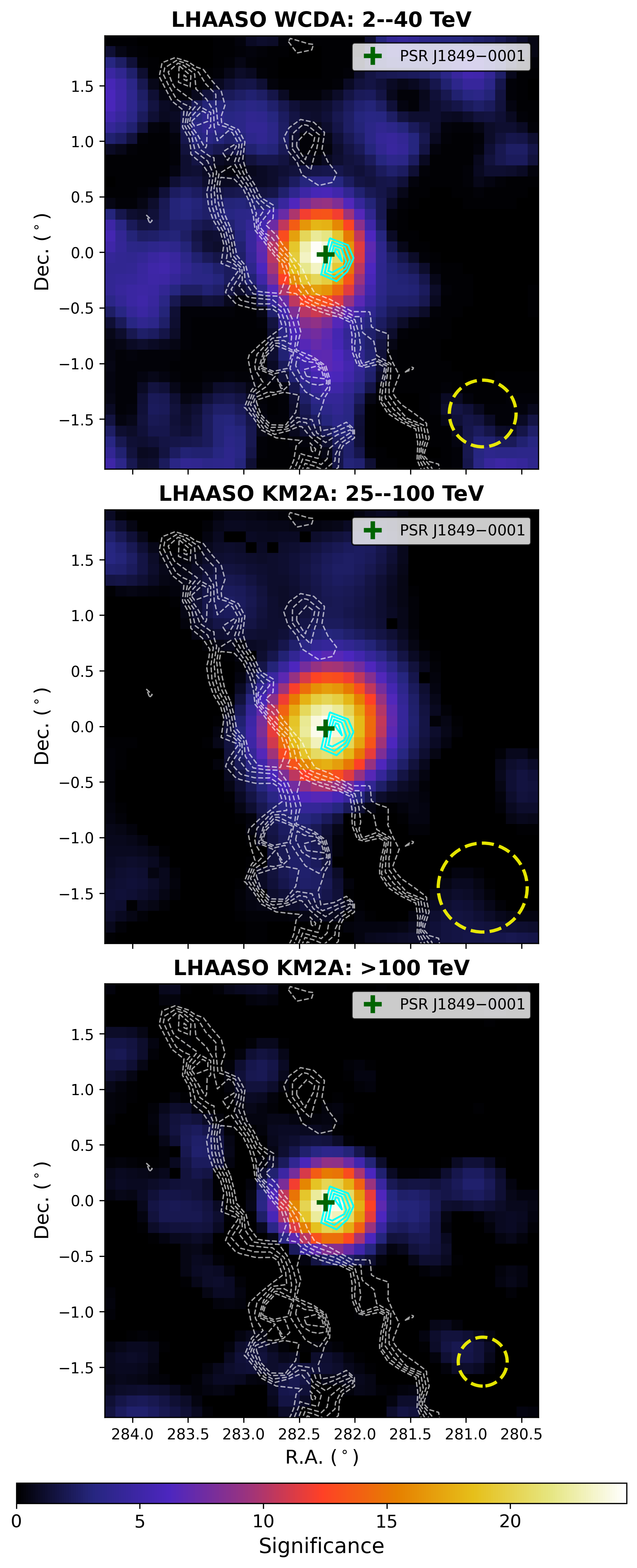
Figure 1: Significance maps for LHAASO J1849∼100002 in three energy bands, highlighting the spatial correspondence between highest-energy ∼11-ray emission and the nearby molecular cloud; the PSR is marked by a green cross.
This spatial and energetic association motivates a search for both leptonic (synchrotron and IC) and hadronic (pion decay) emission channels, especially given the presence of a substantial target mass (∼12) in the molecular cloud at a projected ∼13--∼14 pc from the presumed accelerator.
Model Methodology
The modeling utilizes the GAMERA framework to simulate electron and proton injection and their non-thermal radiation across radiative fields characteristic of the Galactic environment. Three scenarios are confronted with the observed spectral energy distribution (SED):
- Leptonic scenario: High-energy electrons (halo origin) radiate via synchrotron (X-ray) and IC (TeV-PeV ∼15-ray) channels; environmental photon fields are modeled after [popescu2017radiation].
- Hadronic-dominated scenario: Escaped CR protons, diffusing in a region with suppressed diffusion (∼16), interact with the nearby molecular cloud producing ∼17-decay ∼18-rays and neutrinos.
- Hybrid lepto-hadronic scenario: Both leptonic IC and hadronic pion decay contribute, with lower-energy emission dominated by nebular electrons and the highest energies requiring a hadronic component.
In the hadronic and hybrid models, the CR propagation is explicitly treated, with best-fit scenarios requiring a diffusion coefficient ∼19 of the Galactic average, consistent with strong suppression in SNR- or PWN-altered ISM [semenov2021cosmic].
Spectral Fitting Results
Pure Leptonic Model
The leptonic-only model can adequately fit the global SED, with best-fit parameters γ0 erg, γ1, γ2 TeV, and γ3G. However, two problems emerge:
- Extreme electron cutoff: The required electron cutoff energy exceeds typical PWN values for comparable ages [liu2024evolution, aharonian2006first].
- Morphological inconsistency: The model cannot reconcile the discrepancy between compact X-ray and extended TeV--PeV γ4-ray emission morphologies, as both should arise from the same electron population.
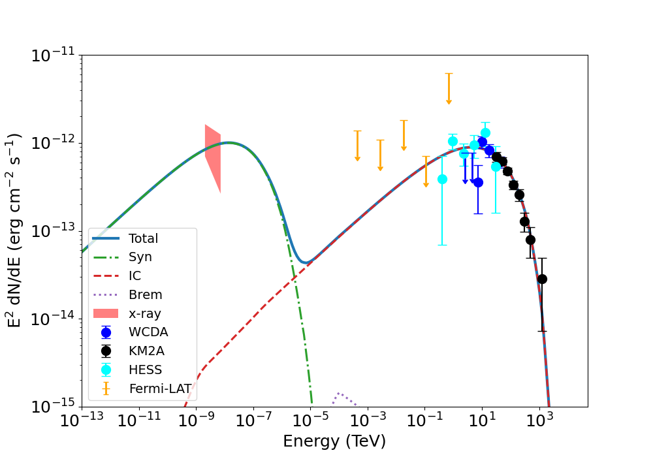
Figure 2: Broadband SED fit under the leptonic scenario; IC emission from electrons matches the high-energy tail but demands γ5 far above other mature PWNe.
Hadronic-Dominated Model
The hadronic model fits the high-energy spectrum with protons of total energy γ6 erg, spectrum γ7, and cutoff γ8 PeV, using a suppressed diffusion coefficient (γ9), and requires the molecular cloud as a dense target. The X-ray flux is constrained by a much lower leptonic energy budget; however, this scenario yields an abnormally strong magnetic field (−0G) for the evolved PWN, inconsistent with expectations for systems of this age [manconi2024geminga].
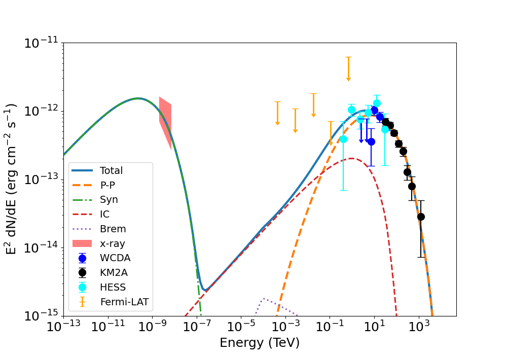
Figure 3: SED fit under the hadronic scenario; −1-rays above several tens of TeV arise from −2 decay of CRs interacting with the cloud, while X-rays remain leptonic.
Hybrid Lepto-Hadronic Model
The hybrid model best fits the SED with more physically reasonable parameters: −3 erg, −4, −5 TeV, −6G for electrons; −7 erg, −8, −9 PeV, −0, −1 for protons. Here, the X-rays and sub-TeV −2-rays are dominated by nebular electrons, while the PeV tail requires CR-proton interactions in the molecular cloud.
The model naturally explains the increasing spatial correlation between the LHAASO −3-ray significance and the cloud at the highest energies, without invoking an extreme leptonic cutoff or an anomalously strong magnetic field. The required diffusion suppression aligns with recent theoretical and numerical analyses of cosmic-ray transport near accelerators [semenov2021cosmic].
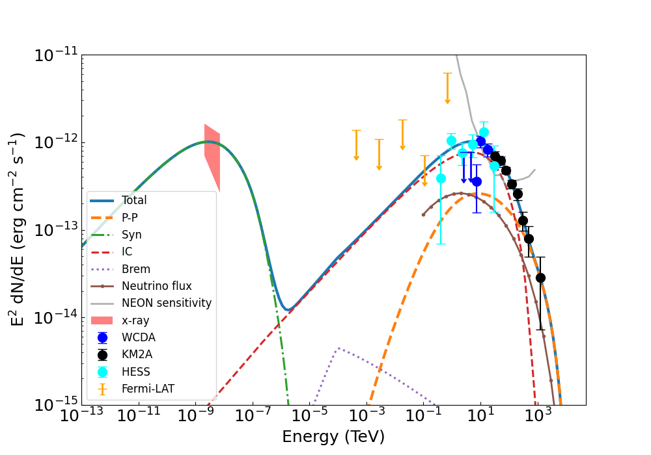
Figure 4: SED of PSR J1849-0001 under the hybrid model, with the high-energy tail achieved by hadronic processes; the predicted neutrino flux is marginally below NEON sensitivity.
Neutrino Emission and Multi-Messenger Implications
In the hybrid scenario, hadronic interactions should produce a parallel flux of high-energy neutrinos. For the best-fit parameters, the expected muon neutrino flux peaks just below the NEON sensitivity curve, suggesting that upcoming neutrino telescopes could directly test the hadronic contribution and thus the hybrid PeVatron scenario in the near future.
Theoretical and Astrophysical Implications
The analysis supports the interpretation of evolved PWNe in complex environments as Galactic PeVatrons. The spatial connection between the PeV −4-ray emission and a massive molecular cloud suggests that SNR/PWN systems, especially those with proximate dense gas, can naturally drive particle acceleration to the knee, illuminate their environment via CR escape, and provide multi-messenger emission. The requirement for suppressed diffusion near the accelerator reflects the broader trend seen in recent theoretical models and numerical simulations [semenov2021cosmic], with implications for the interpretation of other extended −5-ray sources and unresolved Galactic PeVatron candidates.
Conclusion
A detailed multiwavelength analysis of LHAASO J1849−60002 demonstrates that neither pure leptonic nor pure hadronic models can self-consistently reproduce the full SED and spatial properties, primarily due to unphysical or inconsistent parameter requirements. A hybrid lepto-hadronic model, in which the PeV −7-ray emission is attributed to hadronic interactions of escaped CRs with a spatially proximate molecular cloud, provides the most robust fit to both the spectrum and the morphology. This supports a scenario in which evolved PWNe in dense environments represent a key subclass of Galactic PeVatrons, readily testable in the multi-messenger era with next-generation neutrino observatories.
Future work will require higher-resolution −8-ray imaging, expanded CO line surveys, and increased sensitivity to diffuse high-energy neutrino emission, in order to unambiguously characterize the hadronic content and CR diffusion in these complex acceleration sites.
References:
- "LHAASO J1849−90002: A Hybrid Lepto-Hadronic Interpretation of PeV Gamma-Ray Emission" (2606.06974)
- Additional references as cited within the essay.