- The paper presents an empirical evaluation of quantum threats and migration pathways from classical to post-quantum cryptographic schemes within blockchain for CPSS.
- It details a novel QBE infrastructure that integrates quantum threat assessment, embodied AI requirements, and decentralized data economy protocols.
- The study demonstrates scalable, interoperable blockchain protocols (e.g., BrokerChain) that ensure data provenance and reproducibility for intelligent CPSS.
Blockchain Infrastructure for Intelligent Cyber-Physical-Social Systems: Post-Quantum Security, Interoperability, and Trustworthy Data Economies in the Era of Embodied AI
Introduction
The convergence of quantum computing and embodied AI instigates a paradigm shift in the design and deployment of blockchain infrastructures. The paper "Blockchain Infrastructure for Intelligent Cyber--Physical--Social Systems: Post-Quantum Security, Interoperability, and Trustworthy Data Economies in the Era of Embodied AI" (2606.06895) formalizes the Quantum-Blockchain-Embodied (QBE) infrastructure as a unified foundation for intelligent Cyber-Physical-Social Systems (CPSS). This work addresses critical challenges at the intersection of empirical quantum threats to cryptography, the proliferation of embodied AI with world-model-based robotic systems, and the imperative for secure, interoperable distributed ledgers underpinning scalable trustworthy data economies.
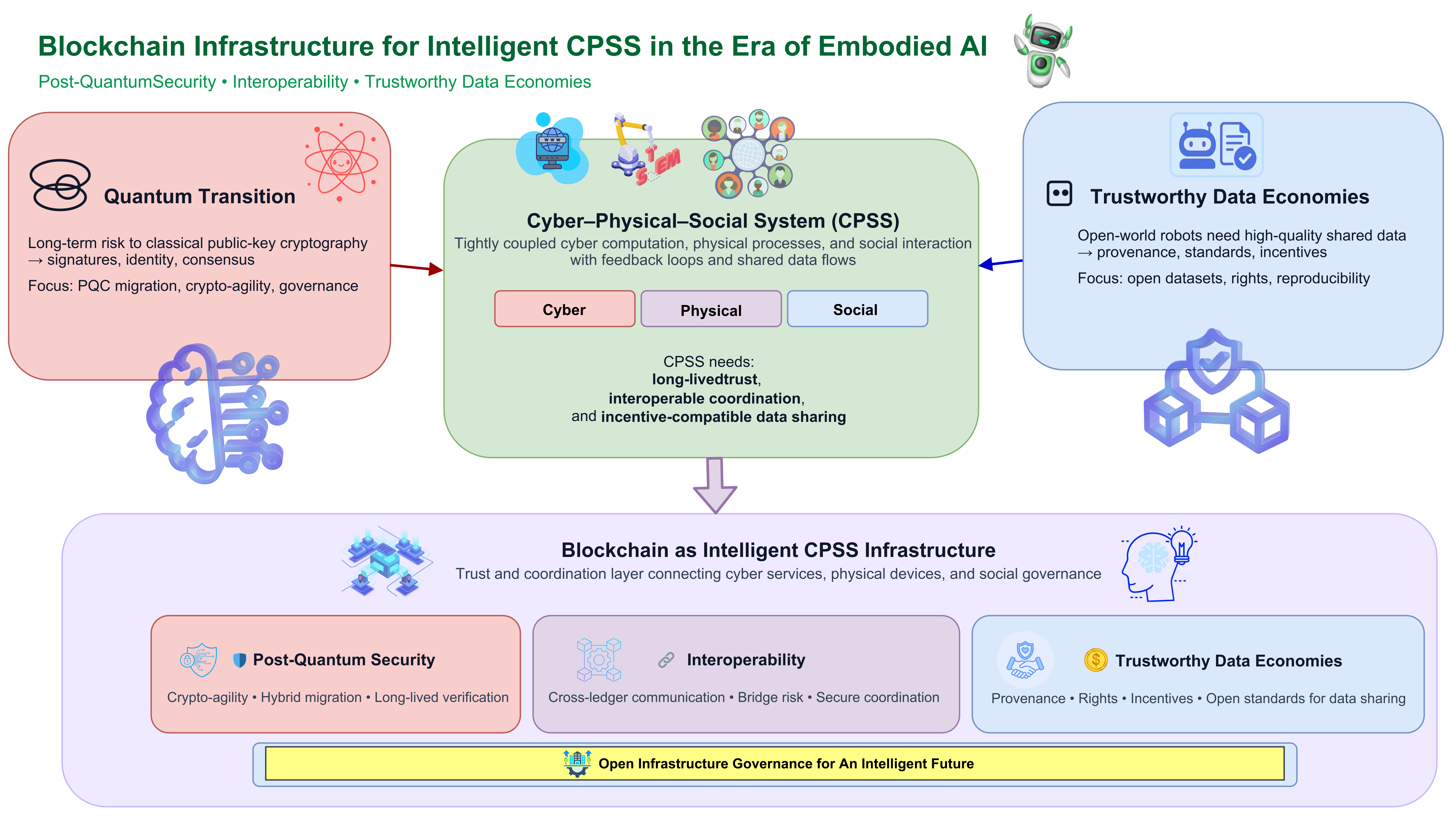
Figure 1: Overview of the Quantum-Blockchain-Embodied (QBE) infrastructure paradigm illustrating the relationship between quantum transition, embodied AI data economies, and cyber--physical--social systems (CPSS).
Motivation and Systemic Imperatives
Two scientific inflection points—the technological maturation of quantum computing and operational deployment of embodied AI—compound infrastructural vulnerabilities and opportunities for CPSS. Quantum advances, as evidenced by the 2025 Nobel Prize in Physics and the Turing Award for quantum science, accelerate timelines for quantum adversaries capable of breaking classical cryptographic primitives such as ECDSA, threatening the integrity of signatures, identity proofs, and consensus protocols foundational to blockchain networks. Simultaneously, the wide-scale adoption of embodied AI, supported by world-model learning and edge-distributed robotic systems, creates unprecedented requirements for granular data provenance, incentive-compatible data sharing, and robust cross-organizational governance over high-volume, multi-source interaction data [monwilliams2025embodied, Zhu_2025_ICCV].
Traditional blockchain settings are insufficient: CPSS now demand not just decentralized trust but also crypto-agility to withstand quantum attacks, standards-compliant interoperability across heterogeneous ledgers, and the institutionalization of trustworthy, reproducible data economies for robotic and AI-centric workflows.
Architecture: Quantum-Blockchain-Embodied (QBE) Paradigm
The QBE paradigm integrates empirical quantum threat assessment, cryptographic migration strategies, scalable cross-ledger architectures, and incentive-compatible data economy protocols into a modular, production-ready pipeline. The paper outlines five tightly coupled modules:
- Opening Demo (Empirical Quantum Threat Assessment): Utilizing AWS Braket, hardware-specific characteristics of superconducting, trapped-ion, and neutral-atom quantum devices are empirically evaluated. The demonstration provides a concrete timeline for cryptanalytic threats and validates transitions from classical to post-quantum signature schemes (notably ECDSA to post-quantum alternatives), reinforcing the urgency for blockchain crypto-agility [liu2026qsignaiquantumrandomnessseededidentitysignatures, liu2026quantumfuturesinteractivelive].
- Embodied AI System Requirements: The detailed world-model-based policy optimization for robotic systems (e.g., WMPO, IRASim) formalizes infrastructural priorities to enable vision-language-action reasoning and long-horizon robotic autonomy in open-world environments [wmpo2026iclr, Zhu_2025_ICCV]. Requirements include not only secure data recording and provenance but enforceable incentives and transparent governance for distributed data economies.
- Quantum Hardware and Post-Quantum Migration: The paper provides evidence-based analysis of quantum hardware capabilities, emphasizing error rates, device coherence times, and gate fidelities as determinants of post-quantum security horizons. Migration pathways employ hybrid cryptographic schemes and staged transitions to preserve long-lived verification and forward secrecy [fedorov2018quantum, google2025otoc].
- Scalable Sharding and Interoperability (BrokerChain): BrokerChain protocols implement efficient cross-shard and cross-ledger coordination, vital for scaling blockchain in CPSS scenarios characterized by multi-organizational, high-throughput operations. Off-chain cross-shard database architectures (as in GriDB) optimize performance while sustaining Byzantine-tolerant security and end-to-end verifiability [huang2022brokerchain, huang2025brokerchain, 10.14778/3587136.3587143].
- Trustworthy Data Economies and Metadata Standards: The Croissant metadata format standardizes blockchain-provenant, ML-ready datasets; open-source frameworks for robotic learning data governance (e.g., LET, Kuavo) implement verifiable, reproducible data flows across heterogeneous blockchain environments [NEURIPS2024_9547b09b, letdataset, kuavochallenge]. Mechanism design and reinforcement learning approaches, as demonstrated for Ethereum proof-of-stake incentives [10704461], align data sharing and data quality.
Numerical Results and Technical Advancements
Across cloud, edge, and on-chain settings, the reviewed architectures yield quantifiable improvements:
- Cryptographic Migration: Empirical demonstrations on AWS Braket highlight explicit quantum threat timelines, showing that state-of-the-art quantum devices are expected to compromise classical ECDSA within a defined horizon, necessitating immediate migration to lattice- or code-based post-quantum schemes [liu2026qsignaiquantumrandomnessseededidentitysignatures].
- Scalability and Throughput: BrokerChain and GriDB architecture evaluations indicate cross-shard throughput improvements of multiple orders of magnitude over classical, non-sharded blockchains, maintaining consensus integrity despite cross-organizational exchanges.
- Data Provenance and Reproducibility: The implementation of Croissant metadata for blockchain-enabled datasets enables standardized, ML-ready data pipelines, drastically reducing validation overhead and facilitating cross-ecosystem robotic learning reproducibility.
- The paper claims that the continued use of classical signature schemes for CPSS infrastructure is unsustainable under the projected quantum attack timeline, directly contradicting some prevailing industry complacency with the status quo.
Implications and Prospective Developments
The synthesis of QBE infrastructure as detailed in the paper suggests several major directions:
- Production-Scale, Post-Quantum Blockchain: Theoretical migration paths are now empirically anchored via quantum hardware, and implementation protocols such as BrokerChain present a viable pathway to at-scale CPSS resilient to quantum adversaries.
- Interoperable Data Ecosystems: Modular off-chain data exchange, standards-aware metadata (Croissant), and blockchain provenance mechanisms enable composable, transparent, and reproducible data sharing across global robotics and AI deployments.
- Incentive Alignment for Trustworthy AI Data Economies: Economic mechanism design and reinforcement learning approaches (as applied to Proof-of-Stake Ethereum) may be generalized to multi-stakeholder robotic AI data marketplaces, introducing dynamic pricing and quality verification aligned with open-governance objectives [10704461].
- Deployment in Heterogeneous Environments: The QBE modular pipeline has been operationalized in production-grade cloud environments (AWS, open-source initiatives), supporting multi-modal dataset curation and distributed AI retraining at ecosystem scale.
Future research will likely focus on formalizing cryptographic governance transitions (e.g., threshold migration, automated crypto-agility), universal cross-ledger bridges adhering to security/privacy standards, and deeper integration between economic mechanism design and large-scale data collaboration for embodied AI.
Conclusion
The paper presents a rigorous, multidimensional architecture for blockchain as the core coordination infrastructure supporting intelligent CPSS amid rapid advances in quantum computing and embodied AI. By systematically integrating empirical quantum threat modeling, post-quantum cryptographic migration, scalable interoperability protocols, and formalized trustworthy data economies, the QBE paradigm directly addresses the long-lived security, coordination, and governance needs of next-generation decentralized intelligent environments. This synthesis points toward an actionable roadmap unifying quantum-resistant security, institutionalized data verifiability, and scalable ecosystem deployment—defining the technical foundation for sustainable, trustworthy CPSS in the era of embodied AI.

