- The paper demonstrates that spin-phonon coupling induces a distinct double-peak thermal conductivity in Fe₂SiSe₄ across multiple magnetic phases.
- The methodology integrates high-precision measurements of thermal expansion, specific heat, and conductivity, modeled via the Debye–Callaway framework.
- Results indicate that tunable magnetic transitions modulate phonon scattering, offering insights for thermoelectric applications and advanced phase-probing techniques.
Complex Thermal Conductivity and Spin-Phonon Coupling in the Sawtooth Chain Magnet Fe2SiSe4
Introduction
The study investigates the intricate thermal transport behavior in single crystals of the sawtooth-chain olivine magnet Fe2SiSe4, which features pronounced geometrical frustration, strong spin-orbit interactions, and multiple magnetic transitions. Unlike traditional A2BX4 olivine systems (with A = Mn, Fe, Co, Ni; B = Si, Ge; X = O, S, Se, Te), Fe2SiSe4 supports successive antiferromagnetic (40 K) and ferrimagnetic (41 K) transitions, in addition to a weaker transition at 42 K. This system explicitly couples spin, lattice, and orbital degrees of freedom, yielding a thermal conductivity 43 with a nontrivial double-peak structure, which is highly sensitive to the underlying spin-lattice interactions.
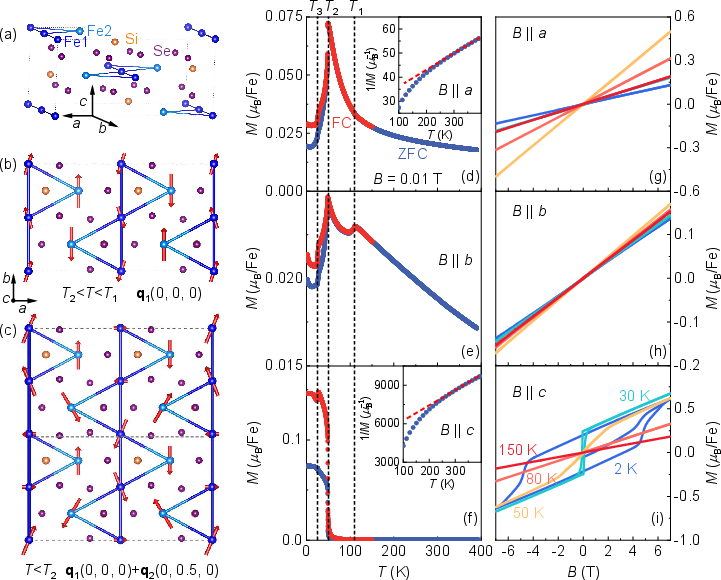
Figure 1: Crystal and magnetic structures of Fe44SiSe45 showing the sawtooth chain arrangement and the distinct single-46 and double-47 magnetic orders below 48 and 49, respectively.
Experimental Approach
High-quality Fe20SiSe21 single crystals were synthesized using chemical vapor transport and characterized via magnetization, specific heat, thermal expansion, and longitudinal thermal conductivity (along the chain 22 axis). Thermal expansion measurements employed a high-resolution capacitive dilatometer; specific heat was measured via the relaxation method. 23 was acquired in steady-state geometry with field-calibrated thermometry, ensuring less than 4% systematic uncertainty below 150 K.
Magnetic and Structural Phase Behavior
Fe24SiSe25 exhibits pronounced magnetic anisotropy in 26, dominated by easy-plane alignment and a strong 27-factor anisotropy due to low-symmetry crystal fields. The system transitions from a paramagnetic phase to a single-28 antiferromagnetic state at 110 K, characterized by Fe2 moments (29/Fe) aligned along 40, with feeble canting on Fe1. Below 41 K, a double-42 structure is realized, introducing 43-axis ferrimagnetism and additional moment components. While 44 yields only minor thermodynamic anomalies, an associated first-order lattice transition is captured in the thermal-expansion coefficient.
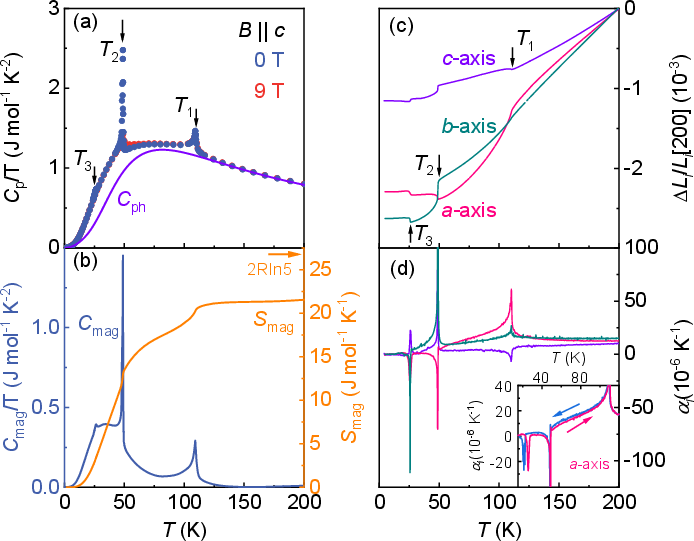
Figure 2: Specific heat and linear thermal expansion as a function of temperature, revealing sharp lambda anomalies at 45, first-order jumps at 46 and 47, and highly anisotropic uniaxial responses.
Thermal expansion (48, 49) constrains the nature of each transition: second-order at A2BX40, weakly first-order at A2BX41 (no detectable hysteresis), and strongly first-order at A2BX42 (hysteresis A2BX434.5 K in A2BX44). These results, combined with Clausius–Clapeyron/Ehrenfest analyses, show A2BX45 and A2BX46 display strong uniaxial pressure dependences, suggesting underlying magnetoelastic coupling is both robust and directionally selective.
Double-Peak Thermal Conductivity and Resonant Scattering
A2BX47 is dominated by phonons, with negligible electronic or purely magnetic heat transport, validated by resistivity and Wiedemann–Franz analysis. The most salient feature is its double-peak form: a broad maximum near A2BX48 K and a sharper, more intense peak near A2BX49 K. This is inconsistent with typical phonon thermal transport in insulators, implicating additional scattering channels.
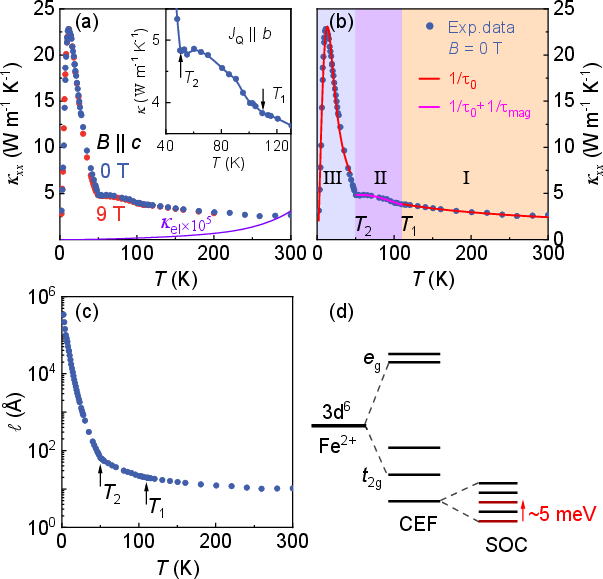
Figure 3: Temperature dependence of the in-plane thermal conductivity A0 displays a pronounced double-peak structure. Fits reveal resonant spin-phonon scattering dominates between A1 and A2.
Quantitative fits using the Debye–Callaway model isolate three regimes:
- Region I (A3): Paramagnetic; A4 well-modeled by boundary, point-defect, and Umklapp scattering. High point-defect scattering reflects short-range spin fluctuations acting as dynamic scatterers.
- Region II (A5): Single-A6 phase; phonon thermal transport is dominated by resonant scattering with a gap A7 meV. This is attributed to phonons interacting with discrete magnetic excitations associated with spin-orbit-split levels on FeA8, analogous to neutron-scattering-observed modes in FeA9SiOB0 at 5.4–5.9 meV. The broad maximum at 60 K appears precisely where this resonance occurs.
- Region III (B1): Double-B2 ground state; resonant contribution is quenched, and B3 recovers a strong peak near 11 K, corresponding to the crossover between boundary and Umklapp scattering. The low-temperature peak amplitude (B423 W mB5 KB6) is %%%%67A68%%%% that of the resonant maximum.
Below B9, abrupt lattice and magnetic reordering shifts the spin excitation spectrum out of resonance with the dominant phonon modes, effectively restoring conventional phonon-limited heat transport. The phonon mean free path X0, evaluated from the kinetic formula and measured/fitted parameters, displays a sharp increase on cooling below X1, corroborating the suppression of spin-phonon scattering.
Broader Implications and Outlook
The work establishes FeX2SiSeX3 as a canonical frustrated magnet where thermal conductivity can be intricately tuned by manipulating spin-orbit and spin-lattice interactions. The strong sensitivity to local crystal field environments demonstrates the utility of thermal transport as a probe of subtle magnetic and electronic microstructures, extending the understanding of heat flow beyond simple phonon paradigms.
The data imply several theoretical and application consequences:
- Thermoelectric Strategies: Controlled spin-phonon scattering in frustrated magnets provides a mechanism to modulate X4 independently of charge carrier behavior. Materials with switchable or tunable spin excitation spectra are promising for the design of thermal management or thermoelectric devices in which decoupled control of thermal and electrical conductivity is crucial.
- Excitation Engineering: Since the observed resonance is attributed to spin-orbit-induced crystal field excitations, modifying the ligand (e.g., S or Te substitution for Se), or applying pressure/strain along specific axes, may permit further manipulation of the magnetic excitation spectrum and the resulting resonance conditions.
- Phase-Competition Probes: The double-peak structure in thermal conductivity serves as a highly sensitive measure for transitions or incipient ordering tendencies, suggesting that analogous measurements in other frustrated or low-dimensional compounds could elucidate hidden quantum phase behaviors.
Conclusion
This study demonstrates that the thermal conductivity of FeX5SiSeX6 is a direct and sensitive probe of spin-lattice coupling, manifested in an unusual double-peak structure driven by resonant spin-phonon scattering at the single-X7 antiferromagnetic phase and its abrupt suppression in the double-X8 ground state. FeX9SiSe20 establishes a new platform for exploring the interplay of geometric frustration, spin-orbit interactions, and lattice dynamics, and highlights the potential of frustrated quantum magnets in thermoelectric and thermal management applications (2606.06858).

