- The paper introduces STRIPS-WM, a framework that learns grounded propositional STRIPS models from raw visual data using image-action-image triplets.
- It employs a three-stage pipeline—task graph induction, constraint-based symbolic model learning, and visual predicate grounding—to derive planning operators.
- Empirical results in simulated and real domains demonstrate high planning success, underscoring the importance of negative evidence in avoiding spurious transitions.
Learning STRIPS-Style Symbolic World Models from Images with STRIPS-WM
Introduction
The paper "STRIPS-WM: Learning Grounded Propositional STRIPS-style World Models from Images" (2606.06832) presents a framework for learning grounded, propositional, STRIPS-style transition models directly from raw visual experience in long-horizon robotic manipulation tasks. Given only image-action-image triplets and opaque action identifiers, the method seeks to induce a symbolic model suitable for classical planning—binary predicates, operators with preconditions and effects—without any access to object-centric labels, segmentation, or symbolic annotations.
Grounded symbolic abstractions with STRIPS semantics are critical for leveraging robust, scalable discrete planners, yet acquiring them from images has been a significant unsolved problem. This work operationalizes the skills-to-symbols hypothesis, demonstrating end-to-end induction of predicates and operators from image data, grounded by a learned visual classifier.
Architecture and Method
STRIPS-WM proceeds in three stages: task graph induction from image transition data, predicate/operator learning via constraint programming, and grounding of predicate vectors with a visual classifier.
1. Image-Grounded Task Graph Construction
STRIPS-WM first encodes observed image-action-image transitions into a compact, finite task graph using a student-teacher encoder scheme with Finite Scalar Quantization (FSQ) and a joint-embedding predictive architecture (JEPA). The pipeline discretizes high-dimensional observations by mapping each image to a quantized latent code, with transitions predicted in code space via an action-conditioned dynamics model. An auxiliary inverse model loss ensures that latent encodings are sensitive to the executed action, preventing representational collapse.
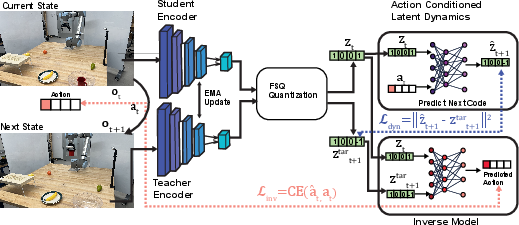
Figure 1: Learning pipeline for the image-grounded task graph, showing perceptual encoders, the transition predictor, and code-based transition extraction.
2. Learning STRIPS Operators and Predicates
Given the abstract transition graph, the next stage lifts this structure to a propositional STRIPS model by solving a binary constraint satisfaction problem. For each abstract node, the solver assigns binary predicate vectors; for each action identifier, it learns precondition and add/delete effect masks defining an operator, such that the STRIPS semantics reproduce observed transitions and, critically, avoid spurious transitions using "trusted missing" negative evidence.
The optimization enforces:
- Observed positive transitions: actions applied at a node must have satisfiable preconditions; their effects must match observed successor predicate vectors under the STRIPS update.
- Negative evidence: actions not observed from certain nodes are inferred inapplicable, enforced by precondition violations unless specifically relaxed via applicability slack.
- Operator sparsity: the lexicographic objective prefers models with low transition/applicability slack and minimal precondition/effect support.
This process yields a binary abstraction of each learned task-graph state and a set of propositional grounded STRIPS operators that (approximately) explain the data.
3. Visual Predicate Grounding and Planning
A visual classifier is trained to predict the learned predicate assignment from pixels. At test time, only start and goal images are processed; their predicates are classified, and a classical planner is invoked to find an action sequence using the learned operators.
As a result, image-to-image planning queries are reduced to symbol-to-symbol planning, leveraging the generality and reliability of classical planners, with tractable perception via predicate recognition.
Experimental Evaluation
STRIPS-WM is evaluated on simulated and real visual manipulation domains (BlocksWorld, DinnerTable, and DinnerTable Real), with a focus on image-to-plan success at various planning horizons. It is benchmarked against rollout and latent-search methods, as well as LatPlan.
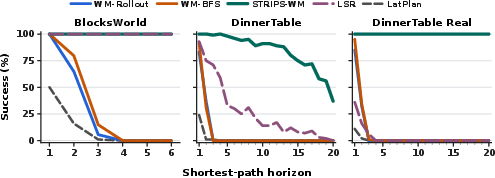
Figure 2: Planning success versus shortest-path horizon indicates STRIPS-WM's robustness in achieving the true ground-truth goal states, notably outperforming rollout and latent search baselines as planning horizons increase.
Key empirical findings:
- Exact recovery in low-noise domains: In BlocksWorld, STRIPS-WM learns a model with zero transition and applicability slack, perfectly matching the true abstraction and yielding 100% long-horizon plan success.
- Robustness to representation fragmentation: In DinnerTable Real (with real images and distractors), over-splitting of the latent space is resolved in the propositional compression step, collapsing visual ambiguity into compact symbolic states.
- Scalability to long horizons: Unlike rollout and graph-search baselines, STRIPS-WM maintains high plan success for distant goals, attributed to its use of sparse, disentangled symbolic operators rather than flat or latent graph transitions.
- Importance of negative evidence: Ablation shows that enforcing negative evidence (trusted missing state-action pairs) is crucial; omitting it leads to degenerate models with trivial or vacuous preconditions, catastrophic for planning.
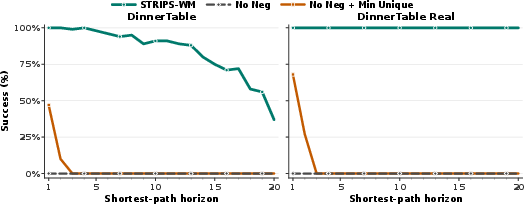
Figure 3: Negative evidence ablation, illustrating catastrophic planning failure when negative constraints are removed—even when the minimum unique-state constraint is imposed.
Theoretical Guarantees
The paper presents formal guarantees on the soundness and completeness of the induced STRIPS model in the zero-slack regime, establishing that the learned operators are well-formed, and all positive and trusted negative evidence in the data are captured in the STRIPS model. When transition and applicability slack are nonzero, the models interpolate between consistency and data-fit.
Implications and Limitations
This work provides the first end-to-end demonstration of learning grounded image-to-plan pipelines, directly connecting action-annotated images to classical symbolic planning. It establishes that negative evidence is essential for learning nontrivial preconditions—an insight with ramifications for all symbolic model learning from raw data.
However, three primary limitations persist:
- Determinism and propositional grounding: The approach requires deterministic, propositional transitions and current implementation cannot learn lifted (relational) operators, thus limiting compositional generalization to novel objects or parameterizations.
- Dependence on transition graph quality: Visual aliasing or insufficient data coverage can introduce inconsistencies or errors in the learned abstraction, affecting plan reliability.
- Non-stochasticity: The method does not currently handle stochastic environment dynamics or latent state.
Despite these limitations, the pipeline illustrates a viable path to bridging deep visual learning and robust, explainable symbolic planning.
Conclusions
STRIPS-WM advances the state of the art in visual-to-symbolic abstraction by inducing STRIPS-style planning models directly from images and action indices. Its staged architecture—representation learning, constraint-based symbolic grounding, and perceptual classifier training—demonstrates strong empirical and formal properties, including state abstraction, operator induction, and robust visual planning. The results highlight the necessity of negative evidence in symbolic model induction and point towards extensions involving relational operator learning, handling stochasticity, and scaling to larger, more complex domains. The approach constitutes a step toward scalable, interpretable perception-to-planning systems in robotics and embodied intelligence.

