- The paper demonstrates that cyclic ladder operators induce a hidden Weyl-Heisenberg structure, yielding equally spaced energy ladders even in non-Hermitian settings.
- It employs a one-dimensional Floquet lattice model to link algebraic symmetries with permutation dynamics and predictable quantum state evolution.
- The study generalizes the quantum harmonic oscillator framework to finite-dimensional systems, offering promising applications in quantum information and state control.
Cyclic Ladder Operators and Hidden Weyl-Heisenberg Structure in a Floquet System
Introduction
This work rigorously investigates the algebraic and dynamical consequences of enforcing a cyclic ladder operator structure in finite-dimensional quantum systems, particularly within the context of Floquet-engineered models. By systematically generalizing the well-established notion of ladder operators associated with the quantum harmonic oscillator (QHO), the authors reveal how an underlying Weyl-Heisenberg (WH) commutation relation can induce equally spaced energy ladders even in non-Hermitian and finite Hilbert spaces. A one-dimensional time-periodic (Floquet) lattice serves as a concrete realization, providing direct physical insight into the interplay between algebraic group structure and quantum dynamics.
Cyclic Ladder Operators and WH Algebra
For generic finite-dimensional quantum systems, standard ladder operators cease to guarantee the existence of an equally spaced spectrum due to boundary conditions and possible degeneracies. The authors construct cyclic ladder operators, a and a†, defined by the action
a∣ψn+1⟩=∣ψn⟩,a∣ψ0⟩=∣ψN−1⟩,
implementing a closed cycle across N non-degenerate eigenstates. The operators' commutation relations with the Hamiltonian H necessitate additional "escalator" operators, encapsulated by the relations
[H,a]=−(a+b)Δ,b∣ψ0⟩=−N∣ψN−1⟩,
where b acts nontrivially only at the boundary of the ladder (lowest state). A key result is that this mechanism supports equally spaced energy ladders even for non-Hermitian H and complex Δ due to the commutativity aa†=a†a=1, a property absent from canonical QHO raising/lowering operators.
Furthermore, the authors demonstrate that when the temporal evolution operator a†0 is introduced as a generator, together with the cyclic ladder operators, a finite-dimensional version of the WH group arises:
a†1
which closes only at discrete times a†2. This connection unifies group-theoretic and dynamical perspectives in quantum mechanics.
Algebraic Equivalence and Basis Structure
The circulant nature of the cyclic ladder operators in the energy eigenbasis allows for their simultaneous diagonalization. In the associated "plane-wave" eigenbasis, all circulant matrices share the same eigenstates:
a†3
with the cyclic ladder operators a†4 being diagonal in this representation. The Hamiltonian a†5 is mapped to a Toeplitz matrix, and the time evolution operator a†6 generally has full matrix structure but collapses to a permutation matrix precisely at the group-closure period a†7, as
a†8
This exact permutation dynamics is highly nontrivial and robust, even in the presence of non-Hermiticity.
Floquet System Realization
The theoretical framework is realized explicitly in a one-dimensional, two-sublattice Floquet lattice with time-periodic, alternating nearest-neighbor couplings. The effective Floquet Hamiltonian, engineered by alternately activating the hopping terms for intervals a†9, generates a rich band structure with tunable properties (Figure 1):
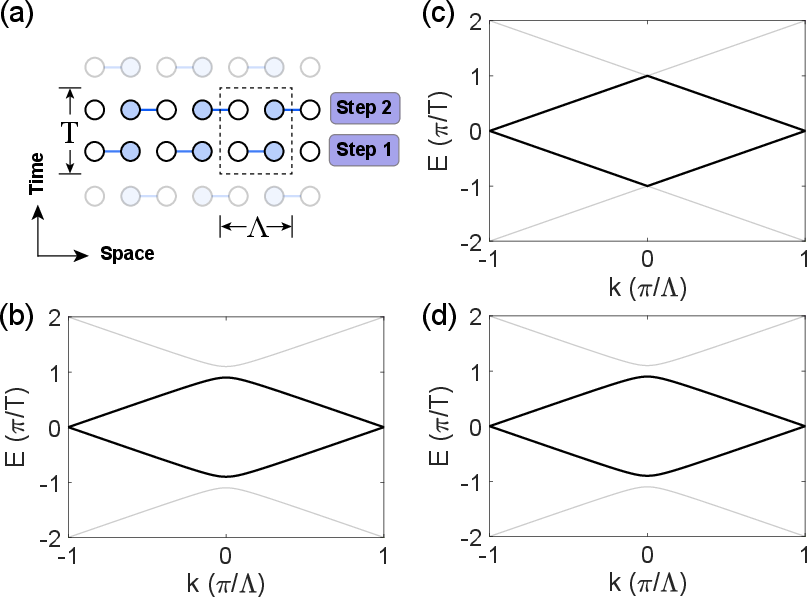
Figure 1: (a) Schematic of the one-dimensional Floquet system; (b-d) Band structure evolution as a∣ψn+1⟩=∣ψn⟩,a∣ψ0⟩=∣ψN−1⟩,0 is tuned across the gap-closing point, highlighting the formation of a Dirac cone and the consequent equally spaced ladder states.
At the critical parameter a∣ψn+1⟩=∣ψn⟩,a∣ψ0⟩=∣ψN−1⟩,1 (a∣ψn+1⟩=∣ψn⟩,a∣ψ0⟩=∣ψN−1⟩,2), the Floquet bandgap closes at a∣ψn+1⟩=∣ψn⟩,a∣ψ0⟩=∣ψN−1⟩,3, inducing a linear Dirac cone dispersion in the Floquet Brillouin zone (BZ). For a finite lattice (see Figure 2), the momentum a∣ψn+1⟩=∣ψn⟩,a∣ψ0⟩=∣ψN−1⟩,4 is no longer a good quantum number, but the WH structure persists, leading to a∣ψn+1⟩=∣ψn⟩,a∣ψ0⟩=∣ψN−1⟩,5 equally spaced energy levels:
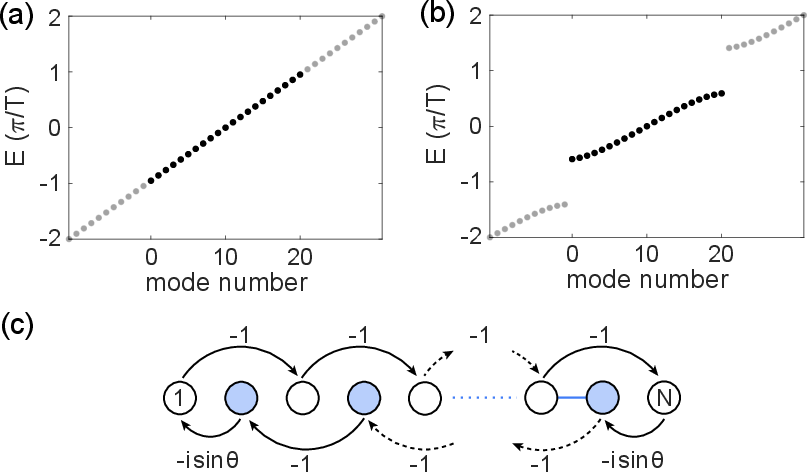
Figure 2: (a, b) Quasienergy spectra for a∣ψn+1⟩=∣ψn⟩,a∣ψ0⟩=∣ψN−1⟩,6 lattice sites, showing the emergence of the equally spaced ladder (a) at a∣ψn+1⟩=∣ψn⟩,a∣ψ0⟩=∣ψN−1⟩,7 and the deviation from linearity (b) for a∣ψn+1⟩=∣ψn⟩,a∣ψ0⟩=∣ψN−1⟩,8; (c) The deterministic itinerary of a particle mapped by the permutation structure of a∣ψn+1⟩=∣ψn⟩,a∣ψ0⟩=∣ψN−1⟩,9.
After one Floquet period, the entire system evolution corresponds precisely to a permutation of the basis states, up to global phases, as encoded in the WH group structure. The ladder operators become diagonal in the itinerant basis, and the dynamical trajectory of basis states is exactly predictable (Figure 2c).
Non-Hermitian Extension
A significant technical result is the persistence of the ladder and permutation structure even in non-Hermitian systems, including the possible emergence of a complex energy ladder. This generality is physically relevant in engineered photonic and open quantum systems, where loss, gain, and other non-Hermitian effects predominate. The construction remains robust as long as the energy levels are nondegenerate and the cyclic ladder structure is satisfied.
Practical and Theoretical Implications
The findings provide a blueprint for synthesizing quantum systems with tunable ladder-type dynamics in finite-dimensional settings, leveraging discrete WH symmetries. This has practical implications in quantum information, coherent control, topological state engineering, and synthetic quantum matter, where Floquet engineering and non-Hermiticity are prevalent tools. For instance, the explicit mapping onto permutation matrices at well-defined time intervals may be exploited for quantum state transfer, dynamical memory, or as a resource for robust state cycling even in the presence of dissipation.
Theoretically, this work extends the algebraic classification of quantum systems by demonstrating the universal emergence of WH algebra from cyclic permutation dynamics, offering new connections between symmetry, spectral structure, and quantum evolution in both Hermitian and non-Hermitian landscapes.
Future Directions
Potential future investigations include:
- Extension of the cyclic ladder and group structure to systems with degenerate energy levels,
- Analysis of interacting or disorder-perturbed Floquet systems,
- Generalization to higher-dimensional or non-Abelian group structures,
- Experimental realization in photonic lattices, superconducting circuits, or cold atom platforms.
The interplay between Floquet topology, non-Hermitian effects, and algebraic symmetries revealed in this work opens avenues for engineered quantum dynamics that transcend the limitations of static or Hermitian quantum systems.
Conclusion
The paper establishes that finite-dimensional quantum systems admitting cyclic ladder operators manifest a hidden WH algebraic structure, with equally spaced energy ladders and time evolution governed by discrete WH group commutation relations. This is concretely realized with a one-dimensional Floquet lattice whose dynamics reduce to permutations of the state basis, resilient even in non-Hermitian regimes. These insights forge new connections between spectral algebra, quantum dynamics, and symmetry, with both fundamental and applied ramifications for complex quantum system engineering.
Reference: "Cyclic ladder operators and hidden Weyl-Heisenberg structure in a Floquet system" (2606.06810).