- The paper presents an information rate decomposition separating ISI effects from a soft alignment penalty due to geometric duplication.
- It leverages Soft-DTW, Markov and semi-Markov process techniques, and ergodic theory to derive lower bounds on achievable rates.
- Numerical results validate the jump-reliability bounds, highlighting the impact of pore geometry on synchronization and sequencing performance.
Introduction
The paper "Information Rate Decomposition for Noisy Nanopore Channels with Geometric Duplication" (2606.06808) undertakes a rigorous investigation of the information-theoretic limits of noisy duplication channels, with direct motivation from nanopore DNA sequencing. The Oxford Nanopore platform is characterized by two dominant impairments: (1) inter-symbol interference (ISI) due to multiple bases simultaneously influencing the output, and (2) stochastic sample-level duplications resulting from variable molecular translocation speeds through the pore. Together, these effects generate a channel with substantial memory and synchronization uncertainty, rendering explicit analysis of the information rate a formidable problem.
The authors present a principled decomposition of the information rate into an ISI (memory) term and a "soft alignment penalty" that quantifies the cost of boundary ambiguity introduced by sample duplications. This separation is operationalized via a Soft-Dynamic Time Warping (Soft-DTW) functional, whose expected value and asymptotic properties are tightly related to achievable rates. By leveraging properties of Markov and semi-Markov processes and techniques from ergodic theory, an alternative proof of the Markov-constrained coding theorem is given, anchored in strong forms of the Asymptotic Equipartition Property (AEP). The decomposition provides new lower bounds on achievable rates, with explicit ties to geometric properties of the nanopore "level map," notably the distribution of adjacent state jump distances.
The model abstraction fixes the input as a Markovian state sequence on a de Bruijn graph (capturing ISI), with each base duplicated for a random geometric number of samples (modeling variable molecule speed across the pore). Thus, the output is a noisy, piecewise-constant time series with ambiguous segment boundaries. Additive white Gaussian noise further obscures segment transitions.
Synchronizing input and output sequences thus involves two coupled uncertainties: (i) channel state transitions (standard ISI), and (ii) segment boundary placement due to random duplications. Fig. 1 schematically illustrates the computation of Soft-DTW for piecewise constant signals, highlighting ambiguity regions for segment boundaries.
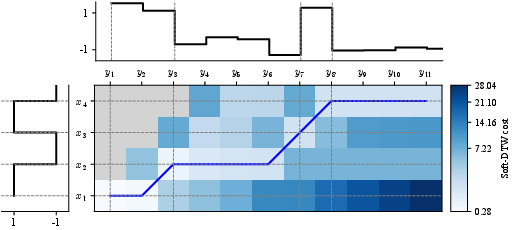
Figure 1: Example Soft-DTW (duplication-only) dynamic programming matrix for piecewise-constant signals; likely alignment paths (light blue), unlikely paths (dark blue), infeasible states (grey), and typical path (dark blue line) are visualized, emphasizing ambiguity in segment placement due to duplication.
The channel model generalizes previous nanopore signal-level abstractions by explicitly incorporating arbitrary Markov memory and geometric duplication statistics. The authors assume an ergodic Markov source and focus on the "input-normalized" mutual information rate, i.e., information per input base as output length is random.
Soft Alignment Rate and AEP
A key innovation is the formalization of a soft alignment functional Ψγ (Eq. 8), generalizing Soft-DTW to quantify the segment alignment cost under noise and geometric duplication. For γ=2σ2, the expected value of the functional, normalized per input, defines the "soft alignment rate" ψ. This quantity captures the entropy of boundary misalignment—formally, it relates directly to the conditional entropy rate HT(K∣Y,S), i.e., the residual uncertainty in boundary locations given observed output and underlying states.
The authors establish that the normalized soft alignment functional converges almost surely to ψ via Kingman's subadditive ergodic theorem. Thus, ψ constitutes a law-of-large-numbers quantity for the alignment cost, and directly enters the information rate expressions as a penalty term due to synchronization uncertainty. The proof leverages the shift-subadditivity of the alignment functional and the ergodicity of the underlying Markov source.
The central theoretical result is an explicit decomposition (Theorem 1) of the achievable information rate for noisy geometric duplication channels:
IT(S;Y)=μ[IISI−Rseg]
where IISI (the auxiliary ISI channel rate) captures the bits/sample achievable in the absence of duplication uncertainty, and Rseg is a segmentation penalty accounting for the residual alignment cost (i.e., the loss incurred by boundary ambiguity). Both terms are computable via sample-level dynamic programming and admit physical interpretations: IISI is the mutual information rate of a "sequence-only" ISI channel, while γ=2σ20 quantifies the extra bits required to resolve duplications. The decomposition enables principled bounding and suggests estimation algorithms based on efficient Monte Carlo and forward-backward ISI computations.
Rate Bounds and Geometric Analysis
The paper develops several lower bounds on achievable rates based on the decomposition:
- Zero-noise bound: By evaluating γ=2σ21 in the noiseless regime, a lower bound is established that captures the inherent uncertainty of segment positions even in the absence of channel noise. For finite-alphabet cases, this can be linked to established capacities of sticky channels.
- Jump-reliability bound: A stronger bound expresses γ=2σ22 in terms of the distribution of "jump distances" between adjacent nanopore level states, γ=2σ23. This result formalizes the intuition that larger jumps between levels enhance synchronizability, suppressing the segmentation penalty. The jump-reliability lower bound depends essentially on the statistical geometry of the pore model.
Numerical evaluation shows that for realistic nanopore models, the jump-reliability bound closely tracks the true rate in SNR regimes relevant to sequencing, validating its utility as a computational proxy.
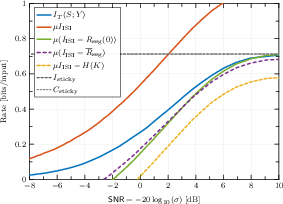
Figure 2: Bounds on achievable information rates of a noisy geometric duplication channel with binary signaling; the gap between the ISI rate upper bound and lower bounds quantifies the effect of the segmentation penalty.
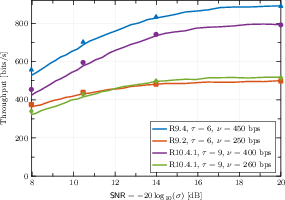
Figure 3: Achievable rates ("throughput", bits/second) for Oxford nanopore sequencers using the jump-reliability lower bound compared with direct computation, highlighting the effect of the jump distance distribution and translocation rates.
Comprehensive analysis across several nanopore generations (e.g., R9, R10.4.1) demonstrates that newer models with larger state spaces and denser level mappings exhibit a broader distribution of small jumps, increasing γ=2σ24 and thus reducing achievable rates at fixed SNR. This affirms the critical role of pore-model geometry in sequencing performance, apart from noise statistics.
Practical and Theoretical Implications
The decomposition directly impacts theoretical code design—by separating the rate penalty induced by duplication ambiguities, it theoretically justifies the design of synchronization-aware coding techniques. Practically, the jump-reliability lower bound provides a computationally tractable metric for optimizing sequencing chemistry and hardware, reducing the analysis to manageable geometric statistics even for high-memory models like R10.4.1.
Methodologically, the work connects concepts from sequence alignment (Soft-DTW), subadditive processes, and information theory for synchronization channels. The explicit link to strong-AEP provides new proofs of capacity theorems for these complex signal-level channels, and the subadditive path-sum structure draws analogies with random polymers in disordered statistical mechanics.
Speculation on Future Directions
The separation of ISI and segmentation effects creates opportunities for modular code and algorithm design: e.g., schemes that target robust ISI equalization in parallel with error-resilient soft alignment. The path-sum viewpoint suggests further cross-fertilization with statistical physics, especially to analyze regimes with long-range memory or more complex duplication statistics.
Extensions to non-geometric duplication laws, more realistic basecallers, or joint modeling of segmentation and substitution/indel errors at the nucleotide sequence level remain open problems. Additionally, quantifying the tightness of the jump-reliability bound for exotic pore models or in fluctuating field conditions warrants further study.
Conclusion
This work provides a mathematically precise and computationally effective framework for understanding the information rates achievable in noisy nanopore sequencing channels with geometric duplication. By decomposing the information rate into an ISI channel term and a geometric soft alignment penalty, the analysis makes transparent the interplay between segmental memory, synchronization uncertainty, and the geometry of the physical pore model. The practical jump-reliability bound permits efficient rate estimation for modern high-memory nanopore architectures and directly connects sequencing physics to information-theoretic performance.
The conceptual framework is likely to stimulate advances not only in nanopore channel analysis, but also in broader contexts where sample-level synchronization errors and memory present critical challenges.