- The paper demonstrates that a shrinking radiation pressure instability zone drives the dramatic state changes in SDSS J1430+2303.
- It leverages multiwavelength observations and spectral-timing analysis to correlate variability across optical, UV, and X-ray bands with disk dynamics.
- The findings challenge SMBHB models by proving that intrinsic disk instabilities can account for the observed flare 'chirp' and amplitude decay.
Radiation Pressure Instability in the "Turn-On" Changing-Look AGN SDSS J1430+2303
Introduction
SDSS J1430+2303 exemplifies the "changing-look" AGN phenomenon, characterized by dramatic transitions in optical spectral type and broadband flux. The object underwent a rapid brightening in the optical beginning in 2018, accompanied by a shift from Seyfert 1.9 to 1.2 classification. During this high state, the object exhibited a unique optical light curve morphology: oscillatory flares with both periods and amplitudes decreasing over several years—a behavior not anticipated by standard AGN variability scenarios.
While initial models invoking a supermassive black hole binary (SMBHB) were considered, multiwavelength constraints and polarimetry now disfavour this explanation. The paper undertakes a comprehensive analysis leveraging X-ray, UV, and optical monitoring to investigate the physical driver underlying the complex accretion state transitions.
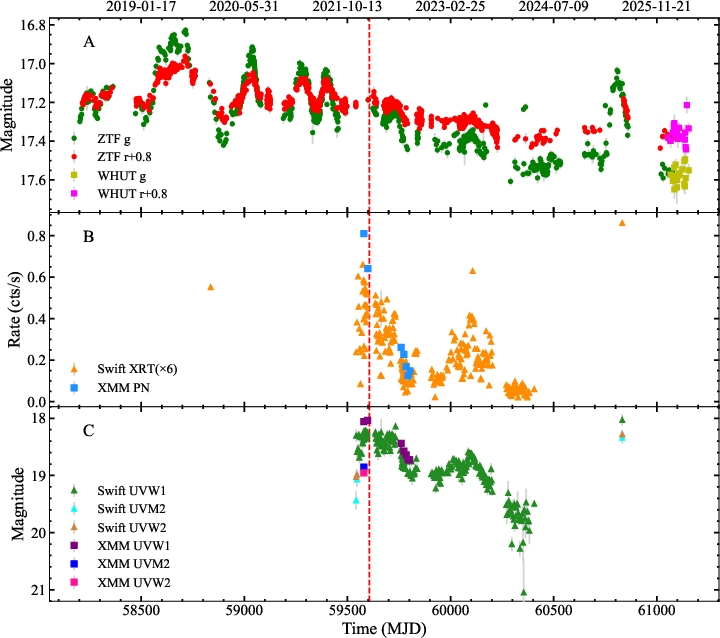
Figure 1: Multiwavelength light curves of SDSS J1430, demonstrating the correlated variability in the optical, UV, and X-ray bands during the changing-look event.
Multiwavelength Variability and Light Curve Morphology
Long-term, high-cadence optical, X-ray, and UV monitoring reveal highly structured variability. In the optical regime, the g- and r-band light curves show at least four discrete flares spanning ∼400 days down to ∼3 months, with a progressive reduction in amplitude. Ultimately, there is a transition from prominent flares to quiescent behavior, followed by a renewed flare event.
Simultaneous UV and X-ray photometry traces even more pronounced flux excursions, with UV flares reaching ∼0.5 mag and X-ray intensities varying by over an order of magnitude. The high-energy variability is temporally correlated with the optical but exhibits larger amplitudes, indicative of a multi-zone response to the underlying accretion rate fluctuations.
X-ray Spectral and Timing Analysis
A detailed spectral decomposition of XMM-Newton and Swift-XRT datasets employs thermal Comptonization and ionized reflection models. All epochs demonstrate a remarkably weak soft excess (kTe≈0.11–0.18 keV in the warm Comptonization component) and a persistent hard X-ray tail with photon index hardening from Γ≈1.73 to Γ≈1.45 as the flux decreases. Tests for intrinsic neutral and ionized absorption do not improve spectral fits, eliminating obscuration as the origin of the weak soft excess.
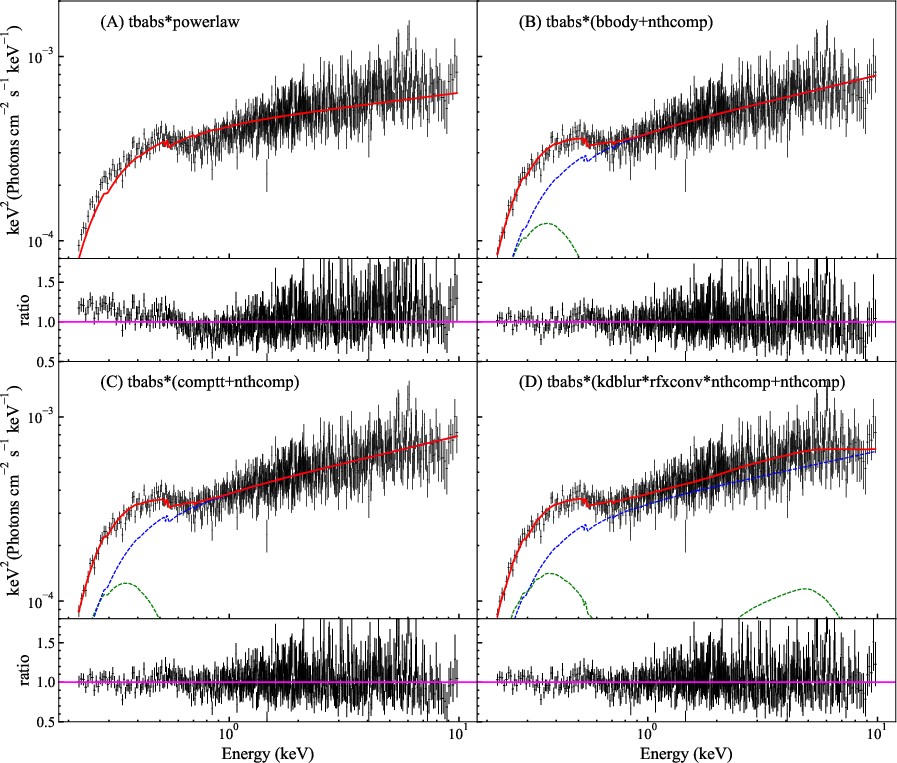
Figure 2: X-ray spectral fitting results illustrating the efficacy of Comptonization and reflection models in describing the spectral states of SDSS J1430.
The amplitude of the soft excess, quantified as the 0.4–3 keV to 1.5–6 keV flux ratio (q), never exceeds ∼10% during the high state, positioning SDSS J1430 at the extreme low end of soft excess strengths in the AGN population.
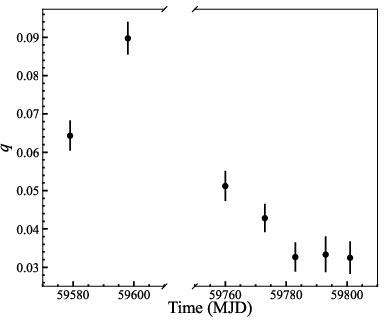
Figure 3: Time evolution of the soft excess strength q, showing persistently weak values throughout the monitoring interval.
Timing analysis of XMM observations finds a constant low-frequency hard lag (∼65–114 s) between soft (0.2–0.5 keV) and hard (0.5–10 keV) bands, with no statistically significant soft lags detected at high frequencies. These spectral-timing characteristics argue for a stable disk–corona geometry over the high-to-low flux transition.
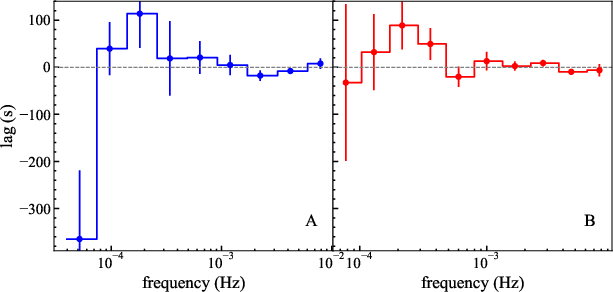
Figure 4: Lag-frequency spectra showing hard lags at low frequencies, supporting the scenario of inward-propagating fluctuations in the corona/disk.
Optical Spectral Decomposition and SED Construction
High S/N DESI spectroscopy, analyzed with principal component analysis and emission-line decomposition, confirms the "turn-on" from Type 1.9 to 1.2 via emergence of a broad H∼0 component. Single-epoch black hole masses derived from line widths and luminosities yield ∼1–∼2. The intrinsic AGN power-law continuum index is consistent with thin-disk models.
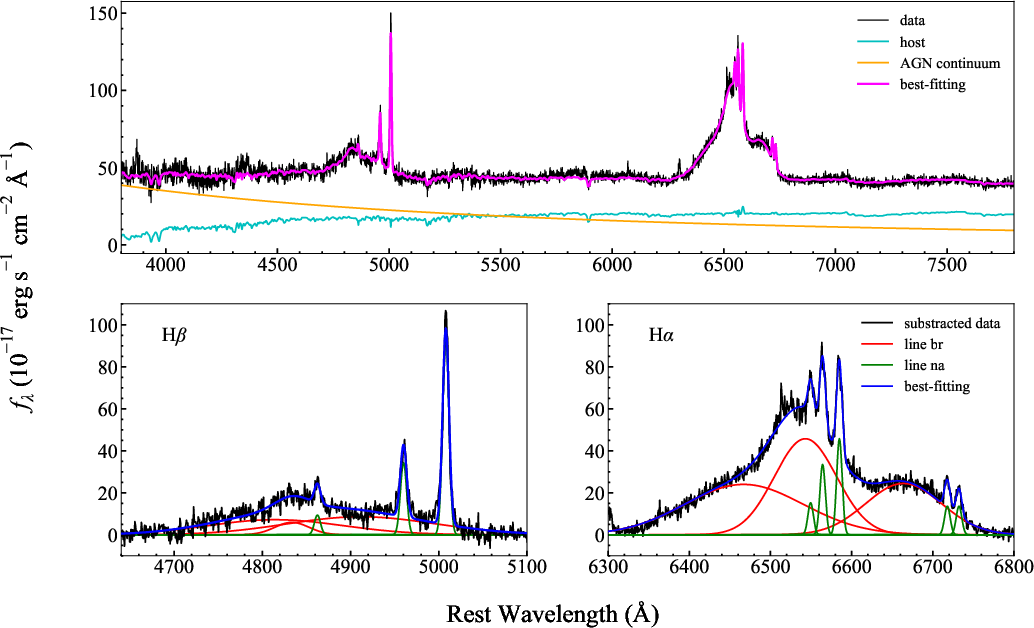
Figure 5: Optical spectral decomposition isolating AGN, host galaxy, and emission line components, underpinning black hole mass and accretion rate estimates.
Broadband SED fitting with the OPTXAGNF model, using well-constrained ∼3 and black hole spin (∼4), yields Eddington ratios ∼5–∼6 for ∼7 in the ∼8–∼9 range, with statistically preferred high spin values (∼0). Soft and hard Comptonization fractions and transition radii are consistent with Compton-thin, compact coronae.
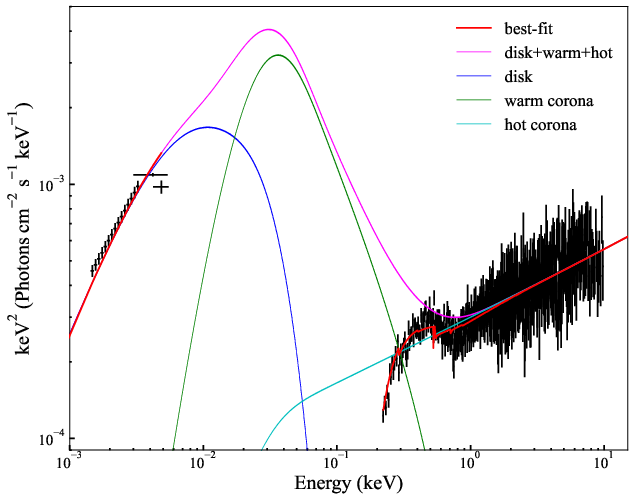
Figure 6: SED model fit to the complete optical, UV, and X-ray data set, illustrating the decomposition into disk, soft, and hard coronal components.
Radiation Pressure Instability as a Disk Variability Driver
The optical flare train is quantitatively modeled under the radiation pressure instability (RPI) paradigm, localized to a narrow (shrinking) annulus at the transition between thin disk and ADAF flow. This regime can produce short timescale, damped oscillations in the local accretion rate, as the RPI zone contracts due to mass supply evolution and disk structure changes.
Simulations based on observed ∼1, Eddington ratio, and viscosity (e.g., ∼2) reproduce the observed decrease in flare period from ∼3400 days to ∼43 months, and the gradual damping of amplitudes, by exponentially decreasing the width ∼5 of the unstable region over ∼6600 days.
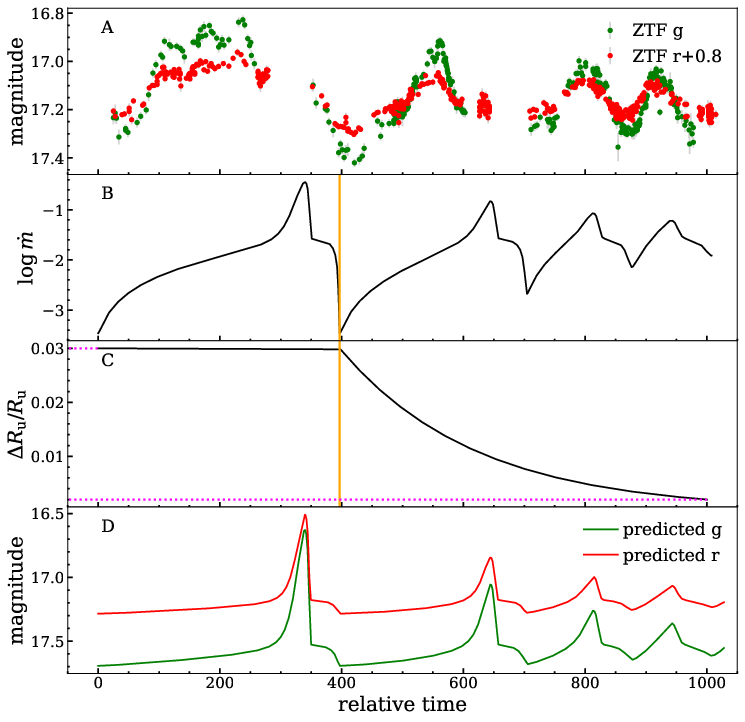
Figure 7: Model output for RPI-driven accretion disk variability, reproducing the observed light curve decay in period and amplitude.
This result constitutes a bold assertion that a time-dependent, shrinking RPI zone is capable of explaining both the light curve "chirp" and energy-dependent amplitudes observed in SDSS J1430, without reference to SMBHBs or external perturbations. Residual discrepancies (e.g., peak optical flare mismatch, and mechanisms for RPI zone contraction) highlight requirements for further dynamical modeling and inclusion of multi-phase coronal variability.
Implications and Future Work
The conclusion that a shrinking, radiation-pressure-unstable disk zone drives changing-look behavior in low-Eddington ratio AGN, if broadly applicable, would reshape the theoretical landscape for AGN spectral state transitions. This result supports the growing evidence that AGN accretion flows exhibit state changes closely analogous to those seen in X-ray binaries, with disk instabilities or transitions at characteristic radii, rather than binary-driven dynamics, controlling observed variability.
Practically, this work establishes the utility of coordinated, rapid cadenced, multiwavelength monitoring to disambiguate between competing variability mechanisms. High-cadence surveys and future time-domain facilities are expected to yield further examples, enabling population-level tests of the RPI scenario and contributing to improved predictive models for AGN transient behavior.
Conclusion
This study demonstrates that the drastic, time-dependent optical and X-ray variability in the "turn-on" changing-look AGN SDSS J1430+2303 can be accounted for by a shrinking radiation pressure instability zone at the disk-ADAF interface. The weak soft X-ray excess is a direct consequence of the low Eddington ratio inferred from SED modeling, and the persistence of disk-corona lags constrains the geometry during state transitions. The results strongly favor disk-instability physics over SMBHB interpretations for this class of changing-look objects, but further dynamical modeling and population studies will be required to fully quantify the conditions for instability onset and evolution.