- The paper introduces a biologically-inspired adaptive binaural front-end that dynamically adjusts cochlear-like filterbanks for improved speaker localisation.
- It employs dual neural controllers to modulate Q-factors, achieving up to 90.82% sound detection accuracy and reducing spatial estimation errors in challenging conditions.
- The system outperforms fixed front-ends in unseen and reverberant environments, paving the way for applications in advanced hearing aids and robotic audition.
BiEAR: Adaptive Human Auditory-Inspired Processing for Robust Multi-Speaker Binaural Scene Analysis
Introduction
BiEAR introduces a biologically grounded, adaptive binaural front-end for simultaneous multi-speaker localization and distance estimation, architecturally inspired by the efferent modulation mechanisms of the human auditory system. The design emulates the medial olivocochlear (MOC) feedback pathways, implementing neural controllers to dynamically adjust the Q-factors of cochlear-inspired subband filterbanks. This approach enables real-time adaptation of filter selectivity in response to changing acoustic conditions, aiming to achieve human-like robustness in computational auditory scene analysis (CASA), especially in unseen or reverberant environments.
The operation of the human binaural auditory pathway involves spatial cue extraction via the medial and lateral superior olive (MSO and LSO) for ITD and ILD computation respectively, followed by modulation from the MOC efferent system, as represented in (Figure 1).
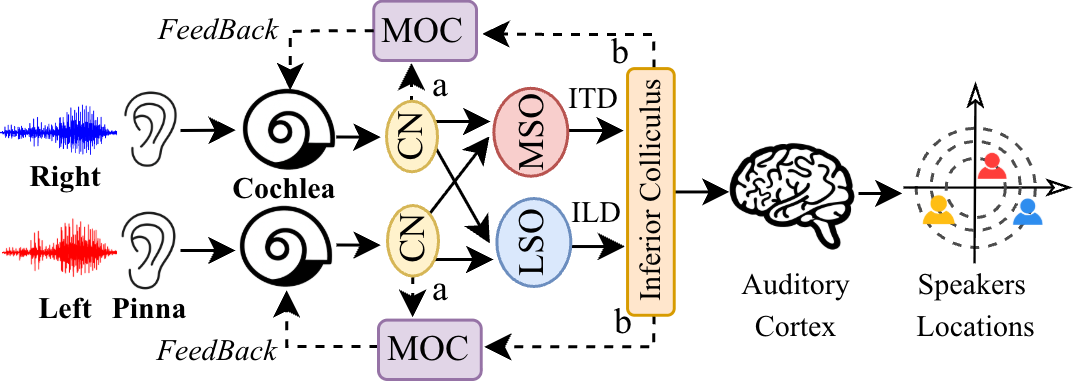
Figure 1: Overview of the human binaural auditory system with MSO/LSO-based ITD/ILD extraction and adaptive MOC efferent modulation.
BiEAR Architecture
BiEAR’s architecture consists of a feedback-controlled adaptive front-end coupled to sector-wise SAD-Nets for joint inference over source presence, azimuth, and distance (Figure 2). Each ear's input waveform undergoes ERB-scale short-time frequency decomposition via a Gabor filterbank, whose subband selectivity is frame-wise modulated by neural feedback controllers. The system derives frequency- and ear-specific ILD and IPD features, as well as waveform-level cross-correlation cues, which serve as the feature basis for downstream multi-task learning modules.
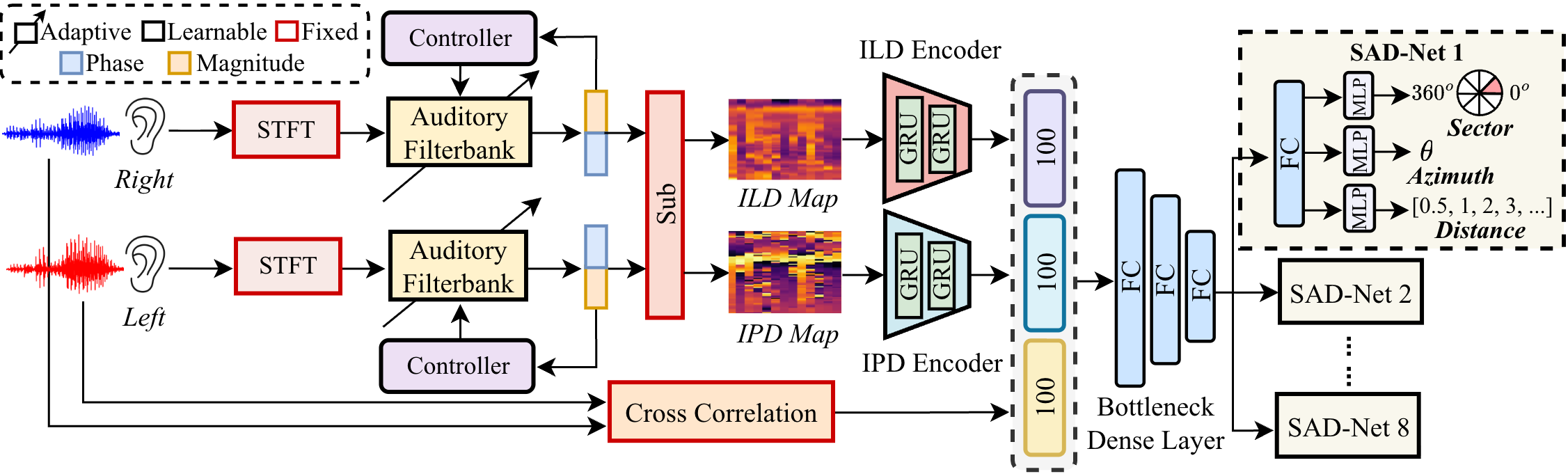
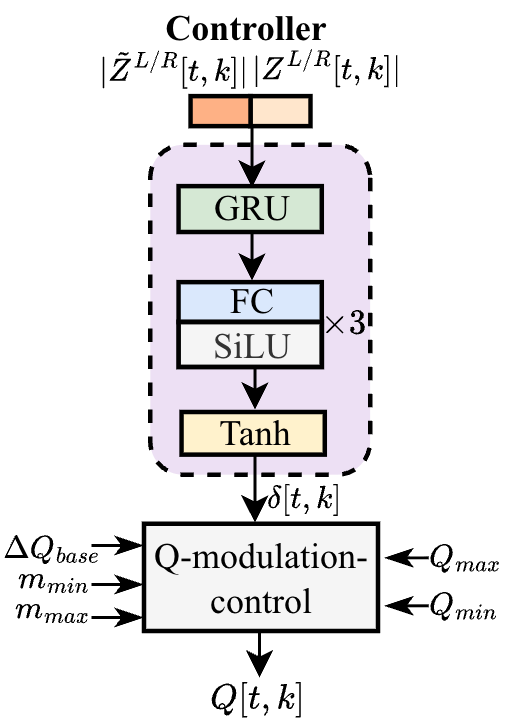
Figure 2: The overview of the proposed binaural model with a feedback-controlled adaptive front-end.
Adaptive Filterbank and Neural Controller Mechanism
The core of BiEAR is its time-frequency adaptive filterbank, where each channel's Q-factor is dynamically regulated. The controller receives a concatenated vector of instantaneous and exponentially smoothed subband SPL values. It outputs bounded control signals, separately for each ear, that modulate the Q-factor via either absolute (additive) or relative (multiplicative) strategies. The frequency-dependency of modulation is aligned with human cochlear physiology, employing a shaped ERB-rate-based scaling across subbands.
Two control topologies are considered: single, shared controller versus independent controllers for each ear. Dual controllers allow asymmetric, more realistic ear-specific filter adaptation, consistent with psychoacoustic findings and the spatial selectivity observed in human listeners.
Experimental Evaluation
Data and Protocol
Test data encompass one-, two-, and three-speaker mixtures synthesized with spatially distributed TIMIT utterances convolved with BRIRs for anechoic, meeting room, and large lecture hall environments. Both matched (seen) and mismatched (speaker- and room-unseen) scenarios are evaluated, with environmental transfer experiments quantifying adaptation via fine-tuning on a subset of reverberant data.
Comparative Benchmarking
BiEAR is compared to DeepEar [DeepEar] and AuralNet [fu25_interspeech], strong auditory-inspired models. All variants share the same back-end to isolate front-end contributions. BiEAR configurations include passive (no controller), shared-controller, and dual-controller models with both absolute and relative Q-control, paralleling recent advances in monaural adaptive front-ends [qiquan_AdaFE, buddhi_AdaFE].
Results
In anechoic evaluations, the dual-controller variant with relative Q-control consistently achieves the best overall results. For three-speaker localization, BiEAR+DualController+Rel yields sound detection accuracy of 90.82% and azimuth mean absolute error (MAE) of 8.03° on previously unseen speakers—both superior to fixed front-ends. For distance estimation, the system's performance, while strong, shows a slight tradeoff against AuralNet, especially in highly reverberant or OOD scenarios due to its focus on spatial rather than direct-path cues.
In practical reverberant rooms, the adaptive BiEAR front-end confers substantial robustness, achieving 95.51% sound detection accuracy in the meeting room and 82.93% in the challenging lecture hall after environment transfer, outperforming the baselines by wide margins. Before adaptation, BiEAR also demonstrates higher zero-shot generalization.
Interpretability and Analysis
Visualization of the Q-factor dynamics reveals interpretable, source- and time-specific ear asymmetries: e.g., increased selectivity (higher Q) on the ear contralateral to the stimulus in mid-high frequencies—precisely where ILD cues are most salient—while the ipsilateral ear exhibits enhanced low-frequency selectivity, exploiting ITD cues. This adaptive, attention-like modulation pattern directly supports improved source separability and localization accuracy (Figure 3).

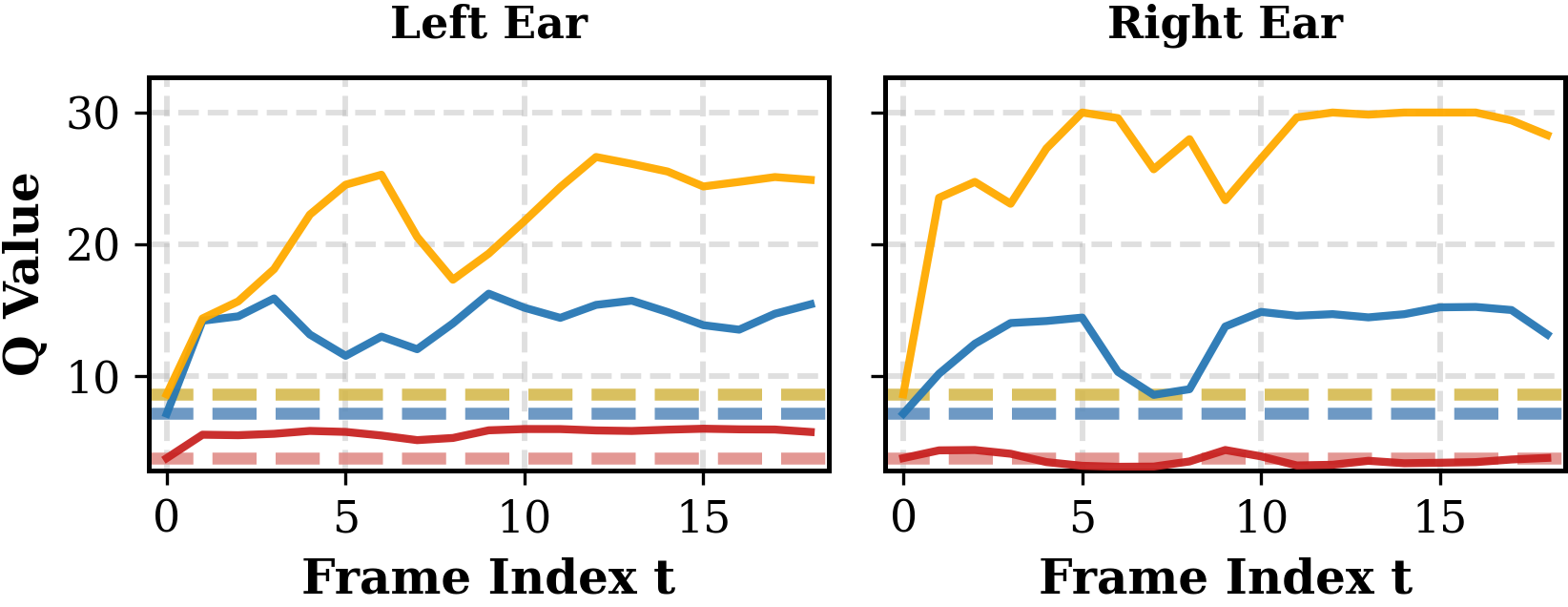
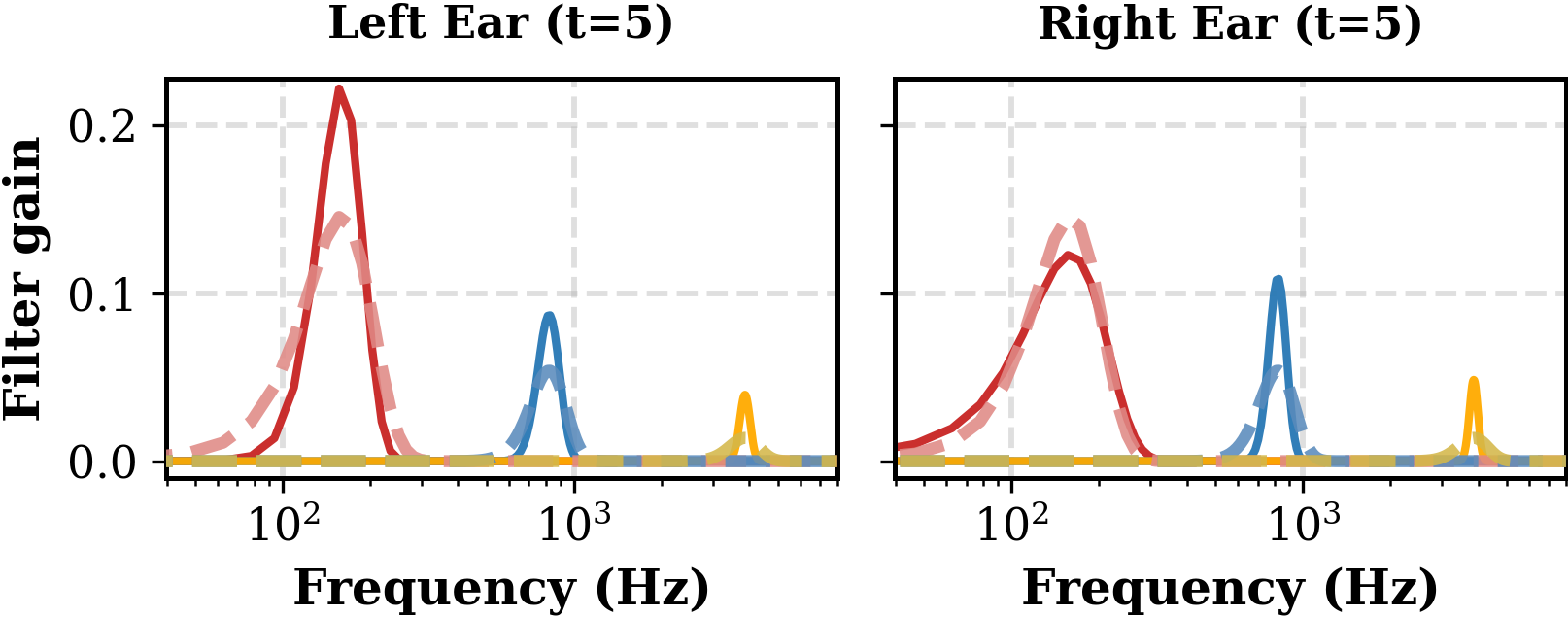
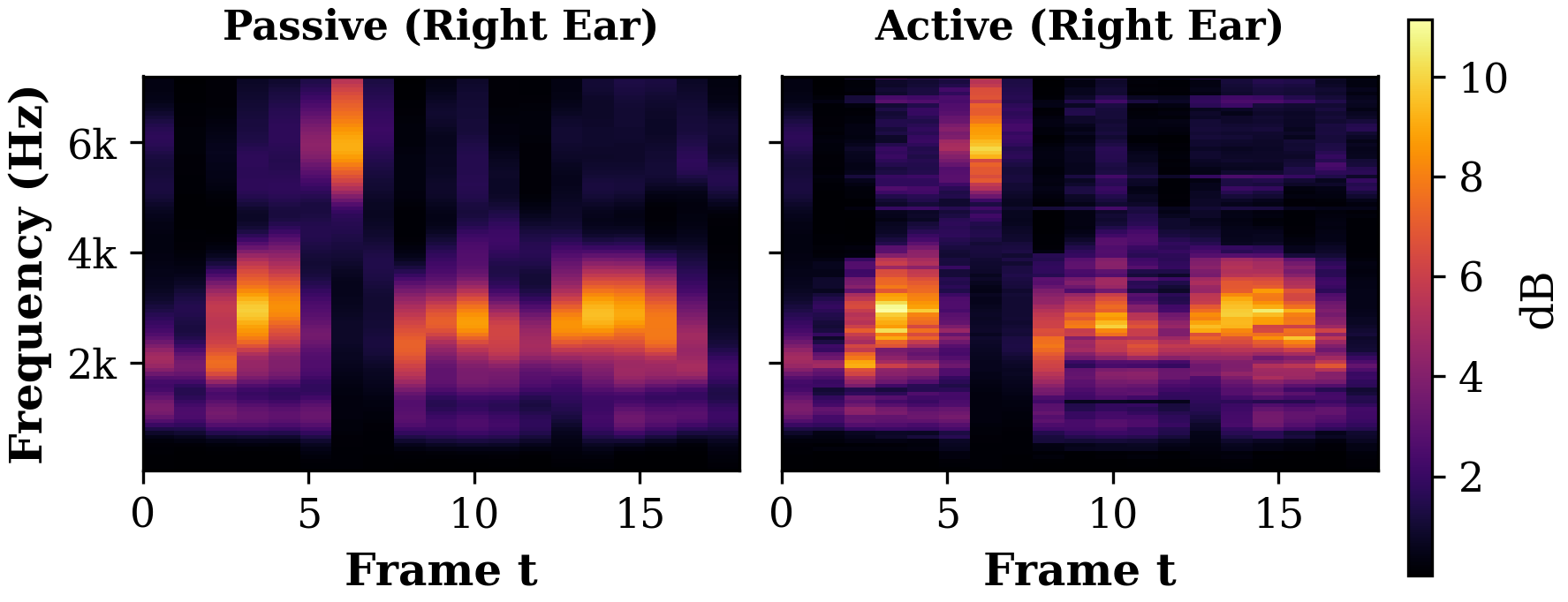
Figure 3: Adaptive filterbank behaviour of BiEAR + Dual Controller + Rel. for a single speaker at 292∘ (front-right) and 2 m. Selected subbands: low ≈ 159 Hz, mid ≈ 821 Hz, high ≈ 3.86 kHz. “Passive" is w/o controller; “Active” is adaptive.
Such visualization underscores BiEAR’s ability to dynamically allocate computational resources to maximize informative spatial cues, analogous to efferent modulations in biological hearing.
Implications and Future Directions
BiEAR’s demonstration of robust and adaptive spatial hearing via MOC-inspired feedback has several implications:
- Practical Applications: The architecture is directly applicable to advanced hearing aids, robot audition, and robust speech interface systems in complex, reverberant, or dynamically changing environments.
- Theoretical Impact: BiEAR operationalizes computational equivalents of auditory efferent pathways, offering a reference model for developing interpretable, neuro-inspired front-ends that generalize beyond stationary or fixed graphs.
- Future Systems: Extensions to multi-turn, moving sources and incremental adaptation over long time horizons are natural next steps. Furthermore, integrating more sophisticated neuro-mimetic feedback (e.g., top-down cognition, context-awareness) could close further gaps between CASA models and human spatial perception.
Conclusion
BiEAR models MOC-driven adaptive filtering mechanisms to enable robust, interpretable, and generalizable binaural scene analysis. Its dual-controller feedback architecture confers significant performance and robustness gains over established baselines, especially under mismatch and reverberant conditions. BiEAR sets a precedent for adaptive machine-hearing front-ends, substantively bridging computational and biological auditory models.
Cited as: "BiEAR: A Human Auditory-Inspired Adaptive Binaural Front-end for Multi-Speaker Localisation and Distance Estimation" (2606.06795)