- The paper demonstrates that flat-band superconductors exhibit novel magnetic field walls driven by a globally negative, periodic free energy.
- It uses sine-Gordon soliton solutions to describe both isolated kink and overlapping breather wall phases under varied magnetic fields.
- Lattice model implementations, including Lieb and BHZ models, validate the robustness of wall phases, opening paths for high-field superconducting devices.
Magnetic Field Walls in Flat-band Superconductors: Summary and Analysis
Introduction and Background
The paper "Magnetic Field Walls in Flat-band Superconductors" (2606.06791) investigates the magnetic responses of superconductors hosted in flat-band systems, specifically predicting and analyzing a novel wall phase characterized by the emergence of magnetic field walls (planar soliton-like magnetic flux structures) in the superconducting bulk under applied magnetic fields. Classical classification of superconductors, which differentiates between type-I and type-II behaviors (formation of domains or Abrikosov vortices, respectively), is inadequate for flat-band systems due to their unique kinetic constraints and the role of quantum geometric form factors.
The core distinguishing property is that, in flat bands, the lack of a Fermi surface and the absence of single-particle energy cost for finite-momentum Cooper pairs allow the superconducting free energy to be a globally negative, periodic function of the vector potential. Consequently, flat-band superconductors exhibit fundamentally different responses to applied magnetic fields compared to their dispersive counterparts.
Periodicity and Negativity of Free Energy in Flat Bands
For flat-band systems at low temperatures and near half-filling, mean-field calculations reveal that the superconducting free energy density fs(A) remains negative for all A along certain high-symmetry directions, a result rooted in multi-orbital quantum geometry and demonstrated through both analytic and lattice-model calculations.
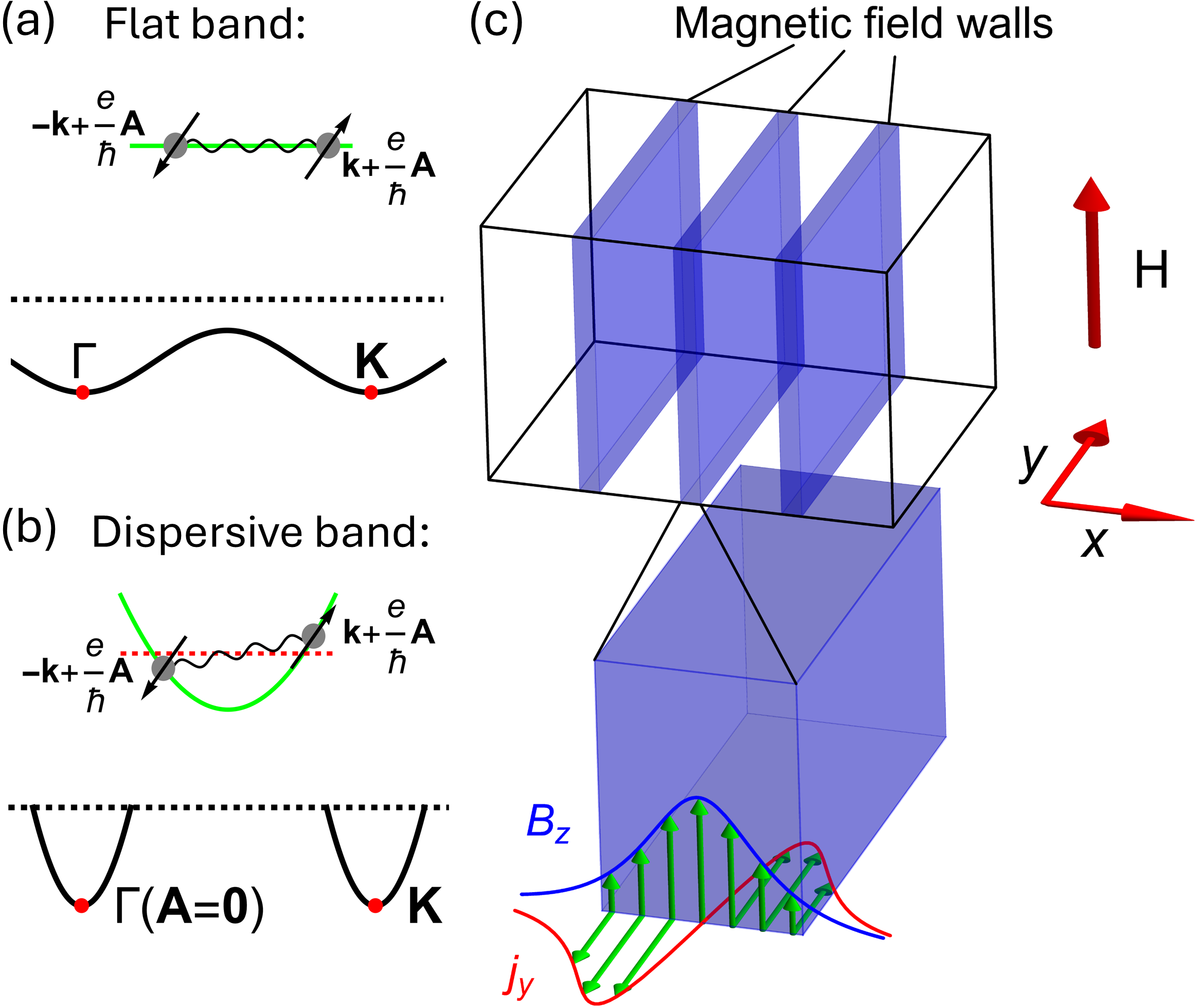
Figure 1: (a)-(b) Schematic showing pairing with nonzero vector potential A and the resulting periodic, globally negative free energy density in flat vs. dispersive bands. (c) Illustration of bulk flat-band superconductor exhibiting magnetic field walls in an applied field.
This property is in sharp contrast to the dispersive band (typical BCS) scenario, where the free energy becomes positive under sufficient phase gradients (i.e., vector potential), leading to superconductor-normal transitions. In flat bands, the periodic and negative fs(A) supports a distinct class of solutions to coupled Maxwell-London-like equations, giving rise to field wall phases.
Sine-Gordon Soliton Solutions: Wall Phases
For flat bands, the spatial dynamics of superconducting order and associated magnetic flux are governed by a sine-Gordon equation for the gauge-invariant vector potential. This equation admits two key real-space soliton solutions pertinent to the wall phase:
- Kink Soliton: Describes isolated magnetic field walls at lower fields, corresponding to a localized, step-like change of the vector potential, with the wall thickness given by the penetration depth λL. The free energy density remains negative everywhere, and the current forms a bidirectional plane structure.
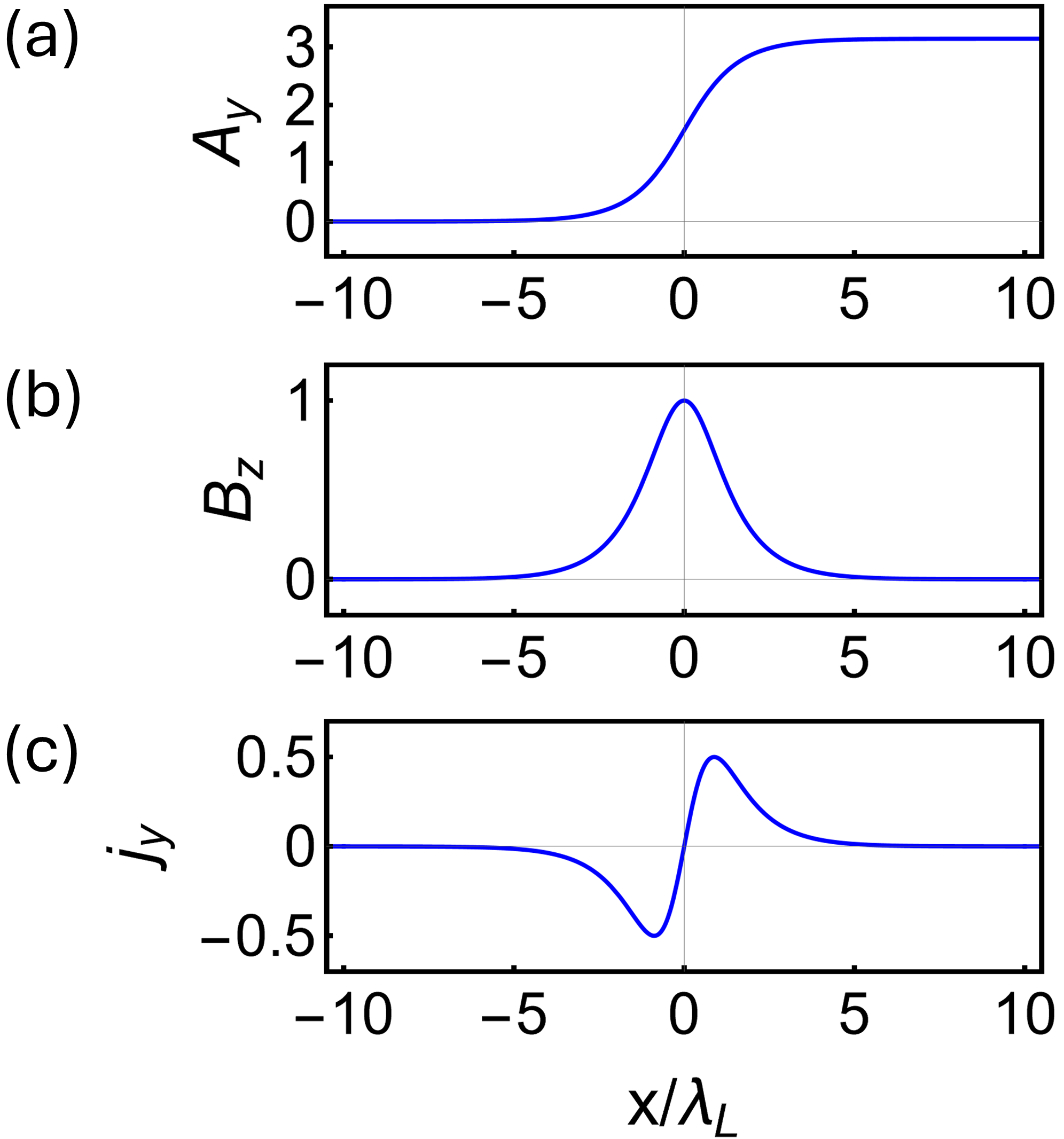
Figure 2: Plots of Ay, Bz, and jy for the kink soliton, showing the spatially localized field and current profiles.
- Breather Soliton: At higher applied fields, kinks proliferate and overlap, transitioning to breather soliton solutions. These correspond to an array of magnetic field walls that may eventually merge, resulting in uniform field penetration and vanishing bulk diamagnetism, yet with the superconducting gap intact.
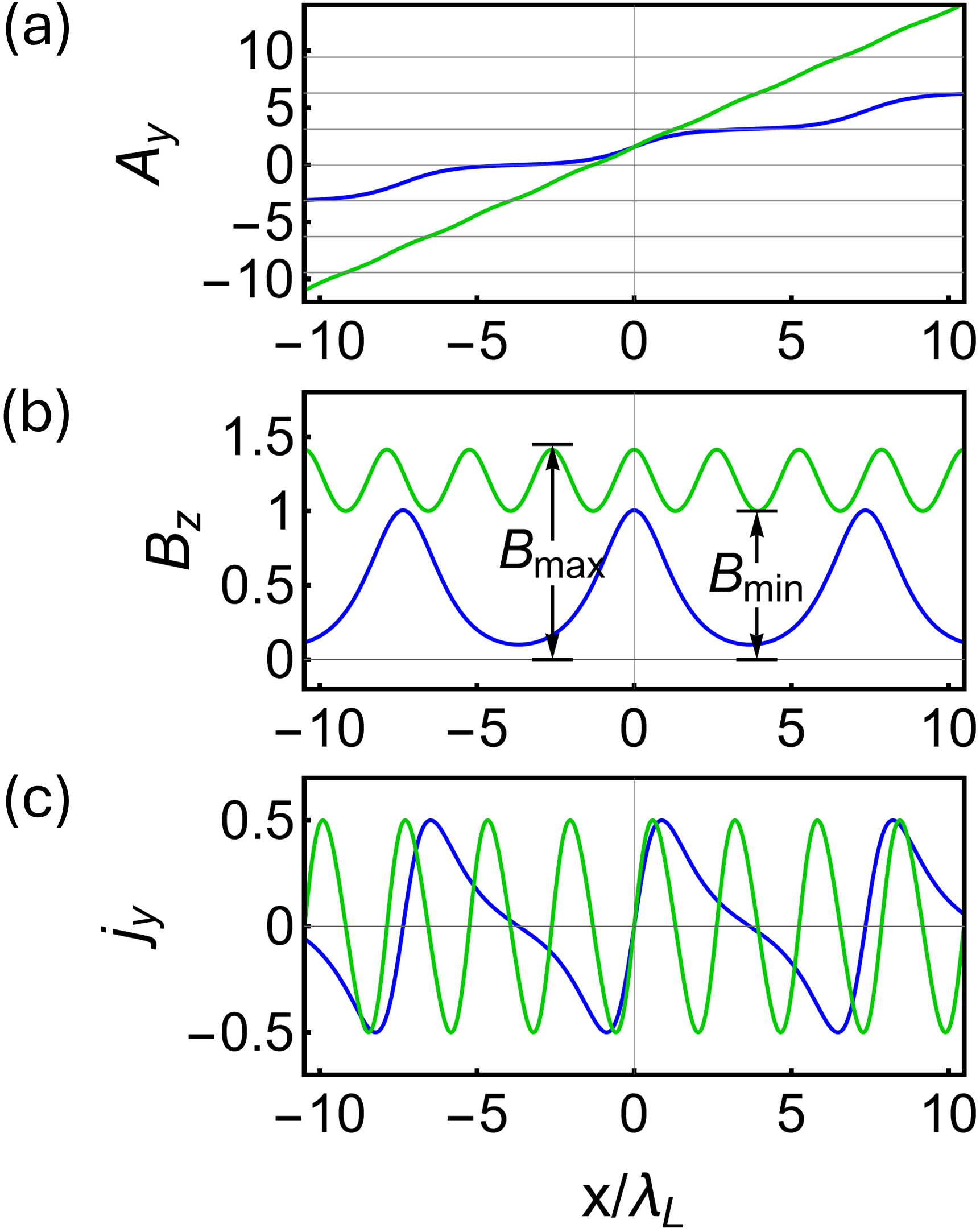
Figure 3: Plots of Ay, Bz, and A0 for the breather soliton at two parameter values, illustrating the evolution from separated walls to more uniform penetration at higher applied fields.
Critical Fields and Magnetic Susceptibility
- Lower Critical Field A1: The onset of field wall proliferation is determined by equating the free energies of the zero-field uniform state and that with a single wall; for the cosine free energy model, A2, essentially set by the flux quantum, lattice constant, and penetration depth.
- Upper Field Robustness: Unlike in conventional superconductors, the wall phase in the flat-band case does not exhibit an intrinsic upper critical field within the validity of the cosine model; the mean superconducting condensation persists until wall density approaches the lattice scale, where the model's assumptions break down.
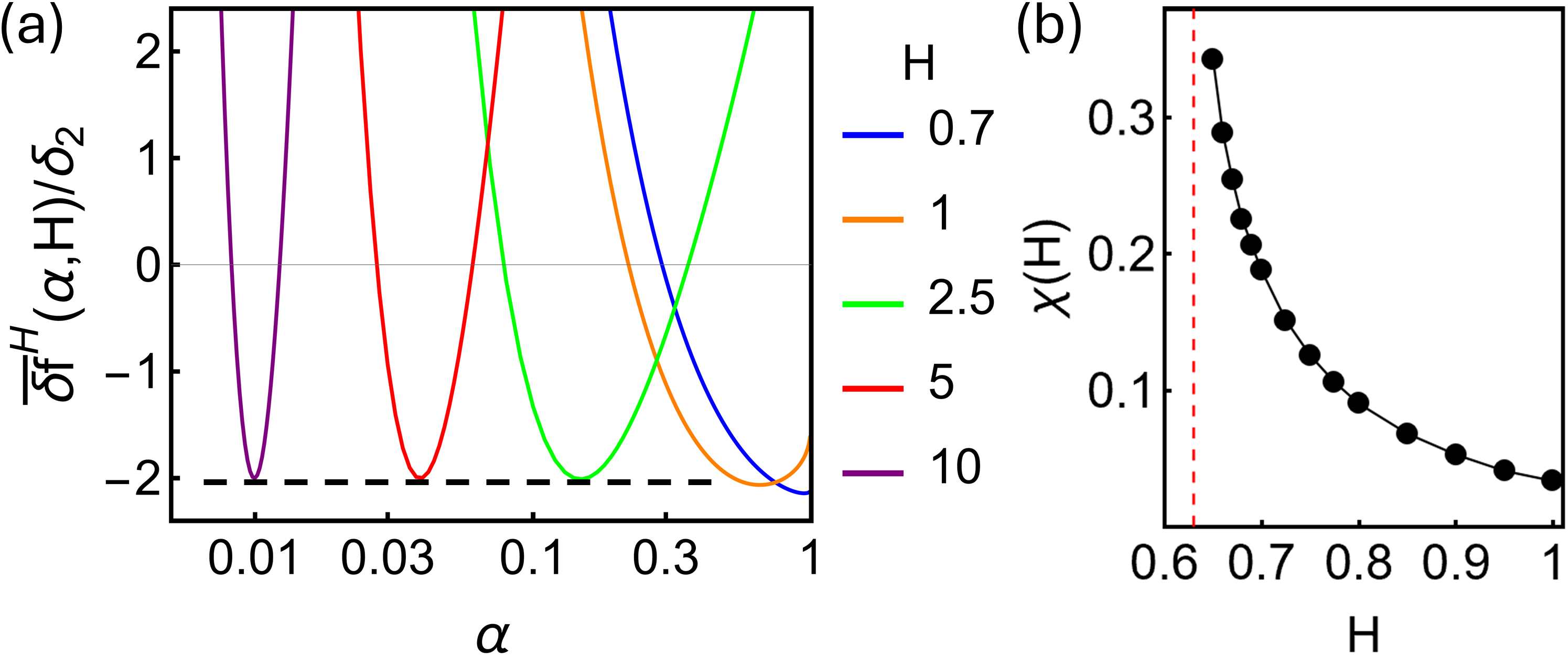
Figure 4: (a) Free energy difference of breather soliton vs. normal state across applied field strengths. (b) Notable suppression of diamagnetic response as breather solutions proliferate.
Magnetic Wall Geometry and Textural Variants
Owing to the geometric structure of A3 and the periodicity of the Cooper pair Brillouin zone, wall solutions can occur along various high-symmetry directions, and can form complex textures, including grids with quantized regions of the vector potential and intersections without singularities in the electromagnetic fields.
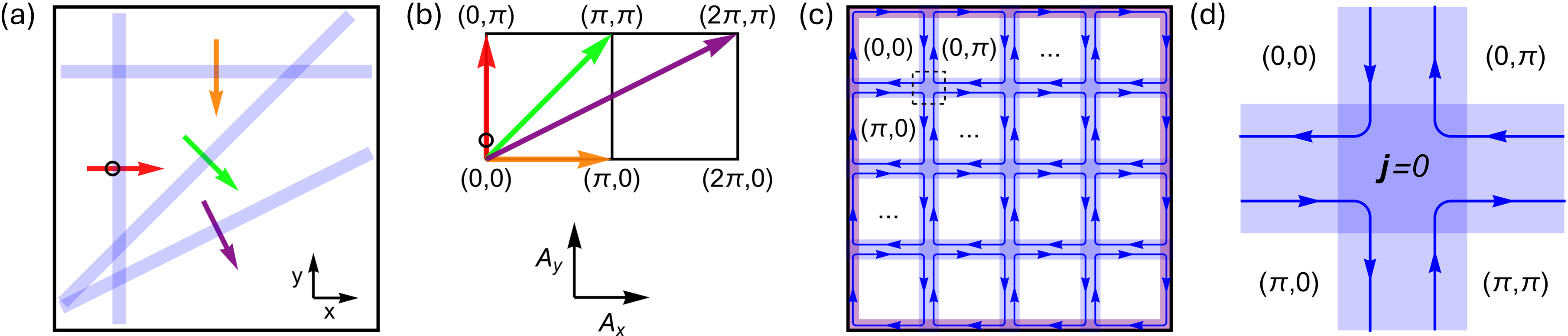
Figure 5: (a)-(d) Schematics of multiple wall orientations, the mapping of wall trajectories in vector potential space, and example of grid formation with current distributions at wall intersections.
This configurational freedom may be exploited experimentally through defect engineering or boundary design to control wall geometries, potentially leading to programmable flux landscapes in flat-band superconductors.
Competition with Vortex Phases
The energetic competition between wall phases and conventional vortex lattice phases is nontrivial in flat-band superconductors. Due to the large energy cost associated with extensive normal vortex cores in flat bands, wall phases are generically preferred—especially when vortex core sizes are on the order of or greater than the lattice constant and the "cosine model" oscillation amplitude is large relative to the mean condensation energy.
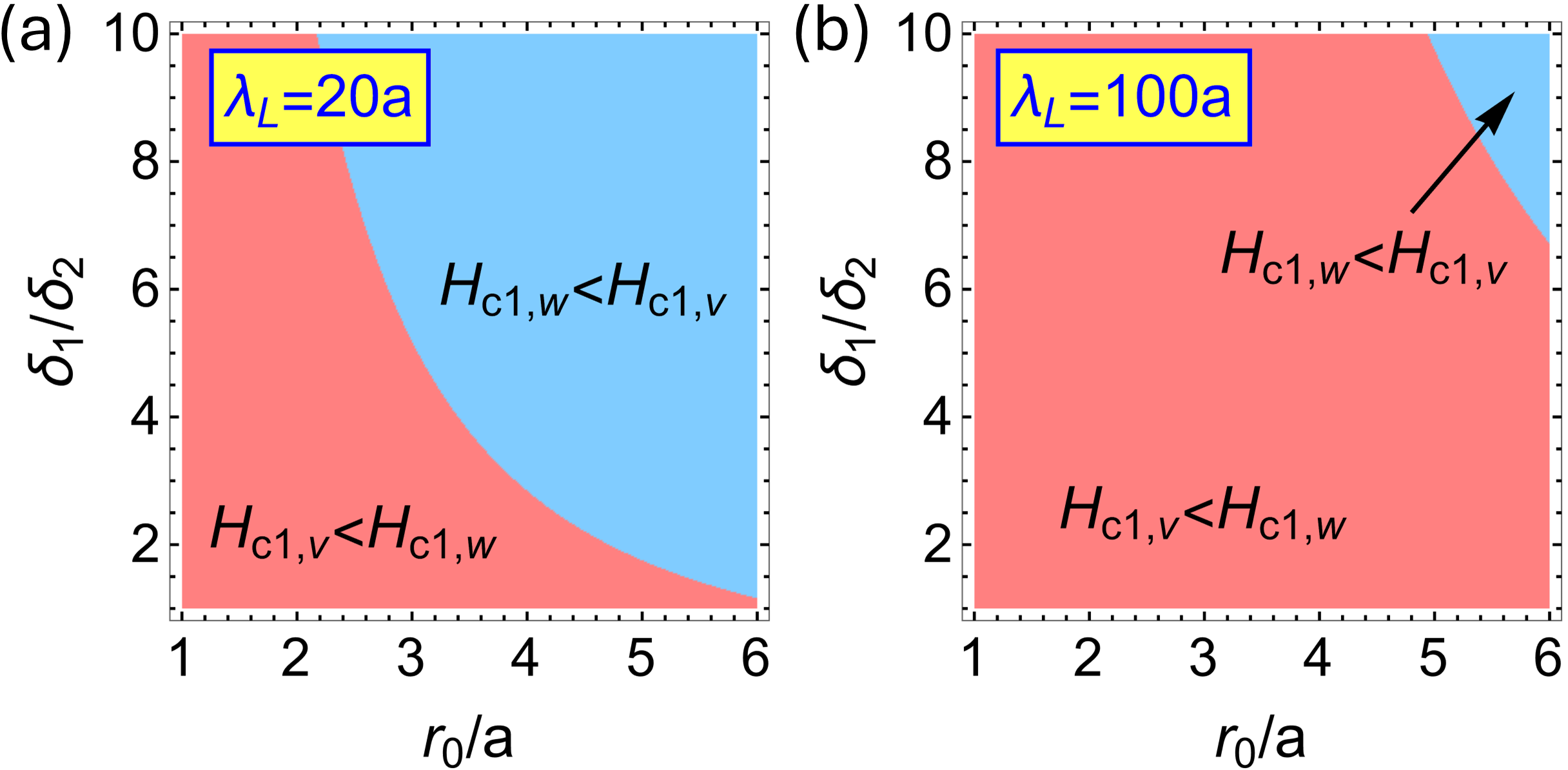
Figure 6: Phase diagrams comparing lower critical fields for wall and vortex phases as functions of coherence length, penetration depth, and condensation energy ratios. Blue indicates wall-favorable regimes.
As penetration depth increases, the vortex phase becomes more competitive, but for parameters relevant to strong-coupling flat bands, wall phases dominate.
Dynamical Properties and Phase Space
The coupled nonlinear Maxwell equations underlying the wall phase admit a periodic, topologically nontrivial phase-space structure. Kink and breather solutions correspond to distinct flow topologies in the A4 plane: the fixed points at time-reversal-invariant momenta act as attractors or repellers, dictating the real-space organization of walls.
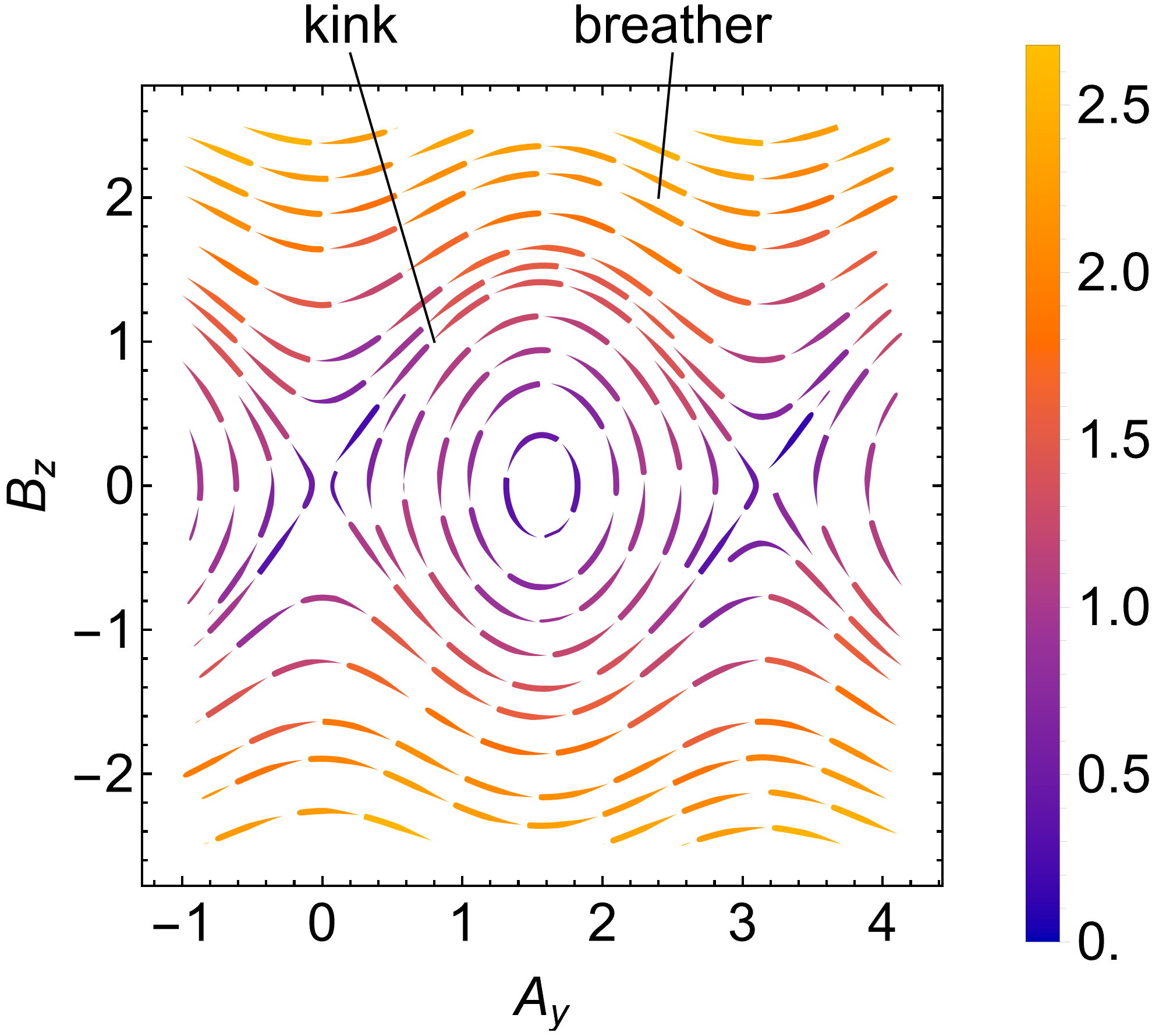
Figure 7: Velocity field and streamlines in A5 phase space for the cosine model, showing kink and breather solution trajectories connecting fixed points.
Lattice Model Implementation
The paper further substantiates the theoretical framework with detailed calculations on multi-orbital lattice models, such as the Lieb lattice and a flattened BHZ (Bernevig-Hughes-Zhang) model, showing the persistence of the negative, periodic free energy and the robustness of the wall phase in both topologically trivial and nontrivial flat bands.
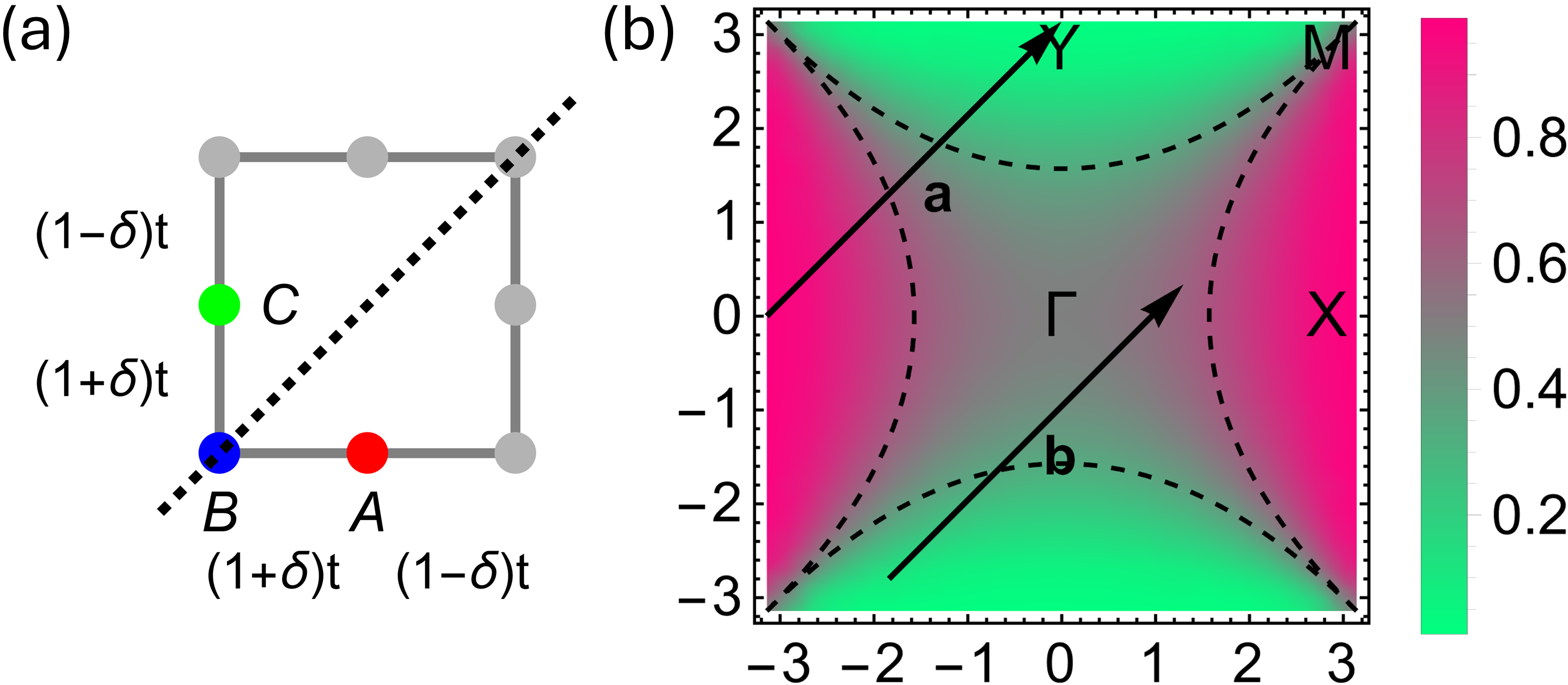
Figure 8: Lieb lattice structure and orbital composition of the flat band eigenstates across the Brillouin zone.
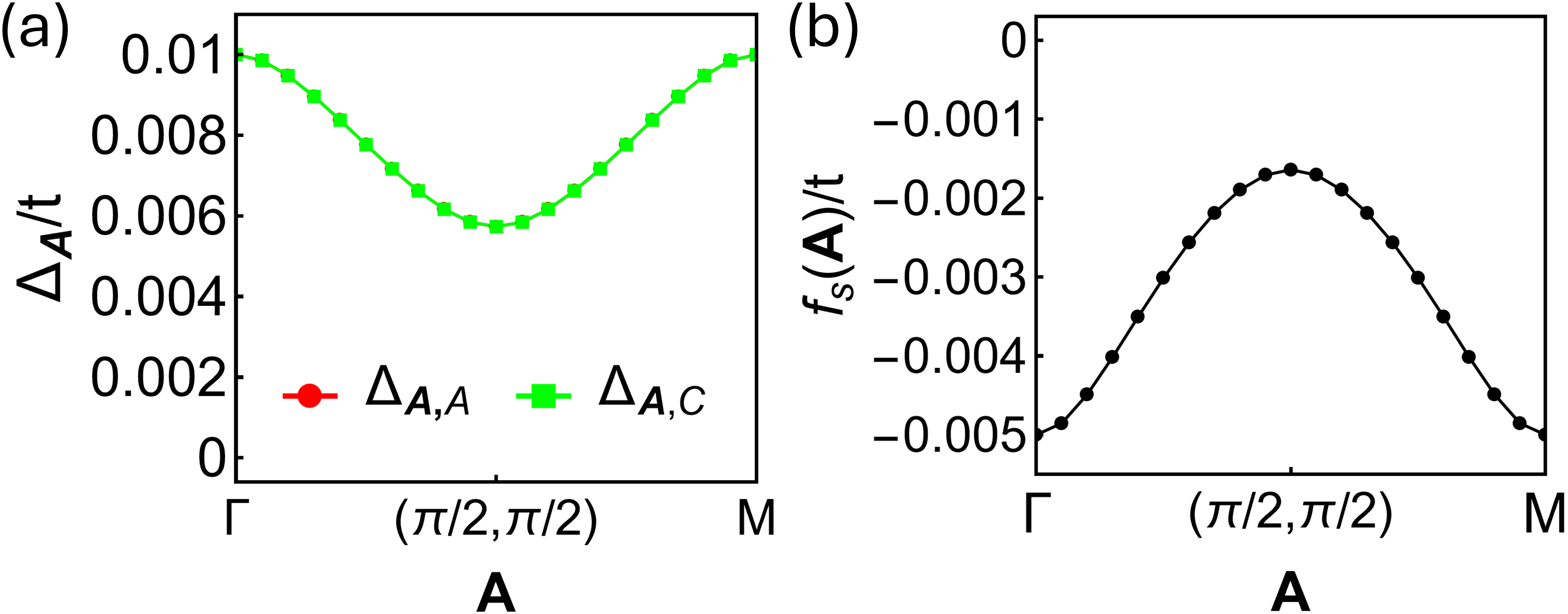
Figure 9: Orbital-dependent order parameter profiles and free energy density along a high-symmetry direction in Lieb lattice, demonstrating global negativity and minimal depairing.
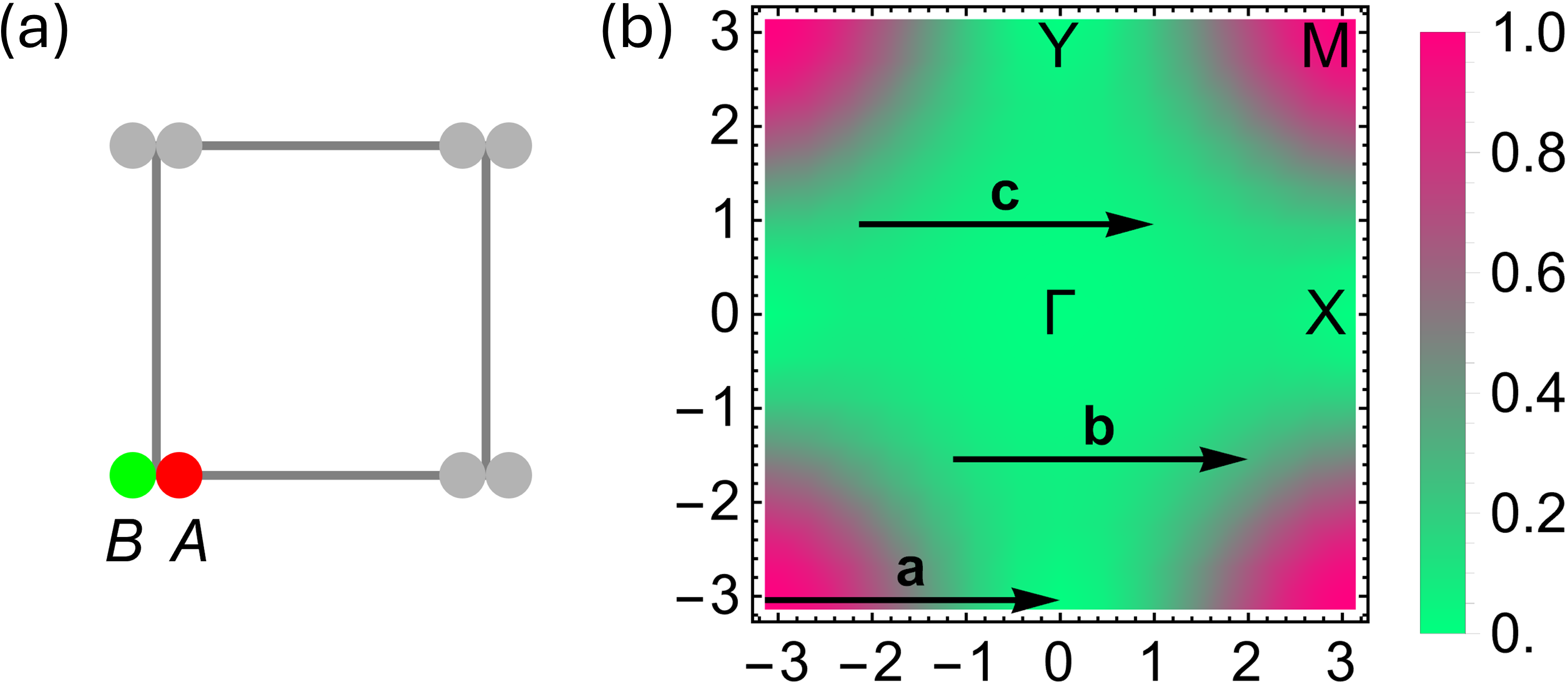
Figure 10: Structure and orbital weight in the flattened BHZ model.
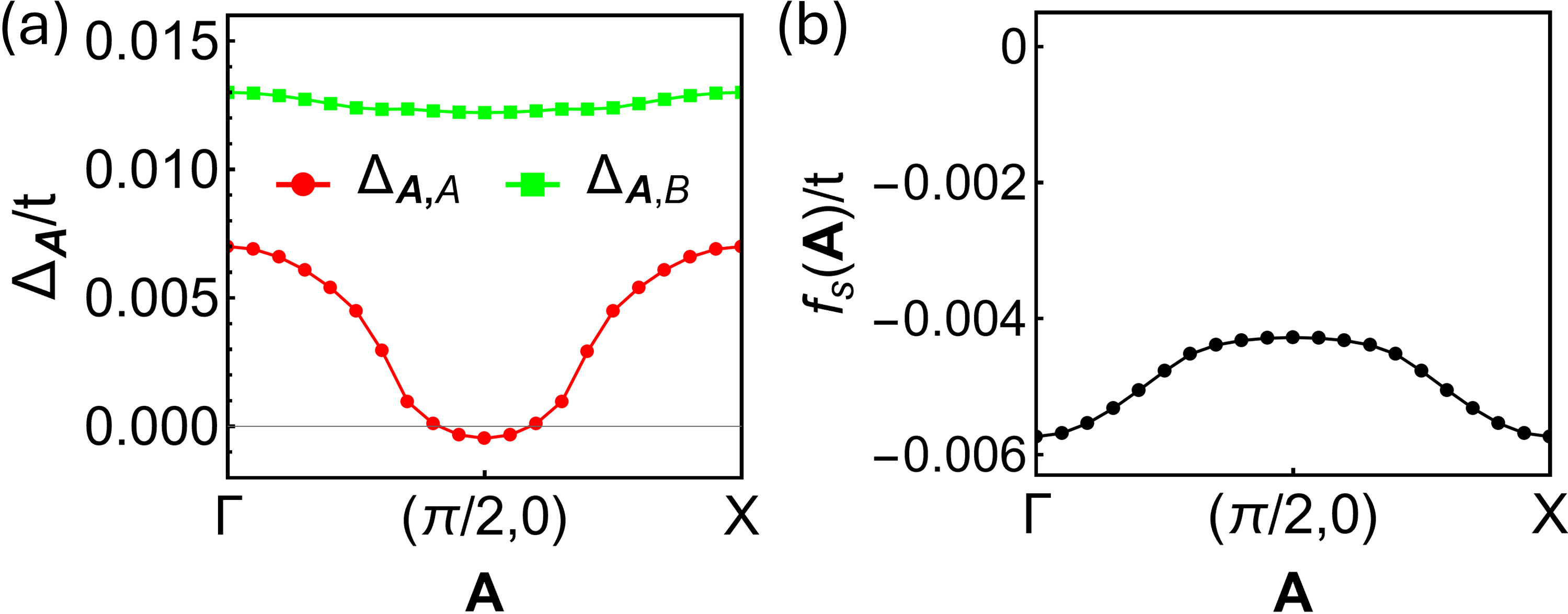
Figure 11: Variation of orbital-dependent order parameters and free energy density in the flattened BHZ model, indicating incomplete depairing even at maximal mismatch.
Implications and Future Perspectives
Theoretical Implications:
The wall phase represents a new paradigm for the coexistence of superconductivity and magnetic field penetration, arising from quantum geometry rather than either spin-multiplet degeneracy or the formation of normal-state cores. It broadens the taxonomy of superconducting responses beyond the canonical type-I/type-II classification. The absence of an intrinsic upper critical field (within the model) and the configurational flexibility of wall geometries suggest rich phenomenology in flat-band platforms.
Practical Implications:
Flat-band superconductors, due to their robustness against magnetic depairing and their ability to form programmable flux wall landscapes, hold promise for high-field superconducting devices, magnetically tunable logic, or artificial gauge fields in metamaterials. The realization of such phases likely requires optimization of lattice geometry, interaction strength, and precise band flattening.
Future Directions:
Open problems include quantitative determination of coherence lengths and the inclusion of microscopic inhomogeneities, exploration of wall phases in correlated flat-band states beyond superconductivity, and extension to three-dimensional or strongly spin-orbit-coupled systems. Experimental signatures of wall textures could be sought via nanoscale magnetic imaging or transport anomalies under high field. Further theoretical work may clarify wall-vortex transitions, pinning effects, and potential topological signatures associated with grid wall intersections.
Conclusion
The work presents a comprehensive theoretical foundation for the magnetic field wall phase in flat-band superconductors, elucidating the interplay between quantum geometry and electromagnetic response. The predicted stability of walls—solitonic planes of flux and current inside the bulk—challenges established paradigms in superconductivity and opens avenues for leveraging topology and geometry in quantum material applications.