Empirical Transfer Operators and Finite-Sample Change Detection for Noisy Expanding Interval Maps
Published 5 Jun 2026 in stat.ML, cs.LG, and math.DS | (2606.06785v1)
Abstract: We study finite-sample change detection for one-dimensional noisy dynamical systems using partition-based empirical approximations of stationary behaviour. Given observations from an interval-valued process, we partition the state space, estimate a finite transition matrix from observed transitions between partition elements, and apply a small Doeblin-type regularisation to ensure a unique stationary distribution. From an initial reference segment, we compute a baseline empirical stationary distribution (\widehatπ{0,ρ}). For each later sliding window, we compute (\widehatπ{t,ρ}) and define the score [ S_t=|\widehatπ{t,ρ}-\widehatπ{0,ρ}|_1. ] Large values of (S_t) indicate a change in stationary behaviour relative to the baseline. The statistic detects changes in invariant density or stationary law, but not all possible changes in transition dynamics. Under explicit assumptions on empirical transition concentration, finite-state stationary distribution stability, partition approximation, regularisation bias, and noise stability, we derive a finite-sample bound for the empirical stationary density. The bound separates sampling error, regularisation bias, partition approximation error, and noise bias. We then obtain a single-window false-alarm guarantee and a sufficient detection condition when the invariant density changes by more than the estimation error. We illustrate the method on synthetic noisy beta-map change-point experiments.
The paper develops a novel operator-theoretic framework that approximates invariant densities to detect regime shifts in noisy interval maps with finite-sample guarantees.
The methodology constructs an empirical transfer operator using binned state spaces and applies Doeblin-type regularization to ensure unique stationary distributions.
The approach is validated with strong numerical results, showing high true-positive rates and controlled false-alarm errors, while explicitly decomposing estimation errors.
Empirical Transfer Operators and Finite-Sample Change Detection for Noisy Expanding Interval Maps
Overview and Motivation
This work introduces a rigorous, operator-theoretic approach for change detection in one-dimensional time series generated by noisy, expanding interval maps. The central methodology leverages empirical transfer operators and their invariant densities, proposing an anomaly score based on finite-sample approximations of these stationary distributions. The approach demonstrates explicit finite-sample guarantees, decomposing estimation error into sampling, regularization, discretization, and noise components. Both theoretical and numerical results underscore the efficacy of the method for detecting regime changes in stationary behavior, especially in contexts where classical pointwise or low-order statistical tests may fail.
Methodology
Empirical Transfer Operator Construction
The observed interval-valued process {Xt} is binned via a partition AN of [0,1] into N intervals, converting the process into a finite-state sequence {Yt}. From observed transitions among bins, an empirical transition matrix Pn is estimated. To ensure strict positivity and uniqueness of the stationary distribution, a Doeblin-type regularization is applied:
Pn,ρ=(1−ρ)Pn+ρJN,JN=N111⊤,
where ρ∈(0,1) is a small regularization parameter. The stationary distribution πn,ρ of this regularized matrix is interpreted, post-embedding, as a piecewise-constant approximation to the invariant density of the underlying process.
Change Detection Statistic
The anomaly score for a given window indexed by t is defined as the AN0 distance between the empirical stationary distribution obtained from the baseline segment (AN1) and that from the current window (AN2):
AN3
Large AN4 values signal a change in stationary behavior; the procedure is theoretically grounded but does not guarantee detection of all transition-mechanism changes unless these alter the invariant density.
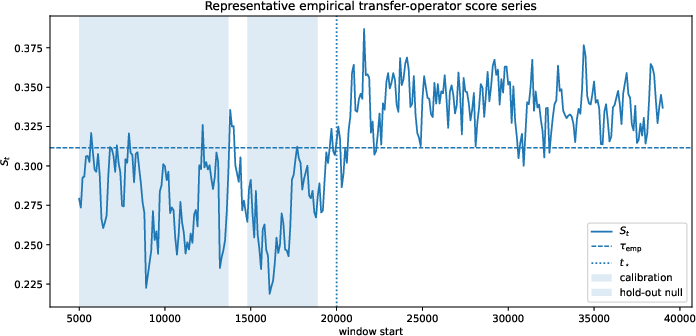
Figure 1: Representative score series AN5 for an instance of the noisy beta-map change-point experiment, including empirical threshold and change point.
Theoretical Guarantees and Error Decomposition
The paper provides explicit non-asymptotic deviation bounds for the empirical approximation. The main finite-sample bound for the embedded empirical stationary density AN6 is:
AN7
with high probability. Here, AN8 is the empirical concentration error, AN9 is the regularization bias, [0,1]0 is the partition approximation error (with partition mesh [0,1]1), and [0,1]2 quantifies noise-induced bias. This separation provides practitioner guidance for calibrating error sources in applied settings. Finite-sample false-alarm and power guarantees are provided: if the true change in invariant density exceeds twice the estimation error, detection probability rapidly approaches one.
Detection and Calibration Protocol
Thresholds are determined either via the derived theoretical guarantee (requiring knowledge of constants that may be inaccessible in practice) or, more commonly, by empirical quantiles on calibration windows from the no-change regime:
[0,1]3
Windows with [0,1]4 are flagged as anomalous. This supports practical deployment in empirical studies.
Experimental Validation
Comprehensive synthetic experiments are conducted using noisy [0,1]5-maps, with regime shifts corresponding to parameter changes in the underlying map. The experiments quantify both pointwise and family-wise error rates, as well as true positive rates and detection delays, under multiple choices for bin counts ([0,1]6), window sizes, regularization levels, and baseline lengths.
Strong numerical results are reported:
True-positive rate (TPR):[0,1]7 across 100 replications in the alternative regime.
Mean detection delay:[0,1]8 time steps post-change.
Pointwise false-alarm rate (FAR):[0,1]9 under the null regime.
Family-wise error rate (FWER):N0 under the null regime.
These results confirm that the statistic N1 is highly effective for detecting changes in stationary behavior, with empirically controlled false-alarm rates under reasonable settings.
Parameter sweeps demonstrate critical bias-variance tradeoffs: increasing the number of bins N2 beyond data-supported regimes degrades detection performance due to sparse transitions, while lengthening windows improves TPR but may delay localization. The method is robust to the regularization parameter N3 within several orders of magnitude, and baseline length N4 may be safely tuned in line with available data.
Discussion and Theoretical Implications
The empirical transfer-operator framework aligns naturally with the spectral approach to statistical stability in dynamical and stochastic systems. The detection method is theoretically justified via a combination of Markov-chain concentration, operator perturbation (in the sense of Keller–Liverani), and classical regularization/stability analysis. Notably, the approach accurately separates error sources, enabling high-confidence, finite-sample certificates.
A fundamental limitation, which the authors make explicit, is that the procedure detects only those changes in dynamics which alter the invariant density; transition-mechanism changes that preserve the stationary law are not detectable via N5 alone. For comprehensive transition change detection, the authors advocate monitoring statistics that directly compare transition matrices (e.g., via Frobenius or max-norm), though finite-sample analysis for these alternatives is left for future work.
Practical Implications and Future Directions
For practical applications in settings where a reliable baseline window exists and regime changes correspond to shifts in stationary behavior (e.g., control, monitoring, climate regimes, finance), this methodology offers a well-founded, easily implementable detector with explicit finite-sample guarantees. The general framework is extensible: similar empirical transfer-operator strategies could be pursued for higher-dimensional state spaces using adaptive or non-uniform partitions, though the computational and statistical challenges need to be addressed.
Important theoretical extensions include:
Derivation of finite-sample guarantees for operator-norm-based transition-mechanism detectors.
Family-wise error correction for multiple-window scanning, e.g. via maxima of anomaly scores.
Adaptation to non-stationary and non-ergodic settings.
Validation on real-world data with external benchmarks for detected change points.
Conclusion
This work establishes a principled, operator-theoretic foundation for finite-sample change detection in noisy, one-dimensional dynamical systems. By building on empirical approximations of transfer operators and their invariant densities, the method provides both theoretical and practical guarantees for detecting changes in stationary behavior. The clear separation of error sources informs data-driven parameter selection. Extensive synthetic experiments affirm the method's utility, while the explicit identification of methodological boundaries and open problems paves the way for further extensions in statistical change detection.
“Emergent Mind helps me see which AI papers have caught fire online.”
Philip
Creator, AI Explained on YouTube
Sign up for free to explore the frontiers of research
Discover trending papers, chat with arXiv, and track the latest research shaping the future of science and technology.Discover trending papers, chat with arXiv, and more.