Bures geodesics for non-faithful states and quantum speed limit
Published 4 Jun 2026 in quant-ph | (2606.06759v1)
Abstract: The quantum speed limit establishes a bound on the minimal time required for a quantum system to evolve from a given initial state to a final state. When the mean energy variance is fixed this limitation is captured by the Mandelstam--Tamm bound. The fastest quantum evolution saturating this bound follows a geodesic arc connecting the two states. Such geodesics in the manifold of quantum states are explicitly known when the states are pure (Fubini-Study geodesics) and when they are mixed and given by faithful density matrices (Bures geodesics). In this article we obtain the explicit form of the Bures geodesic arcs joining two non-faithful density matrices, which may have different ranks. For pure states one recovers the Fubini-Study geodesics. A necessary and sufficient condition for the uniqueness of the shortest geodesic arc is given. When the condition is not fulfilled there are infinitely many such arcs, all having length equal to the arccos Bures distance between the two states, in analogy with the arcs of great circles connecting the two poles of a sphere. We discuss the implications of our results for the quantum speed limit.
The paper provides an explicit construction of Bures geodesics between non-faithful quantum states, addressing the open problem of connecting density matrices of different ranks.
It introduces a regularization approach and detailed classification of support and kernel intersections to determine the uniqueness of minimal geodesic paths.
The findings impact quantum speed limits, control protocols, and metrology by elucidating optimal quantum state evolutions under rank-deficient conditions.
Bures Geodesics for Non-Faithful States and Quantum Speed Limit
Introduction and Context
The geometry of quantum state space, particularly the structure of geodesics under monotone Riemannian metrics like the Bures metric (identical to the quantum Fisher information metric for full-rank states), has wide-reaching implications for quantum information theory, quantum thermodynamics, and quantum control. Of specific operational importance is the quantum speed limit (QSL), which constrains the minimal time required for a quantum system to evolve between two states under physical constraints such as fixed average energy variance. For pure states, geodesic arcs in the projective Hilbert space, called Fubini–Study geodesics, are known to saturate the Mandelstam–Tamm bound. For mixed states with full rank (faithful states), Bures geodesics are known. However, until now, the structure of Bures geodesics connecting two non-faithful (non-full-rank) mixed states—potentially of different ranks—had remained an open problem.
This paper gives an explicit construction of Bures geodesic arcs connecting arbitrary non-faithful density matrices, delivers a criterion for the uniqueness of the shortest geodesic, and classifies the regimes leading to non-uniqueness with a complete set of geodesic arcs, solidifying the connection between geometry and attainable quantum dynamics.
Bures Geodesics: Faithful and Non-Faithful Cases
In the manifold of quantum states, the Bures distance between ρ and σ is defined as
dB(ρ,σ)=arccosF(ρ,σ)
where F(ρ,σ) is the quantum fidelity. For full-rank (faithful) states, the unique (up to time reversal) Bures geodesic is given explicitly via Uhlmann's parallel transport, and its realization is enabled via a fiber-bundle construction relating purifications of mixed states and the Hilbert space geometry.
When either or both endpoints are non-faithful, the structure is more complex. Notably, the support and kernel subspaces of the density matrices stratify the manifold and dramatically affect the possible paths. For pure states, Fubini–Study geodesics are recovered; for orthogonal pure states or states with orthogonal supports, the set of shortest arcs is infinite in analogy to great circle connections on a sphere between antipodal points.
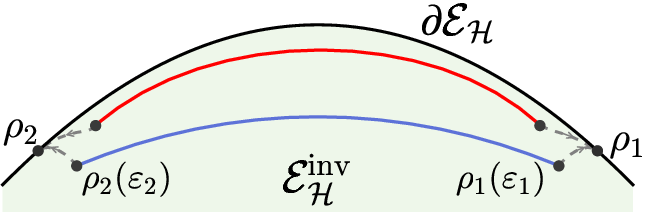
Figure 1: Geodesic arcs (solid lines) connecting perturbed versions of non-faithful states via regularization, with the limiting paths converging to the Bures geodesics between non-faithful states. Dashed lines depict the regularization paths.
Regularization Approach for Boundary Geodesics
A central technical development is the regularization approach: non-faithful states ρ1, ρ2 are approximated by faithful (full-rank) states ρ1(ε1),ρ2(ε2), their Bures geodesic arc is constructed, and the limit ε1,2→0 is taken. This process is highly nontrivial because the polar decomposition defining the path becomes non-unique on the boundary, and the limiting path can depend on how the regularization is performed.
The structure of the limiting geodesics crucially depends on the relative geometry of the supports and kernels of ρ1 and ρ2:
Uniqueness Criterion: There exists a unique shortest Bures geodesic arc if and only if σ0 or σ1.
Non-Unique Case: When both intersections are nontrivial, there is a continuous family (infinitely many) of shortest arcs, all of the same (minimal) Bures length.
The explicit form of the geodesics follows from detailed analysis of the limiting behavior of the polar decomposition and spectral perturbation theory. The family of geodesics in the non-unique case is parameterized by contractions between support subspaces associated with the degenerate components.
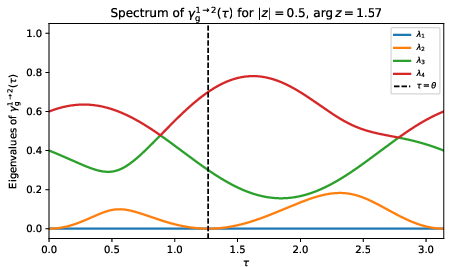
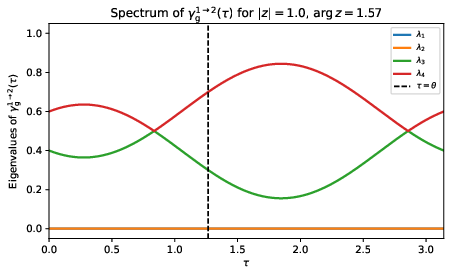
Figure 2: Spectrum of a Bures geodesic connecting two states, highlighting changes in rank along the path corresponding to boundary transits.
Subspace Restriction and Classification
A second method exploits the fact that any geodesic arc must have support contained in the span of the supports of the endpoints, and the structure of geodesics can thus be analyzed within lower-dimensional subspaces. The paper provides a comprehensive classification for low-dimensional systems (qubit, qutrit, and two-qubit), mapping out when uniqueness holds, the possible ranks of geodesics, and the set of all possible minimal-length arcs. The case studies, including the non-uniqueness for rank-deficient qutrit and two-qubit states even when kernels are non-orthogonal, demonstrate the subtlety of the general conditions.
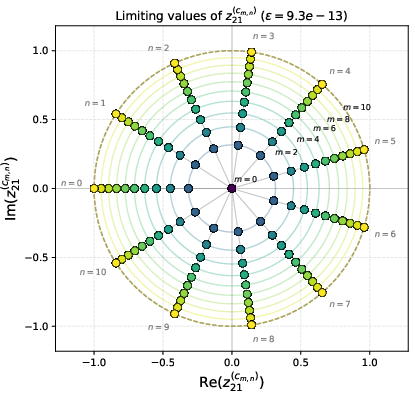
Figure 3: Complex-plane representation of the family of possible contraction parameters σ2, demonstrating the filling of the unit disk and illustrating the non-uniqueness of geodesics for certain pairs of non-faithful states.
Implications for Quantum Speed Limit
The structure of Bures geodesics underpins the geometric approach to quantum speed limits: the minimal-time evolution between two quantum states under a constraint on energy variance is achieved along geodesic arcs. The presence of multiple geodesics of equal minimal length in the non-unique case implies a corresponding multiplicity of fastest possible evolutions between fixed quantum states, which could be operationally significant for quantum protocols that exploit or must tolerate rank changes or degeneracy in the state. For pure states, uniqueness or non-uniqueness corresponds, respectively, to whether the states are non-orthogonal or orthogonal. However, for higher-rank mixed states, non-uniqueness can arise even in the absence of strict orthogonality, highlighting a richer structure than in the purely projective (pure-state) case.
Broader Theoretical and Practical Implications
The results of this paper extend fundamental understanding in several ways:
Geometry of State Space: By resolving the structure of Bures (and by extension, quantum Fisher information) geodesics between arbitrary, possibly rank-deficient, quantum states, the work fills a key gap in quantum information geometry, especially in understanding the stratified manifold formed by the union of state spaces of different ranks.
Quantum Control and Metrology: The geodesics constructed provide optimal paths for quantum metrology under ancilla constraints and for quantum control protocols where rank changes or partial support over a Hilbert space are exploited or encountered.
Algorithmic and Experimental Design: The explicit criteria and constructions can inform algorithmic search strategies for time-optimal quantum gates and paths, and offer guidance for interpreting and designing experiments where absolute purity or full rank is unattainable, as is common in quantum technology platforms.
Looking forward, this understanding points toward a more complete geometric characterization of quantum dynamics, robustness of control paths under degeneracy, and refined resource accounting that properly includes constraints on state purity and support.
Conclusion
This work establishes the explicit structure and uniqueness conditions for Bures geodesics between arbitrary quantum states, including all cases of rank deficiency. The results generalize both the Fubini–Study pure-state case and the previously understood full-rank mixed-state case, establishing a direct geometric route to the quantum speed limit for all quantum state transformations.
The uniqueness of the time-optimal path is governed not by spectral or commutativity properties, but by the intersection geometry of support and kernel subspaces. When uniqueness fails, there arises a family of equal-length, minimal-time geodesics, providing operational flexibility in quantum evolution.
These findings will impact future developments in quantum thermodynamic resource theories, high-precision control for quantum computation, and foundational geometric approaches to quantum information. The connection to information geometry suggests avenues for further work in distinguishing statistics, optimal measurements, and generalized quantum state manifolds.
“Emergent Mind helps me see which AI papers have caught fire online.”
Philip
Creator, AI Explained on YouTube
Sign up for free to explore the frontiers of research
Discover trending papers, chat with arXiv, and track the latest research shaping the future of science and technology.Discover trending papers, chat with arXiv, and more.