- The paper demonstrates that UV irradiation nearly doubles the imaginary refractive index in CH4-rich haze analogs, markedly increasing mid-IR opacity.
- The paper employs a controlled laboratory setup with FTIR spectroscopy and Kramers-Kronig analysis to derive robust optical constants for water-rich exoplanet hazes.
- The paper uses synthetic transmission spectra for planets like GJ 1214b, showing that increased haze opacity from UV exposure mutes spectral features and underscores the need for dynamic haze models.
Ultraviolet-Driven Modulation of Water-Dominated Exoplanet Haze Optical Properties
Introduction
The opacity and composition of sub-Neptune and terrestrial exoplanet atmospheres orbiting M-dwarf stars are strongly influenced by photochemical hazes, which profoundly affect observational interpretation and retrieval of atmospheric properties. In "Ultraviolet Radiation Effects on the Optical Properties of Water-Dominated Exoplanet Hazes" (2606.06691), Huseby et al. rigorously explore the impact of UV irradiation — mimicking stellar flare conditions — on laboratory analogs of water-rich exoplanetary hazes. This work directly addresses the paucity of experimentally derived, compositionally realistic optical constants for exoplanetary aerosols, especially those applicable to planets receiving high UV flux.
Experimental Design and Methodology
A core component of the study is the realistic synthesis of haze analogs under controlled compositions, motivated by equilibrium chemistry for 1000× solar metallicity, representative of water-rich sub-Neptune exoplanets. Two distinct haze chemistries were investigated, with the minor carbon source being either CH4 or CO. Particle formation used a custom PHAZER setup employing AC glow discharge in gas mixtures, with thin films deposited on MgF2 substrates. The samples were transferred and subjected to sequential UV irradiation at 228 nm and 350 nm, each simulating typical flare peaks. The irradiation and spectroscopy procedures were explicitly isolated from terrestrial contaminants through strict environmental controls.
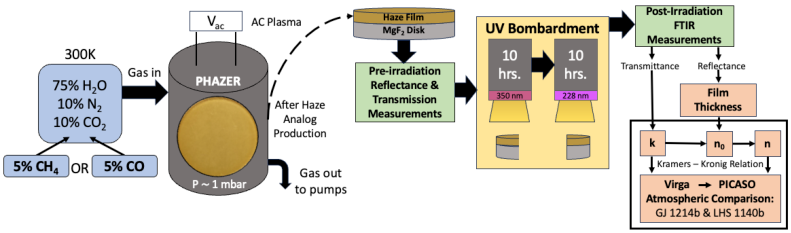
Figure 2: Schematic of the full experimental procedure, from atmospheric simulation and thin-film generation to UV irradiation and post-irradiation optical analysis.
Transmission and reflectance spectra were recorded across $0.5$–$8$ μm (24000–1250 cm−1) via FTIR spectrometry. The derivation of real and imaginary refractive indices (n, k) leveraged Kramers-Kronig transformations, with careful correction for thin film thickness and sample roughness. The post-processing, including error propagation, follows robust protocols established in prior laboratory haze studies.
Optical Constants: Variability Induced by UV and Composition
A primary result is that UV irradiation induces marked alterations in the optical constants of CH4-dominated haze analogs, but has a markedly smaller effect on CO-driven samples. For the CH4-haze, the imaginary refractive index 20 in the 21 22m region nearly doubles post-irradiation (from 23 to 24), consistent with the formation of more oxygen-rich bonds and/or UV-driven molecular rearrangements. The CO-sourced haze remained largely invariant under similar irradiation, with only minor variations in the 25 spectrum at longer wavelengths, attributed to organic oxygen functionalities.
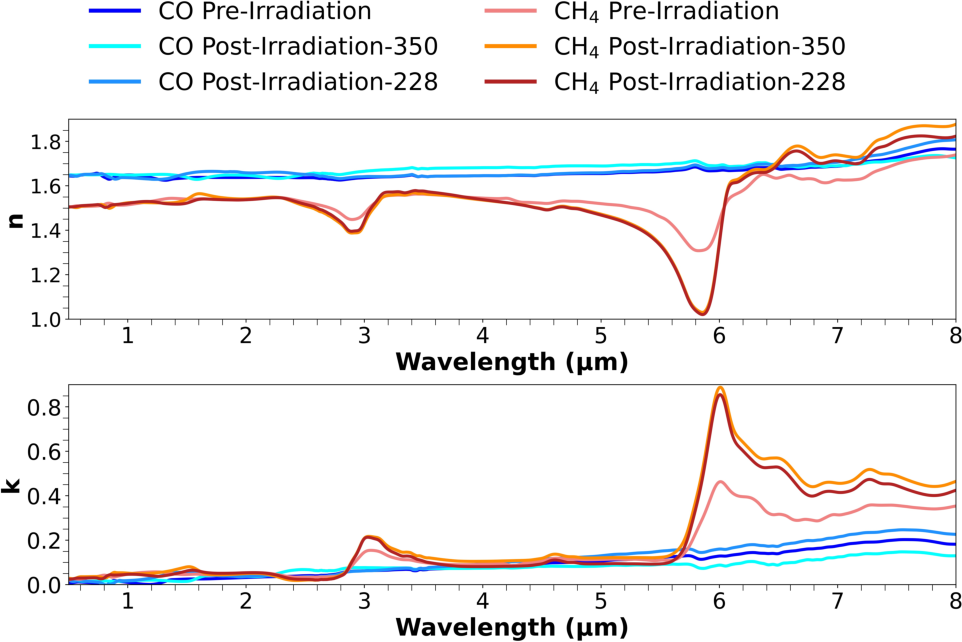
Figure 1: Derived 26 and 27 values for both haze chemistries before and after UV irradiation, delineating large compositional and irradiation-induced differences.
Comparison to legacy haze optical constants (including Titan analogs and early Earth conditions) demonstrates that the new water-world analogs occupy a distinct region of optical parameter space, especially in their post-irradiation state. Oxygen-rich and CH28-rich hazes separated by the 29–$0.5$0 spectra emphasize the crucial importance of accurate laboratory constraints rather than reliance on solar system analogs for exoplanet retrievals.
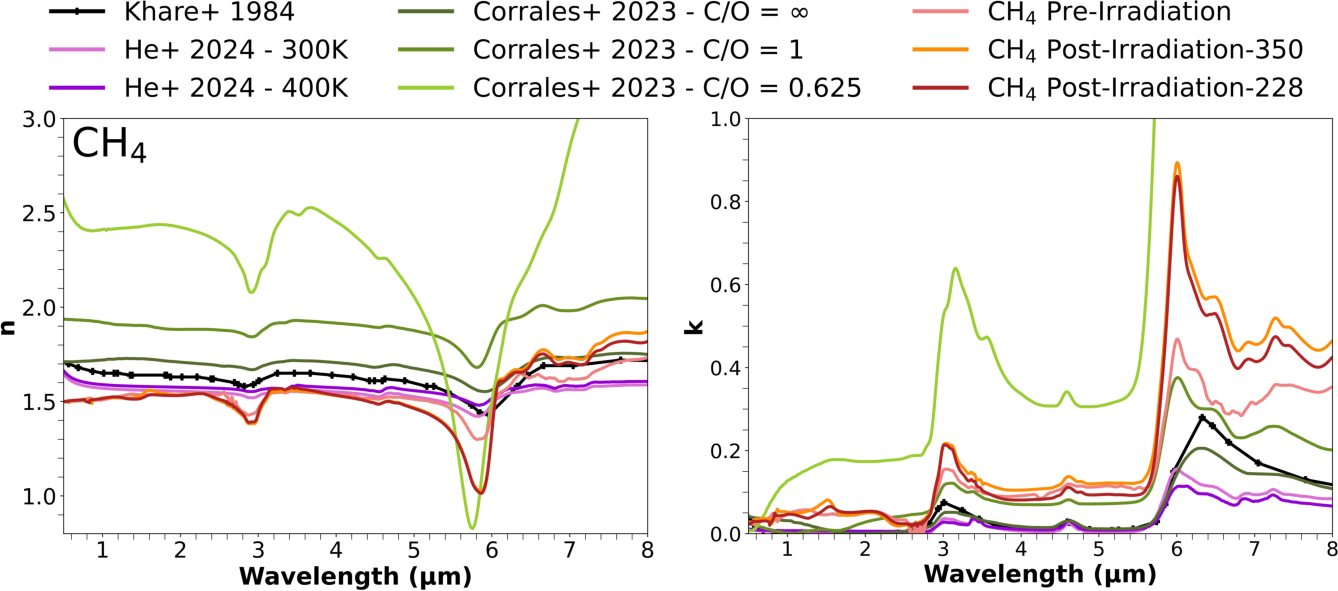
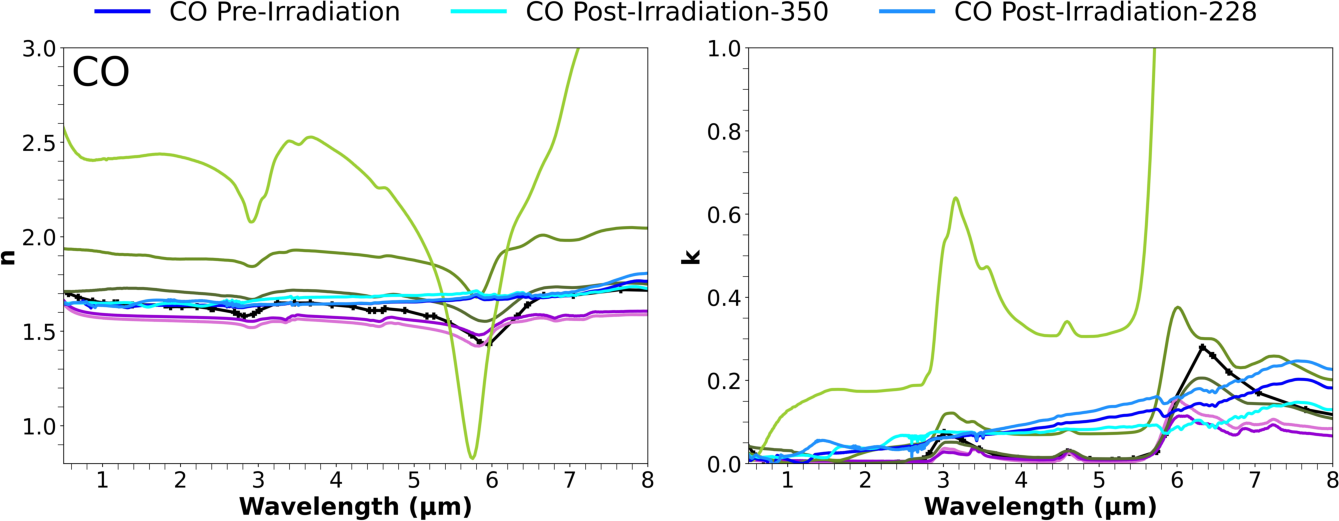
Figure 3: Comparison of the laboratory-derived optical constants to those from previous studies, highlighting compositional sensitivity and the distinctiveness of water-dominated analogs.
Implications for Transmission Spectra: GJ 1214b and LHS 1140b
The Virga and PICASO radiative transfer frameworks were employed to compute exoplanet transmission spectra by incorporating these newly derived haze optical constants. Two water-dominated exoplanets, GJ 1214b and LHS 1140b, serve as atmospheric testbeds. The impact of irradiated versus non-irradiated haze analogs was directly quantified in the synthetic spectra.
For GJ 1214b, CH$0.5$1-haze models yield almost entirely muted spectra when haze number density is fixed, but a key result is the pronounced difference at the N–H band at 2.6 $0.5$2m between pre- and post-irradiation states — an amplitude difference of $0.5$3100 ppm that lies at or above the sensitivity threshold of JWST NIRISS/SOSS and NIRCam. This spectral flattening is a direct consequence of increased $0.5$4 post-irradiation, leading to higher continuum opacity and masking of molecular features. Comparisons against the Khare (1984), Corrales (2023), and He (2023) optical properties underscore that previous analogs do not match the magnitude and structure of such UV-modulated, water-dominated haze absorption.
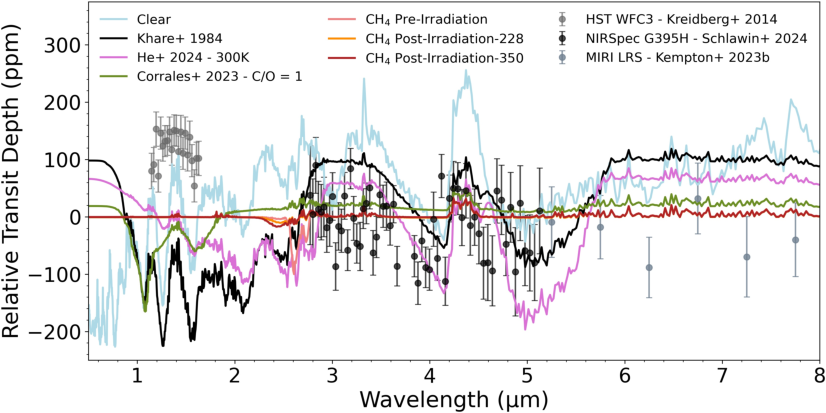
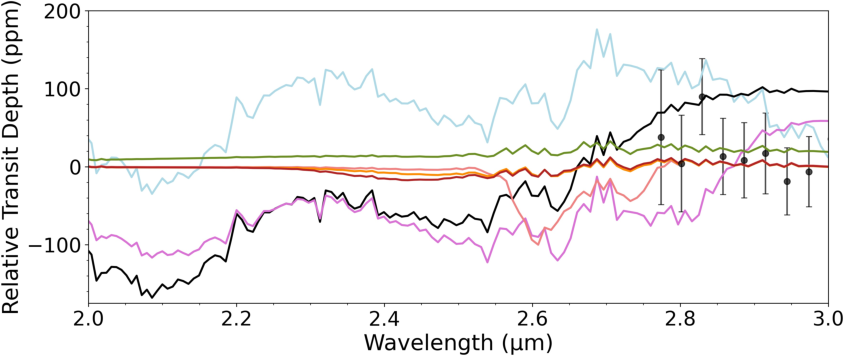
Figure 4: Simulated GJ 1214b transmission spectra with CH$0.5$5-haze, illustrating flattening and feature suppression post-irradiation.
CO-driven haze models present even more featureless, high-opacity transmission spectra, dominated by the intrinsic optical dullness of the haze. Differences in model spectra before and after irradiation are at the $0.5$615 ppm level, beneath current instrumental sensitivity.
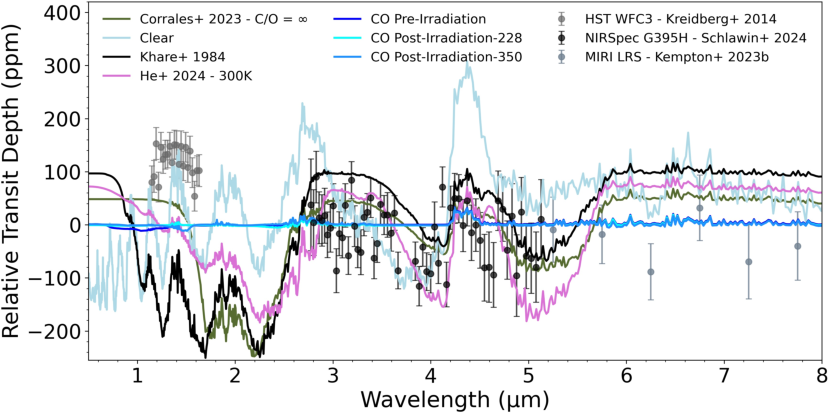
Figure 5: GJ 1214b transmission spectra with CO-haze, showing minimal observable effect of irradiation.
For LHS 1140b, which has a lower scale height, the differences between optical constant models fall well below near-term detection thresholds — typically $0.5$750 ppm, with muted features across the covered range.
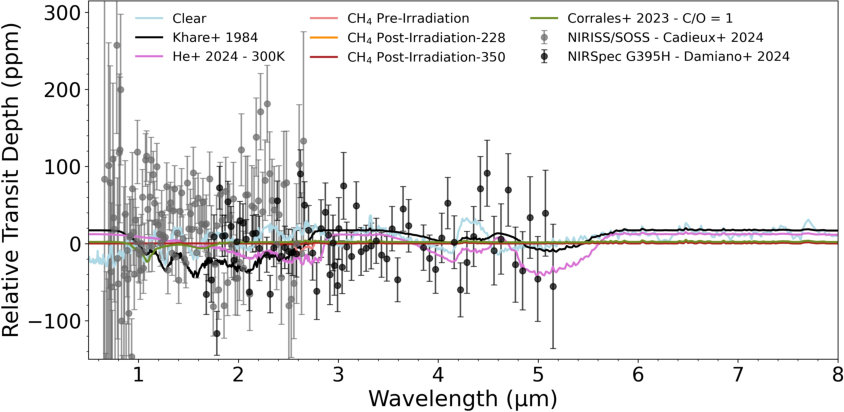
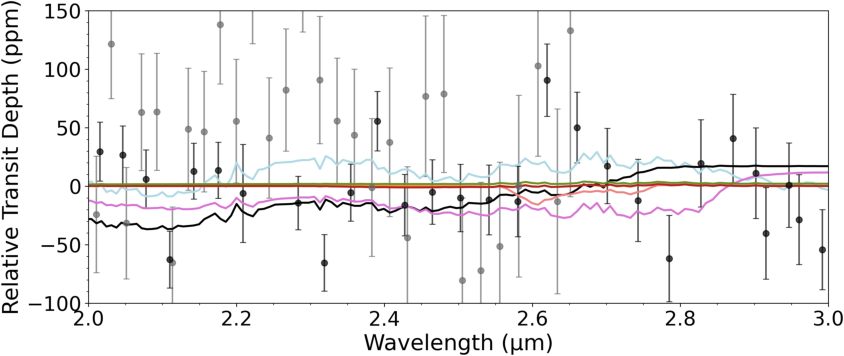
Figure 6: LHS 1140b synthetic spectra with CH$0.5$8-haze, showing the tight suppression of distinguishing features and the limited impact of irradiation.
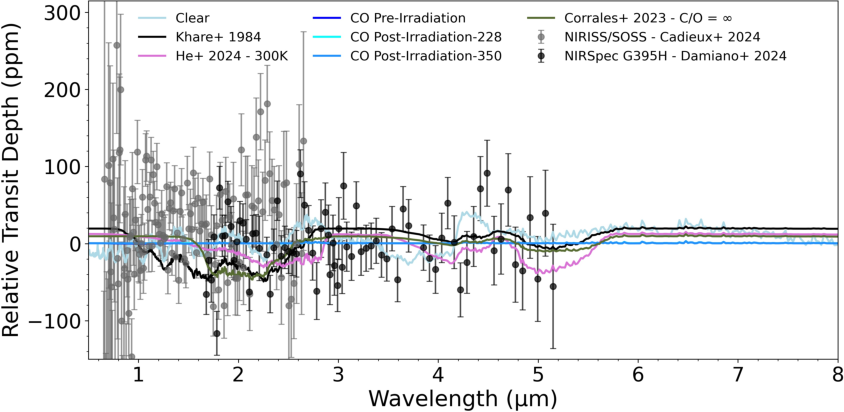
Figure 7: LHS 1140b spectra with CO-haze, confirming the trend of extreme spectral muting and low irradiation responsiveness.
Theoretical and Observational Implications
This work robustly demonstrates that the use of non-representative haze refractive indices can induce substantial errors in inferred atmospheric abundances, thermal profiles, and even atmospheric retrieval degeneracy with current and next-generation exoplanet characterization instruments. The strong $0.5$9 enhancement and spectral feature damping observed under high UV irradiation suggest that temporally variable stellar activity could produce measurable time-dependent changes in exoplanet spectra, though the effect size is highly composition-dependent. Notably, the recognition that only certain compositional regimes (notably CH$8$0-rich hazes) produce observable irradiation signatures demands that haze chemistry be considered a dynamic, temporally-evolving parameter in exoplanet atmosphere models.
The nearly flat spectra created by both haze types set hard upper limits on the opacity of water-rich exoplanet atmospheres — relevant for JWST and later ELT-scale transmission studies — and challenge retrievers to consider haze microphysics and photochemical aging explicitly rather than treat haze parameters as static.
Conclusion
This study establishes, through precise laboratory analog measurements and rigorous spectral modeling, that UV irradiation substantially increases the opacity of CH$8$1-rich, water-dominated exoplanet hazes over $8$2–$8$3 $8$4m, with a doubling of $8$5 in key mid-IR bands. Such changes yield distinct, potentially observable shifts in transmission spectra (notably at 2.6 $8$6m) for sufficiently extended atmospheres, while thermochemically distinct hazes (CO-rich) are relatively inert to stellar flare-like irradiation. These findings necessitate next-generation atmospheric retrieval frameworks that integrate time-dependent haze microphysics and utilize compositionally- and environmentally-realistic optical constants for accurate exoplanet atmospheric diagnostics.
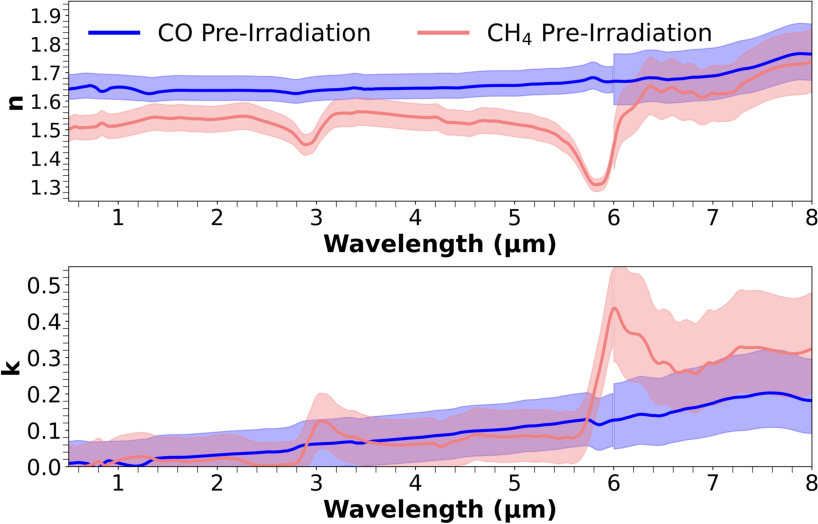
Figure 8: Propagated uncertainties in $8$7 and $8$8 values, supporting the robustness of the observed irradiation-induced trends.
The practical implication is that exoplanet atmosphere interpretation—especially for sub-Neptunes and super-Earths orbiting flare-active M-dwarfs—requires direct laboratory haze characterization in relevant compositional and irradiation regimes. Future developments should integrate haze microphysics, radiative–convective coupling, and photochemical evolution into retrieval pipelines, potentially enabling time-resolved atmospheric characterization sensitive to both haze aging and flare history.