- The paper introduces a closed-loop architecture that combines an anchor-chaining diffusion planner with an online multi-tree orchestrator to construct long-horizon routes from short-horizon data.
- It uses temporal distance estimates and uncertainty-aware ranking for selective bridge construction, achieving near-perfect success rates on standardized navigation benchmarks.
- The method outperforms previous diffusion-based planners by up to 34.5 percentage points in giant-stitch tasks while maintaining computational efficiency.
ChronoForest: Closed-Loop Multi-Tree Diffusion Planning for Long-Horizon Offline Routing
ChronoForest addresses long-horizon route planning under a highly constrained offline setting where only short-horizon trajectory data is available and where agents must compose efficient long-range routes covering designated goals and waypoints. Unlike classical path planning and mTSP solutions that assume a priori knowledge of pairwise traversal costs or explicit roadmaps, ChronoForest targets the compositional regime where such route costs are entirely unavailable at planning time and must be progressively estimated online. The problem structure is formally equivalent to a navigation-coupled mTSP with distinct start/goal anchors and shared waypoint coverage constraints, but the challenge is compounded by the necessity to jointly resolve local bridge feasibility and global waypoint assignment from incrementally gathered evidence.
This setting induces a two-level coupling:
- At the microscopic level, the challenge is to efficiently construct short, feasible "bridges" between anchor pairs, trading off search cost and segment quality.
- At the macroscopic level, the route optimizer must infer globally efficient waypoint permutations despite unreliable long-range cost priors.
ChronoForest System Architecture
ChronoForest's core principle is the closed-loop coupling between a low-level anchor-chaining tree diffusion planner (for local bridge construction) and a high-level online multi-tree orchestrator (for route re-solving and budget allocation).
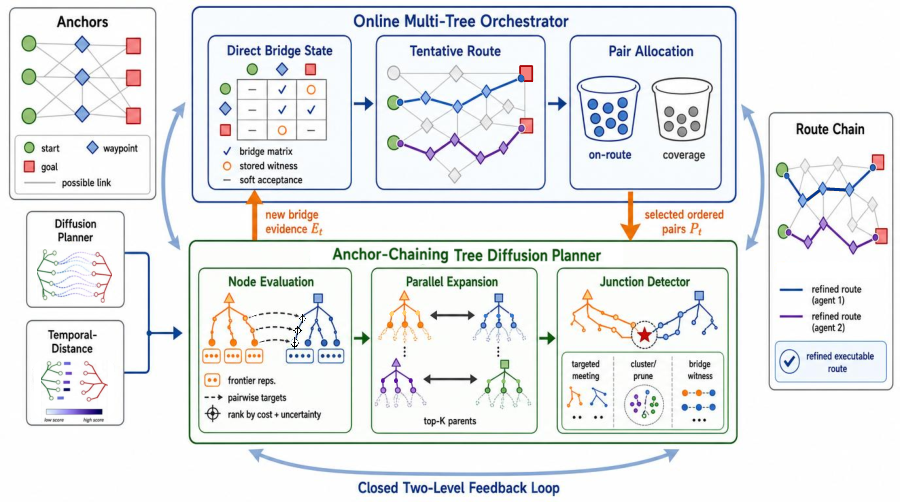
Figure 1: Closed-loop interaction between the Anchor-chaining tree diffusion planner and the Online multi-tree orchestrator, featuring temporal distance for bridge guidance and route re-solving based on bridge evidence.
Anchor-Chaining Tree Diffusion Planner
ChronoForest organizes planning as the expansion of multiple bidirectional search trees rooted at anchors (starts, waypoints, or goals). Each tree node encapsulates feasible prefixes and caches representative short-horizon trajectory segments generated via goal-conditioned diffusion. Node expansion and evaluation are guided by temporal-distance estimates—learned value functions predicting expected steps-to-goal—used for both node selection and target conditioning. To maintain efficiency and tractability:
- Only a limited number of candidate extensions are considered per planning round (“selective and parallel node expansion”).
- Node evaluation employs an uncertainty-aware, pair-conditioned ranking, incorporating both route cost estimates and the dispersion of stochastic lookahead samples.
- Clustering and pruning ensure compact reuse of promising trajectory segments and local multi-modality exposure.
Online Multi-Tree Orchestrator
At the route level, ChronoForest accumulates bridge evidence across anchor pairs and incrementally solves the joint mTSP route via repeated closure updates and combinatorial assignment. The orchestrator uses a direct-bridge matrix (storing current best evidence per unordered anchor pair) and its Floyd-Warshall closure to re-solve the tentative route. Allocation of planning budget is split between current route-critical pairs (those most marginal to the route objective) and a small off-route exploratory floor, ensuring global route correction and non-starvation of promising alternatives. Acceptance of bridge connections is managed via a revocable adjacency set with degree-compatibility checks, enabling robust completion detection.
Theoretical and Algorithmic Analysis
ChronoForest introduces a quantitative, envelope-based analysis of route estimation under incomplete pairwise cost knowledge:
- Bridge cost estimates are treated as upper bounds, justified by a calibration scheme with a conservative quadratic correction on temporal-distance predictions (see Figure 2).
- The route solver operates on the closure of the direct-bridge matrix, with theoretical guarantees on suboptimality scaling with the number of anchors and the worst-case coverage error.
- Exact recovery conditions are provided in terms of the minimal route margin and maximal cumulative error, parameterizing the required exploration depth to resolve ambiguity.
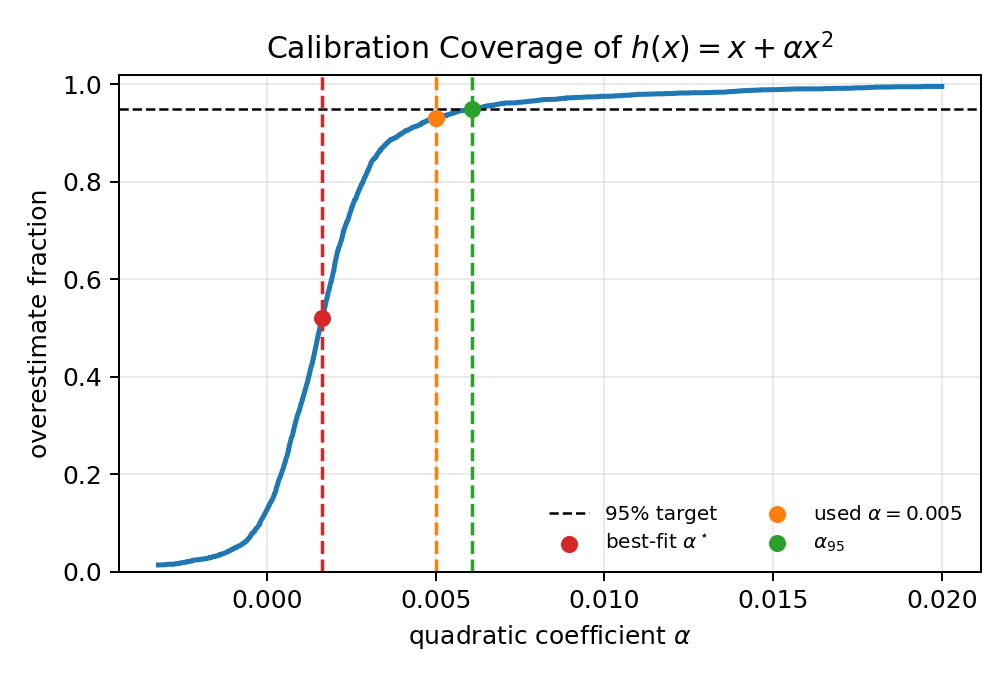
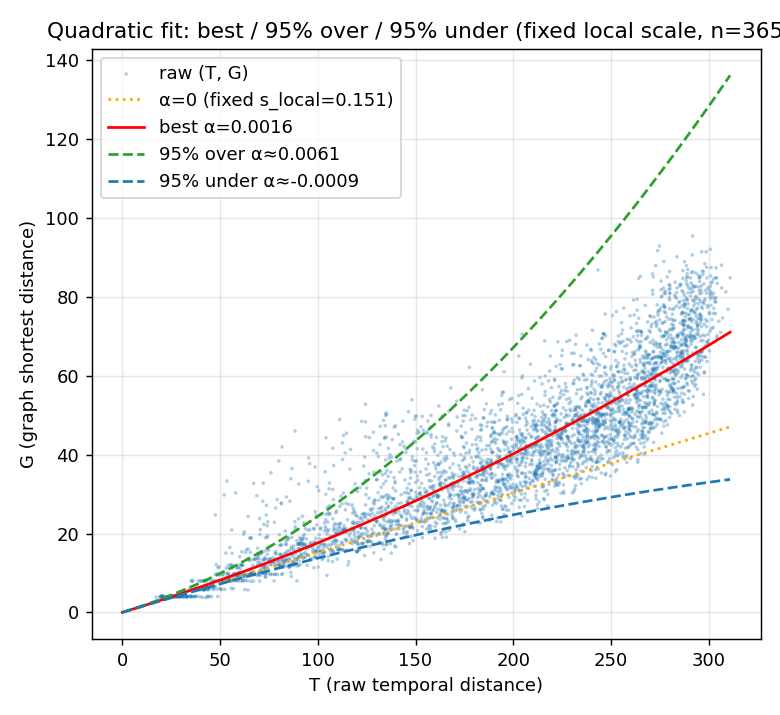
Figure 2: Quadratic temporal-distance calibration used to upper-bound bridge costs, supporting the correctness envelope for bridge acceptance.
This yields principled stopping criteria and route-certification thresholds, explicitly linking sample allocation strategy to the combinatorial route structure.
Empirical Evaluation
ChronoForest is extensively evaluated on the OGBench AntMaze-Stitch family, a standardized long-horizon offline navigation benchmark, on medium, large, and giant splits. The method achieves near-perfect success rates (99.8%, 99.3%, and 99.5%, respectively), improving giant-stitch success by up to 34.5 points over prior diffusion-based planners—a substantial margin over CompDiffuser, CDGS, and C-MCTD baselines. Critically, the gains are not due to brute-force search: balanced efficiency metrics (planning time, node expansions) demonstrate that ChronoForest reaches high-quality solutions without the computational penalty of exhaustive mTSP enumeration.
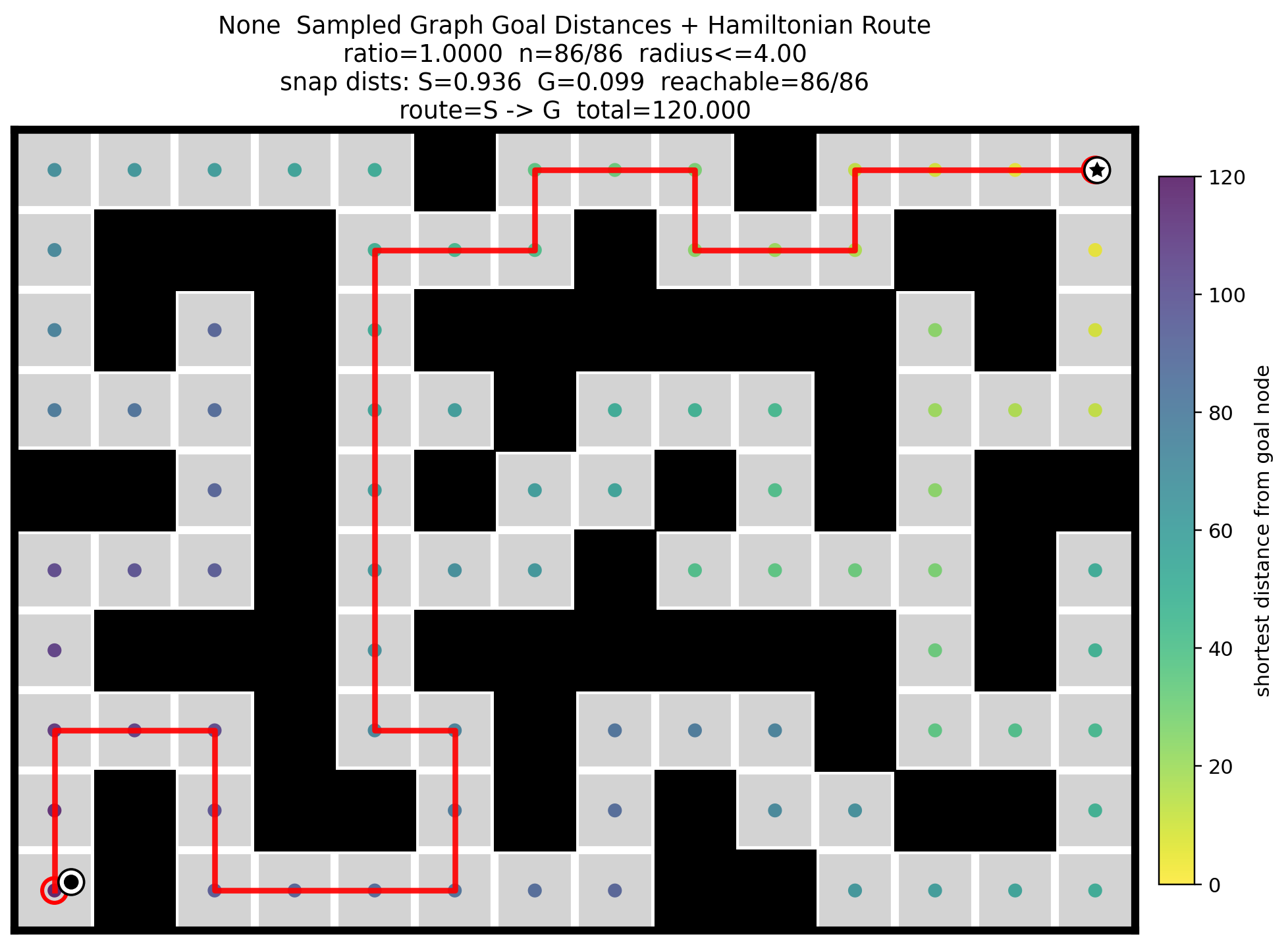
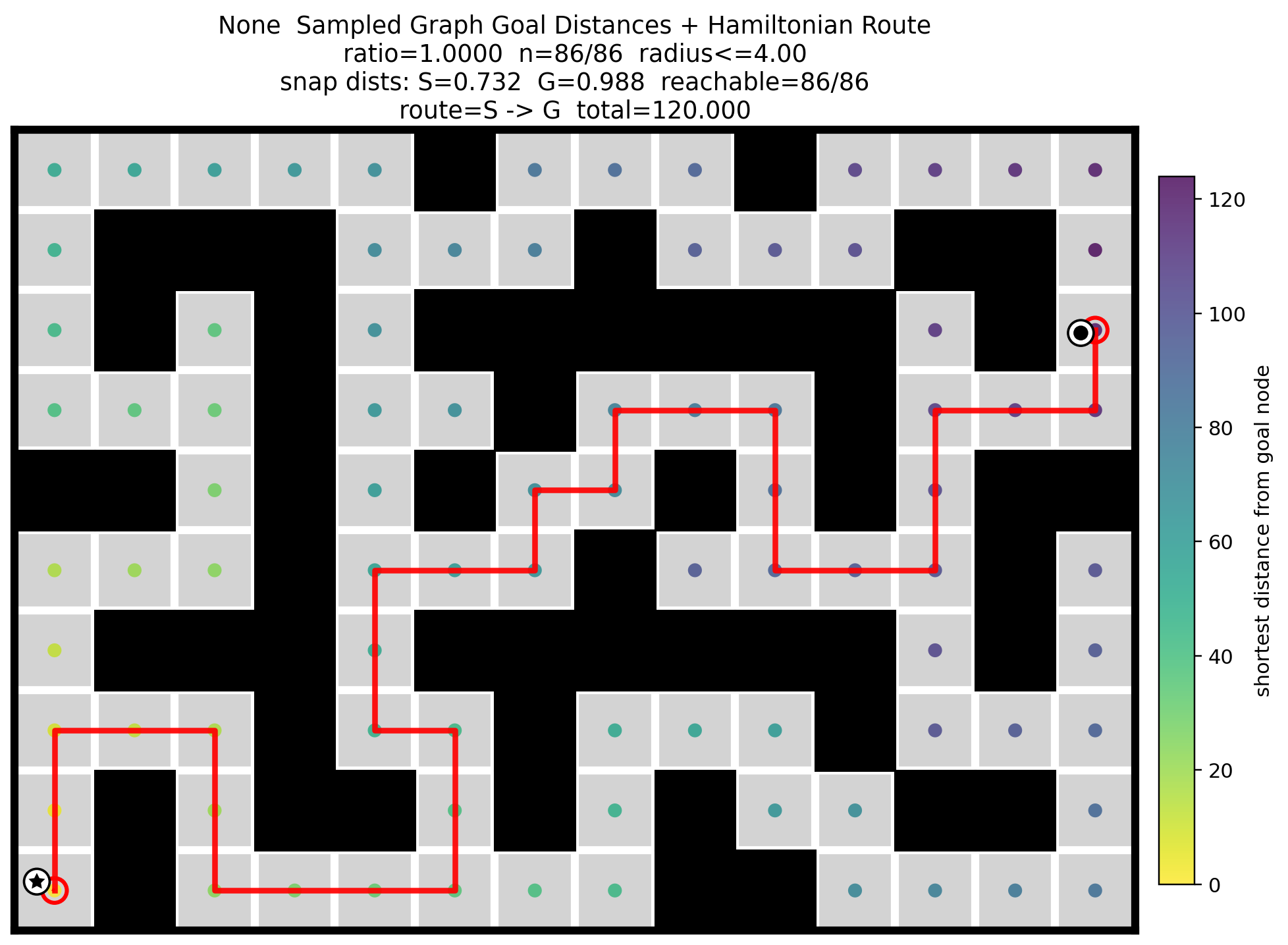
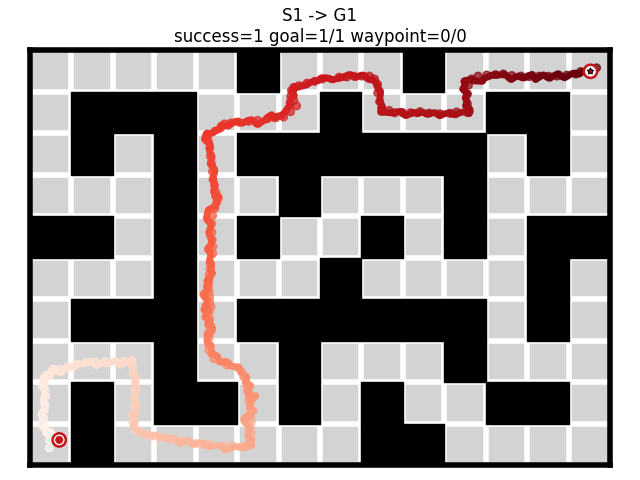
Figure 3: Qualitative route-length validation on antmaze-giant-stitch-v0, comparing BFS shortest paths with ChronoForest rollouts.
Route quality is further validated by reference to BFS shortest-path baselines, confirming that success gains are not masked by detours or suboptimal waypoint orderings. Explicit pairwise and waypoint-group analyses show that ChronoForest leverages online re-solving to actively correct poor temporal-distance induced permutations, approaching graph-optimal references both in single- and multi-agent scenarios.
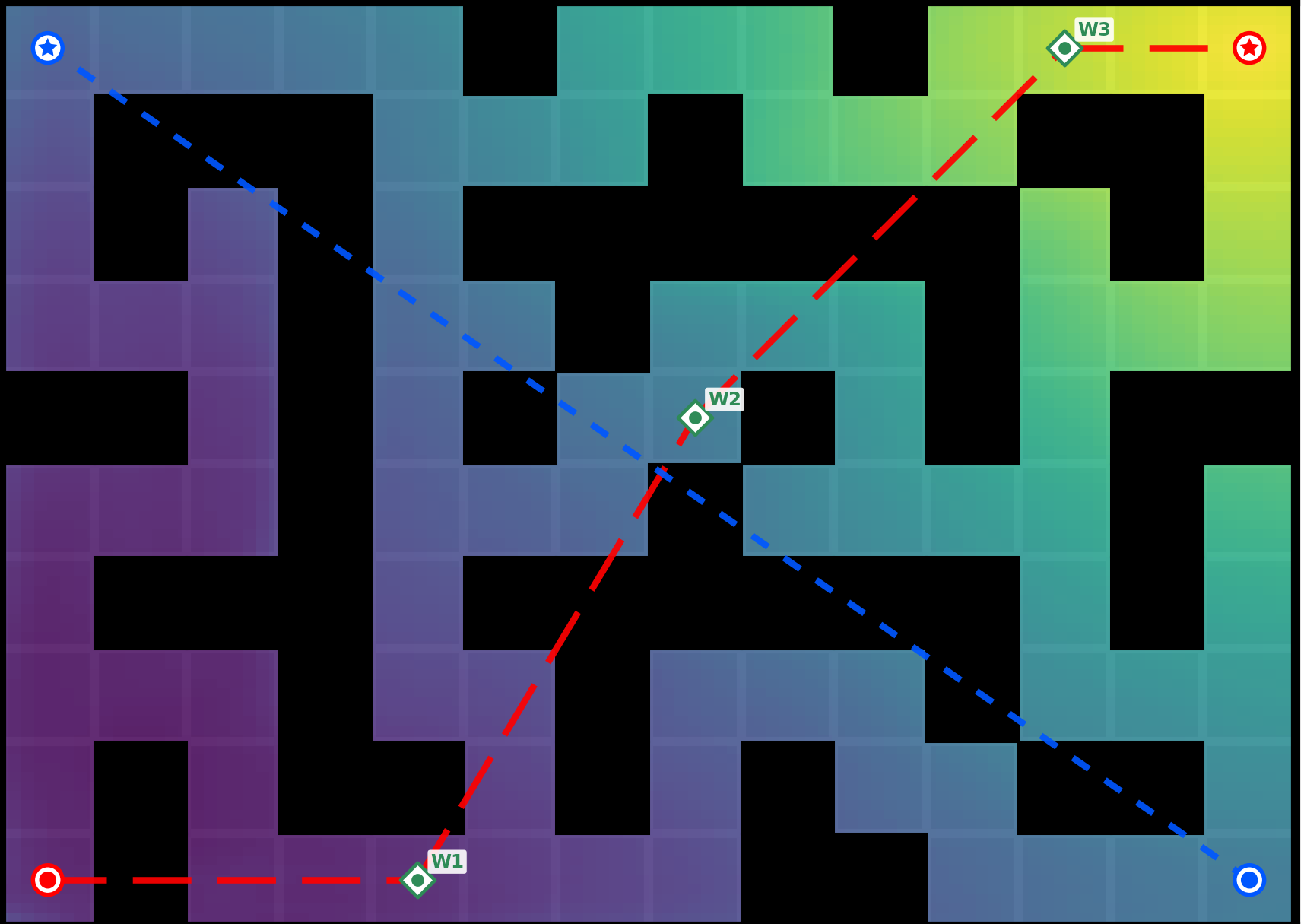
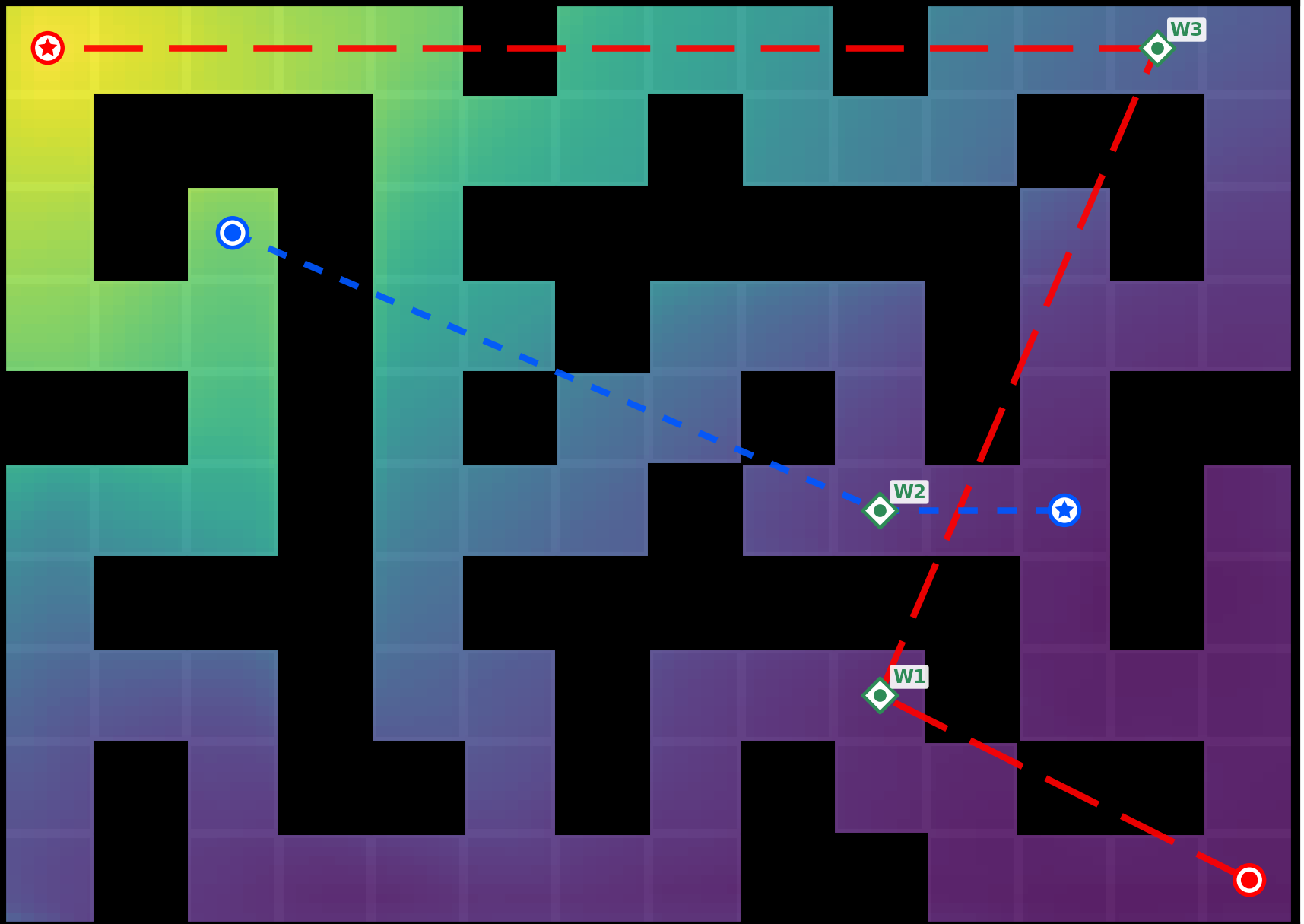
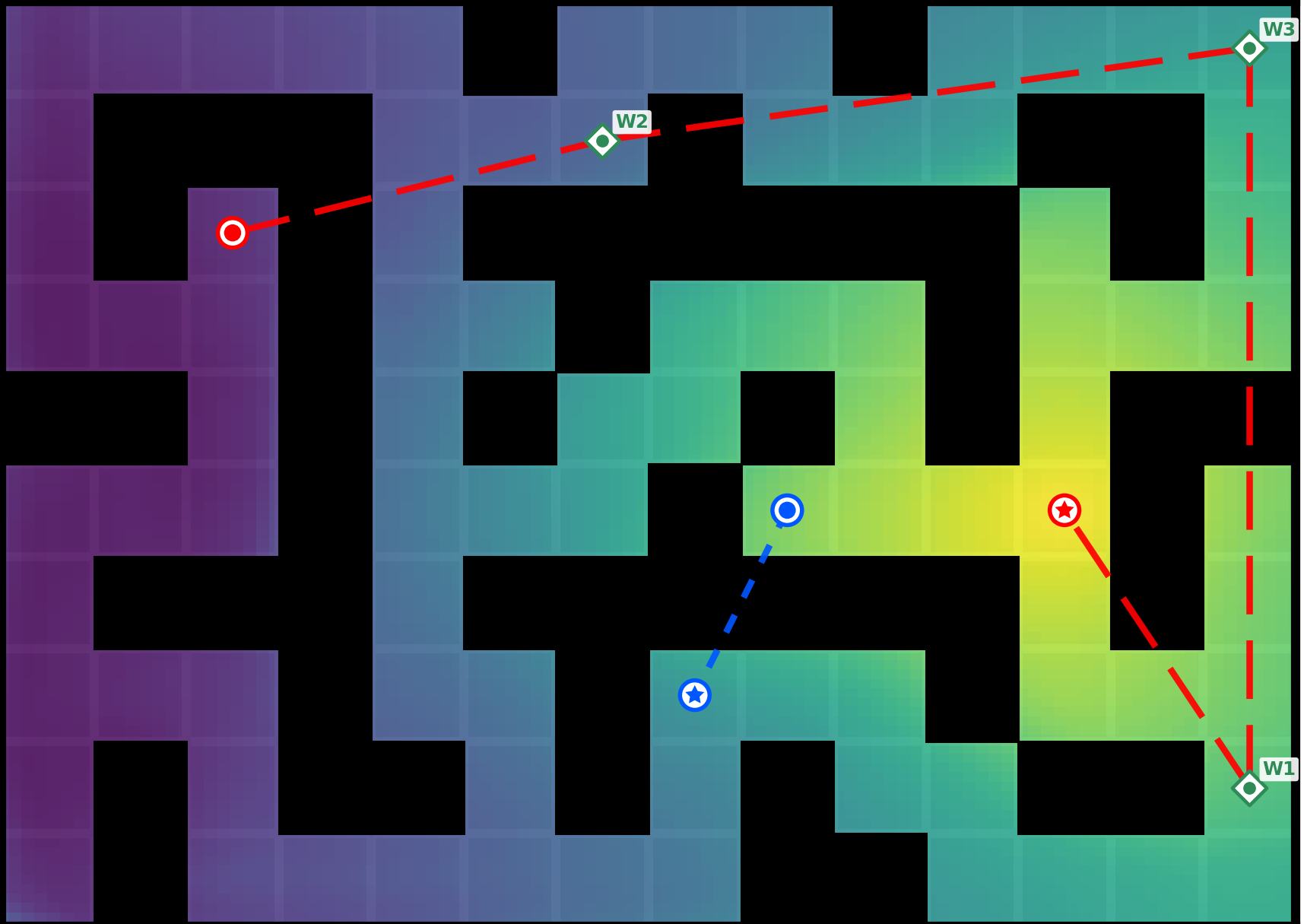
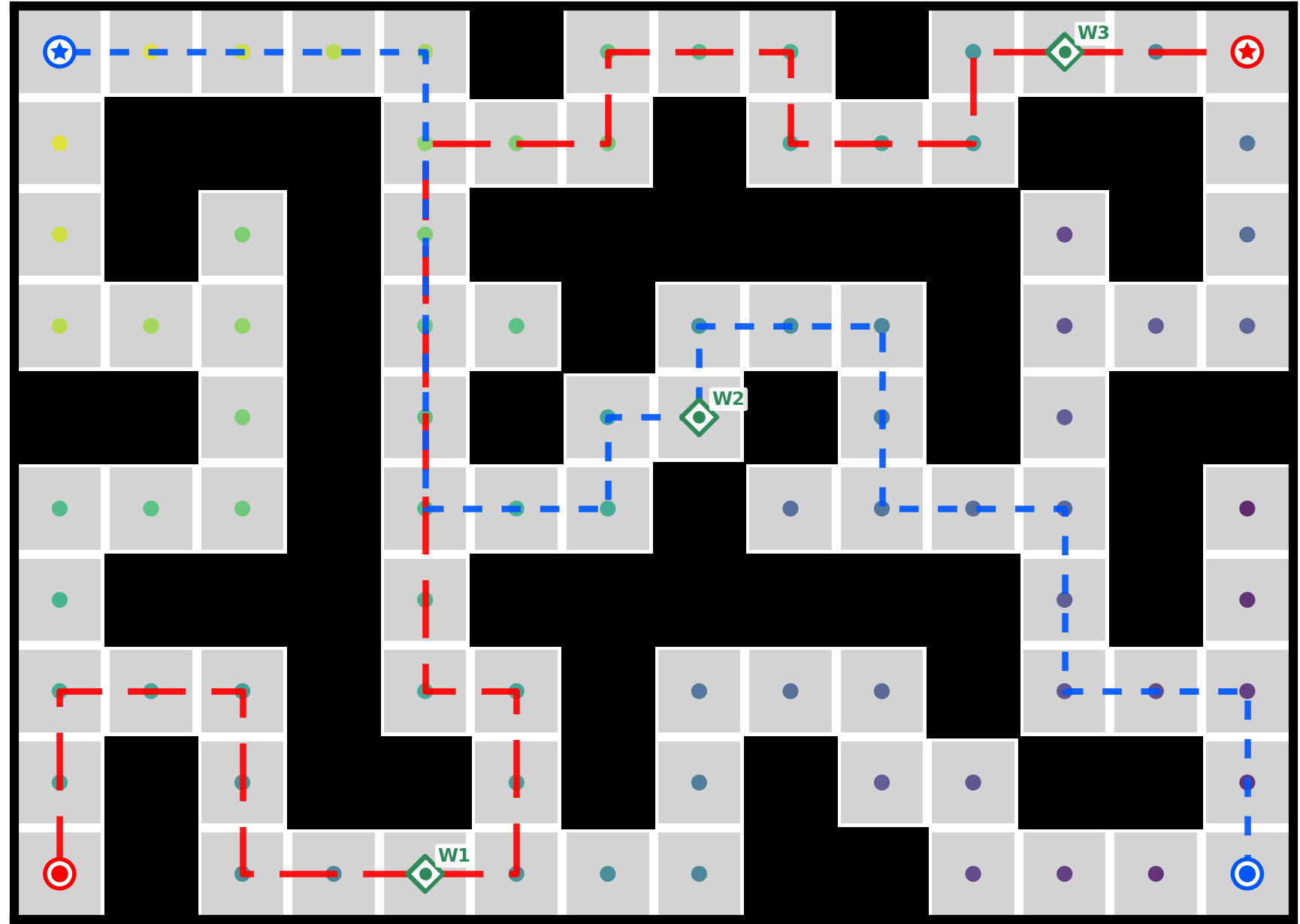
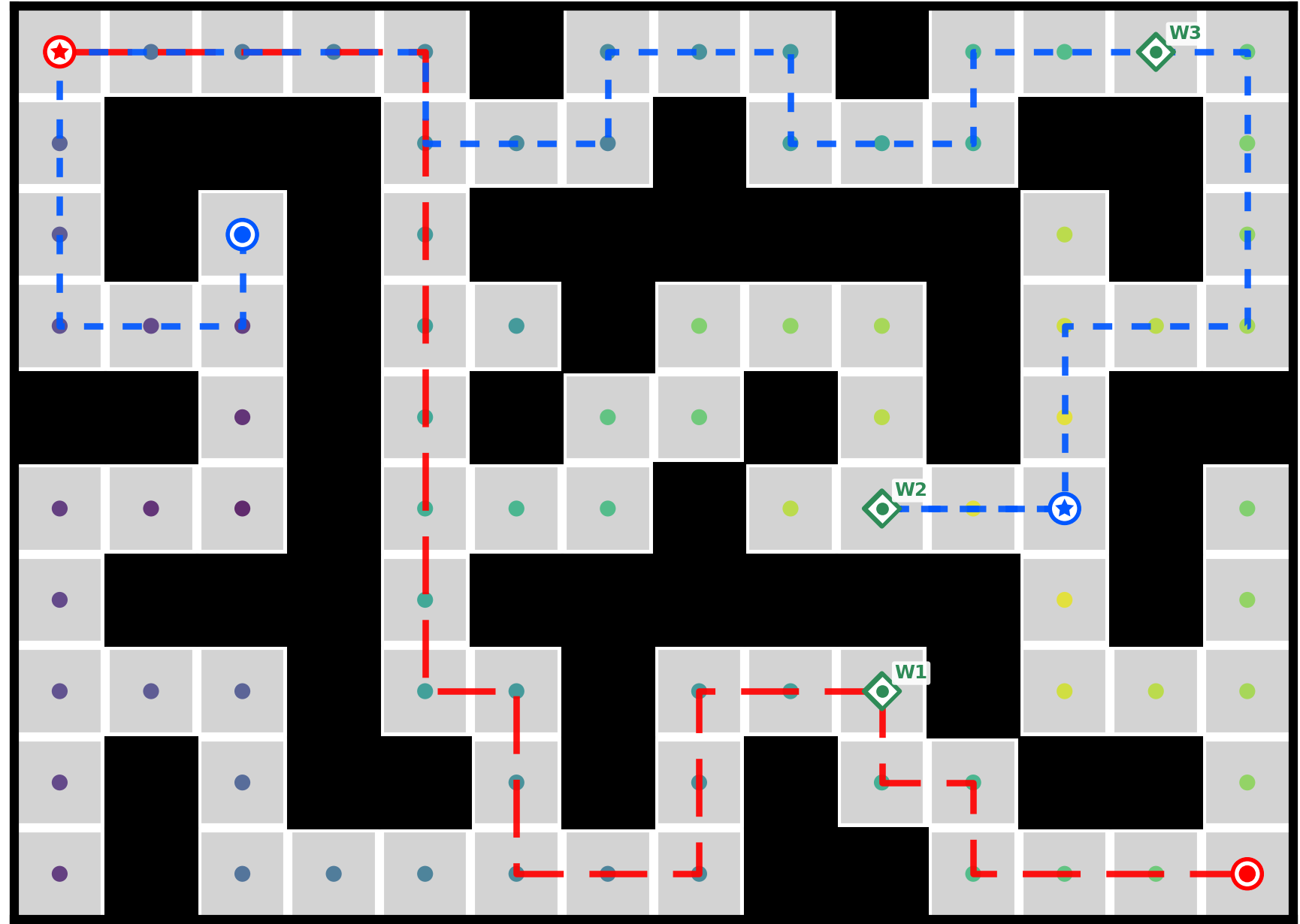
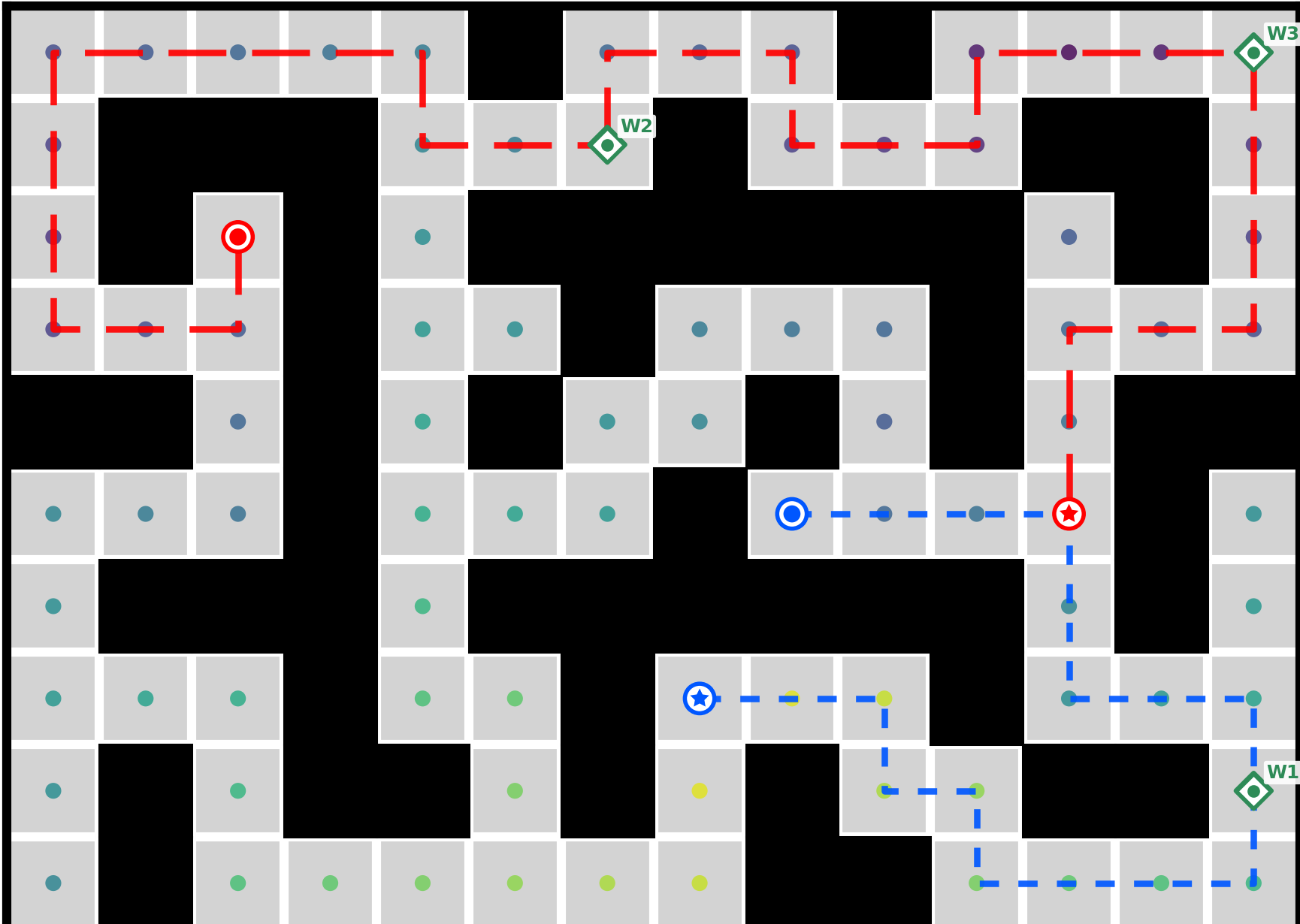
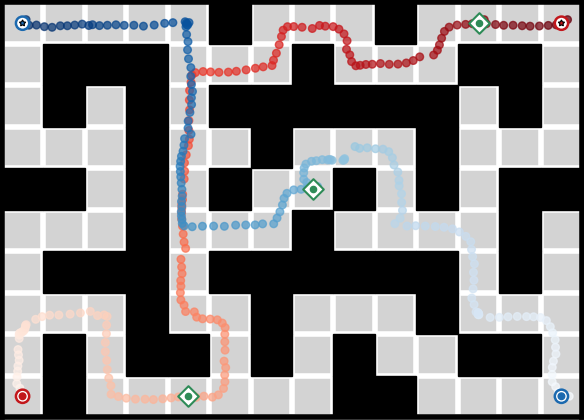
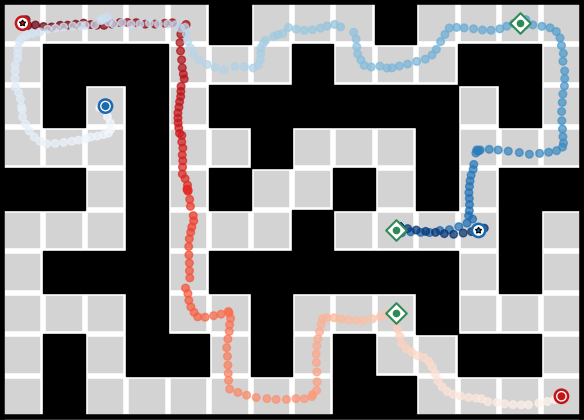
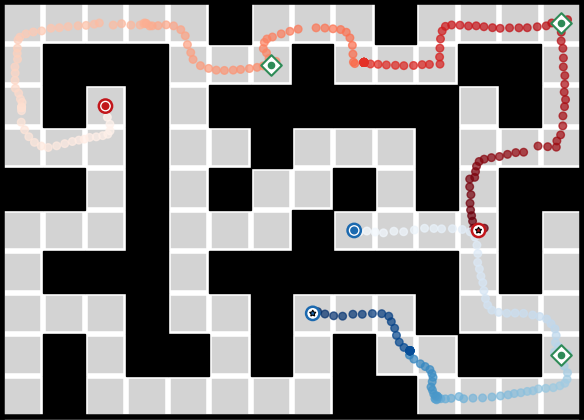
Figure 4: Representative matched waypoint-group instances in M=2 Hamiltonian composition, highlighting improvement in route order and total length from online re-solving.
Ablative studies in broader stochastic regimes (e.g., teleport tasks) further support the necessity of uncertainty-aware ranking and adaptive bridge validation in the face of model and environment noise.
Implications and Future Directions
ChronoForest establishes that explicit closed-loop route composition, with temporal-distance-guided local search and online route re-solving, is a critical enabler for scalable long-horizon offline planning in data-limited regimes. The approach challenges the adequacy of pure compositional diffusion and sequence generation methods for route-cost-sensitive navigation, advocating strong integration of planning structure into generative controllers.
Practically, this framework is applicable to multi-agent navigation, robotic coverage, and any setting where global route costs must be inferred online under combinatorial waypoint objectives and partial data. Theoretically, the method provides a template for combining learned distance surrogates with dynamic combinatorial solvers, suggesting extensions to larger anchor sets, richer task distributions, and more sophisticated route-pruning heuristics.
Future research may target scaling mechanisms (approximate solvers, further pruning), tighter uncertainty quantification in temporal-distance estimates, and generalization to non-metric or asymmetric cost structures.
Conclusion
ChronoForest delivers a theoretically motivated and empirically validated system for long-horizon route planning from offline, short-horizon data. By tightly coupling anchor-chaining diffusion guidance with online multi-tree route re-solving, it achieves route-efficient, computation-efficient performance far beyond prior compositional planners, and provides new algorithmic and theoretical tools for navigation-coupled combinatorial planning under incomplete cost knowledge.

