- The paper connects decoherence with quantum error correction to derive precise conditions under which objectivity emerges.
- It uses stabilizer codes and local recoverability to distinguish between accessible classical and quantum information in environmental fragments.
- The work provides scalable simulation methods via Clifford circuits to dynamically trace the spread and redundancy of classical information.
Demystifying Objectivity with Operator Algebra Quantum Error Correction
Introduction and Motivation
Objectivity—how multiple observers can independently and consistently obtain classical information from the quantum world—represents a central issue in quantum foundations. Decoherence theory and Quantum Darwinism (QD) attempt to formalize this emergence, yet prevailing diagnostics, such as spectrum broadcast structure (SBS) and classical plateaus in quantum mutual information (QMI), conflate redundancy, classicality, and recoverability, resulting in inherent ambiguity. This paper presents a unifying algebraic framework, leveraging operator algebra quantum error correction (OAQEC), delineating conditions under which objectivity arises. By connecting emergent objectivity with algebraic local recoverability of quantum codes, a precise taxonomy of information classicality and redundancy is constructed. Theoretical developments are illustrated using stabilizer codes, which admit efficient analysis and scalable simulations of decoherence dynamics.
The central insight is that decoherence-driven dynamics encode the quantum system's information into the environment analogously to the encoding in a quantum error correcting code (QECC). The observable algebra accessible to an observer with access to a subsystem (or fragment) f of the environment corresponds to a logical operator subalgebra Mf in the code. The algebra's structure determines whether classical or quantum data is available on f. Specifically, the commutant (center) of Mf hosts the measurable classical information, while anticommuting generators signal locally accessible quantum information.
Local recoverability of logical operators—established through operator algebra QEC theorems—equates information theoretical diagnostics (like QMI plateaus) with explicit algebraic conditions. This facilitates a robust distinction between classical records that can be redundantly accessed and quantum records, which no-cloning prohibits from being redundantly recoverable.
Classicality is characterized by nontriviality of the center Z(Mf) of the recoverable algebra for a fragment f. The spectrum of Z(Mf) partitions the code space into classical sectors, with corresponding logical projectors yielding nondisturbing measurement observables. Quantum data corresponds to anticommuting logical pairs and is fundamentally non-redundant.
Redundancy is algebraically defined: a logical observable is ℓ-redundant if it belongs to the intersection of the centers of logical algebras associated to ℓ disjoint fragments. This generalizes and makes precise the notion underlying the classical plateau in QMI diagnostics.
The stabilization code formalism, in particular for asymmetric Calderbank-Shor-Steane (CSS) codes, reveals the direct algebraic mechanism: small fragments can have access only to Z-type logicals (classical data), while a much larger fragment is required for access to the full quantum logical algebra. This underlies the signature QMI plateau structure.
Key result: For stabilizer codes,
Mf0
where Mf1 is the number of anticommuting logical qubit pairs (quantum rank) and Mf2 is the rank of the center (number of classical bits). Thus, QMI directly quantifies accessible quantum and classical information.
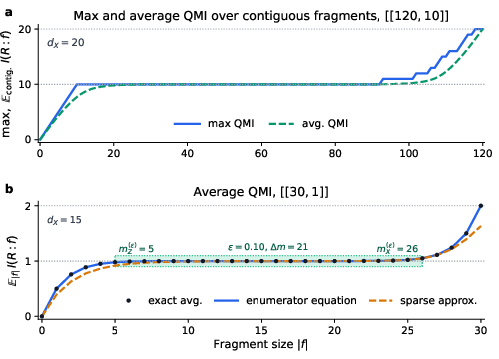
Figure 1: Plot of Mf3 and Mf4 for a Mf5 CSS code, illustrating the classical plateau and transitions as fragment size increases.
Average QMI and the statistics of accessible logicals (i.e., coset enumerator polynomials) provide refined, robust diagnostics, insensitive to localization and informative for non-homogeneous codes.
Dynamics and Clifford Simulation: Emergent Objectivity Cones
The OAQEC framework admits not only static but also dynamic analysis of the proliferation and suppression of classical and quantum information. By composing local encoding unitaries (e.g., Clifford brickwork circuits), emergent "lightcones" delineate the spatial-temporal spread of objectivity. The stabilizer formalism and Gottesman-Knill theorem enable simulation of thousands of qubits, tracing both the distribution and character (classical vs quantum) of information on arbitrary fragments.
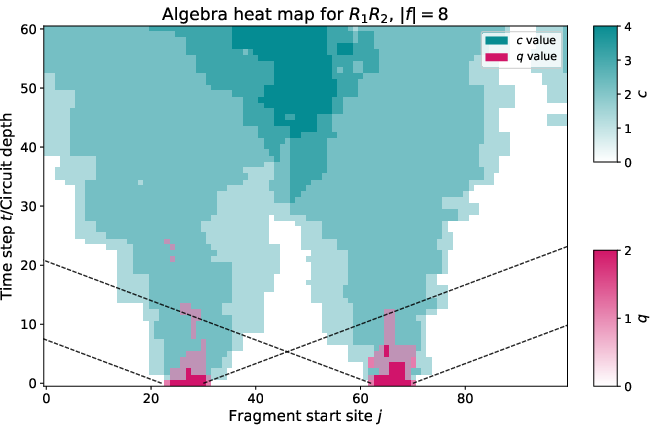
Figure 2: Heat map of the recoverable algebra Mf6 for contiguous fragments in a brickwork Clifford circuit—teal for classical information, pink for quantum—overlaid with emergent light cone boundaries.
This clarifies, for example, how classical information, once generated, propagates and becomes redundant across disjoint regions, while quantum coherence is rapidly lost outside of growing "objectivity cones".
Classification of Algebraic Objectivity Regimes
Multiple objectivity regimes are defined:
- Strong Algebraic Objectivity (SAO): All relevant fragments have a common maximal center—i.e., only classical information exists everywhere, and it is identical on all fragments. This recovers Zurek's GHZ-state scenario.
- Localized Algebraic Objectivity (LAO): All fragments carry only classical information, but possibly about different sectors of the system; redundancy is local.
- Quantum-Doped Objectivity (QDO): Fragments can have quantum, non-central recoverable information; classical information is still globally or locally redundant.
Although only SAO precisely maps to strong quantum Darwinism, LAO and QDO capture intermediate situations relevant for realistic decoherence and measurement processes, forging new links between information localization, redundancy, and the hierarchy of objectivity.
Implications and Future Directions
The algebraic recovery framework resolves ambiguities endemic to QD and classical plateau diagnostics. Redundancy and classicality are succinctly and precisely codified by the recoverable logical algebra structure. The practical consequences are significant:
- Efficient classification and diagnosis of objectivity in arbitrary system-environment models, including those with spatial and temporal disorder.
- Construction of models where objectivity and decoherence are dynamically tunable and scalable.
- Large-scale Clifford simulations of decoherence dynamics with access to fine-grained local algebraic observables.
- Immediate translation of coding-theoretic results (e.g., from quantum LDPC codes or asymmetric codes) into insight on the quantum-to-classical transition and objectivity emergence.
Theoretically, this framework generalizes beyond stabilizer or even qubit-based codes to operator algebraic settings (including non-Pauli and qudit systems), laying groundwork for the study of emergent classicality in more general quantum systems.
Conclusion
By connecting Quantum Darwinism with operator algebra quantum error correction, a quantitatively precise, scalable, and conceptually rigorous theory of emergent objectivity is achieved. The algebraic framework generalizes and unifies prior approaches, enabling both efficient simulation and systematic classification of classicality and redundancy. Future developments may generalize to interacting, non-Clifford, and higher-dimensional system-environment models, providing deep insights into the mechanisms underlying the emergence of the classical world from quantum substrates.