- The paper introduces a novel analytic solution for a charged black string immersed in a quintessence fluid and string cloud set within an AdS background.
- The paper identifies modified horizon structures and thermodynamic phase transitions stemming from the interplay of quintessence and string cloud parameters.
- The paper examines null geodesics to reveal a photon cylinder whose location and characteristics are significantly affected by the combined matter fields.
Charged Black String Solutions with Quintessence Fluid and String Cloud in Anti-de Sitter Spacetime
Introduction
The study explores the most general static solution for a charged black string immersed in both a Kiselev-type quintessence fluid and a cloud of strings within an anti-de Sitter (AdS) background. The confluence of these matter fields prompts significant modifications in horizon structure, curvature singularities, and the thermodynamic landscape of the black string. The analysis is directed primarily at the physically compelling case of the Kiselev parameter wq=−2/3, corresponding to a quintessence state interpolating between cosmological constant and string cloud matter. The work encompasses analytic metric construction, energy condition analysis, thermodynamic behavior, and photon cylinder structure.
Metric Structure and Field Equations
The Einstein-Maxwell equations are addressed with explicit matter sector contributions from: (i) electromagnetic fields, (ii) the anisotropic Kiselev fluid with arbitrary wq∈[−1,−1/3], and (iii) a string cloud characterized by density parameter a. The static, cylindrically symmetric black string ansatz leads to a metric function whose general solution is
f(r)=ℓ2r2−r2M+r2Q2+r3wq+1Nq+α,
where Nq and α encapsulate quintessence and string cloud effects, respectively.
For wq=−2/3, the metric function reduces to:
f(r)=ℓ2r2−r2M+r2Q2+Nqr+α.
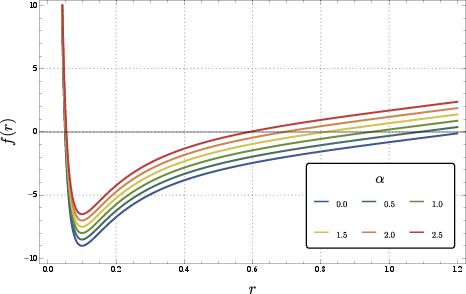
Figure 1: The effect of varying the string cloud parameter α on the metric function f(r), illustrating horizon transitions and the possible emergence of naked singularities.
The vertical displacement controlled by wq∈[−1,−1/3]0 tunes the number of event horizons, including transitions to extremal or horizonless geometries depending on the parameter regime. The explicit inclusion of both matter components generalizes previous black string solutions, recovering them as particular limits.
Energy Conditions and Physical Admissibility
By explicit computation, the energy densities and pressures for the composite stress-energy tensor reveal dependencies on the sign and values of wq∈[−1,−1/3]1 and wq∈[−1,−1/3]2. The weak energy condition (WEC) and strong energy condition (SEC) impose explicit constraints:
- WEC establishes positivity requirements for densities and principal pressures, leading to conditions on wq∈[−1,−1/3]3. For wq∈[−1,−1/3]4, a negative wq∈[−1,−1/3]5 is required for positive physical energy density.
- SEC does not lead to constraints on the string cloud, but constrains the sign and magnitude of the Kiselev term.
These energy conditions delimit the physical configurational space for the black string solution and ensure absence of unphysical matter content at the classical level.
Horizon Structure and Singularities
The event horizon radii wq∈[−1,−1/3]6 are the roots of a polynomial, quartic in wq∈[−1,−1/3]7 for wq∈[−1,−1/3]8, incorporating coupled contributions from wq∈[−1,−1/3]9, a0, a1, and a2. The Kretschmann scalar a3 is computed explicitly, revealing its divergence at a4 (central singularity) and complex functional dependence on all matter parameters. The presence of nonzero a5 and a6 introduces cross-terms with a7 and a8, enabling finer control of curvature divergence rates at intermediate and asymptotic regimes. The qualitative structure of singularities is substantially affected by the admixture of string cloud and quintessence components.
Thermodynamics and Stability
The Hawking temperature, derived from the surface gravity, and the heat capacity a9 (via f(r)=ℓ2r2−r2M+r2Q2+r3wq+1Nq+α,0 at f(r)=ℓ2r2−r2M+r2Q2+r3wq+1Nq+α,1) were calculated. The temperature exhibits standard black hole behavior, modulated by the linear and constant contributions of quintessence and string cloud parameters.
The heat capacity admits critical points where it diverges, associated with phase transitions between locally stable and unstable thermodynamic regimes. For f(r)=ℓ2r2−r2M+r2Q2+r3wq+1Nq+α,2, the critical horizon radii are given by a biquadratic equation:
f(r)=ℓ2r2−r2M+r2Q2+r3wq+1Nq+α,3
with reality conditions f(r)=ℓ2r2−r2M+r2Q2+r3wq+1Nq+α,4 demarcating the region of parameter space admitting second-order phase transitions.
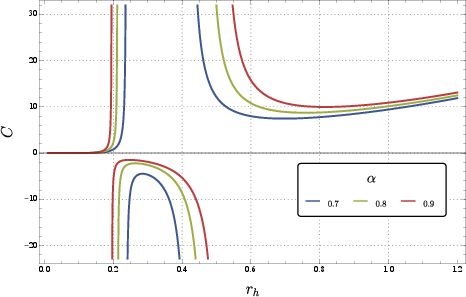
Figure 2: Heat capacity f(r)=ℓ2r2−r2M+r2Q2+r3wq+1Nq+α,5 vs. f(r)=ℓ2r2−r2M+r2Q2+r3wq+1Nq+α,6 for various f(r)=ℓ2r2−r2M+r2Q2+r3wq+1Nq+α,7 below the critical threshold; f(r)=ℓ2r2−r2M+r2Q2+r3wq+1Nq+α,8 is continuous and strictly positive, indicating global thermodynamic stability.
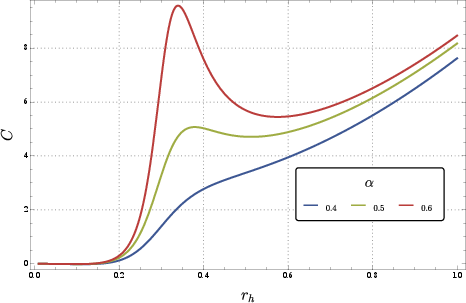
Figure 3: Heat capacity f(r)=ℓ2r2−r2M+r2Q2+r3wq+1Nq+α,9 vs. Nq0 for Nq1 above the critical threshold; divergences correspond to phase transition points separating stable and unstable domains.
For sufficiently large Nq2, the model predicts a thermodynamic phase transition, with the stable region (Nq3) corresponding to large black strings and instability (Nq4) emerging in the small-radius regime.
Photon Cylinder and Null Geodesics
The study of null geodesics confirms the existence of a photon cylinder—circular null orbits at a critical radius Nq5. For Nq6, the condition for Nq7 is a cubic equation:
Nq8
demonstrating the strong influence of the quintessence and string cloud parameters in shifting the photon sphere relative to standard black string cases. In limiting parameter regimes, analytic expressions for Nq9 display straightforward dependencies on α0, α1, α2, and α3. The position and energy of this photon barrier directly determine strong-lensing phenomena and the behavior of high-frequency field modes.
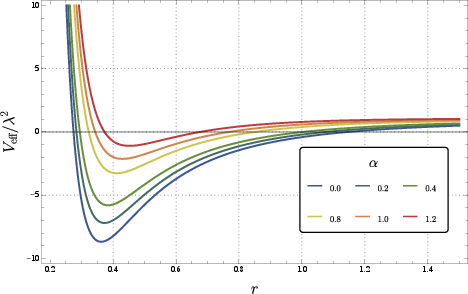
Figure 4: Normalized effective potential α4 for varying α5, highlighting the shift in the photon barrier and displacement of α6 by the string cloud.
Implications and Future Outlook
This work fills the gap in the characterization of noncompact black objects in AdS with a generalized matter sector, verifying that the simultaneous presence of Kiselev quintessence and a string cloud yields black string solutions with richer horizon, singularity, and thermodynamic structures. The results are relevant for the study of gravitational collapse, dynamical and thermodynamical stability of extended objects, and modifications to gravitational lensing by non-spherically symmetric horizons.
Practically, the stability criteria and photon barrier modifications could be employed in models of extended astrophysical objects or in constructing boundary scenarios for holographic studies within AdS/CFT correspondence. Theoretically, further extensions could include rotation, higher-curvature corrections (e.g., α7 modifications as in (Santos et al., 24 Feb 2026)), or dedicated analysis of dynamical/stationary instabilities, especially the Gregory-Laflamme channel, in presence of complicated matter distributions.
Conclusion
The constructed family of charged black string solutions demonstrates that the interplay of Kiselev quintessence and string clouds induces substantial modifications to both local and global geometric and thermodynamic properties. The parameter space exhibits phase transition structure, explicit energy condition signatures, and nontrivial photon cylinder features. The analysis offers a reference point for further examinations of stability, semiclassical effects, and observable phenomena in generalized cylindrical spacetimes (2606.06435).

