- The paper presents a Bayesian detection framework using Monte Carlo simulations on 200 BNS events to identify transient tidal resonances.
- It quantifies phase shifts in gravitational waveforms (ΔΦ ≈ 0.03–0.1) and assesses their impact on tidal deformability measurements.
- The study highlights the necessity of incorporating resonance modeling to avoid systematic bias in inferring neutron star matter parameters.
Bayesian Detection of Tidal Resonances in Binary Neutron Star Inspirals with the Einstein Telescope
Introduction
The prospect of directly probing the dense-matter equation of state (EoS) via neutron star (NS) gravitational-wave (GW) signals is a central objective for third-generation GW observatories such as the Einstein Telescope (ET). The study "Detecting Tidal Resonances in Binary Neutron Stars" (2606.06376) delivers a detailed Bayesian assessment of whether tidal resonances—transient excitation of NS oscillation modes—can be detected through GW analysis with the ET, and quantifies their effects on measurement of the system's intrinsic parameters. The novelty lies in the exhaustive simulation of one year of ET observations and statistical inference over the 200 highest signal-to-noise ratio (SNR) binary neutron star (BNS) coalescences.
Resonant Mode Excitation in Binary Neutron Stars
During the late inspiral of a BNS system, increasing GW frequencies bring the system through the resonance condition ∣m∣Ω≃ωα for specific non-radial stellar oscillation modes. The resulting mode excitation extracts orbital energy—generating a phase shift ΔΦα in the GW waveform that depends on stellar structure, the resonance mode’s mass-multipole overlap, and the orbital configuration (Equation 2 in the paper). For typical masses and radii, theoretically motivated phase shifts for g-modes and inertial modes are ΔΦ∼0.01–$0.1$. This regime is inaccessible to current second-generation detectors but promises observability with ET-class sensitivity.
Simulation Framework and Bayesian Analysis
Monte Carlo simulations of 200 BNS systems were performed, injecting mergers with a physical parameter distribution reflecting expected astrophysical rates, equations of state, and spin populations. Both resonance and non-resonance (control) populations were considered. Signals were injected into synthesized ET-D noise, and Bayesian inference conducted using the Bilby package and nested-sampling (dynesty) to estimate Bayesian evidences for two hypotheses: presence or absence of tidal resonance signatures.
Event detectability is determined by the logarithmic Bayes factor x=logB, comparing resonance and no-resonance models. A false-alarm probability PFA is defined using the background distribution from non-resonant signals (see below for the figure).
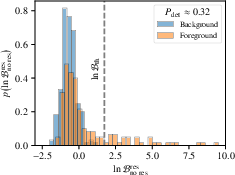
Figure 1: Distributions of Bayes factors B for resonance (orange) and non-resonance (blue) populations, with a detection threshold set to lnB≈1.73 corresponding to 5σ significance.
A five-sigma detection threshold was placed at xth≈1.73, above which resonance detection is claimed. The detection efficiency is then directly quantified from the foreground population.
Statistical Sensitivity to Resonances
Analysis reveals that for the top 200 SNR events in one year of ET observations—ΔΦα0–ΔΦα1—tidal resonances will be confidently detectable in ΔΦα232% of loud events. The limiting factor for detectability is the amplitude of the phase shift, not the resonant frequency. In detail, the efficiency function shows ΔΦα3 at ΔΦα4, rising rapidly with phase shift.
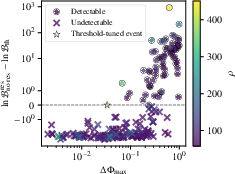
Figure 2: Log Bayes factor as a function of maximal injected phase shift ΔΦα5, with the SNR of each event indicated by color. The threshold for detection is marked, and the minimal phase shift resolvable by ET is estimated at ΔΦα6 for the loudest events.
Empirically, for favorable sources (ΔΦα7), the minimal detectable resonance is ΔΦα8. This is a substantial improvement over previous second-generation detector projections, and implies that dynamical tides due to physical g-modes and inertial modes are within the reach of terrestrial GW observation.
Bias in Tidal Parameter Inference
Neglect of resonant mode effects in waveform modeling induces systematic bias in inference of other NS matter parameters, notably the mass-weighted tidal deformability ΔΦα9. The analysis demonstrates that for resonances with ΔΦ∼0.010, omission of the phase jump leads to a measurable overestimation of ΔΦ∼0.011.
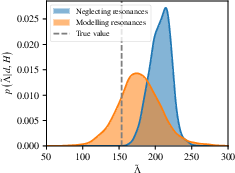
Figure 3: Posterior distributions for the inferred mass-weighted tidal deformability ΔΦ∼0.012 with (orange) and without (blue) resonance modeling. For a signal with ΔΦ∼0.013, omission leads to significant bias.
The impact is most pronounced for high-SNR and large-resonance events; for smaller shifts or low-SNR signals, the bias diminishes.
Implications for Neutron Star Structure and Dense Matter Theory
Mode-resolved phase shifts measurable by ET span the theoretically expected range for NS g-modes and inertial modes. Recent microscopic EoS and oscillation-mode calculations estimate typical quadrupole moment overlaps and resonance frequencies compatible with the ΔΦ∼0.014 values detectable by ET. Interface modes (core-crust) and discontinuity g-modes, associated with sharp EoS transitions, induce smaller shifts, potentially accessible only to detectors surpassing ET sensitivity or in joint ET–Cosmic Explorer observing campaigns.
The detectability of these resonances opens a new avenue for GW asteroseismology, providing a direct probe of composition gradients, stratification, and exotic matter phases through dense matter sensitivity of the relevant mode overlaps and frequencies.
Conclusions
This study establishes that fully Bayesian analyses with the sensitivity and bandwidth of the Einstein Telescope can robustly detect tidal resonances in BNS inspirals over realistic astrophysical populations. Phase shifts as small as ΔΦ∼0.015 are observable in optimal cases, with substantial fractions of loud events yielding confident detections. These results elevate tidal resonance detection from theoretical possibility to observational reality in the third-generation era.
Beyond practical implications for GW parameter estimation—mandating resonance modeling to avoid tidal deformability bias—the results motivate more detailed nuclear-theory–informed modeling of mode spectra, with direct consequences for EoS inference in future multi-messenger campaigns.
Predicted future developments include implementation of hierarchical Bayesian models linking resonance parameters directly to dense-matter microphysics, joint analysis across detector networks, and expansion to include multiple mode excitations and non-adiabatic effects in waveform families suitable for imminent ET/CE observations.