- The paper presents a detailed construction of anisotropic neutron star models within f(Q) gravity, ensuring central regularity and stability.
- It employs the Krori-Barua metric with observational constraints to derive density and pressure profiles while verifying energy conditions.
- Mass-radius relations and redshift limits are shown to match observed data, reinforcing the viability of f(Q) gravity in astrophysical contexts.
Realistic Neutron Star Evolution in f(Q) Gravity Framework
Introduction
This paper presents a comprehensive technical analysis of neutron stars within the f(Q) gravity framework, specifically considering anisotropic stellar matter configurations. In this framework, modifications to General Relativity (GR) are enacted via a dependence on the nonmetricity scalar Q. The study develops and numerically constrains models for the compact objects LMC X-4, SMC X-4, Cen X-3, and Vela X-1, utilizing the Krori-Barua (KB) interior metric, matching to the Schwarzschild exterior, and performing detailed explorations of physical plausibility, stability, and compatibility with observational constraints.
Model Construction in f(Q) Gravity
The work begins by adopting f(Q) gravity, where the usual Ricci scalar in the Einstein-Hilbert action is replaced with a function of the nonmetricity scalar, namely f(Q)=aQ+b. The field equations are obtained via metric variational principles, with a spherically symmetric KB ansatz for the interior solution, parameterized by constants A, B, and C related to mass and radius via boundary matching conditions.
The authors ensure the non-singularity of the energy density at the stellar center, imposing bounds on the model parameters a and b. Observational data provide the mass and radius for the considered neutron stars, thus enabling unique specification of the metric parameters for each object.
Density and Pressure Profiles
Using the specified KB metric and the chosen f(Q) form, the radial profiles of energy density Q0, radial pressure Q1, and tangential pressure Q2 are analytically derived and numerically plotted. All profiles display the expected monotonic decreases with radius and are regular throughout the star, vanishing exactly at the stellar surface. This behavior confirms the absence of central singularities and aligns with physical expectations for compact stars.
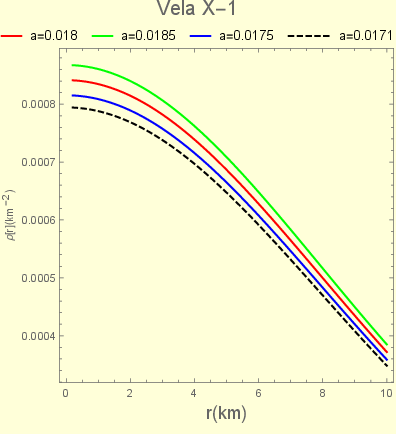
Figure 1: Density evolution versus radius Q3 for LMC X-4, SMC X-4, Cen X-3, and Vela X-1.
The anisotropy parameter Q4 is demonstrated to be positive and monotonic, yielding a net outward anisotropic force that counteracts gravity in the star's structure.
Pressure Anisotropy and Equilibrium
Pressure anisotropy is shown to be significant, with Q5 across each model. The Tolman-Oppenheimer-Volkoff (TOV) equation is satisfied, with the gravitational force balanced by the combined action of hydrostatic and anisotropic forces, as demonstrated for all four neutron stars.
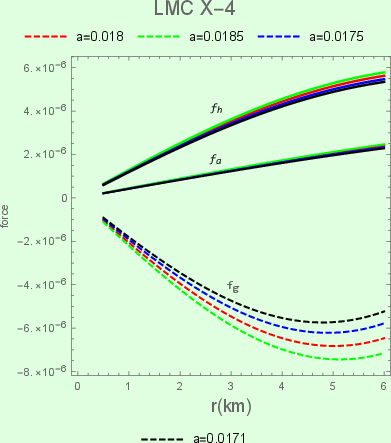
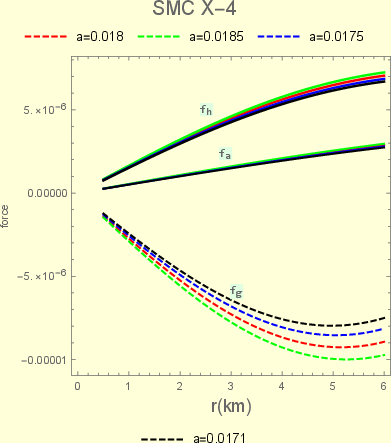
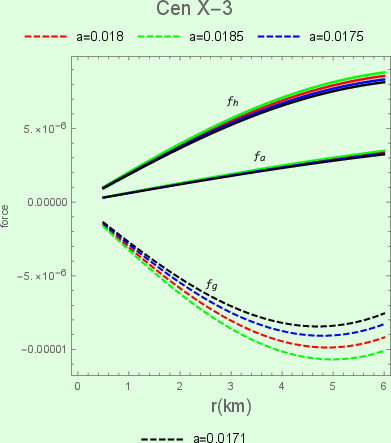
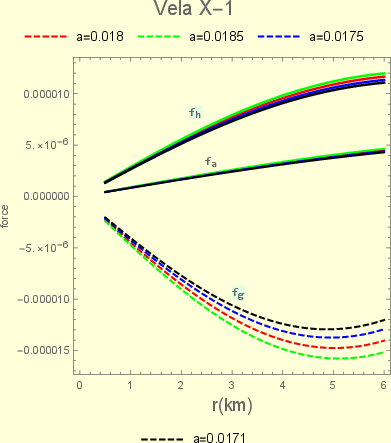
Figure 3: Force equilibrium profiles for gravitational, hydrostatic, and anisotropic components as functions of Q6 for the four compact objects.
Energy Conditions, Causality, and Stability
The Null and Strong Energy Conditions (NEC, SEC) are systematically verified. Calculations confirm that both Q7 and Q8 remain positive everywhere, as do Q9, evidencing a standard matter regime in the neutron star interiors.
The equation of state (EoS) parameters f(Q)0 and f(Q)1 remain within f(Q)2 across the entire stellar interior, ruling out exotic matter phases. Stability is further assessed using several criteria:
- Causality: Squared sound speeds in radial and tangential directions (f(Q)3, f(Q)4) strictly satisfy f(Q)5.
- Adiabatic Index: The adiabatic index f(Q)6 exceeds f(Q)7 throughout, indicating dynamical stability against adiabatic perturbations.
Mass-Radius Relation and Observational Consistency
Numerical integration yields the stellar mass as a function of radius, which aligns with observational data for all four neutron stars. The dependency on the model parameter f(Q)8 is explicitly explored. Additionally, a f(Q)9 hypothesis test, employing thirty values of f(Q)=aQ+b0, shows no statistically significant deviation between predicted and observed masses, with calculated test statistics well below the acceptance threshold.
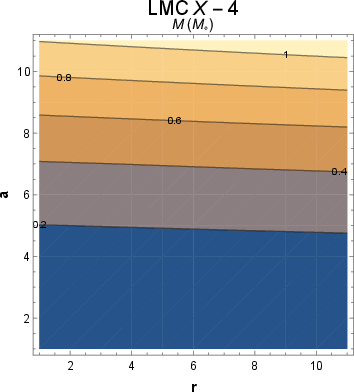
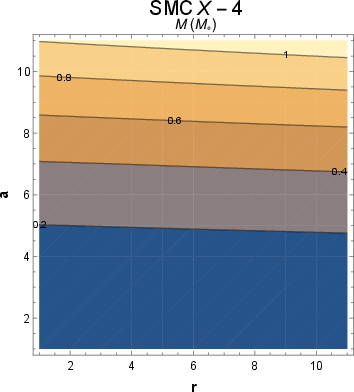
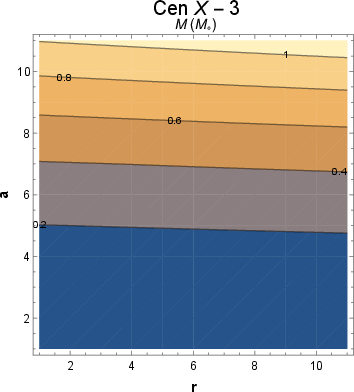
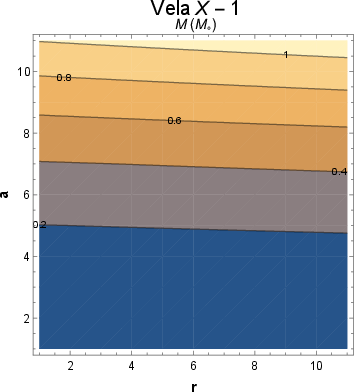
Figure 5: Contour (equi-mass) diagrams in the f(Q)=aQ+b1–f(Q)=aQ+b2 plane for the four compact stars; mass increases with both radius and f(Q)=aQ+b3.
Compactness and Surface Redshift
Stellar compactness f(Q)=aQ+b4 remains within the Buchdahl limit (f(Q)=aQ+b5), and, crucially, in the interval consistent with neutron star identification (f(Q)=aQ+b6). The surface redshift f(Q)=aQ+b7 of these models is always below the upper bound of 5.211, ensuring the absence of ultra-compact (black hole-like) behavior. Radial profiles of both quantities further corroborate the physical acceptability of the solutions.
Theoretical and Astrophysical Implications
The investigation demonstrates that neutron stars modeled within f(Q)=aQ+b8 gravity with a linear Lagrangian and anisotropic matter satisfy all key theoretical and observational constraints. The stellar structure equations in f(Q)=aQ+b9 gravity do not, in this context, yield configurations or predictions in stark contrast to GR within current observational bounds; however, they accommodate compactness, redshift, and mass in the observed ranges for realistic EOS.
The framework offers a natural arena for exploring departures from canonical GR, especially in regards to the role of pressure anisotropy, the phenomenology of massive neutron stars, and possible extensions to include further nonminimal couplings or more general forms of A0. The authors suggest that future work should compare such models more directly with gravitational wave results and incorporate more elaborate EOS and microphysical inputs.
Conclusion
This study provides a robust demonstration that linear A1 gravity, supplemented by physically justified anisotropic stresses and constrained by observational data, delivers neutron star models that satisfy regularity, stability, and all requisite energy conditions. All examined models are in agreement with observed mass, compactness, and redshift. This supports the viability of A2 gravity as a framework for precision neutron star phenomenology, and lays groundwork for confronting more complex modifications of gravity with future astrophysical and gravitational wave observations.

