- The paper systematically benchmarks deep learning models using UAV multispectral imagery for BLB segmentation in rice.
- U-Net++–EfficientNet-B3 outperforms other CNN and transformer models, achieving mIoU over 97% with efficient real-time inference.
- Inclusion of vegetation indices (NDVI, NDRE) marginally boosts segmentation accuracy, underscoring the benefits of spectral augmentation.
Comparative Evaluation of Deep Learning Frameworks for UAV-based Rice Disease Segmentation
Introduction
The rise of precision agriculture has dramatically increased the use of deep learning for canopy-level disease monitoring, leveraging high-resolution UAV multispectral imagery. This paper systematically benchmarks state-of-the-art encoder-decoder architectures for segmenting bacterial leaf blight (BLB) in rice, focusing on canonical CNNs (U-Net, U-Net++, DeepLabV3+) and a transformer-based approach (SegFormer). The evaluation isolates the impact of network architecture and input spectral configuration using a public, well-annotated multispectral UAV dataset, with bands augmented by vegetation indices (NDVI, NDRE).
Experimental Design and Methodology
The dataset consists of multispectral UAV images (blue, green, red, red-edge, NIR) and detailed pixel-level BLB severity masks from rice fields in Thailand. Patches of size 256×256 are extracted with overlap, and three input variants are constructed: D1 (raw multispectral), D2 (multispectral + NDVI), and D3 (multispectral + NDRE). The segmentation task is formulated as a multiclass semantic segmentation over four categories: healthy rice, low-severity BLB, high-severity BLB, and background.
All frameworks are trained with identical protocols using Adam optimizer, a composite cross-entropy and soft Dice loss, and early stopping based on validation mIoU. Six-channel input support is leveraged across all models.
The architectures under comparison include:
- U-Net with ResNet-101 backbone
- U-Net++ with EfficientNet-B3 and EfficientNet-B7
- DeepLabV3+ with ResNet-101
- SegFormer (MiT-B2 backbone)
Performance is assessed via mIoU, mF1, mAcc, mPrec, mRec, and inference speed on RTX A6000 GPUs.
Training Dynamics
Training and validation loss curves over 500 epochs reveal steady convergence with no substantial overfitting, validating the proposed loss formulation and the soundness of the multispectral data augmentation.
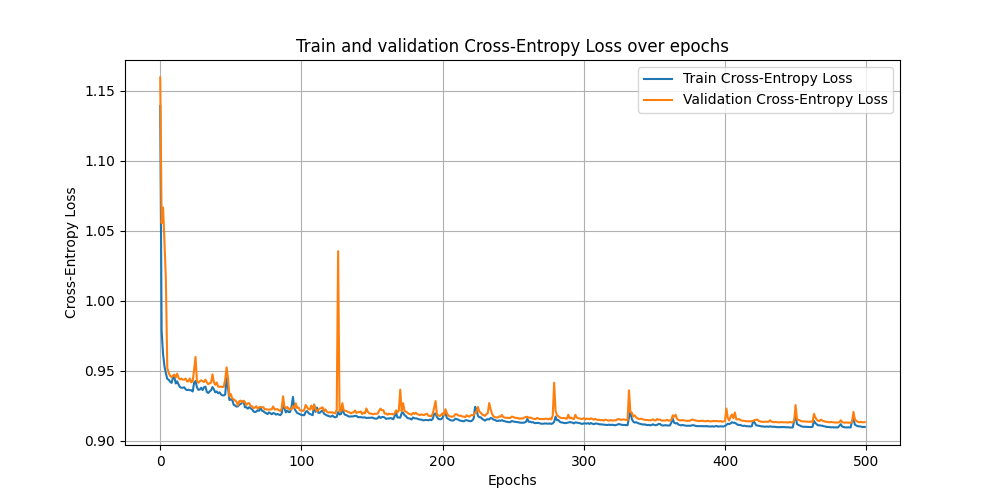
Figure 1: Training and validation loss curves over 500 epochs using the combined categorical cross-entropy and soft Dice loss.
Quantitative and Qualitative Results
Segmentation Accuracy
For the D2 (multispectral + NDVI) configuration, all CNN-based architectures achieve mIoU exceeding 95%. Notably, U-Net++ with EfficientNet-B3 consistently yields the highest scores (mIoU 97.62%, mAcc 99.51%, mF1 98.79%), marginally exceeding the U-Net–ResNet101 baseline and outperforming DeepLabV3+ by ~1.3 percentage points in mIoU. U-Net++ with EfficientNet-B7 achieves even slightly higher metrics at the expense of reduced inference throughput.
SegFormer (MiT-B2), while achieving comparable inference speed, underperforms with a maximum mIoU of 90.36% and exhibits systematically high recall but substantially lower precision, indicating over-segmentation of disease regions.
Effect of Vegetation Indices
Across band combinations, the addition of NDVI or NDRE yields small but consistent increments in mIoU for CNN architectures, with NDRE providing marginally higher gains for U-Net++. The consistency of accuracy across D1–D3 for top-performing architectures indicates that robust modeling is achievable given adequate spectral diversity.
Qualitative Segmentation
Visual inspections corroborate quantitative results: U-Net++–EfficientNet-B3 yields spatial segmentations closely matching ground truth, with precise boundary delineation and strong discrimination between healthy vegetation and background classes. SegFormer outputs are visually coarser with tendency towards overestimation.
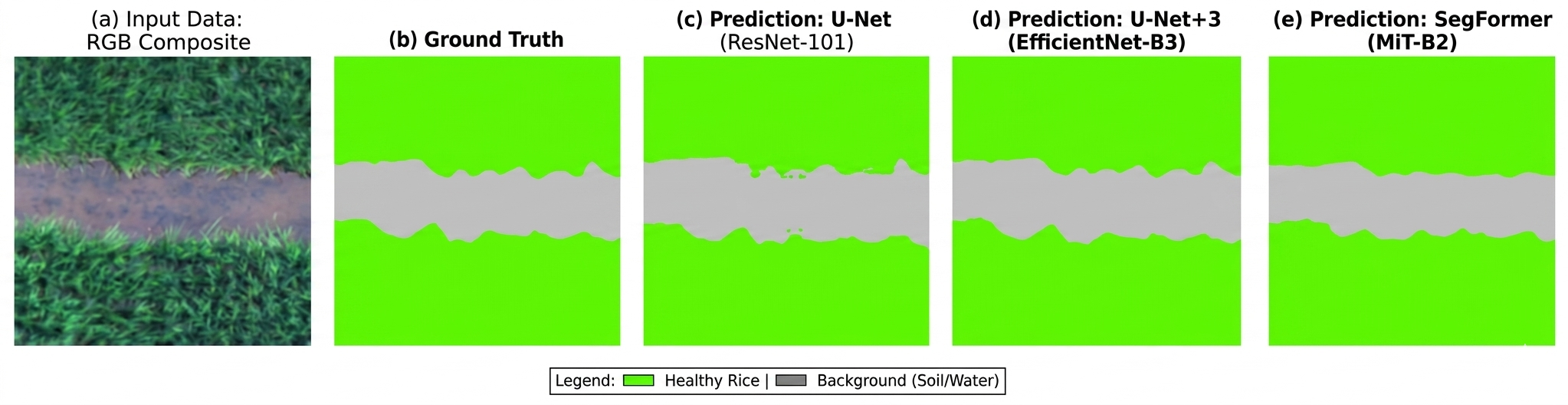
Figure 2: Spatial segmentation comparison on a D2 test patch: (a) RGB composite, (b) ground truth, (c) U-Net–ResNet101, (d) U-Net++–EfficientNet-B3, (e) SegFormer–MiT-B2.
Inference throughput is high for all CNN-based models (≥ 17 images/s per RTX A6000 GPU), with only minor trade-offs for deeper encoders. U-Net++–EfficientNet-B3 achieves a superior accuracy-speed trade-off, supporting real-time operational field deployment. SegFormer performance is throughput-equivalent but accuracy-deficient for these data regimes.
Discussion and Implications
The experiment substantiates that, given moderate dataset scale and the spectral characteristics of rice disease, CNN backbones—especially U-Net++–EfficientNet-B3—are the most reliable tool for operational disease mapping, striking an advantageous balance between generalization, boundary localization, and computational efficiency. The addition of NDVI or NDRE channels can incrementally boost accuracy but does not fundamentally alter the ranking of architectures.
The results suggest that transformer-based models like SegFormer, when trained from scratch on limited-size multispectral datasets, are less robust due to over-segmentation and a recall bias. This indicates a need for improved regularization, specialized pretraining, or possibly tailored transformer architectures for agricultural remote sensing.
Publicly available, annotated UAV datasets like the one leveraged here are crucial for providing reproducibility and enabling systematic benchmarking across modeling paradigms. The findings have practical import for both research and industry: lightweight, well-tuned CNN models, armed with appropriate spectral inputs, are best suited for near-real-time, field-scale BLB monitoring tasks.
Conclusion
This comparative study demonstrates that U-Net++–EfficientNet-B3 is the most reliable architecture among those evaluated for BLB segmentation in UAV multispectral imagery, achieving mIoU ≥ 97% and fast inference. Lightweight CNNs remain preferable for operational precision agriculture disease mapping, while transformer architectures require further optimization and domain adaptation. Incorporating vegetation indices as additional channels confers marginal but consistent benefits.
The study's methodology—standardizing data, protocol, and evaluation—is exemplary for future remote sensing model benchmarking. Beyond its immediate domain, this protocol sets a foundation for expanded, cross-seasonal, multi-region disease surveillance, and porting to multimodal sensor modalities such as thermal or LiDAR for earlier plant stress detection.