$\tt GrayHawk$ $\tt v2$: wormholes and numeric extension
Published 4 Jun 2026 in gr-qc | (2606.06339v1)
Abstract: We enlarged the capabilities of the publicly available Mathematica-based tool $\tt GrayHawk$. This second version expands the spectrum of metrics that can be considered in two distinct and disjoined directions. First, it enables a fully numerical computation of the tortoise coordinates integral, allowing the user to account for many metrics for which an analytic computation was impractical. Second, it extends the scattering problem to wormhole solutions. The pool of pre-loaded metrics is enriched, enabling immediate testing of the new features, and the code's modular structure is maintained to facilitate easy modification. This implementation proves $\tt GrayHawk$ adaptability and makes it an even more powerful tool for studying black holes, wormholes, Hawking radiation, and other features involving field propagation on curved manifolds. The codes described in this work are publicly available at \href{https://github.com/marcocalza89/GrayHawk-v2}{\faGithub}.
The paper presents an upgraded Mathematica-based GrayHawk code that numerically computes gray-body factors for black holes and traversable wormholes.
It implements robust numerical tortoise coordinate evaluations and adaptive grid techniques to accurately capture wave scattering phenomena and echo signatures.
The code’s extensible framework validates against published benchmarks, enabling exploration of quantum gravity-inspired metrics and exotic spacetimes.
GrayHawk v2: Enhanced Computation of Gray-Body Factors for Black Holes and Wormholes
Overview and Motivation
The paper "GrayHawk v2: wormholes and numeric extension" (2606.06339) introduces a substantial upgrade to the Mathematica-based GrayHawk code, aimed at the numerical computation of gray-body factors (GBFs) and transmission coefficients for static, spherically symmetric black holes (BHs) and wormholes (WHs). Two principal limitations of the original release are addressed: the analytic intractability of tortoise coordinate integrals for a broad class of metrics, and the previous restriction to horizon-possessing spacetimes, i.e., black holes. By extending support to horizonless geometries, notably traversable wormholes, and by implementing robust numerical evaluation of the tortoise coordinate mapping, the code enables exploration of a far wider range of compact-object backgrounds, including those inspired by quantum gravity and exotic matter.
Theoretical Framework
Scattering Formalism and Gray-Body Factors
Wave propagation in spherically symmetric, asymptotically flat spacetimes is governed by a Schrödinger-type equation for each field spin, with the key ingredients being the metric functions F(r), G(r), and H(r). The tortoise coordinate r∗ is defined through
drdr∗=F(r)G(r)1,
mapping the range r∈(rH,∞) to r∗∈(−∞,∞) for BHs. The effective potential Vs(r), entering the master equation, vanishes asymptotically at both the horizon and spatial infinity.
For both BHs and WHs, one numerically solves for the mode functions Zs(r∗), imposing appropriate boundary conditions—purely ingoing at the horizon (BHs) or at one asymptotic region (WHs)—and extracts the transmission coefficient or gray-body factor as a function of energy.
Extension to Wormholes
The wormhole module leverages a symmetric, double-sided tortoise coordinate, with the throat mapped to r∗=0 and distinct universes extending to G(r)0. Transmission coefficients in WHs encapsulate the likelihood for a field excitation to traverse from one universe to the other, and encode echo signatures and resonance phenomena of direct observational relevance.
Expanded Metric Coverage
GrayHawk v2 pre-loads an enlarged catalog of analytically and numerically challenging metrics:
Regular black holes with Minkowski or de Sitter cores (e.g., CGSV, Dymnikova).
Quantum gravity-inspired backgrounds (e.g., ZLMY metric) grounded in loop quantization and covariance requirements.
Analytical computation of G(r)1 is feasible only for a subset of backgrounds, making the general-purpose numeric integral crucial.
Numerical Infrastructure
Modular Workflow
The main workflow, packaged as GrayHawkv2.nb, can be launched in a single step. Core components include:
Parameter specification (geometry, field, energy grid, etc.).
Analytic or numeric tortoise coordinate calculation and inversion—supporting both smooth and thin-shell WHs.
Construction of the geometric potential and solution of the master equation for each energy.
Output of GBFs or transmission coefficients with diagnostic plots.
Calibration files (CalibratorGHv2.nb) aid in fine-tuning sampling regions and step sizes for optimal convergence, especially in highly resonant or high-l modes.
Robustness and Accuracy
Numerical tortoise coordinate reconstruction leverages near-horizon (or near-throat) series expansion, high-precision quadrature, and adaptive grid selection. Emphasis is placed on sufficient coverage of the effective potential and rigorous boundary matching for accurate extraction of amplitudes.
Validation against published results for thin-shell WHs [Bao:2022iaz, Rosato:2025byu] and ZLMY BHs and WHs [Konoplya:2025hgp] yields weighted residuals G(r)2, except near steep resonances.
Numerical Results
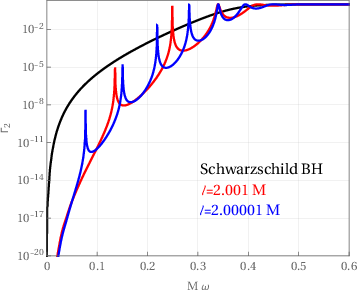
A selection of benchmark figures demonstrates the code's capability to reproduce and extend state-of-the-art results for diverse geometries. For example, the transmission coefficient for spin-2, G(r)3 on a thin-shell WH closely tracks published reference data.
Figure 1: Transmission coefficient of a field of spin-2 and G(r)4 scattering on a thin-shell WH with the throat at G(r)5.
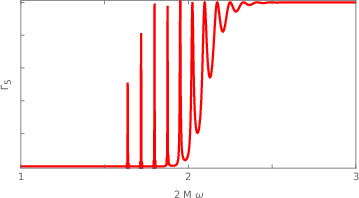
Parameter variations in the throat location and spin/mode values yield the expected resonance structure and transition features, with the code's numeric results visually indistinguishable from literature benchmarks.
Figure 2: Transmission coefficient of a field of spin-2 and G(r)6 on a thin-shell WH with G(r)7.
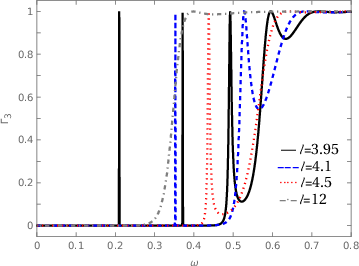
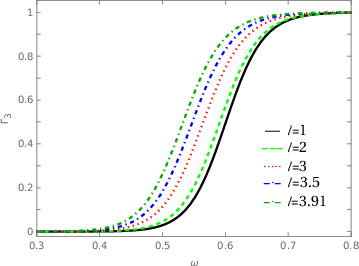
Quantum-corrected black hole and wormhole backgrounds from LQG effective models (e.g., ZLMY) show pronounced sensitivity of transmission spectra to the regularizing parameter G(r)8.
Figure 3: Transmission coefficient for spin-2, G(r)9 on ZLMY WHs for various H(r)0.
Figure 4: Transmission coefficient for spin-2, H(r)1 on ZLMY BHs for various H(r)2.
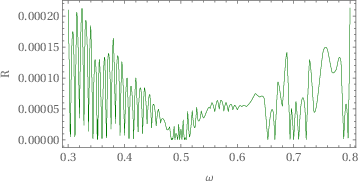
The code's precision is further quantified through residual plots.
Figure 5: Residuals between gray-body factors for spin-2, H(r)3 on ZLMY BH (H(r)4) as computed by GrayHawk v2 and in [Konoplya:2025hgp].
Discussion and Implications
GrayHawk v2 enables the systematic study of field propagation, Hawking emission, echo phenomenology, and direct astrophysical observables across a diverse landscape of compact-object metrics. By decoupling the code from analytic intractabilities, the package supports the theoretical investigation and numerical characterization of new, exotic geometries emerging from quantum gravity proposals, energy condition violation, or phenomenological model building.
The ability to compare wormhole and black hole echoes and transmission spectra within the same computational architecture is of direct utility given the increase in gravitational-wave and horizon-scale observational capabilities. In particular, the connection between GBFs, scattering-induced echoes, and ringdown signatures in horizonless spacetimes provides a crucial link to experimental tests of strong-field gravity and possible non-standard compact-object detection.
On the computational front, this modular, user-extendable design lowers barriers to rapid model exploration and cross-code integration with external packages such as BlackHawk v3.0 [BHv3]. This flexibility is essential as new constraints from LIGO-Virgo-KAGRA and EHT prompt regular updates to phenomenological and quantum-corrected metric databases.
Future Directions
Future improvements discussed include extension to massive and higher-spin fields, incorporation of rotating (non-spherically symmetric) backgrounds, automatable resonance searches, and direct integration with data analysis pipelines for gravitational wave and electromagnetic observations. Such developments will further close the loop between model-building/theory and observation-driven phenomenology.
Conclusion
GrayHawk v2 (2606.06339) represents an important advance in the numerical treatment of wave scattering, Hawking emission, and compact-object spectroscopy for both standard and non-standard spacetimes. Its recursive, modular architecture—now supporting numerical tortoise coordinate construction and traversable wormhole metrics—not only broadens the range of objects accessible to precision analysis but also positions the tool as a foundation for continued developments in gravitational, high-energy, and quantum gravity phenomenology. The code's reliability and extensibility are substantiated through stringent cross-validation, and it is poised for ongoing integration with the growing ecosystem of compact-object computational frameworks.