- The paper demonstrates that a unified gauge-theoretic framework based on su(2,2|3) naturally generates NJL-like four-fermion interactions without the need for elementary scalars.
- It employs nonminimal couplings and a fixed algebraic structure to precisely relate gravitational, gauge, and fermionic sectors.
- The model predicts composite bound states and dark matter candidates, linking dynamically generated mass scales directly to Planck-scale physics.
Chiral Symmetry Breaking in Geometric Gauge Models with Unconventional Supersymmetry
Introduction and Theoretical Motivation
The paper develops a gauge-theoretic framework for dynamical mass generation that avoids elementary scalar fields and arbitrary four-fermion interactions. The construction is grounded in a geometric model based on the super Lie algebra su(2,2∣3), unifying gravity, Yang-Mills sectors, and fundamental fermions as components of a single gauge connection. A central feature of the model is that fermionic self-interactions arise inevitably from nonminimal couplings and torsion, as dictated by the geometric and algebraic structure rather than phenomenological input.
This paradigm shift signals a notable departure from the Standard Model, where mass generation relies on explicit scalar fields, and even from QCD-like theories, where dynamical chiral symmetry breaking is emergent but not strictly determined by underlying symmetry. Here, the very geometry of the unified gauge field entails four-fermion interactions that, in the low-energy sector, mimic a Nambu–Jona-Lasinio (NJL) potential.
Gauge-Geometric Model and Algebraic Structure
The construction begins from a gauge connection valued in su(2,2∣3), encapsulating both spacetime and internal gauge symmetries:
A=Ω+αieψiα+ψαieQiα,
with Ω holding Lorentz, translation, dilation, SU(3), and U(1) constituents. The curvature F is constructed, and the action S=−∫⟨F⊛F⟩ involves a geometric dual that partially breaks the full symmetry, producing a tractable model with SO(1,3)×SU(3)×U(1) invariance. This reduction yields a geometric environment corresponding to an AdS background with fixed torsion.
The superconformal structure is highly restrictive, fixing all relative couplings, including gauge, gravitational, and four-fermion terms. Notably, this geometric rigidity eliminates arbitrariness in coupling assignments and correlates physical parameters such as the dynamically generated fermion mass with the geometric sector.
Emergence of NJL-like Four-Fermion Interactions
Upon reduction to low-energy dynamics, the effective theory displays NJL-type four-fermion interactions:
L4=G[(ψˉψ)2+(ψˉγ5ψ)2],G−1=6MP2,
where su(2,2∣3)0 is determined by the Planck scale. The elimination of elementary scalar fields and the absence of ad hoc four-fermion terms underscore the claim that dynamical mass generation follows directly from the underlying superalgebraic geometry.
The gap equation for the constituent fermion mass su(2,2∣3)1 is then written as:
su(2,2∣3)2
where su(2,2∣3)3 is the geometry-induced bare fermion mass.
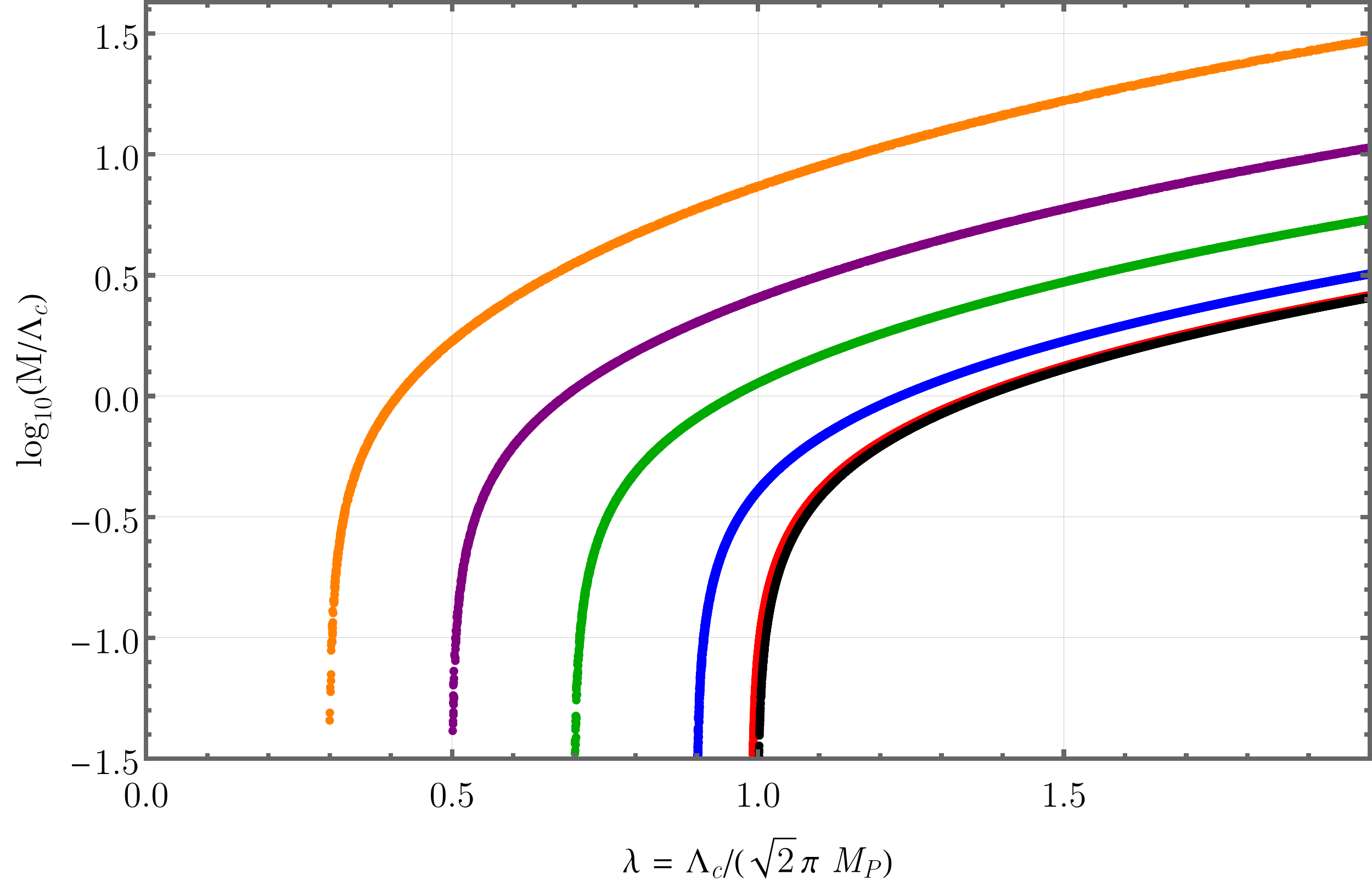
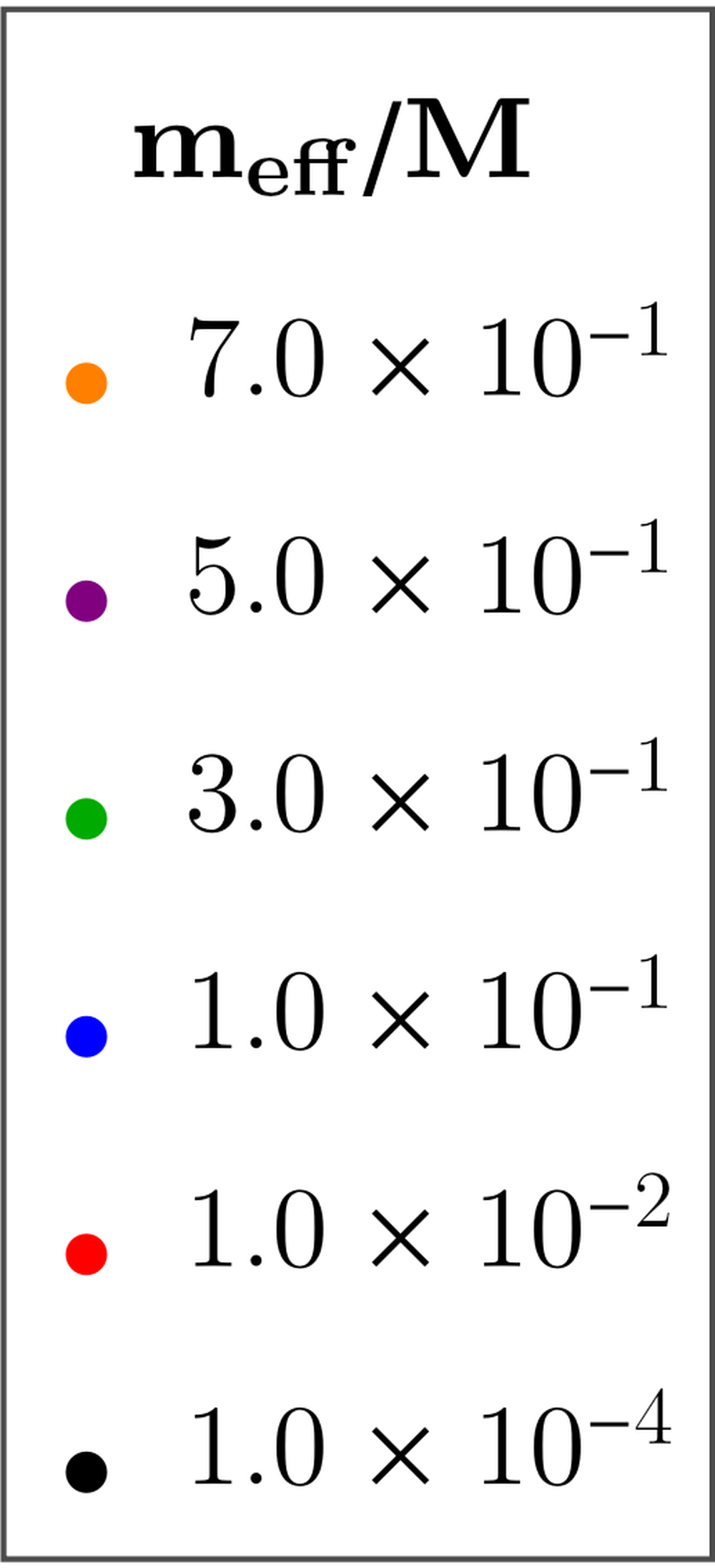
Figure 1: Constituent mass as a function of the NJL cutoff for several values of su(2,2∣3)4, with a critical threshold delineating symmetry restoration and breaking.
A dimensionless analysis reveals an extreme sensitivity to the cutoff parameter su(2,2∣3)5: obtaining constituent masses in the GeV range requires su(2,2∣3)6 to be unity up to su(2,2∣3)7. This fine-tuning is not imposed but instead dictated by the geometric constraints of the model.
Spectrum of Composite Bound States
The model realizes a standard NJL mechanism of chiral symmetry breaking with the formation of bound pseudoscalar states evaluated via the Bethe–Salpeter equation in the RPA. For a constituent fermion mass su(2,2∣3)8 MeV, the model yields a stable pseudoscalar meson with mass su(2,2∣3)9 MeV. The scalar channel lacks a bound-state solution, consistent with expectations from the underlying interaction structure.
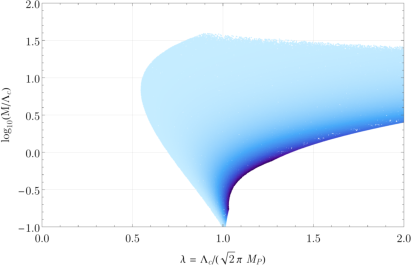
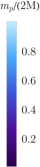
Figure 2: Range of solutions allowed by the model describing pseudoscalar composite particle at chiral limit.
The scalar–pseudoscalar structure arises due to Fierz identities in the A=Ω+αieψiα+ψαieQiα,0 case, leading to the vanishing of the tensor channel—an intrinsic feature of the superalgebra and not an arbitrary truncation.
Implications for Dark Matter and Beyond Standard Model Phenomenology
The rigidly unified construction naturally suggests novel dark-sector scenarios. Because geometric mass generation does not mandate Standard Model charges, the mechanism accommodates hidden or secluded sectors, supporting composite dark matter candidates like gluequarks. These bound states form at temperatures set by a confinement scale that can be parametrically below the constituent mass, realizing scenarios where relic abundance and late-time signals are dynamically decoupled.
The gluequark paradigm, whereby dark matter is a stable, neutral composite of a heavy colored fermion and a dark gluon, finds a consistent realization within this supersymmetric geometric construction. The absence of ad hoc symmetries for stability—replacing A=Ω+αieψiα+ψαieQiα,1 with residual consequences of superalgebraic structure—further enhances predictivity.
Theoretical and Practical Implications, Prospects for Future Developments
The approach demonstrates that nonperturbative phenomena such as chiral symmetry breaking and composite formation can be encoded at a geometric level, provided sufficiently rich superalgebraic unification. This underscores the possibility that mass hierarchies and new matter sectors may originate from geometric rather than dynamical or phenomenological considerations.
Future work should systematically explore the inclusion of multiple fermion flavors and the role of nonvanishing torsion components (e.g., as chiral chemical potentials), both for theoretical completeness and for the study of possible parity-violating phases. Additionally, the severe fine-tuning inherent in the required cutoff suggests that a deeper investigation into renormalization group and UV completion effects is warranted. The geometric origin of all scales in the model points to intriguing connections with Planck-scale physics and raises the possibility of embedding such models in broader quantum gravity theories or extended supersymmetric frameworks.
Conclusion
The paper establishes a geometrically unified framework in which chiral symmetry breaking and dynamical mass generation are rigid consequences of the A=Ω+αieψiα+ψαieQiα,2 superalgebra, without recourse to elementary scalars or phenomenological quartic couplings. All interaction strengths and dynamical scales are fixed algebraically, and the model yields both a physically plausible hadronic sector and natural composite dark matter candidates. While the scenario requires severe fine-tuning in the cutoff parameter, this emerges from geometric considerations rather than phenomenological adjustment. The approach unifies gravity, gauge, and matter fields at the action level and reveals deep connections among spacetime geometry, internal symmetry, and dynamical mass generation. Further generalization and inclusion of additional dynamical ingredients should be pursued to evaluate the full theoretical power and phenomenological reach of this geometric gauge model.