- The paper demonstrates that high lexical density in text contexts leads to significant performance degradation in LLM retrieval tasks.
- It employs controlled benchmarks like MK-NIAH, Scene-Rules, and WordChecker to isolate density effects from context length and positional factors.
- Reducing lexical density via sparsification restores LLM performance by up to 30%, highlighting the potential of density-aware mitigation strategies.
Lexical Density as a Bottleneck for Context Utilization in LLMs
Introduction
Scaling LLMs for effective long-context processing remains a central challenge. Prior work has predominantly attributed context utilization breakdown to context length and the position of relevant information. The paper "Dense Contexts Are Hard Contexts: Lexical Density Limits Effective Context in LLMs" (2606.06203) systematically introduces lexical density—quantified as the rate of new information per token—as a third, critical axis constraining LLM context efficacy. Through controlled "find-the-needle" benchmarks, the authors demonstrate that even state-of-the-art open-weight LLMs, spanning 9B to 685B parameters, exhibit sharp retrieval failures in high-density contexts, even when context length and needle position are matched.
Motivation and Benchmarks
The study critiques the standard Needle-in-a-Haystack (NIAH) paradigm’s assumption that contexts of equal length and matched target placement pose equivalent retrieval difficulty. By operationalizing lexical density through the Moving-Average Type–Token Ratio (MATTR), with reference points ranging from literary prose (MATTR ≈ 0.72 for "Pride and Prejudice") to highly dense agentic configuration files (MATTR ≈ 0.82), the authors dissect LLM breakdowns not accounted for by token count or position.
Three formalized benchmarks are introduced:
- MK-NIAH: The canonical, sparse needle-in-haystack retrieval with MATTR ≈ 0.58.
- Scene-Rules: A semantically richer, intermediate-density benchmark (MATTR ≈ 0.75).
- WordChecker: An ultra-dense setup (MATTR = 1.0) where nearly every token is unique.
Each benchmark comprises around 12k-token contexts and uses matched placement strategies for the needle, supporting direct, controlled comparisons.
Experimental Results: Lexical Density Drives Breakdown
Across all benchmarks, LLM accuracy is measured as a function of needle position, normalized to the 2k token position baseline. In sparse (low-MATTR) contexts, all models sustain near-ceiling accuracy even towards the deepest positions, replicating past observations that context length/position alone do not saturate retrieval at 12k tokens. However, when lexical density is increased, a strong, early collapse emerges.
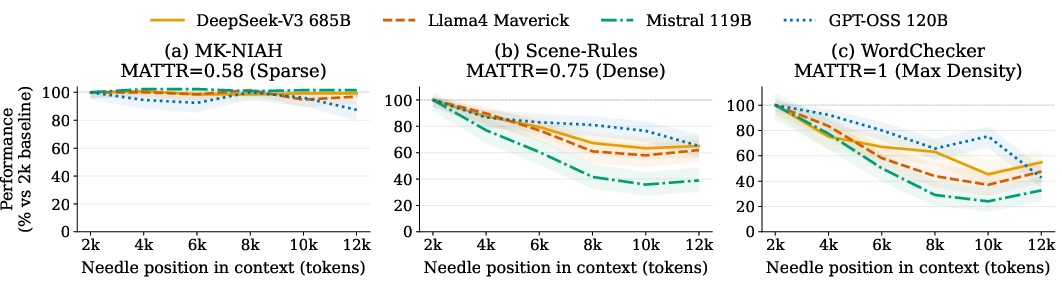
Figure 1: High retrieval scores persist on sparse MK-NIAH, but collapse sharply on denser Scene-Rules and WordChecker, illustrating density as a principal variable in long-context breakdown.
Key numerical findings:
- On MK-NIAH, average accuracy drop between the earliest and deepest positions is negligible (+1%).
- On Scene-Rules (MATTR ≈ 0.75), performance falls by 27% on average.
- On WordChecker (MATTR = 1.0), the average decline reaches 31% at 12k tokens.
Notably, this degradation occurs even when reasoning is minimal (WordChecker), establishing that density-induced collapse is not solely a function of semantic complexity.
Controlled Density Manipulation
To isolate density effects from other confounding dimensions, each benchmark undergoes a series of within-benchmark "sparsification" interventions: distractor items are repeatedly sampled to synthetically lower MATTR while holding task structure, context length, and position fixed.
Results reveal that reducing lexical density restores model performance by 11–30% relative to maximum density. In Scene-Rules, this improvement is monotonic across the density spectrum. In WordChecker, non-monotonic trends are traced back to specific model heuristics (e.g., deduplication and iterative search), yet the maximally sparse configuration still recovers high performance.
Mechanistic Analysis of Failure
Decompositional analysis on the ultra-dense WordChecker setting elucidates the architectural correlates of density failure:
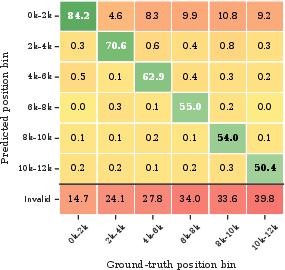
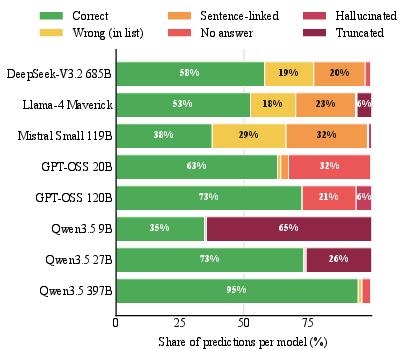
Figure 2: Predicted vs. ground-truth needle positions on WordChecker reveal a systematic bias: as the needle moves deeper, models increasingly (and erroneously) attend to earlier context segments.
Distinct failure modes are observed:
- Conflation: Models confuse distractor and query words as density/position increase.
- Abstention: Some LLMs refuse to answer under high density and deep placement.
- Truncation/Loop Inversion: Certain architectures enter infinite-reasoning patterns, leading to output truncation before retrieval completes.
This suite of behaviors demonstrates that the nature—not just the rate—of failure is density-dependent and model-specific.
Post-Target Noise and Attention Robustness
Further ablation studies assess whether mere prompt truncation or distraction after the target (needle) exacerbates failures. Most competitive LLMs exhibit robust attention that is not swayed by post-target distractors even in high-density settings, with only a minority degrading sharply (cf. Qwen models, which drop from 85% to 50% on WordChecker with post-target padding).
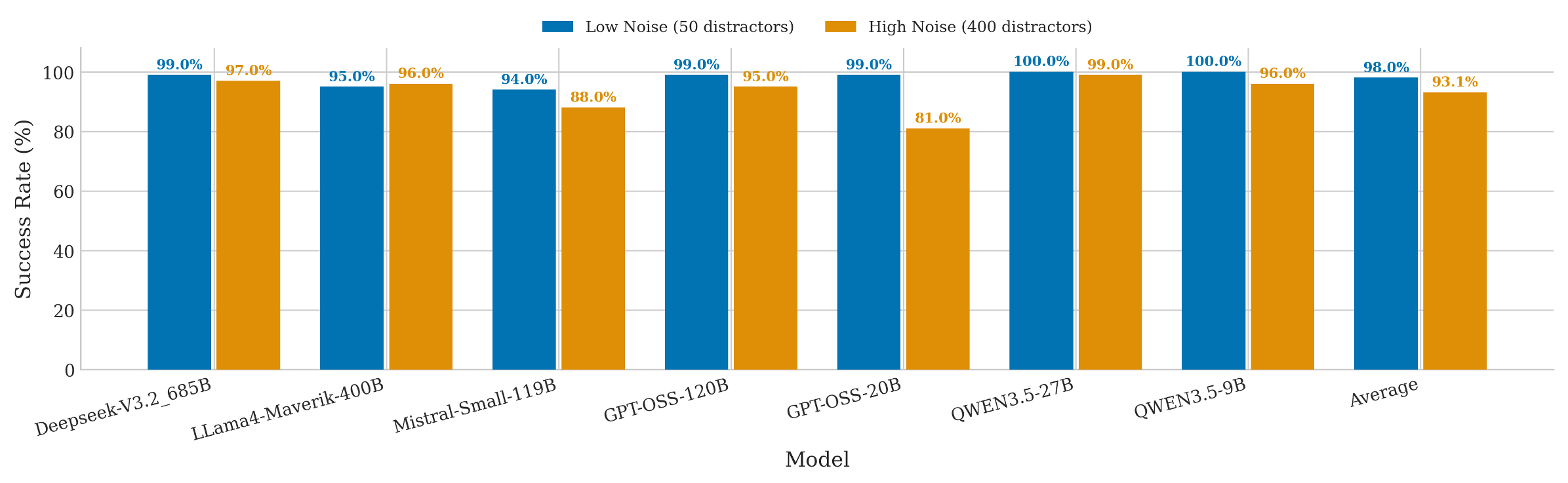
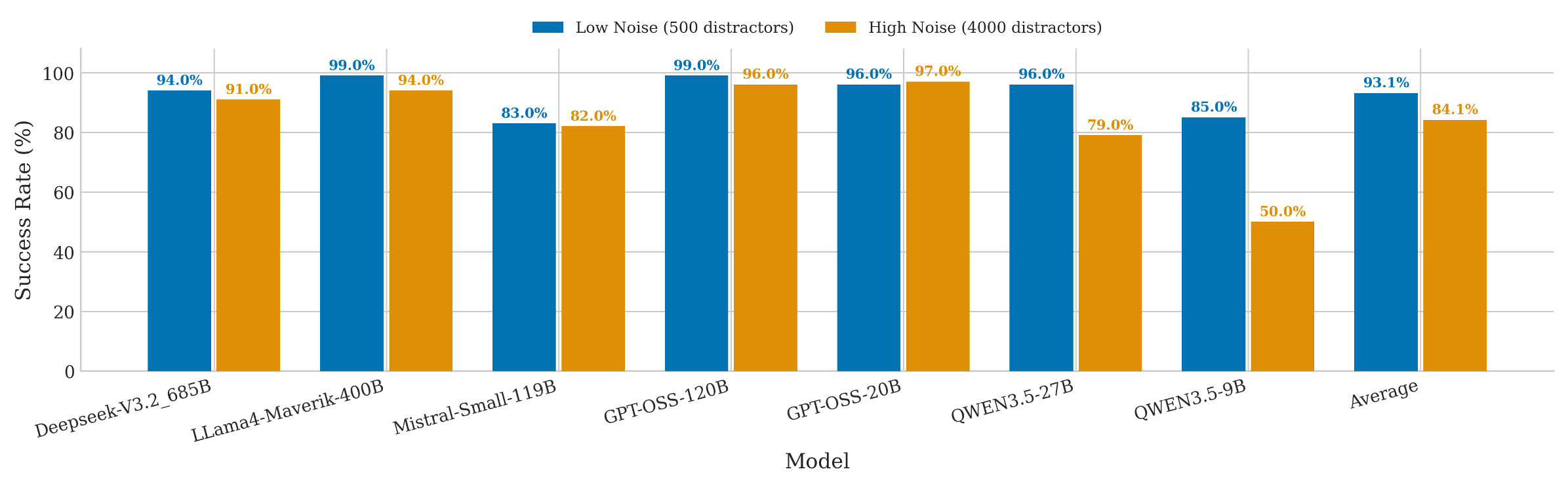
Figure 3: Comparison of retrieval under truncated and fully saturated post-target context; most models show minimal difference, evidencing stable early target locking in robust LLMs.
Implications, Limitations, and Theoretical Trajectory
These findings carry direct implications for prompt engineering, context compression, and upstream retrieval-augmented systems. Specifically, compression and chunking approaches may inadvertently amplify lexical density, causing an earlier collapse of effective context utilization than token limits alone would predict—a nontrivial concern for tasks involving technical, configuration, or structured contexts with inherently high MATTR.
Opportunities for future research include:
- Mechanistic studies tracing circuit-level attention allocation under density stress.
- Developing information-theoretic measures beyond type-token proxies, capturing semantic—as opposed to solely lexical—redundancy.
- Engineering mitigation strategies, such as density-aware training or adaptive context expansion, to robustify retrieval in dense regimes.
Conclusion
This work establishes lexical density, measured at the context level, as a causal axis constraining LLM performance in long-context scenarios, co-equal with and orthogonal to length and positional variables. The introduction of density-controlled benchmarks and ablation protocols surfaces distinctive model-family failures, providing both a new diagnostic for evaluation and a target for architectural refinement. Any roadmap for true long-context scaling must explicitly account for the information rate, not just the token budget—especially when compact, information-rich inputs predominate (2606.06203).