- The paper demonstrates that intermediate-mass progenitors with non-degenerate cores produce long-period, massive white dwarfs via stable mass transfer.
- The paper employs extensive binary evolution calculations with varied donor masses, mass-transfer schemes, and metallicities to map detailed stability regimes.
- The paper shows that metallicity and mass-transfer prescriptions critically reshape the observable mass–orbital period relations, challenging canonical common envelope models.
Introduction and Motivation
The evolution of close binary systems fundamentally alters the end states of their stellar members, especially regarding the formation of white dwarfs (WDs) and the characteristics of their binary orbits. Two principal formation channels are dominant: common envelope evolution (CEE) and stable mass transfer. While CEE typically produces short-period compact systems, stable mass transfer yields a wider range of orbital configurations. The mass–orbital period (MWD–Porb) relation is a powerful diagnostic, encoding information about the formation channel, donor mass, and metallicity.
This study rigorously examines the MWD–Porb distribution for systems formed via stable mass transfer, with a focus on resolving observed discrepancies in long-period, high-mass WD binaries not explained by canonical models based on low-mass progenitors. Extensive binary evolution calculations with MESA are employed, and the quasi-adiabatic stability criterion is utilized to identify systems where mass transfer remains stable.
Methodology
A comprehensive grid of binary models is constructed, spanning donor masses from 1.0M⊙ to 4.0M⊙, accretors of 1.4M⊙ (NS/MS) and 2.3M⊙, and initial orbital periods from 3 to 1950 days. Wind mass-loss prescriptions, mixing-length theory, convective overshooting, and four metallicities (Z⊙,0.1Z⊙,10−3Z⊙,10−4Z⊙) are considered.
Two mass-transfer schemes—Kolb and Han—are contrasted, revealing substantial differences in stability regimes and final period distributions. Mass-transfer efficiency is parametrized via β, and Eddington-limited accretion as well as X-ray radiation effects are implemented for NS accretors; for MS accretors, higher mass-transfer efficiency (Porb0) is adopted, and radiative effects are neglected.
The quasi-adiabatic criterion is applied to ensure models are not contaminated by unstable mass transfer, and the influence of metallicity and mass-transfer prescription on the parameter space for stable transfer is mapped in detail.
Physical Evolution and Mass-Period Relations
Binary evolution sequences exhibit distinct behavior depending on progenitor mass and metallicity. Low-mass progenitors typically develop degenerate helium cores and obey a well-defined core mass–radius relation, resulting in canonical Porb1–Porb2 relations. In contrast, intermediate-mass stars retain non-degenerate cores prior to central helium burning, accumulating core mass before substantial expansion, which shifts their final Porb3–Porb4 distribution to lower periods for a given WD mass.
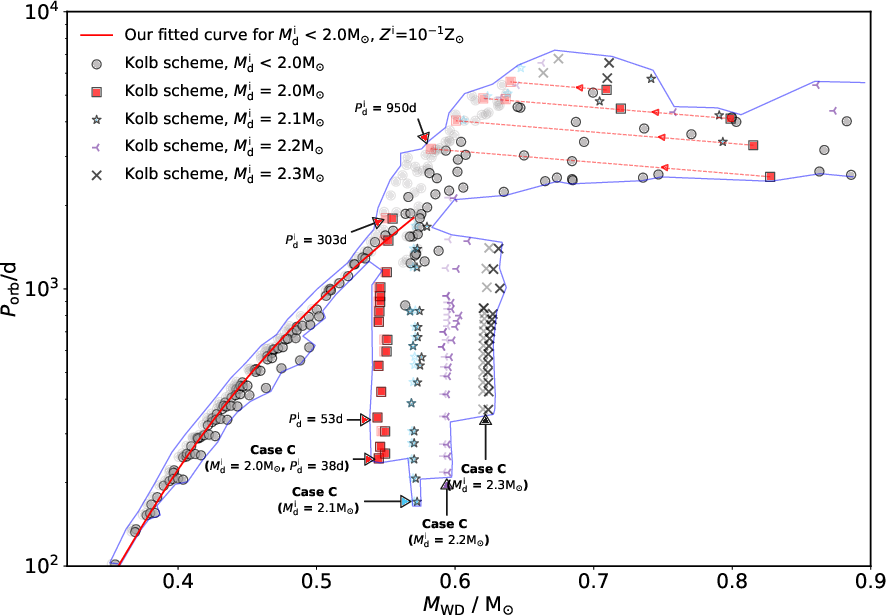
Figure 2: Comparison of the Porb5–Porb6 parameter space for different progenitor masses and metallicities, showing substantial vertical offset for intermediate-mass channels.
This effect is amplified at lower metallicity, where stars remain more compact and case-C mass transfer (AGB phase) occurs at shorter periods. Systems formed from intermediate-mass donors exhibit a notably vertical trend in the Porb7–Porb8 plane, diverging from canonical relations derived for degenerate core donors.
Numerical Results and Schematic Structure
Adopting the Kolb scheme, the authors provide robust fits for Porb9–MWD0 relations as a function of progenitor mass, metallicity, and mass-transfer prescription. The Han mass-transfer scheme drives higher rates, destabilizing transfer in intermediate-mass systems and yielding very little stable parameter space for such donors.
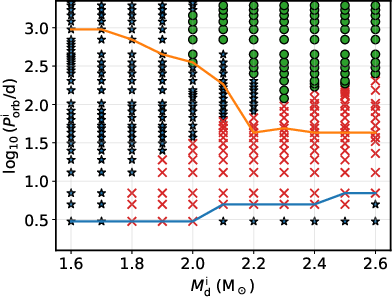
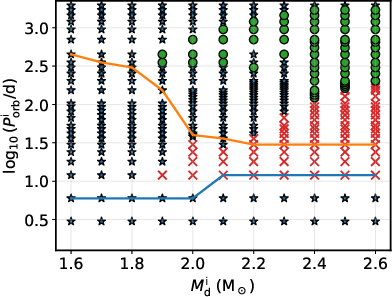
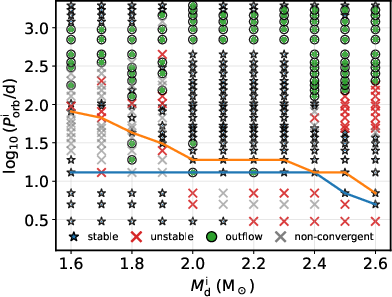
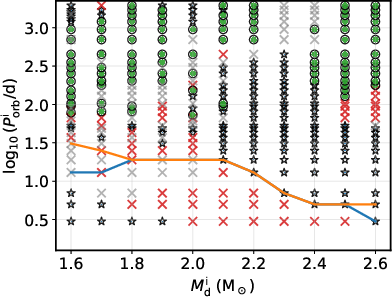
Figure 4: MWD1–MWD2 relations with metallicity dependence, illustrating how a drop in MWD3 lowers the period for given WD mass.
Strong metallicity dependence is confirmed: as metallicity decreases, the relation shifts downward, both owing to structural compactness and lower core degeneracy thresholds.
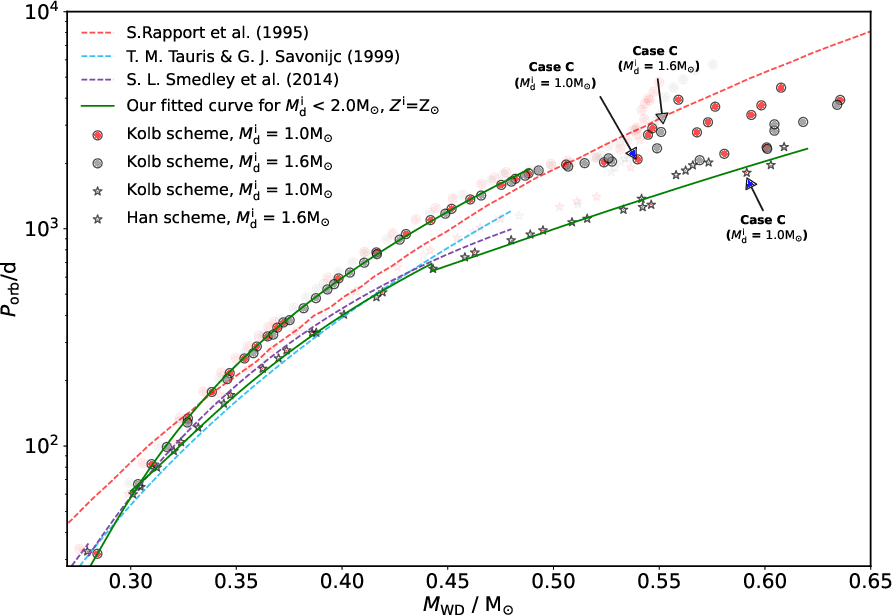
Figure 6: Comparison of the MWD4–MWD5 distribution across mass-transfer schemes and accretor types.
Models demonstrate that long-period, massive WD binaries (e.g., B0820+02, KIC 06233093) occupy regions of the MWD6–MWD7 parameter space only explainable via intermediate-mass progenitors with stable mass transfer—contradicting the assumption that such systems require CEE.
Observational Comparison
A detailed comparison is carried out between model predictions and observed samples (WD+NS and WD+MS binaries, Gaia DR3 WD+MS catalog). Many long-period, high-mass systems (especially those characterized as self-lensing binaries or identified in Gaia DR3) lie substantially below the canonical MWD8–MWD9 relation derived for low-mass, degenerate-core progenitors.
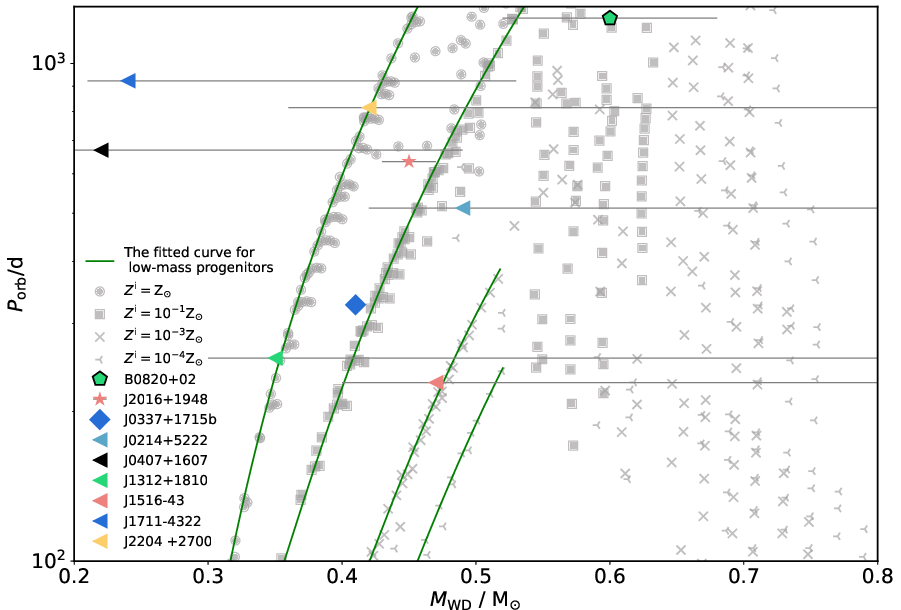
Figure 8: Overlay of observed WD binary parameters and theoretical models, highlighting systems that are only explained by intermediate-mass stable transfer channels.
Gaia DR3 wide binaries are also covered by the expanded intermediate-mass stable transfer parameter space, though definitive formation channel assignments remain uncertain due to limitations in treating extreme mass ratios and Porb0 mass loss.
Astrophysical Implications and Model Limitations
The expanded Porb1–Porb2 distribution for stable mass transfer among intermediate-mass progenitors necessitates significant revision of binary population synthesis assumptions, especially regarding the prevalence of CEE compared to stable mass transfer. Both mass-transfer prescription and metallicity play a critical role in shaping the observable population. The authors demonstrate with explicit model results that the final Porb3–Porb4 location is decoupled from accretor mass/effects under the explored parameter regimes for intermediate-mass donors. The results also suggest that Porb5 mass loss can remain both dynamically and thermally stable at extreme mass ratios, but further work is required to delineate the onset of true CEE and the impact of modified mass-transfer rates.
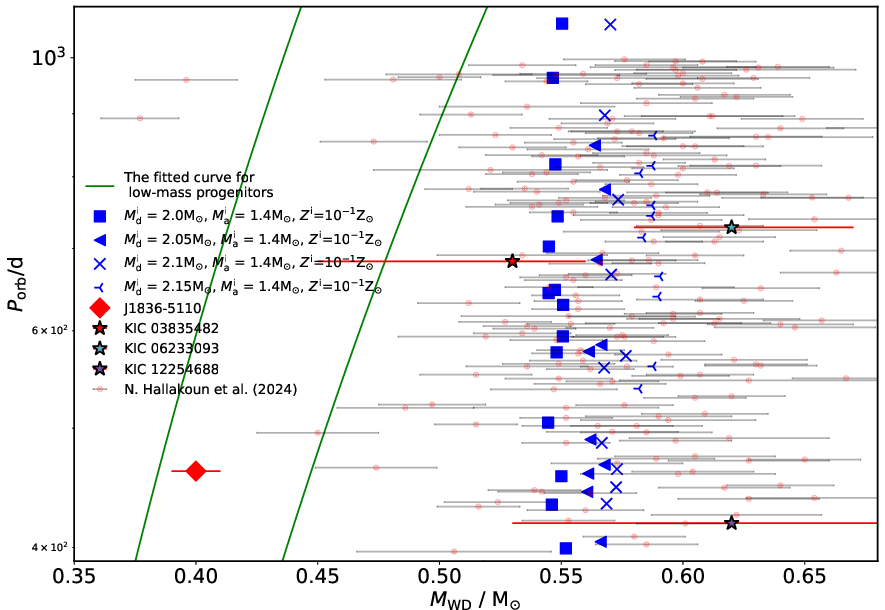
Figure 10: Expanded theoretical Porb6–Porb7 space for intermediate-mass progenitors vs. observed binary distribution from Gaia DR3 and self-lensing systems.
Conclusion
This paper provides a thorough computational and theoretical analysis of the Porb8–Porb9 distribution for massive WDs formed via stable mass transfer. The results establish that intermediate-mass progenitors with non-degenerate cores prior to central He burning explain the presence of long-period, massive WD binaries previously considered outliers to canonical models. Strong metallicity dependence is confirmed, and mass-transfer scheme effects are quantified. The findings challenge the prevailing narrative that CEE is required for the formation of wide, massive WD binaries and highlight the need for refined binary evolution prescriptions, specifically targeting mass loss via the outer Lagrangian points at extreme mass ratios. Further high-fidelity modeling will be needed to map the exact boundaries between stable mass transfer and CEE, especially in the context of the rapidly growing population of wide WD binaries observed in large-scale surveys.