Adaptive state-action abstractions via rate-distortion
Published 4 Jun 2026 in cs.LG and stat.ML | (2606.06123v1)
Abstract: When learning to walk, infants seem to address a coarse version of the problem first - stay upright, reach the caregiver - and refine it only when further practice at that resolution stops paying off. Reinforcement learning offers multiple techniques for building simple versions of complex tasks, but lacks general principles for how to dynamically adjust the granularity of these abstractions during learning. This paper proposes one such principle: refine the abstraction as soon as the learning error within it becomes comparable to the error induced by the abstraction itself. Here, we investigate one way of formalising this principle via a performance certificate that decomposes value error into two terms: a learning error bound captured by a Bellman residual, and an abstraction error bound given by a bisimulation metric. The resulting switching strategy is implemented by soft state-action abstractions built from rate-distortion principles, whose resolution along state and action axes can be continuously adjusted. We validate this construction in a range of tabular settings, showing that near-optimal performance can be achieved under substantial lossy compression of state and action information.
The paper introduces an adaptive rate-distortion method that refines state-action partitions when Bellman residuals match abstraction errors.
It employs soft, stochastic abstraction techniques to continuously tune MDP abstractions and quantify the compression–distortion trade-off.
Empirical results show that the adaptive framework achieves near-optimal RL performance with a significantly reduced state-action space.
Adaptive State-Action Abstractions via Rate-Distortion
Problem Motivation and Conceptual Framework
The paper "Adaptive state-action abstractions via rate-distortion" (2606.06123) introduces a principled approach for dynamically calibrating the granularity of state-action abstractions within MDPs using rate-distortion theory. Existing RL abstraction frameworks usually fix their state or state-action partitions a priori or refine only based on transitions or verification counterexamples, often failing to flexibly manage the trade-off between computational resources and optimal policy fidelity during learning.
This work formalizes the following criterion: refine an abstraction only when the within-abstraction learning error (Bellman residual) falls to the scale of the error induced by the abstraction (as quantified by bisimulation-induced distortion). The resulting framework is instantiated with soft (stochastic) abstractions parametrized via rate-distortion, yielding a continuous family of refinements, and introduces practical adaptive algorithms for their deployment in planning.
Formalization: Soft State-Action Abstraction and Error Decomposition
The central technical apparatus is a soft abstraction mechanism, generalized from MDP homomorphisms, that utilizes stochastic encoders and decoders over states and actions. Explicitly, an abstraction is defined by a tuple of stochastic encoders (νS,νA) and decoders (ηS,ηA), inducing the abstract MDP via expectation over rewards and transitions. This enables abstraction resolution to be continuously tuned rather than relying on hard partitions.
The paper’s main theoretical result is an explicit decomposition of value error for abstract MDP planning:
where Tˉ† is a lifted Bellman operator, and the abstraction error is bounded by a bisimulation-type (Hausdorff) metric. This establishes a control certificate separating error due to incomplete planning in the abstraction versus error inherent to the chosen compression.
The criterion for adaptive refinement thus becomes straightforward: begin with a coarse abstraction, refine the abstraction only when the empirical Bellman residual matches or falls below the abstraction error floor. This prescription is amenable to sample-based and online implementations.
Rate-Distortion Abstraction and the Adaptive Procedure
To operationalize adaptive abstractions, the paper deploys a rate-distortion objective, where the loss comprises both information cost (mutual information between original and compressed state-actions) and average reconstruction distortion:
ν,gminIμ(Sˉ;S)+λIμ(Aˉ;S,A∣Sˉ)+βΔˉμ(ν,g)
The parameter β controls the abstraction–distortion trade-off: low β induces maximal compression (high induction of error), while high β prioritizes low distortion (fine abstractions).
A practical adaptive scheme proceeds as follows:
Estimate a Bellman-compatible pairwise distortion (e.g., via bisimulation metrics).
Optimize the rate-distortion abstraction for a low initial β.
Plan within the induced abstraction until the Bellman residual reaches the abstraction error bound.
Increase β and repeat, progressively refining abstraction only as much as is empirically warranted.
This construct generalizes and subsumes many existing abstraction frameworks, including state aggregation, MDP homomorphisms, and various policy-conditioned abstraction methods, as constrained or limiting cases.
Empirical Evaluation
The framework is extensively evaluated on classical tabular RL domains (Four Rooms, Taxi, and MiniGrid-style DoorKey) and a factored, scalable SysAdmin benchmark. Results are presented in the context of the compression-distortion trade-off and the adaptive trajectory of abstraction selection.
The empircial findings substantiate several claims:
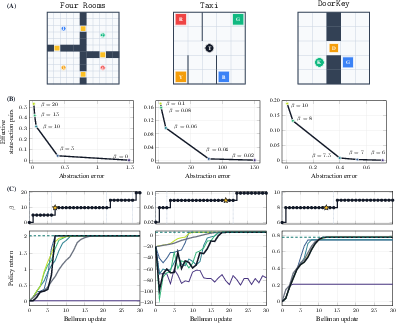
The rate-distortion frontiers are well-structured: as (ηS,ηA)0 increases, abstraction error reliably decreases, at the cost of increased effective state-action alphabet size.
Figure 1: Compression–distortion frontiers and adaptive trajectories demonstrate that increasing (ηS,ηA)1 produces finer abstractions and lower distortion; adaptive schemes reliably track efficient frontiers for all benchmarks.
In all benchmarks, the adaptive procedure discovers abstractions that achieve near-optimal policy performance with significant lossy compression (i.e., far fewer effective state-action pairs than the ground-truth bisimulation partition or exact MDP homomorphism).
The distribution of abstracted information across states and actions reveals task-specific regularities. For instance, in Four Rooms, maximal compression occurs on states; in Taxi, action compression dominates; and in DoorKey, the abstraction compresses both state and local action sets, reflecting compositional structure.
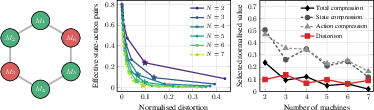
In the SysAdmin scaling test, the framework compresses more aggressively as the number of machines grows, and the abstraction features correlate with human-interpretable local ring structure motifs.
Figure 2: SysAdmin scaling: Larger systems admit higher rates of abstraction, and compression targets local motifs and action relevance, rather than global enumeration.
Claims, Implications, and Future Developments
The paper’s key claim is that RL agents can employ state-action abstractions that adapt to the current estimation and environmental limitations, thus utilizing only as much representation capacity as needed for optimal or near-optimal task achievement. This contrasts with bisimulation or homomorphism-based methods, which may retain unnecessary distinctions and thus require larger memory or compute.
The separation of value error and abstraction error in the control certificate highlights the practical importance of distinguishing current suboptimality due to planning from irreducible error due to model compression. This distinction is central for scalable RL and supports efficient planning, representation learning, and memory-limited agent design.
In practice, this line of work has significant implications for:
Designing scalable infrastructures for deep RL and model-based planners that can exploit environmental regularities in arbitrary domains.
Task-driven representation learning, where decisions regarding which distinctions to preserve are made adaptively rather than via heuristics or fixed taxonomies.
Interpretability, as the decomposition of abstracted information can be analyzed to diagnose which aspects of the task or controller demand more bits (i.e., which state or action features are “hard” to compress).
Transfer and continual learning, since separating out action or state invariances equivariances provides a path for generalizing across related domains or tasks.
Future work may extend these principles into model-free, sample-based RL, as well as deep RL scenarios, where Bellman residuals and abstraction errors must be approximated online. Extensions to hierarchical temporal abstractions (options framework) are also indicated as a compelling direction.
Conclusion
This study establishes that adaptive, rate-distortion-based state-action abstraction enables RL agents to recover near-optimal performance with dramatically reduced representational complexity. The theoretically grounded separation of learning and abstraction errors provides operational criteria for resolution refinement, with strong empirical support across both classic and scaling benchmarks. This framework offers a rigorous path towards more interpretable, efficient, and scalable abstraction in reinforcement learning and lays foundations for further integration into deep RL and continual learning paradigms.