The Dignity-Centric Stack: A Commons-Governed, Horizontally Federated Architecture for Human-Dignity AI
Abstract: The human-dignity-centric digital social contract grounds personal data in human dignity, data personalism, and data sovereignty, and articulates six dimensions of data governance: technological oversight, automation limits, economic justice, political legitimacy, social cohesion, and legal guarantees. It presupposes, however, that enforcement falls to State regulators, licensed fiduciaries, and multi-stakeholder bodies embedded in existing legal systems. This paper asks whether its normative content can instead be realized not as rules imposed on the owners of the AI stack from without, but as a commons-governed infrastructure that any person, firm, or State may use and fund while its governance stays horizontal, polycentric, and subsidiary. We construct the Dignity Stack, a six-layer architecture mapping each dimension onto a layer of commons-governed AI infrastructure, with protocols drawn from the Liberation Stack framework and from the cooperative, mutualist, and libertarian-municipalist traditions. The commons is State-agnostic rather than anti-State, anarchist in its horizontal means but not in the abolition of the State. Its central device is a decoupling of capital from control, by which the stack functions as a shared civic battery, charged by many contributors yet steered by none in proportion to its charge. We prove that this defeats formal capture through votes or surplus, and show that structural capture, the leverage of a dominant supplier free to withdraw what it provides, is resisted only insofar as operational supply is polycentric and substitutable, a condition demanding at the lower layers and perhaps presently unattainable at chip fabrication. We conclude, with explicit attention to its limits, that commons-governed AI realizes the values the contract proclaims more faithfully than the regulation it presupposes.
Paper Prompts
Sign up for free to create and run prompts on this paper using GPT-5.
Top Community Prompts
Explain it Like I'm 14
What this paper is about (in simple terms)
This paper asks: Can we build and run AI in a way that always respects people’s dignity, not just by making laws, but by designing the whole AI system so communities themselves can govern it?
The authors propose a new way to organize AI called the “Dignity Stack.” Think of it like a layered cake of rules and communities, where each layer protects a different value (like fairness or participation). Instead of letting big companies or a single government control the “cake,” the Dignity Stack is run like a community garden: anyone can help plant and water, but no one gets to own or control it just because they gave more seeds or tools.
The main questions the paper tries to answer
- Can the big promises in “human-dignity” data rules (like meaningful consent, fair benefits, and real participation) be enforced by the people affected, not just by outside regulators?
- Is there a practical way to let governments, companies, and everyday people use and fund shared AI tools without handing control to the biggest funder?
- What would a community-run AI system look like, layer by layer, and where are its limits?
How they approach the problem
The paper builds an approach using ideas from three places:
- Human dignity: People must never be treated “merely as a means” (like raw data to be mined). People should have ongoing, real, revocable choice.
- Personalism (being a person-in-community): We are who we are in relation with others. So data rules should support real communities, not replace them with distant bureaucracies or black-box algorithms.
- Contextual integrity: Information should stay within its proper social context (for example, health data shouldn’t secretly slide into advertising or policing).
To turn these values into a working system, the paper proposes:
- A commons-governed architecture: “Commons” means shared resources managed by the people who use them (like a community garden). “Horizontal” means no single boss sits on top. “Polycentric” means many small centers make decisions locally. “Subsidiarity” means decisions are made as close as possible to the people affected.
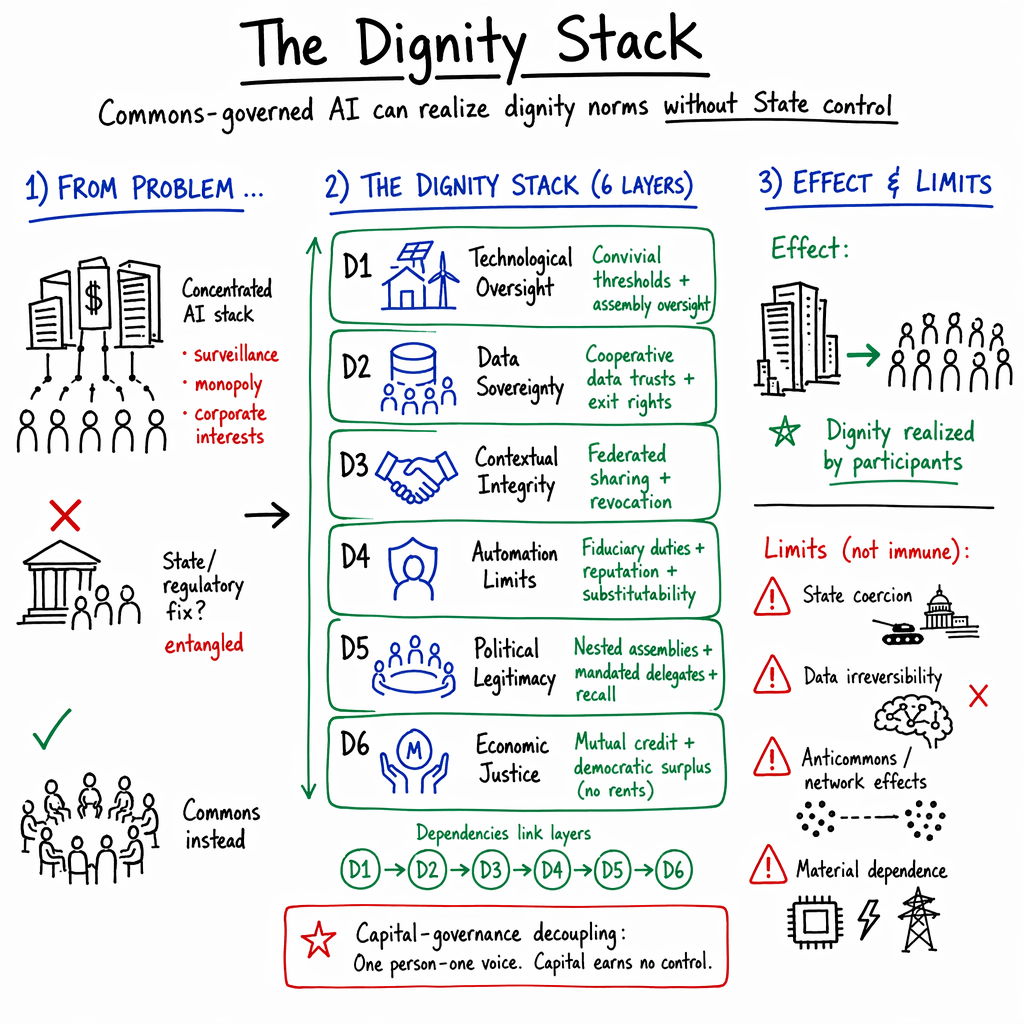
- Decoupling money from power: You can help fund the system, but you don’t get extra votes because you paid more. The authors call this a “shared civic battery”: lots of people can charge it, but no one person gets to steer it just because they charged it more.
- A six-layer “Dignity Stack” that maps values to practical rules and institutions at each layer.
To keep things concrete, the paper also uses “operational checks.” For example, one check says a community should be able to understand, power, and quickly shut down its AI system if needed. If you can’t turn it off faster than you can hold a meeting to decide to turn it off, your AI is too big for your community.
The Dignity Stack (the six layers, in everyday language)
Below is a short, plain-language tour of the six layers. Each layer is governed by the people it affects, using voluntary rules that fit the value of that layer.
- D1 Technological Oversight: Build AI at a “convivial” scale—small and understandable enough that your community can power it, make sense of it, and shut it down quickly. Think “tools that serve people,” not “machines people must serve.” Decisions happen in local assemblies (town-hall style).
- D2 Data Sovereignty: People and groups hold their data in cooperative data trusts (like a credit union for your data). Clear, open protocols let you leave (“exit”) if you don’t like how your data is used, and take your data (and rights) with you.
- D3 Social Cohesion: Communities share data with one another through federations only when it helps mutual aid (for example, public health across towns). If norms are broken, a community can revoke sharing. This helps keep information in its right context.
- D4 Automation Limits: Set firm limits on what should and shouldn’t be automated. Operators make public promises (like “fiduciaries,” meaning genuine caretakers), and people have strong exit rights if trust is broken. Reputation and substitution (others can replace a failing operator) keep power in check.
- D5 Participatory Governance: Use nested assemblies (small groups elect and recall delegates) to make decisions from the bottom up. Mandates (clear missions) and recall (removing delegates who drift) prevent hidden power-building.
- D6 Economic Justice: Share the benefits. Use mutualist tools (like mutual credit and co-op revenue-sharing) so value flows back to the people whose data, labor, and communities make AI possible—not just to capital.
What they found and why it matters
Here are the big takeaways, explained plainly:
- Commons governance can make dignity real, not just a slogan. When communities can power, understand, and shut down their AI tools, they truly control them. That’s stronger than checking boxes for a distant regulator.
- Funding doesn’t buy control. By “decoupling capital from control,” the system avoids “formal capture” (where the biggest funder wins the vote or skews the rules). You can help pay, but you can’t buy steering rights.
- But there’s a catch: “structural capture.” If one supplier is the only source for something crucial (like a special chip) and can threaten to walk away, they still have leverage. This is only fixable if supply is “polycentric and substitutable” (many sources, easy to switch). Today, that’s hard at the very bottom of AI (like chip manufacturing).
- Layered design helps prevent abuse. Matching each value (like consent or fairness) to its own layer and governance tools makes it harder for one powerful actor to dominate everything at once.
- It’s state-agnostic, not anti-state. Governments can use and fund the system, but they don’t get special control just for being the state. The same goes for companies.
What this could change (implications)
- Stronger, everyday control: Communities can actually steer their AI, not just complain after harm happens. That makes “human dignity” practical.
- Fairer economics: People and communities who provide the data, energy, and care get a fair share of the benefits.
- Safer data flows: Because decisions are local and context-based, it becomes structurally harder for data to leak into the wrong hands or purposes.
- Real limits on automation: The system builds in brakes—what must stay human, and who decides—so we don’t slide into “automate everything because we can.”
- Honest boundaries: The authors are clear that some things are still hard—like breaking chip monopolies, avoiding “too many vetoes” (gridlock), or preventing hidden power in leaderless groups. Knowing these limits helps communities design better safeguards from the start.
In short, the paper’s message is hopeful and practical: if we build AI like a shared civic utility—funded by many, steered by none alone, and governed close to the people it affects—we can keep human dignity at the center, not as an afterthought but as the operating principle.
Knowledge Gaps
Below is a concise, action-oriented list of the paper’s unresolved knowledge gaps, limitations, and open questions.
- Operationalization of convivial thresholds: define measurable indicators and audit methods for E(A), G(C), K(A), U(C), T_dismantle, and T_assembly; establish reference ranges and community-calibrated measurement protocols.
- Epistemic capacity mapping: develop practical methodologies to estimate K(A) and U(C) (community technical competence) without imposing prohibitive assessment burdens or expert gatekeeping.
- Assembly cadence vs. system agility: empirically test whether T_dismantle ≤ T_assembly is achievable for real AI deployments, including rollback mechanics and emergency shutdown procedures.
- Verification predicates V_i: specify concrete, testable criteria and auditing tooling for each v_ij; create checklists, metrics, and automated compliance harnesses that communities can run.
- Inter-layer dependency function Φ: formally enumerate and validate all dependencies; analyze failure propagation and design isolation mechanisms to prevent cascades from lower to upper layers.
- Formal proof of “decoupling capital from control”: fully state assumptions, adversary models (vote buying, bribery, collusion, cartelization, sybil attacks), and game-theoretic analysis; provide impossibility boundaries.
- Structural capture quantification: develop substitutability indices and concentration metrics across power, bandwidth, chips, and hosting to judge when “no single source is indispensable.”
- Chip-layer feasibility: assess realistic pathways to polycentric, substitutable supply at fabrication and accelerator design (e.g., open PDKs, RISC‑V, advanced packaging, lagging-node strategies) and identify minimum viable thresholds.
- Energy sovereignty at scale: model localized renewable generation and storage profiles needed for training/inference; quantify grid dependency and curtailment risks for community AI clusters.
- Network effects and exit costs: measure and mitigate switching frictions in federated governance (data gravity, API dependencies, identity lock-in); design migration protocols and escrow for exit.
- Identity and sybil resistance: design privacy-preserving proof-of-personhood suitable for horizontal governance; evaluate inclusion risks and defenses against identity fraud and plutocratic capture.
- Minority protections: specify mechanisms (e.g., consent quora, veto domains, rights charters) that prevent majoritarian harms in assemblies while preserving decisional efficiency.
- Cross-context and cross-commons dispute resolution: define arbitration layers, jurisdictional boundaries, and appeals processes when contextual integrity claims conflict across federations.
- Contextual integrity enforcement-by-architecture: prototype technical controls (data flow constraints, context tags, purpose binding, capability-based access) that reduce reliance on ex post legal remedies.
- Model unlearning and data irreversibility: develop operational protocols and guarantees for removing personal data from trained models; evaluate feasibility, costs, and residual risk in federated settings.
- Safety and abuse response: specify decentralized incident response, red-teaming exchanges, and recall procedures for harmful models/agents without centralized kill switches.
- Economic layer viability: stress-test mutual credit and surplus allocation under high-capex regimes (compute, facilities); design credit risk management, clearing across federations, and anti-default safeguards.
- Capital attraction without control: identify instruments (non-governance-bearing capital, capped-return notes, revenue-share without votes) and empirically test whether they can finance heavy infrastructure sustainably.
- Interoperability with incumbents: define APIs, legal interfaces, and procurement templates that let States/firms contribute resources “charge without steer,” including verifiable non-control covenants.
- Legal personality and recognition: map the minimum legal scaffolding needed (association rights, limited liability, tax status) in multiple jurisdictions; plan for hostile or non-recognizing States.
- Compliance with IP and export controls: analyze how commons operations interface with IP licensing, model weights distribution, and geopolitical export regimes without reintroducing centralized chokepoints.
- Governance scalability: evaluate nested assemblies’ throughput, latency, and decision quality at different sizes; compare to alternative federative designs (sortition councils, quadratic voting, liquid delegation).
- Anti-structurelessness safeguards: codify minimal structure (roles, mandates, accountability, rotation, transparency) and test whether it avoids “hidden hierarchies” while remaining horizontal.
- Anticommons risk management: design coordination and consolidation protocols (option-to-merge licenses, shared stewardship pools) to prevent permission gridlock across many rights-holders.
- Measurement of dignity outcomes: define empirical indicators for non-instrumentalization, meaningful consent, relational personhood, and contextual integrity; run comparative studies vs. regulatory baselines.
- Inclusivity and digital divide: develop processes, training, and tooling that enable low-resource communities to meet K(A) and governance demands; evaluate costs and support programs.
- Environmental impacts beyond energy: assess lifecycle emissions and material footprints (hardware manufacturing, e‑waste) under commons provisioning; propose circularity and refurbishment strategies.
- Security and supply-chain integrity: specify trust models, firmware/open-hardware requirements, attestation, and update channels compatible with polycentric ownership.
- Data contribution consent and scope: resolve edge cases (inferred, relational, communal, and indigenous data), intergenerational consent, and diaspora participation within the sovereignty layer.
- Federated learning fit: prototype protocols for context-bound gradient sharing, contribution accounting, and consent revocation in horizontally governed federations.
- Roadmapping and pilots: outline minimal viable instantiations of each layer, cross-layer integration milestones, and evaluation plans; gather case studies from existing commons to validate assumptions.
Practical Applications
Immediate Applications
These applications can be piloted or deployed today with existing legal forms, open-source tooling, and standard procurement or research workflows.
- Community AI oversight with “convivial threshold” checks
- Sectors: municipalities, education, healthcare, libraries, cultural institutions, NGOs
- Tools/products/workflows: adopt a “dignity-by-design” checklist plus three convivial checks (energy self-provision, in-house auditability, decommission time ≤ assembly decision time); add requirements to RFPs and IRB protocols; create kill‑switch and rollback procedures; publish energy and governance dashboards; use local/open models sized to team capacity
- Assumptions/dependencies: community or institutional assembly with decision cadence; transparent power metering; access to open models; willingness to set size limits on systems and vendors
- Cooperative data trusts for domain‑specific data stewardship
- Sectors: healthcare, education, social services, agriculture, civic tech
- Tools/products/workflows: set up co‑op/foundation data trusts; standard consent flows (UMA/OAuth2), data use licenses, purpose binding; independent trustees; periodic member referenda; audit logs; Data Use Ontologies embedded in pipelines
- Assumptions/dependencies: legal recognition of co‑ops/foundations; DPA templates; operational funding; member recruitment and legitimacy
- Federated mutual-aid data collaboration
- Sectors: healthcare (cross‑hospital learning), finance (fraud), manufacturing (predictive maintenance), public health
- Tools/products/workflows: federated learning stacks (e.g., PySyft/OpenMined), secure aggregation, differential privacy; federation charters defining join/exit rights and revocation; dataset/model cards include context norms
- Assumptions/dependencies: privacy engineering expertise; interoperable schemas; opt‑out/exit codified; incentives for contributions
- Voluntary fiduciary commitments with enforceable exit rights
- Sectors: software/SaaS, consumer apps, govtech
- Tools/products/workflows: provider charters that bind use to stated purposes; standardized user exit including data export, consent revocation, and model unlearning where feasible; third‑party monitors; reputation registries
- Assumptions/dependencies: contract templates; feasible unlearning or compensatory remedies; independent oversight accepted by vendors
- Participatory AI governance via nested assemblies
- Sectors: cities, universities, school districts, hospital networks, professional associations
- Tools/products/workflows: citizen/staff assemblies (Decidim, Loomio, Polis) with mandate/recall; working groups for data, model, and deployment decisions; public registries of systems and decisions
- Assumptions/dependencies: facilitation capacity; clear scope of authority; transparency norms; budget/time allocation
- Capital–control decoupling in AI ventures and labs
- Sectors: AI startups, research labs, platform cooperatives
- Tools/products/workflows: steward‑ownership, non‑voting investor shares, capped returns; constitutional bylaws separating surplus claims from governance; community “golden share” or foundation veto on purpose drift
- Assumptions/dependencies: jurisdiction allows steward‑ownership/non‑voting classes; investor acceptance of capped economics; enforceable charters
- Governance‑aware MLOps
- Sectors: software/ML platforms, safety/compliance
- Tools/products/workflows: model/dataset registries that carry governance metadata (purpose, consent scope, revocation rules); CI/CD gates for consent changes and assembly approvals; audit‑ready logs
- Assumptions/dependencies: integration into existing pipelines; agreement on minimal metadata standards
- Commons‑governed research consortia
- Sectors: academia, public interest research, precompetitive industry consortia
- Tools/products/workflows: shared model and data commons under co‑op/foundation governance; contribution/accounting rules; publication and sharing norms tied to contextual integrity
- Assumptions/dependencies: funder alignment; IP frameworks (open licenses with use restrictions); conflict resolution procedures
- Mutual credit for data/compute contributions within consortia
- Sectors: research networks, SME clusters, platform co‑ops
- Tools/products/workflows: lightweight internal ledgers (Open Collective/CObudget/SourceCred) to track data, labeling, compute, and moderation; periodic netting; surplus allocation rules
- Assumptions/dependencies: agreement on valuation formulas; accounting and tax treatment; modest scale to start
- Procurement clauses for dignity and sovereignty
- Sectors: public sector, large nonprofits, universities
- Tools/products/workflows: standard clauses requiring convivial thresholds, exit rights, open interfaces, substitutability of providers, and community oversight; vendor scorecards
- Assumptions/dependencies: procurement authority buy‑in; market of compliant vendors; measurable criteria
- Community‑run AI services powered by local renewables
- Sectors: libraries, community centers, rural health, adult education
- Tools/products/workflows: edge inference on co‑op‑owned micro‑data centers; small LLMs for tutoring, translation, assistive tech; solar/wind microgrids; local administrators trained to audit and decommission
- Assumptions/dependencies: modest compute demand; basic ops skills; capital grants or community financing
- Context‑aware consent and data “passports”
- Sectors: consumer apps, health/fitness, education platforms
- Tools/products/workflows: user dashboards showing context, purpose, and sharing norms; toggles to revoke and move data between context‑specific trusts; signed data receipts
- Assumptions/dependencies: interoperable consent standards; UX investment; truthful vendor reporting
- “Commons governance as a service” for SMEs and municipalities
- Sectors: govtech, compliance, managed services
- Tools/products/workflows: turnkey cooperative data trusteeship, assembly facilitation, governance registries, and MLOps controls packaged as a service
- Assumptions/dependencies: sustainable pricing; trust in provider neutrality; clear SLAs that don’t compromise governance autonomy
Long-Term Applications
These require further research, legal evolution, ecosystem scaling, or supply‑chain diversification before broad deployment.
- Polycentric, substitutable chip and accelerator supply
- Sectors: semiconductors, HPC, edge/embedded
- Tools/products/workflows: open silicon (e.g., RISC‑V) ecosystems, community/consortium fabs, open EDA; multi‑vendor abstraction layers to reduce lock‑in
- Assumptions/dependencies: massive capital; geopolitics; maturation of open EDA and IP blocks; safety/certification pathways
- Global “civic battery” for AI compute
- Sectors: cloud/edge, energy, research networks
- Tools/products/workflows: federated, commons‑governed compute pools tied to renewable microgrids; portability of workloads across co‑op clouds; contribution‑based allocation
- Assumptions/dependencies: interop standards; robust scheduling and billing; legal status for cross‑border commons
- Sectoral foundation models governed by data subjects
- Sectors: healthcare, agriculture, education, climate
- Tools/products/workflows: domain models trained via federated pipelines under data‑trust governance; formal purpose constraints; revocation-aware training with machine unlearning
- Assumptions/dependencies: effective unlearning at scale; stable privacy guarantees; sufficient domain data and compute in commons
- Protocol‑level contextual integrity
- Sectors: software, identity, data spaces
- Tools/products/workflows: context‑aware data routing and enforcement in infrastructure (policy‑carrying data, verifiable purpose tokens); automated boundary checks across services
- Assumptions/dependencies: standardized context taxonomies; secure attestation; widespread adoption
- Legal codification of data personalism and commons recognition
- Sectors: policy, judiciary, corporate law
- Tools/products/workflows: statutory data fiduciary duties, recognition of cooperative data trusts, enforceable purpose limitations, legal support for capital–control decoupling and steward‑ownership
- Assumptions/dependencies: legislative windows; harmonization across jurisdictions; case law development
- Convivial threshold metrics as standards
- Sectors: standards bodies, regulators, procurement
- Tools/products/workflows: certified methods to measure energy sovereignty, auditability, and decommissionability; conformity assessments; public labeling
- Assumptions/dependencies: consensus on metrics; accredited auditors; market pressure
- Large‑scale mutual credit for digital commons
- Sectors: finance/fintech, regional development
- Tools/products/workflows: interoperable mutual credit networks spanning co‑ops, municipalities, and institutions; settlement rails; risk management
- Assumptions/dependencies: regulatory clarity; liquidity backstops; governance for fraud/abuse
- Structural capture resistance at lower layers
- Sectors: energy, networking, colo, content delivery
- Tools/products/workflows: diversified, substitutable providers with open interconnect; pre‑negotiated portability; commons‑owned last‑mile and micro‑data centers
- Assumptions/dependencies: capital and right‑of‑way access; fair peering; community ops capacity
- Governance‑native AI safety and evaluation
- Sectors: AI safety, certification, insurance
- Tools/products/workflows: community red‑teaming guilds; recallable deployment charters; continuous post‑deployment monitoring tied to assembly authority
- Assumptions/dependencies: standardized evaluation suites; liability frameworks; sustained funding
- Education and accreditation for “community AI stewards”
- Sectors: higher ed, professional bodies, workforce development
- Tools/products/workflows: curricula on commons governance, privacy engineering, federated learning, assembly facilitation; certification and continuing education
- Assumptions/dependencies: institutional adoption; employer demand; funding
- International federations of commons‑governed AI
- Sectors: multilateral cooperation, development, humanitarian
- Tools/products/workflows: cross‑border federations for health and disaster response respecting local contexts; treaty‑backed recognition of exit and revocation rights
- Assumptions/dependencies: diplomatic agreements; data transfer regimes; security assurances
- Governance decoupling inside incumbents
- Sectors: hyperscalers, large labs
- Tools/products/workflows: carve‑outs of infrastructure into neutral foundations with community governance; binding charters limiting uses; independent boards with recall by participant assemblies
- Assumptions/dependencies: strategic incentives for incumbents; antitrust oversight; stakeholder pressure
Notes on Feasibility and Dependencies
- The architecture presumes legal recognition of associations’ right to self‑govern and enter binding charters; absence or withdrawal of such recognition limits enforceability.
- Structural capture remains a risk where operational supply is non‑substitutable (notably chips and some energy contexts); mitigation depends on diversification and open standards.
- Data revocation in trained models is technically constrained; interim remedies include model retraining windows, unlearning research, and compensatory governance (e.g., halting uses, payments).
- Network effects can raise exit costs; federation design should keep switching costs low (portability, open formats, APIs).
- The approach scales only if communities possess or can build the knowledge to audit and dismantle systems; capacity‑building and stewardship training are critical.
Glossary
- Accelerator vendor: A company that designs and sells specialized hardware (e.g., GPUs/AI accelerators) used to speed up AI workloads. Example: "the industry's dominant accelerator vendor"
- Bottom-up federation: A governance approach where local units self-organize and federate upward, retaining autonomy while coordinating collectively. Example: "bottom-up federation"
- Capital--governance decoupling: The separation of financial contribution from decision-making power to prevent funders from controlling governance. Example: "capital--governance decoupling"
- Categorical imperative: Kant’s ethical principle requiring that persons be treated as ends in themselves, not merely as means. Example: "the Kantian categorical imperative"
- Commons-based peer production: Collaborative creation and management of resources by a community, without traditional market or hierarchical control. Example: "commons-based peer production"
- Commons-governed AI: Artificial intelligence systems whose ownership and decision-making are held by a community using commons governance principles. Example: "commons-governed AI"
- Commons-governed infrastructure: Shared technical resources (e.g., compute, data, energy) managed by a community under commons rules. Example: "commons-governed infrastructure"
- Contextual integrity: A privacy framework stating that data flows are appropriate only when they respect the norms of the specific social context. Example: "contextual integrity"
- Convivial AI threshold: A scale and design criterion ensuring a community can power, understand, and dismantle an AI system it governs. Example: "Convivial AI threshold"
- Cooperative data trusts: Member-owned fiduciary entities that steward data on behalf of participants under collectively set rules. Example: "cooperative data trusts"
- Data fiduciary duties: Legal obligations requiring entities handling personal data to act in the best interests of data subjects. Example: "data fiduciary duties"
- Data personalism: The view that personal data is an expression of personhood and not a detachable commodity. Example: "data personalism"
- Data sovereignty: The right and capacity of individuals or communities to control their data, its use, and governance. Example: "data sovereignty"
- Data trustees: Intermediaries tasked with stewarding personal data in the interests of data subjects. Example: "data trustees"
- Digital social contract: A normative framework grounding data governance in dignity, personalism, and contextual integrity. Example: "digital social contract"
- Dignity Stack: A six-layer, commons-governed governance architecture mapping digital social contract dimensions to infrastructure. Example: "The Dignity Stack"
- Exit rights: The guaranteed ability of participants to withdraw from a governance arrangement or data-sharing relationship. Example: "exit rights"
- Export controls: State regulations restricting the transfer of critical technologies or components across borders. Example: "export controls"
- Federated protocols: Technical and organizational rules enabling interoperable, decentralized collaboration across independent nodes. Example: "federated protocols"
- Fiduciary law: Legal doctrines defining duties of loyalty and care owed by trustees or fiduciaries to their beneficiaries. Example: "fiduciary law"
- Formal capture: Control of governance through official mechanisms such as voting shares or surplus distribution. Example: "formal capture"
- Foundation models: Large, general-purpose AI models pre-trained on broad data and adapted to multiple downstream tasks. Example: "foundation models"
- Governance overlay: A governance framework layered atop existing technical infrastructure to define ownership and control. Example: "a governance overlay"
- Hyperscalers: Large cloud providers operating massive data centers and infrastructure at global scale. Example: "hyperscalers"
- Liberation Stack: A reference framework providing protocols and principles for building emancipatory technical systems. Example: "Liberation Stack framework"
- Mandatory impact assessments: Required analyses evaluating the risks and effects of data practices or AI systems before deployment. Example: "mandatory impact assessments"
- Manufactured consent: The orchestration of apparent public agreement through managed processes that mask power imbalances. Example: "manufactured consent"
- Multi-stakeholder governance bodies: Decision forums including representatives from diverse sectors (public, private, civil society). Example: "multi-stakeholder governance bodies"
- Municipal assemblies: Local democratic bodies through which communities deliberate and decide on public matters, including tech oversight. Example: "municipal assemblies"
- Mutual aid: Reciprocal support networks where participants share resources and assistance without hierarchical control. Example: "mutual aid"
- Mutual credit: A moneyless accounting system where participants extend credit to one another within agreed limits. Example: "mutual credit"
- Nested assemblies: Tiered democratic bodies that federate local decisions into higher-level coordination. Example: "Nested assemblies"
- Non-instrumentalization thesis: The claim that governance should minimize relationships where persons are subject to non-consensual authority. Example: "Non-instrumentalization thesis"
- Ostrom's seventh design principle: The rule that communities have recognized rights to organize their own institutions without external interference. Example: "Ostrom's seventh design principle"
- Polycentric governance: A system with multiple overlapping decision centers operating autonomously yet coordinating as needed. Example: "polycentric governance"
- Polycentric jurisdiction: A jurisdictional structure with multiple authorities, none sovereign over all contexts, limiting overreach. Example: "polycentric jurisdiction"
- Proudhonian mutualism: An economic philosophy favoring cooperative exchange and credit without capital’s residual claims. Example: "Proudhonian mutualism"
- Purpose limitation: A principle restricting data use to the specific purposes for which it was collected. Example: "purpose limitation requirements"
- Relational personhood thesis: The view that personhood is constituted through community relations that governance should protect. Example: "Relational personhood thesis"
- Shared civic battery: A metaphor for infrastructure that can be collectively “charged” by many funders without granting them control. Example: "shared civic battery"
- State-agnostic: A posture that neither relies on nor seeks to abolish the state, enabling cooperation without ceding control. Example: "State-agnostic"
- Structural capture: De facto control exerted by indispensable suppliers who can withdraw critical resources. Example: "structural capture"
- Structural contextual integrity thesis: The claim that context-specific governance units make boundary violations structurally difficult. Example: "Structural contextual integrity thesis"
- Subsidiarity: The principle that decisions should be made at the lowest competent level closest to those affected. Example: "subsidiarity"
- Surveillance capitalism: An economic system that commodifies personal data for prediction and control. Example: "surveillance capitalism"
- Tragedy of the anticommons: Inefficiency arising when too many parties hold exclusion rights, creating gridlock. Example: "the tragedy of the anticommons"
- Tyranny of structurelessness: The tendency of unstructured groups to develop implicit, unaccountable power dynamics. Example: "the tyranny of structurelessness"
- Verification predicate: A formal check that an organizational protocol satisfies specified normative requirements. Example: "a verification predicate"
- Voluntary fiduciary commitment: A non-coercive pledge by stewards to act in beneficiaries’ interests, enforceable through exit and reputation. Example: "Voluntary fiduciary commitment"
Collections
Sign up for free to add this paper to one or more collections.