Merging model-based control with multi-agent reinforcement learning for multi-agent cooperative teaming strategies
Abstract: In this work, we propose a framework that combines multi-agent reinforcement learning (MARL) with model-based control to achieve safe, dynamically feasible actions in cooperative multi-agent tasks. Multi-agent reinforcement learning provides the advantage of learning cooperative policies for multi-agent teams from discrete non-differentiable rewards in a long planning horizon. Model-predictive control is robust and offers safe, dynamically feasible actions in a fast replanning framework for short horizons. We propose an algorithm that extends actor-critic model predictive control for MARL which we refer to as multi-agent actor-critic model predictive control (MA-AC-MPC). We demonstrate the capabilities of this algorithm by applying it to a multi-agent pursuit-evasion scenario. Specifically, we compare the evader team's strategy using the MA-AC-MPC model and a multi-layer perceptron model (MA-AC-MLP). The pursuer team uses augmented proportional navigation as it is accepted as an advanced adversarial control law. We also provide an example with a heterogeneous environment where a drone and omni-wheeled rover cooperate to achieve repeatable and successful landing with 100% success rate in hardware for MA-AC-MPC compared to 60% for MA-AC-MLP. We demonstrate the robustness of the proposed MA-AC-MPC algorithm in hardware for both environments.
Paper Prompts
Sign up for free to create and run prompts on this paper using GPT-5.
Top Community Prompts
Explain it Like I'm 14
What is this paper about?
This paper shows a new way to control teams of robots so they work together safely and reliably. The authors combine two ideas:
- Reinforcement learning (RL): where robots learn good behavior by trial and error, like learning to play a game by practicing.
- Model predictive control (MPC): a math-based planner that checks physics and safety rules before moving, like a careful driver planning the next few seconds to avoid obstacles.
They build a combined method called MA-AC-MPC (Multi-Agent Actor–Critic Model Predictive Control) and test it in two teamwork challenges: (1) a game of “tag” in the air between flying robots and (2) a drone landing on a moving rover. They run both in simulation and on real hardware.
What questions were they trying to answer?
In simple terms:
- Can teams of robots learn clever, long-term strategies (thanks to RL) while still following physics and safety rules at every step (thanks to MPC)?
- Does this combo work better than using a plain neural network controller alone?
- Will what they learn in simulation still work well on real robots?
- Is the approach robust when things change (like a robot’s weight)?
How did they do it?
Reinforcement learning, simply explained
Think of RL as teaching by rewards. The robots try actions, see what happens, and get points (rewards) for good outcomes. Over time, they learn strategies that earn more points.
- “Multi-agent” means several robots learn to cooperate.
- “Actor–critic” means:
- The actor suggests what to do next (like a player making a move).
- The critic judges how good that move was (like a coach giving feedback).
- They used a training style called “centralized training, decentralized execution.” During training, the critic can see lots of information about all robots to guide learning. At run-time, each robot acts on its own local view—no heavy communication needed.
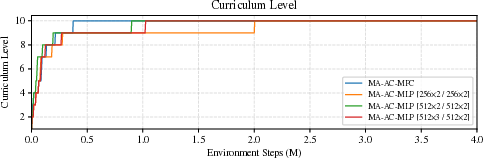
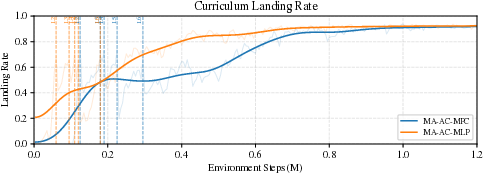
- They also use “curriculum learning,” meaning they start with easy versions of the task and gradually make it harder (like game levels) so learning is smoother.
Model predictive control, simply explained
MPC is like a short-term, fast planner. At each moment it:
- Predicts what will happen in the next short time window,
- Chooses a safe action that follows physics and avoids breaking rules (like maximum speeds or collision limits),
- Repeats this rapidly many times per second.
MPC is great for safety and physical realism, but it usually needs a clear, math-friendly goal.
How they combined them (MA-AC-MPC)
They stack the two ideas:
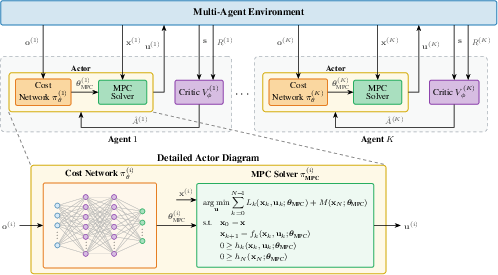
- The “actor” neural network doesn’t directly output motor commands. Instead, it outputs goals and weights for the MPC (for example, where to head and how to balance different priorities).
- The MPC then turns those high-level goals into precise, safe movements that follow the robot’s dynamics and constraints.
- The “critic” evaluates how well the team did and improves the actor’s planning over time.
This way:
- RL handles complex, long-term teamwork and weird reward signals (like “win if the pursuers crash into each other”).
- MPC guarantees each step is safe and physically possible.
They used fast simulation tools for drones and a special MPC library that can be connected to neural networks. They trained with a well-known algorithm (MAPPO) and added practical tricks (like handling “dead” or inactive agents cleanly during training).
What did they test and find?
Test 1: Aerial pursuit–evasion (2 vs 2)
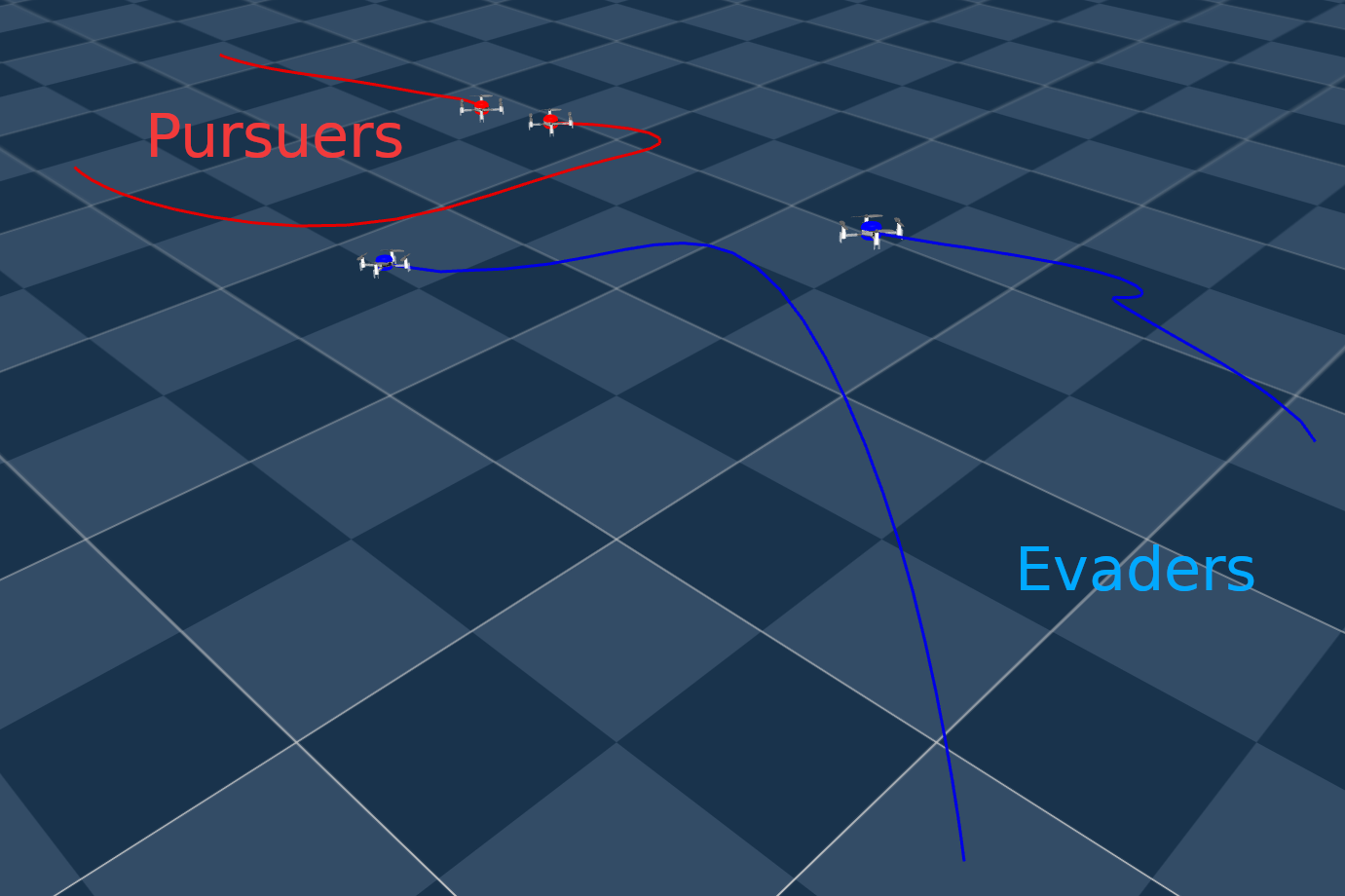
- Scenario: Two “pursuer” drones try to catch two “evader” drones. The evaders must cooperate to make the pursuers collide with each other instead.
- Setup: The evaders used the new MA-AC-MPC method. The pursuers used a strong hand-designed chasing rule.
- Comparison: They compared MA-AC-MPC against a standard neural network controller (called MA-AC-MLP) that doesn’t use MPC.
Main findings:
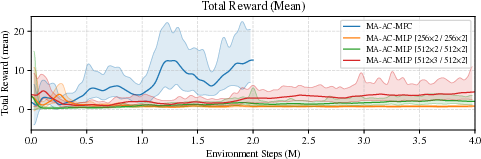
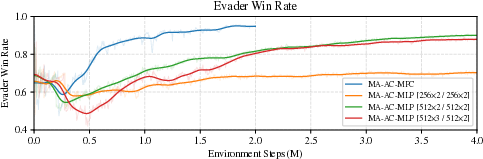
- Faster, smarter learning: Even though each training step is slower (because MPC solves a small planning problem), MA-AC-MPC needed fewer training steps to reach high performance. The neural net can focus on strategy while MPC handles the physics.
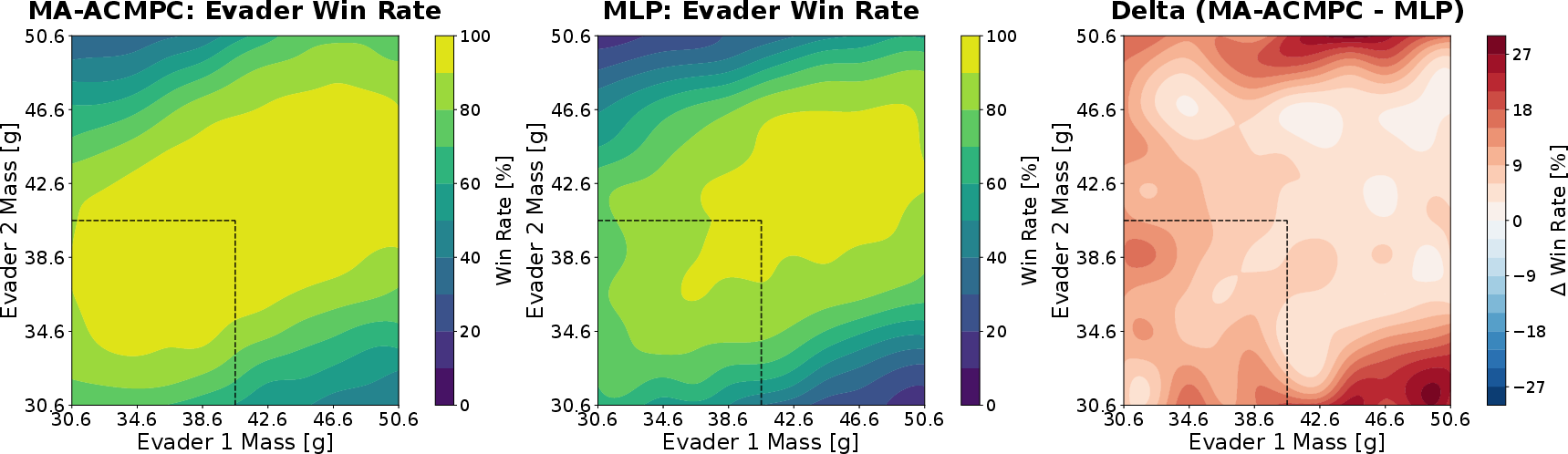
- More robust: When they changed the drones’ mass (weight) after training, the MA-AC-MPC evaders kept winning much more often than the plain neural-net version. That means the method handles changes it wasn’t trained for.
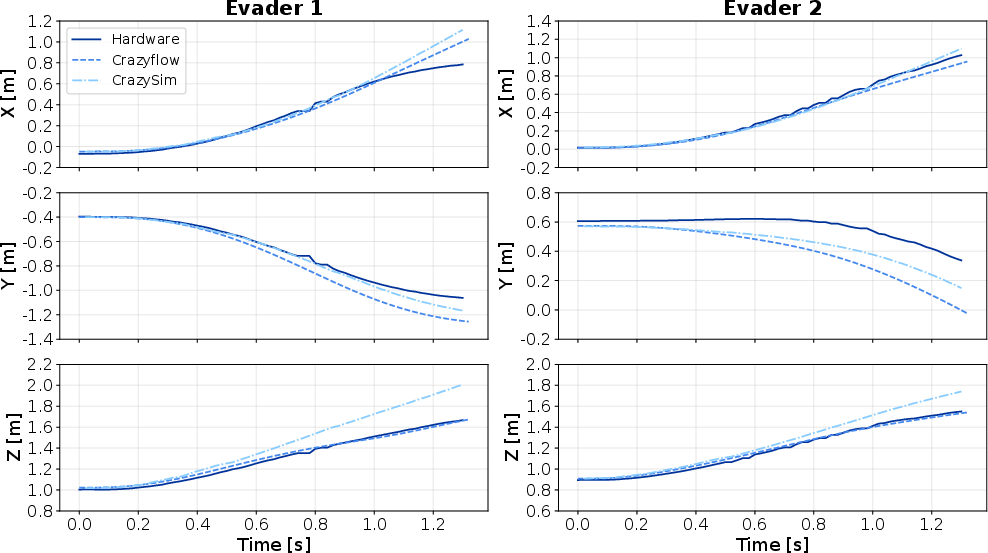
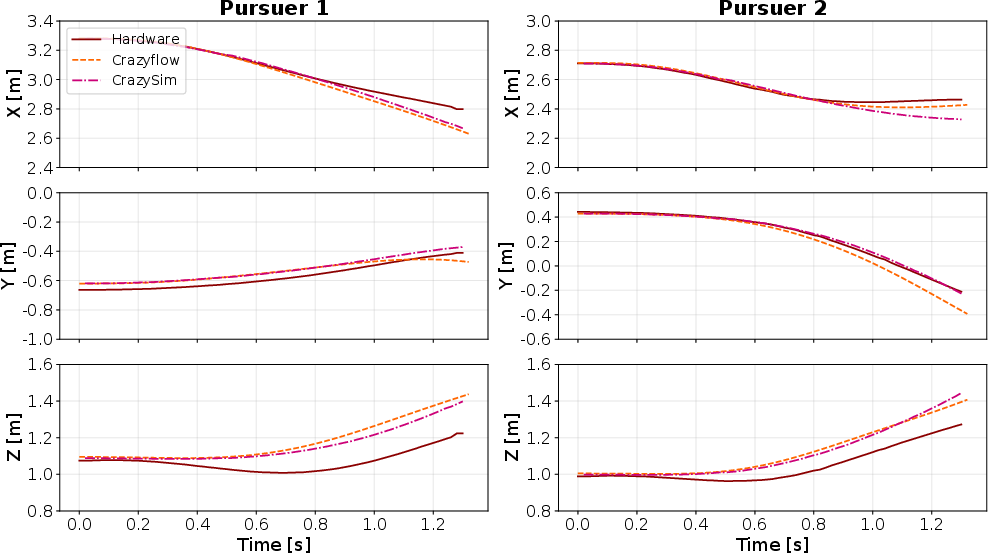
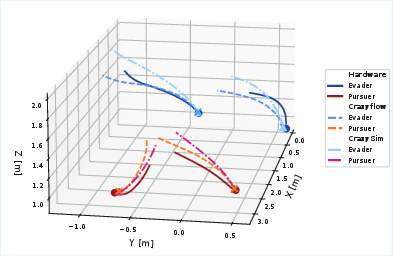
- Works on real drones: They trained in simulation and then ran the same policies on real Crazyflie drones. The real flight paths looked very similar to simulation, even with noise and disturbances.
Why it matters:
- In high-speed drone chases, tiny mistakes can cause crashes. MA-AC-MPC helps keep actions safe while still learning clever teamwork.
Test 2: Drone landing on a moving rover (heterogeneous team)
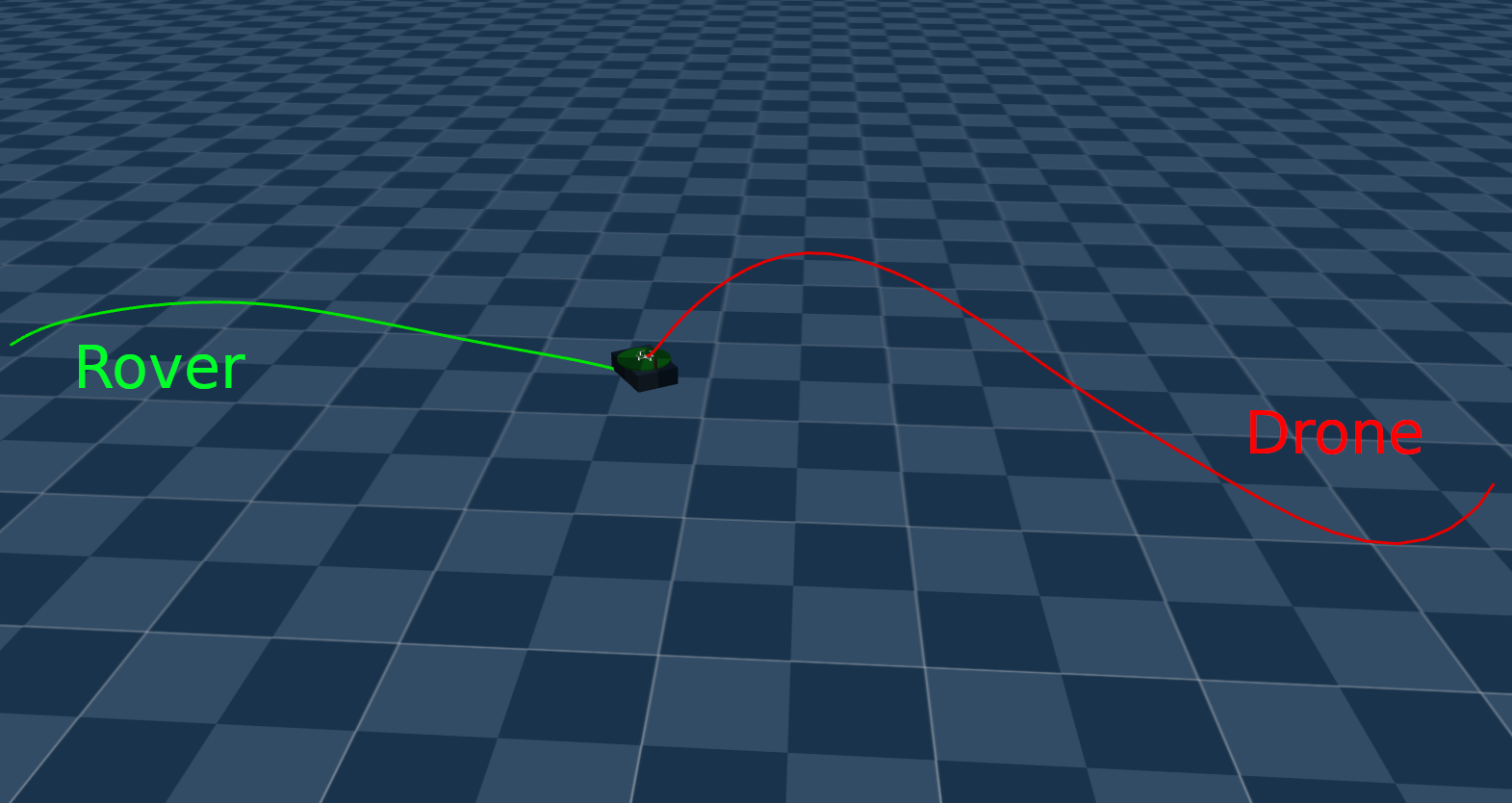
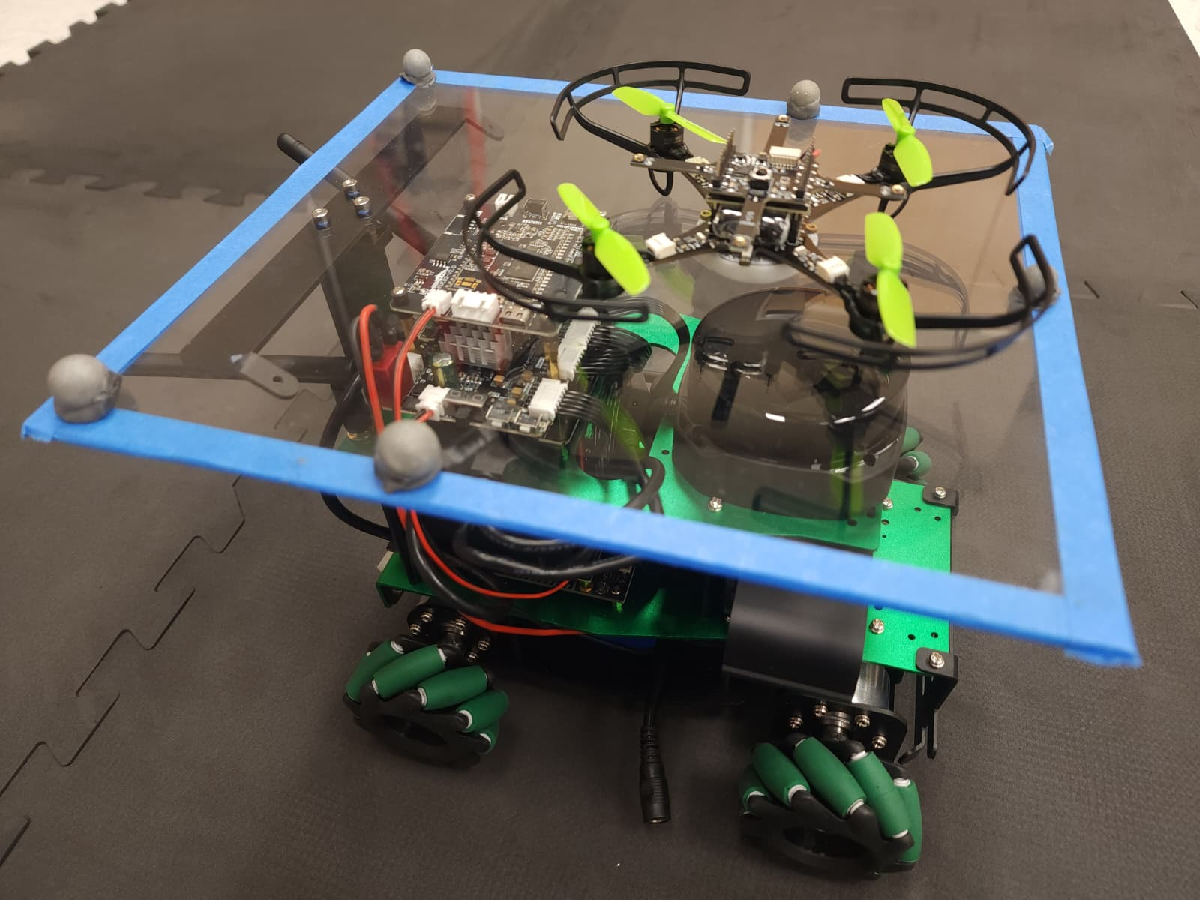
- Scenario: A quadcopter must land on a small, moving ground robot (a mecanum-wheeled rover that can move forward, sideways, and rotate).
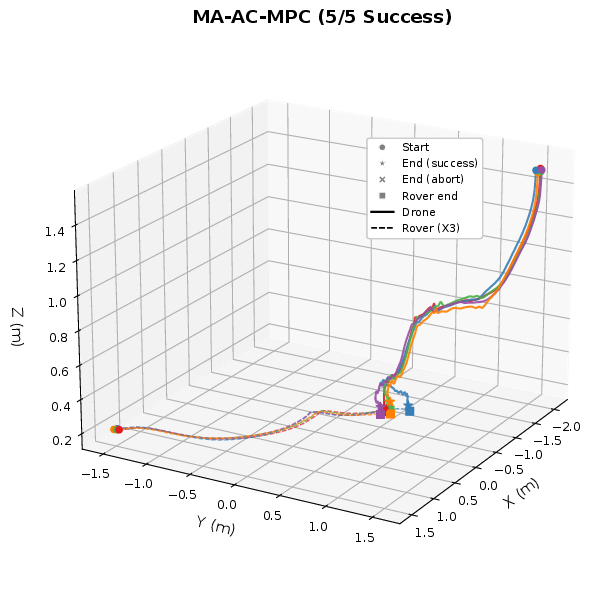
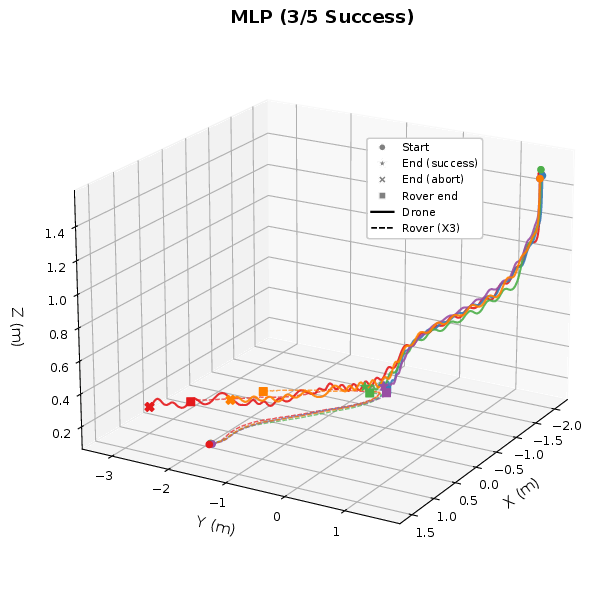
- Both the drone and the rover had their own MA-AC-MPC controllers and had to coordinate to meet in the right place, at the right speed and orientation.
- Results on real hardware:
- MA-AC-MPC: 100% successful landings.
- Plain neural network (MA-AC-MLP): 60% success.
Why it matters:
- Landing on a moving platform requires precise timing and safe approach speeds. The combined method made this repeatable and reliable.
Why is this important?
- Safety with smarts: The method blends long-term, team-level “smarts” from learning with short-term, safety-focused planning. That’s ideal for real-world robots where mistakes can be costly.
- Reliable transfers from simulation to reality: Because MPC enforces physics and constraints, the gap between simulation and the real world is smaller. That means less time re-tuning on hardware.
- Teamwork at scale: Many future tasks—like warehouse robots moving together, delivery drones landing on mobile pads, or search-and-rescue swarms—need smart cooperation and strict safety. This approach helps with both.
Bottom line
The authors show a practical, powerful way to teach robot teams to cooperate while staying safe. By letting a neural network plan “what to aim for” and letting MPC decide “how to move safely right now,” their robots learn faster, handle surprises better, and work more reliably in the real world. This could make multi-robot systems much more trustworthy in everyday applications.
Knowledge Gaps
Below is a concise, actionable list of knowledge gaps, limitations, and open questions left unresolved by the paper:
- Scalability to larger teams: No analysis of computational or learning scalability when the number of agents increases beyond 2v2; per-agent MPC solve times and centralized critic bottlenecks under larger teams remain unquantified.
- Communication assumptions and robustness: Execution relies on access to other agents’ states (masked when inactive) but the paper does not specify communication bandwidth/latency requirements or evaluate performance under packet loss, delays, or partial observability constraints.
- Generality to competitive/self-play settings: Pursuers use a fixed guidance law; it is unclear how MA-AC-MPC performs when both teams learn (self-play) or against stronger adaptive adversaries.
- Formal safety/feasibility guarantees: Despite positioning as “safe,” the approach provides no theoretical guarantees on recursive feasibility, closed-loop stability, or constraint satisfaction under learned, time-varying cost parameters and model mismatch.
- Constraint satisfaction metrics: No empirical reporting of constraint violation rates (e.g., control/attitude/position limits) during training or deployment, hindering assessment of safety in practice.
- Sensitivity to model mismatch beyond mass: Robustness is only evaluated via a mass sweep; effects of inertia, rotor time constants, aerodynamic drag, sensor biases/noise, latency, and actuation limits are unstudied.
- MPC horizon and control frequency: Only brief mention that N=5 did not help; no systematic study of prediction horizon, sampling time (50 Hz), and solver settings on training stability, performance, or feasibility.
- Gradient quality through differentiable MPC: No analysis of gradient accuracy/stability for nonlinear constrained OCPs (e.g., effects of active-set changes, constraint Jacobian conditioning) or strategies (e.g., warm-starts) to improve training.
- CPU-only MPC inference: acados-based MPC runs on CPU (≈1 ms/agent) with no GPU support; the impact on embedded/edge deployment and multi-agent scaling under real-time constraints is unexplored.
- Resource scaling on hardware: The hardware demonstrations involve small teams; no profiling of compute, power, and network usage as agent count grows, or strategies for distributed on-board solves.
- Cost parameterization design space: The actor outputs references and weight matrices (W, WN), but constraints on weight positivity/structure and the impact of different parameterizations (e.g., diagonal vs. full) are not investigated.
- Safety filtering vs. learned costs: It is unclear whether adding explicit safety layers (e.g., control barrier functions or safety filters) could reduce dependence on reward shaping and improve safety guarantees.
- Reward shaping dependence: The method relies on extensive shaping and curriculum; ablations are missing to determine which rewards/curriculum elements are essential vs. incidental to success.
- Curriculum dependence and generalization: Performance without curriculum and the learner’s ability to generalize to new initializations/distributions outside the staged levels is not evaluated.
- Comparative baselines: The only baseline is an MLP policy; comparisons to other model-based RL methods (e.g., AC4MPC, terminal-value-learning MPC, CBF-augmented RL, imitation-from-MPC) are absent.
- Partial observability at execution: The paper adopts CTDE but does not quantify the gap between training (centralized critic) and execution (decentralized observations), nor how observation noise or missing teammate states affect policy quality.
- Robustness to sensor/estimator imperfections: Hardware plots are provided, but there is no systematic study on estimator drift, VIO/GNSS dropout, motion-capture removal, or IMU bias on MA-AC-MPC performance.
- Landing task validation breadth: The 100% vs. 60% success claim lacks details on number of trials, rover speeds, environmental conditions, and failure modes; reproducibility and statistical significance are not established.
- Multi-objective trade-offs: The framework does not analyze trade-offs between task success, energy/effort, and safety margins (e.g., touchdown relative velocity, aggressive maneuvers), despite having penalties that could affect them.
- Coordination mechanisms learned: No interpretability analysis of how the learned cost parameters encode cooperative strategies (e.g., do W matrices reflect role assignment/formation?); unclear how cooperation emerges.
- Robustness to actuation saturation and failures: Effects of actuator saturation, partial failures, or degraded motors on MPC feasibility and policy robustness are not tested.
- Domain randomization scope and coverage: The curriculum’s domain randomization is narrow; no assessment of whether training randomizations sufficiently cover real-world variability.
- Transfer to different platforms: Policies are trained for Crazyflie-like drones and a specific rover; portability to other platforms with different dynamics/constraints is not examined.
- Multi-agent solver coupling: The work adopts decentralized per-agent MPC with cooperative costs; open questions remain on when distributed coupling (e.g., consensus constraints) is needed and how to manage solver convergence and communication overhead.
- Robustness to adversarial disturbances: No experiments on worst-case disturbances (e.g., gusts, sudden pushes) or safety margins under bounded perturbations, which are relevant for safety-critical deployment.
- Failure analysis and recovery: The paper does not report qualitative failure cases (e.g., near-collisions, late aborts) or mechanisms for recovery when MPC becomes infeasible or the policy induces unsafe references.
- Hyperparameter sensitivity: No study of sensitivity to PPO/MAPPO hyperparameters (entropy, clip ranges, GAE) and MPC solver parameters on learning speed and stability.
- Reproducibility details: Some training/inference timing is given, but seed variability, variance across runs, and code/parameter release details for full replication are missing.
These gaps suggest concrete directions: scalability experiments, communication-robust execution, formal safety analysis, richer robustness testing, broader baselines, ablations on curriculum/reward/parameterization, GPU-accelerated differentiable OCP, and comprehensive hardware evaluations with statistical rigor.
Practical Applications
Overview
Based on the paper’s findings and innovations—namely the Multi-Agent Actor-Critic Model Predictive Control (MA-AC-MPC) framework that embeds a short-horizon, constraint-aware MPC layer in the actor of a multi-agent RL policy (trained via CTDE with MAPPO and implemented with leap-c/acados)—the following are concrete, real-world applications. Each item notes sectors, potential tools/products/workflows, and key assumptions/dependencies that affect feasibility.
Immediate Applications
- Autonomous drone-to-UGV docking/landing in controlled environments
- Sectors: Robotics, Logistics, Industrial Inspection, Agriculture
- What it is: A deployable “Autonomous Mobile Landing System” for quadrotors to land on moving ground robots (e.g., for recharging, payload handoff, or transport) in labs, warehouses, or indoor farms. The MA-AC-MPC ensures safe, dynamically feasible approaches while learning high-level coordination.
- Tools/products/workflows: ROS 2 integration (Crazyswarm2), acados-based onboard MPC, small neural “planner” per agent, training with Crazyflow + SKRL/MAPPO, HIL validation via CrazySim.
- Assumptions/dependencies: Reliable indoor localization (e.g., motion capture/VIO), modest onboard compute (≈1 ms/agent inference at 50 Hz), reasonable model identification for MPC (mass/inertia), predictable indoor conditions, regulatory compliance for indoor UAS.
- Multi-robot fleet deconfliction and cooperative tasking in warehouses
- Sectors: Robotics, Warehouse Automation, Manufacturing
- What it is: A “Cooperative Fleet Controller” that blends MARL (task-level coordination) with MPC (collision avoidance, speed/acceleration constraints) to reduce robot-robot collisions and improve throughput for AMRs/AGVs.
- Tools/products/workflows: Agent-level acados MPC with decentralized execution and shared or heterogeneous actor heads; CTDE training for shared tasks; curriculum learning to ramp difficulty.
- Assumptions/dependencies: Accurate kinematics/dynamics/constraints per robot; CPU availability for MPC on each unit; well-defined geofences and safety constraints; facility map and moderate communications for partial state sharing.
- Tactics prototyping and training in pursuit–evasion scenarios (simulation)
- Sectors: Defense/Security, Aerospace, Research
- What it is: A “Pursuit–Evasion Tactics Workbench” for simulating and analyzing cooperative strategies, e.g., evaders coordinating to induce pursuer collisions or vice versa, with constraints enforced by MPC.
- Tools/products/workflows: Crazyflow/CrazySim for simulation; MA-AC-MPC to rapidly explore cooperative policies with realistic dynamics and constraints; data collection for operator training.
- Assumptions/dependencies: Simulation fidelity for target use cases; reliable data logging; no immediate field deployment without further validation.
- Robotics research and education testbed for constrained multi-agent learning
- Sectors: Academia, Education, Software/Tools
- What it is: Reproducible labs for teaching and researching multi-agent constrained RL with differentiable MPC using open-source tooling (leap-c + acados + PyTorch/JAX).
- Tools/products/workflows: Course modules combining MAPPO with MA-AC-MPC; benchmark tasks (cooperative docking, pursuit–evasion); HIL pipelines (CrazySim, Crazyflie).
- Assumptions/dependencies: Access to compatible hardware (Crazyflie-class drones, UGVs), installation of acados and leap-c, basic GPU/CPU infrastructure for training.
- Drone choreography and coordinated motion with built-in safety
- Sectors: Entertainment, Events, Robotics
- What it is: Multi-drone shows where high-level cooperative motions are learned (RL), while MPC enforces dynamics/geofences and smooth control, improving safety and repeatability.
- Tools/products/workflows: Show-specific training in simulation, onboard MPC during execution, ROS 2 for orchestration.
- Assumptions/dependencies: Indoor/controlled venues; sensor accuracy; well-defined no-fly zones and collision radii; per-agent CPU budget.
- Robust sim-to-real workflows for constrained policies
- Sectors: Robotics, Software/Tools, QA/Validation
- What it is: A validated pipeline where Crazyflow (training), CrazySim (firmware-in-the-loop), and MPC-backed execution reduce the sim-to-real gap and increase success rates (e.g., 100% vs 60% for MLP).
- Tools/products/workflows: Curriculum design, death-masking for inactive agents, domain randomization (masses, disturbances), CTDE.
- Assumptions/dependencies: Transferable models/parameters; careful reward design and constraint tuning; availability of HIL tools.
Long-Term Applications
- Dynamic drone landing on moving vehicles in outdoor logistics
- Sectors: Logistics, Last-Mile Delivery, Infrastructure Inspection, Aerospace
- What it is: Drones autonomously landing on trucks/boats/trains for charging or payload exchange during operations, with learned coordination and MPC-enforced safety.
- Tools/products/workflows: Edge-optimized acados solver on embedded CPUs/MCUs, robust perception stack, V2X communication for partial state sharing, cloud-based retraining.
- Assumptions/dependencies: Outdoor robustness (wind, GNSS loss), regulations around operation over people/moving vehicles, advanced perception and tracking, rigorous safety certification.
- Connected autonomous vehicle (CAV) cooperative maneuvers
- Sectors: Transportation, Automotive, Smart Cities
- What it is: Intersection negotiation, platooning, and cooperative collision avoidance where RL learns negotiation/coordination policies and MPC guarantees dynamic feasibility and constraint satisfaction.
- Tools/products/workflows: Decentralized execution with V2V/V2I; digital twins for training/testing; safety monitors that bound RL actions via MPC.
- Assumptions/dependencies: High-reliability communications; standardized safety cases and certifications for learning-enabled controllers; compute headroom in ECUs; liability frameworks.
- Multi-robot search-and-rescue with heterogeneous teams
- Sectors: Public Safety, Disaster Response, Robotics
- What it is: Teams of drones and UGVs coordinating to explore, deliver supplies, and perform handoffs in uncertain environments; RL plans cooperation, MPC enforces safety and physical limits.
- Tools/products/workflows: Robust partial observability handling, comms-dropout resilience (death masking), sim-to-real with extensive domain randomization.
- Assumptions/dependencies: Robust onboard perception and state estimation; unpredictable terrain and dynamic obstacles; stringent operational safety constraints; training data for rare events.
- Hospital and campus robot fleets with orchestrated docking and transfer
- Sectors: Healthcare, Facilities Management, Service Robotics
- What it is: Coordinated delivery robots/drones with safe docking, elevator interfacing, and handoffs; RL for timing/priority policies, MPC for dynamics and safety constraints.
- Tools/products/workflows: Fleet management with CTDE-trained policies; per-agent constrained MPC; integration with building infrastructure.
- Assumptions/dependencies: Privacy/security policies, reliability SLAs, infection control considerations, building integration and IT support.
- Space and orbital robotics: formation flying and cooperative servicing
- Sectors: Aerospace, Space Robotics
- What it is: Multi-satellite formation control and on-orbit servicing with RL-learned coordination and MPC-based constraint handling (e.g., thrust limits, collision cones).
- Tools/products/workflows: High-fidelity orbital dynamics in training; on-board deterministic MPC solvers; ground-in-the-loop validation.
- Assumptions/dependencies: Radiation-tolerant compute; extreme reliability/safety verification; tight fuel/energy budgets; formal guarantees.
- Energy systems and microgrids: multi-agent coordination with hard constraints
- Sectors: Energy, Utilities, Smart Grids
- What it is: Distributed control of DERs (storage, PV, flexible loads) where MARL learns coordination for efficiency/cost while MPC enforces operational limits and network constraints.
- Tools/products/workflows: acados-based constrained OCPs in the loop; CTDE on grid simulators; hierarchical control with safety filters.
- Assumptions/dependencies: Accurate grid and device models; regulatory approval for learning-enabled control; cyber-security requirements; explainability.
- Standardization and policy for safe learning-enabled control
- Sectors: Policy/Regulation, Certification, Safety Assurance
- What it is: Adopting architectures that combine RL with constraint-aware MPC to satisfy safety requirements, with verifiable constraint enforcement and fallback behaviors.
- Tools/products/workflows: Compliance templates where MPC constraints encode regulatory rules; audit trails from CTDE training; HIL verification protocols.
- Assumptions/dependencies: Consensus on standards for learning-enabled systems; toolchains for evidence generation; alignment with safety cases (e.g., aerospace, automotive).
- Consumer/home robotics: cooperative service robots
- Sectors: Consumer Robotics, Smart Home
- What it is: Coordinated vacuum/mop robots or assistant drones that share tasks and dock autonomously on moving platforms (e.g., robotic carts), with RL for cooperation and MPC for safety.
- Tools/products/workflows: Lightweight acados deployments on embedded controllers; home-scale training via digital twins; over-the-air updates.
- Assumptions/dependencies: Low-cost compute budgets; robust SLAM in clutter; safety around people/pets; acceptance and privacy considerations.
- Developer SDKs for constrained multi-agent RL
- Sectors: Software/Tools, Robotics Platforms
- What it is: A turnkey SDK that exposes MA-AC-MPC patterns (PyTorch/JAX + leap-c + acados) for building cooperative robotic behaviors with constraint enforcement.
- Tools/products/workflows: Prebuilt actor templates (planner + MPC), CTDE training flows, curriculum learning utilities, HIL connectors (ROS 2).
- Assumptions/dependencies: Long-term support and maintenance of acados/leap-c; optimized solver backends for embedded targets; developer education.
Cross-cutting assumptions/dependencies to consider
- Model fidelity and identification: MPC needs reasonable dynamics and constraint models; robustness to moderate mismatch was observed (e.g., mass variations) but not universal.
- Compute budget and scalability: Per-agent MPC incurs CPU cost; scaling to large teams may require solver optimization, batching, or hardware acceleration.
- Training stability and time: While step-efficiency improves, wall-clock time can be longer; CTDE stability relies on curriculum design, death masking, and tuning.
- Communications: Decentralized execution tolerates limited comms, but partial state sharing improves performance; severe dropouts require robust policies.
- Safety constraints design: Properly specifying constraints and cost references/weights is critical; MPC is only as safe as its encoded limits.
- Regulatory and certification pathways: Real-world deployments in transportation, healthcare, or aerospace demand formal assurance beyond empirical tests.
- Environment variability: Outdoor/weather effects, sensor noise, and unmodeled dynamics require additional robustness mechanisms and verification.
Glossary
- AC-MPC: An end-to-end learning approach that embeds model predictive control inside an actor-critic RL architecture. "we extend Actor-Critic Model Predictive Control (AC-MPC) \citep{romero2025actor} for multi-agent reinforcement learning"
- acados: An open-source software framework for fast nonlinear optimal control with costs, dynamics, and constraints, plus sensitivities. "The open-source software framework acados \citep{acados} is designed for optimal control problems with nonlinear and parametric costs, dynamics, and inequality constraints with the speed required for real-time control applications."
- augmented proportional navigation: A guidance law from aerospace used for intercepting targets by steering based on line-of-sight dynamics. "The pursuer team uses augmented proportional navigation as it is accepted as an advanced adversarial control law."
- centralized training and execution (CTE): A multi-agent learning paradigm where agents are trained and act with full shared information under a single joint policy. "this is known as centralized training and execution (CTE) \citep{amato2024introductioncentralizedtrainingdecentralized}."
- centralized training with decentralized execution (CTDE): A training setup where learning uses global information but execution uses only local observations. "this is known as centralized training with decentralized execution (CTDE) \citep{jiang2024fullydecentralizedcooperativemultiagent}."
- Crazyflow: A fast, parallelizable Crazyflie drone swarm simulator (JAX-based) for high-fidelity training. "we chose to use crazyflow \citep{schuck2025crazyflow}, a fast parallelizable Crazyflie drone swarm simulator using JAX."
- Crazyflie: A small open-source quadrotor platform commonly used for research and education. "the Crazyflie firmware."
- CrazySim: A simulation setup that runs the actual Crazyflie firmware in the loop with a physics engine. "using CrazySim \citep{LlanesICRA2024} with the MuJoCo simulator"
- Crazyswarm2: A ROS 2-based framework for controlling and coordinating swarms of Crazyflie drones. "We deployed the trained MA-AC-MPC model to a ROS 2 framework using Crazyswarm2 \citep{crazyswarm} for hardware testing."
- dec-POMDP (decentralized partially observable Markov decision process): A formalism for multi-agent decision-making with partial observations and decentralized policies. "is known as a decentralized partially observable Markov decision process (dec-POMDP)"
- death masking: A training technique where inactive agents’ inputs are zeroed to stabilize value estimation after agent “death.” "This leads us to the concept of death masking in which an inactive or dead agent has its observation or states masked by a zero vector."
- differentiable MPC: MPC formulations whose solutions are differentiable w.r.t. parameters, enabling gradient-based learning through the solver. "Several differentiable MPC methods have been developed \citep{amos2018diffmpc, Oshin-RSS-24}"
- distributed MPC: An MPC setup where each agent solves a local MPC subproblem that collectively coordinates the team. "uses distributed MPC for each agent that contributes to the global value function in a centralized learning framework."
- generalized advantage estimate (GAE): A variance-reduced, bias-controlled estimator for policy gradients using temporal-difference residuals. "The advantage estimate is calculated using the generalized advantage estimate (GAE) \citep{schulman2018highdimensional}"
- iterative LQR (iLQR): A trajectory optimization method that iteratively refines a locally linear-quadratic approximation to compute controls. "a box-constrained iterative LQR solver."
- KKT conditions: Optimality conditions (Karush–Kuhn–Tucker) used to characterize and differentiate solutions of constrained optimization problems. "by implicitly differentiating KKT conditions at a fixed point of a box-constrained iterative LQR solver."
- leap-c: An open-source project providing differentiable interfaces to acados sensitivities within ML frameworks like PyTorch/JAX. "the open-source project, leap-c \citep{leonard_fichtner_2025_17244101}, which is faster than the previously used differentiable MPC module, mpc.pytorch, in AC-MPC \citep{romero2025actor} and works for general nonlinear optimal control problems with general nonlinear inequality constraints by using acados \citep{acados}."
- MA-AC-MPC (multi-agent actor-critic model predictive control): The paper’s proposed extension of AC-MPC to multi-agent settings, using MPC as the policy layer per agent. "we refer to as multi-agent actor-critic model predictive control (MA-AC-MPC)."
- MAPE (multi-agent pursuit-evasion): A benchmark domain where pursuers attempt to capture evaders in a shared environment. "multi-agent pursuit-evasion (MAPE) scenario \citep{Llanes2026ICRA}"
- MAPPO (multi-agent proximal policy optimization): A widely used on-policy actor-critic algorithm adapted to multi-agent cooperative/competitive tasks. "we use multi-agent proximal policy optimization (MAPPO) \citep{yu2022surprising}."
- MARL (multi-agent reinforcement learning): Reinforcement learning with multiple decision-making agents interacting in a shared environment. "Multi-agent reinforcement learning (MARL) \citep{4445757} has emerged as a tool for modeling and control of environments with multiple agents acting as decision makers."
- Mellinger controller: A geometric controller for quadrotors often used with Crazyflie, providing fast, agile trajectory tracking. "The Mellinger controller in crazyflow is used because it contains the same parameters as the Crazyflie firmware."
- model predictive control (MPC): An optimization-based control method that plans over a finite horizon and applies the first control input, repeating at each step. "Model-predictive control (MPC) recomputes the optimization problem over a receding horizon while continuously updating the solution."
- MuJoCo: A high-performance physics engine commonly used for robotics simulation and RL research. "Both screenshots are from MuJoCo for rendering."
- multilayer perceptron (MLP): A feedforward neural network baseline used as the policy in place of MPC. "and compare the results to a standard multilayer perceptron actor."
- OCP (optimal control problem): A mathematical problem of optimizing a control sequence subject to system dynamics and constraints. "we define a nonlinear MPC formulation as an optimal control problem (OCP)"
- parameter sharing: A technique where homogeneous agents share a single policy network to speed up and stabilize learning. "Parameter sharing is an effective way \citep{gupta2017} to speed up the learning process when agents have a common goal and need to learn similar behaviors."
- receding horizon: The MPC strategy of solving an optimization over a moving time window at each control step. "over a receding horizon"
- ROS 2: A modern robotics middleware framework for distributed control and communication. "We deployed the trained MA-AC-MPC model to a ROS 2 framework"
- sensitivity propagation: Computing derivatives of the MPC solution with respect to parameters/initial conditions for use in learning. "Sensitivity propagation has also been implemented in the acados framework \citep{Frey2023, frey2025differentiablenonlinearmodelpredictive} for computing derivatives of the optimal solution with respect to parameters and initial state."
- SO(3): The Lie group of 3D rotations, used to represent drone attitude without singularities. "where is the drone rotation matrix"
- stage cost: The per-timestep cost component in an OCP/MPC objective accumulated over the prediction horizon. "the stage cost to encode complex task-specific behavior"
- terminal cost: The final-horizon cost component in an OCP/MPC objective to shape end-of-horizon behavior. "the terminal cost"
Collections
Sign up for free to add this paper to one or more collections.