- The paper introduces a novel learning protocol that recovers a Hamiltonian from its long-time evolution by exploiting its unique local conservation property.
- It employs randomized product-state probes and classical shadows to construct a data matrix whose null singular vector identifies the Hamiltonian direction.
- Numerical evidence confirms the method’s polynomial sample complexity and inverse-polynomial decay in autocorrelation for non-Hamiltonian observables.
Hamiltonian Learning from Long-Time Dynamics: Weak Equilibration and Robust Identification
The paper "Learning Hamiltonians at Long Times" (2606.05690) rigorously addresses the identification of an unknown n-qubit local Hamiltonian H from a black-box unitary evolution U=e−iHt at a single, potentially macroscopic, unknown time t. This regime, where t may be arbitrarily large and not under experimental control, is substantially more challenging than previous Hamiltonian learning settings, which require access to short-time dynamics or variable-time samples. The work focuses primarily on typical (average-case) instances, specifically for broad random ensembles of local Hamiltonians.
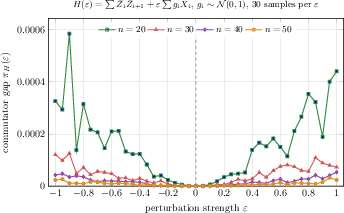
The central technical innovation leverages the following: for a generic H, among all local observables, only H itself (up to scale and sign) remains approximately conserved under long-time evolution. This is formalized via uniform lower bounds (inverse-polynomial in n) on the Frobenius norm of commutators [U,A] for all normalized local observables A orthogonal to H0.
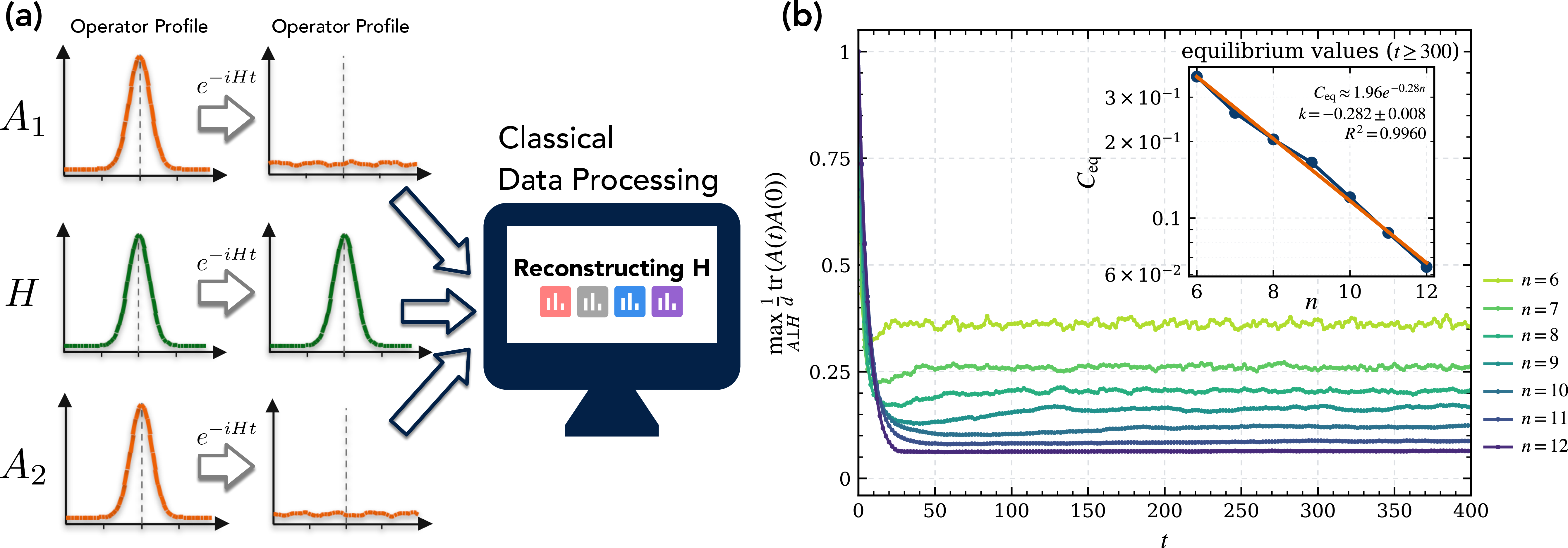
Figure 1: Hamiltonian learning from weak equilibration: (a) Local observables orthogonal to H1 lose their autocorrelation under long-time dynamics, while H2 is conserved. (b) Numerical evidence that the maximal autocorrelation for non-Hamiltonian local observables decays rapidly with system size.
The pivotal argument reduces Hamiltonian learning to finding the unique local observable most preserved by conjugation by H3. This is quantified by minimizing the dynamical gap H4, subject to normalization and orthogonality constraints. The paper proves that, for generic local H5 and almost all times, any normalized H6 satisfies a lower bound H7. This result generalizes to demonstrate that weak local equilibration holds: autocorrelators H8 for H9 drop at least an inverse polynomial below unity for a typical U=e−iHt0.
Algorithmic Protocol and Guarantees
The proposed Hamiltonian learning protocol is closely linked to the classical shadow formalism, utilizing randomized product-state probes and Pauli measurements to empirically populate a data matrix. The main steps are:
- Probe Preparation and Measurement: Polynomially-many random product-state inputs are time-evolved with U=e−iHt1; classical shadows are used to efficiently estimate post-evolution expectation values for all Pauli strings in the model support.
- Construction of Data Matrix: For each probe and Pauli string, one computes the difference between the pre- and post-evolution expectations, assembling a data matrix U=e−iHt2.
- Null Direction Extraction: The Hamiltonian direction U=e−iHt3 (in the chosen basis) emerges as the unique approximate null right singular vector of U=e−iHt4. All other directions are separated from nullity by a spectral gap inherited from the dynamical commutator gap.
- Normalization and Consistency: Post-processing yields a normalized estimate U=e−iHt5 equivalent to the learned direction, up to sign.
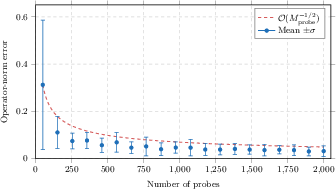
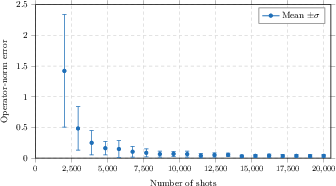
Figure 2: Learning accuracy scaling: operator-norm error for TFIM Hamiltonian estimation decays as a function of number of probes; vertical axis is U=e−iHt6.
The algorithm achieves polynomial sample complexity in all parameters (system size, inverse commutator gap, inverse error). Importantly, the recovery theorem is proven without requiring knowledge of U=e−iHt7, and the protocol is robust to all practical sources of finite-statistics and shadow measurement error.
Strong Numerical and Structural Findings
The paper provides extensive analytic and numerical evidence supporting the static and dynamical commutator gap claims. Key findings include:
- Random local Hamiltonian ensembles (Pauli-injective and geometrically local) generically have a unique, robust local conserved direction.
- In the Pauli-injective (e.g., TFIM) regime, the commutator gap can be related to a spectral gap of the anticommutation graph, allowing explicit, deterministic bounds.
- In geometrically local models, a patching argument yields local-to-global lower bounds via structurally certified local types.
Numerical studies confirm:
Physical and Theoretical Implications
The work reveals a strong connection between quantum equilibration and identifiability of many-body dynamics. In particular:
- Conservation Laws as Learnability Obstructions: If, and only if, t1 is the unique local conserved quantity, it is learnable from a single unknown long-time evolution.
- Weak Equilibration Is Sufficient: The results show that full thermalization is unnecessary for robust recovery. Inverse-polynomial decay in autocorrelation suffices.
- Smoothed Analysis Perspective: Even for systems near integrability, generic local perturbations eliminate conservation laws in the local sector, restoring identifiability.
- Promise Setting and Model Testing: The empirical null space of the data matrix acts as a built-in test for model-class validity.
These findings have broad ramifications for quantum characterization protocols in both experiment and theory. They enable Hamiltonian learning in resource-limited scenarios where fine time control is unavailable, such as in many analog quantum simulators and noisy intermediate-scale quantum devices.
Future Directions and Open Problems
- Extension to Worst-Case Hamiltonians: The presented results are average-case; extending dynamical identifiability to pathological or highly symmetric cases with extensive conservation laws remains challenging.
- Beyond Local Observables: Analysis of equilibration rates for more general operators and correlations—beyond those orthogonal to t2—could elucidate the operational significance of weak vs. strong thermalization.
- Sharper Gap Estimates: Empirical gaps are often orders of magnitude larger than the conservative proven bounds; developing tighter analytic control could improve practical resource estimates.
Conclusion
This paper establishes that typical local quantum many-body Hamiltonians are identifiable from a single unknown long-time evolution via a robust, efficiently implementable procedure. The key mechanism is that, in typical ensembles, the Hamiltonian is the unique approximately conserved local observable, as certified by uniform dynamical commutator lower bounds. This perspective yields both a rigorous learning algorithm with explicit polynomial complexity and new insights into the operational manifestations of equilibration. Extending this framework to worst-case Hamiltonians, or formulating necessary and sufficient conditions for local identifiability in more general settings, represents a compelling direction for ongoing research.
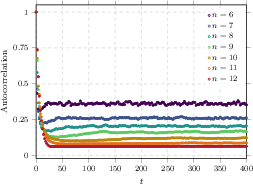
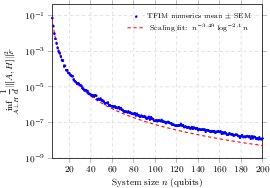
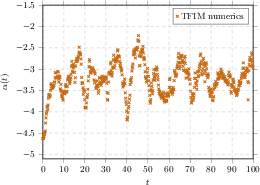
Figure 4: Maximum late-time autocorrelation for normalized non-Hamiltonian local observables orthogonal to t3—showing rapid decay, i.e., absence of robust non-Hamiltonian conservation laws.