- The paper presents a dual lattice gauge theory mapping quantum error correction circuits, where circuit faults become gauge fields and detector relations appear as Wilson loops.
- It introduces a systematic gauging procedure for subsystem spacetime codes that recasts data and measurement errors into matter and gauge fields, establishing fault equivalence via Gauss laws.
- The framework unifies QEC, homological methods, and learning theory, offering practical insights for designing advanced fault-tolerant protocols and benchmarking noise in quantum circuits.
Gauging the Spacetime Code: Fault Tolerance as Lattice Gauge Theory
Introduction and Motivation
The paper "Gauging the Spacetime Code" (2606.05664) presents a comprehensive framework for relating quantum error correction (QEC) circuits—particularly Clifford circuits as they arise in practical fault-tolerance—directly to lattice gauge theory. The work leverages the subsystem spacetime code (SSC) formalism and implements a systematic “gauging” procedure, resulting in a gauge-theoretic dual description whose structural elements correspond precisely to key aspects of fault-tolerance: circuit faults become gauge fields, detector relations become Wilson loops, and equivalence among error configurations are encoded by Gauss laws.
This construction addresses both practical and foundational questions:
- How properties such as error detectability and syndrome redundancy (detectors) are naturally reflected as symmetries and observables in a gauge theory.
- How operational distinctions between data and measurement errors can be recast as local and classical degrees of freedom, respectively.
- How the approach unifies notions from QEC, statistical mechanics, MBQC, and learning theory.
The paper does not limit itself to standard syndrome extraction (e.g., repeated measurement circuits), but extends to more general Clifford circuits, including those with multi-qubit measurements and arbitrary discretizations, and discusses generalization to boundaries, MBQC, and learning-theoretic settings.
Clifford Circuits, Spacetime Codes, and Fault Tolerance
The foundational formalism begins by recasting a Clifford circuit as a set of "elementary circuit operators" (ECOs) indexed by discretized spacetime locations, incorporating:
- Measurement slices: Operators associated with multi-qubit measurements.
- Propagators: Operators representing the time-propagation of Pauli errors through unitaries and their interactions with measurements.
- Measurement dephasers: Operators used to formally decouple measurement and data errors, rendering ancilla noise as classical variables.
This abstraction mirrors the structure of the SSC [Pesah 2025]; crucially, it puts measurement and data errors on equal footing, facilitating the identification of fault equivalence classes, wherein two error configurations are equivalent if they yield the same logical effect modulo the "instantaneous stabilizer group" (ISG) at the output time.
Detectors are defined as sets of measurements whose outcome parities are deterministically constrained by circuit structure (i.e., invariants across noise realizations), often corresponding to the physically relevant “syndrome” bits used for fault-tolerant decoding. The space of equivalence classes of faults, together with these detectors, constitutes the operational backbone for the circuit's error correction properties.
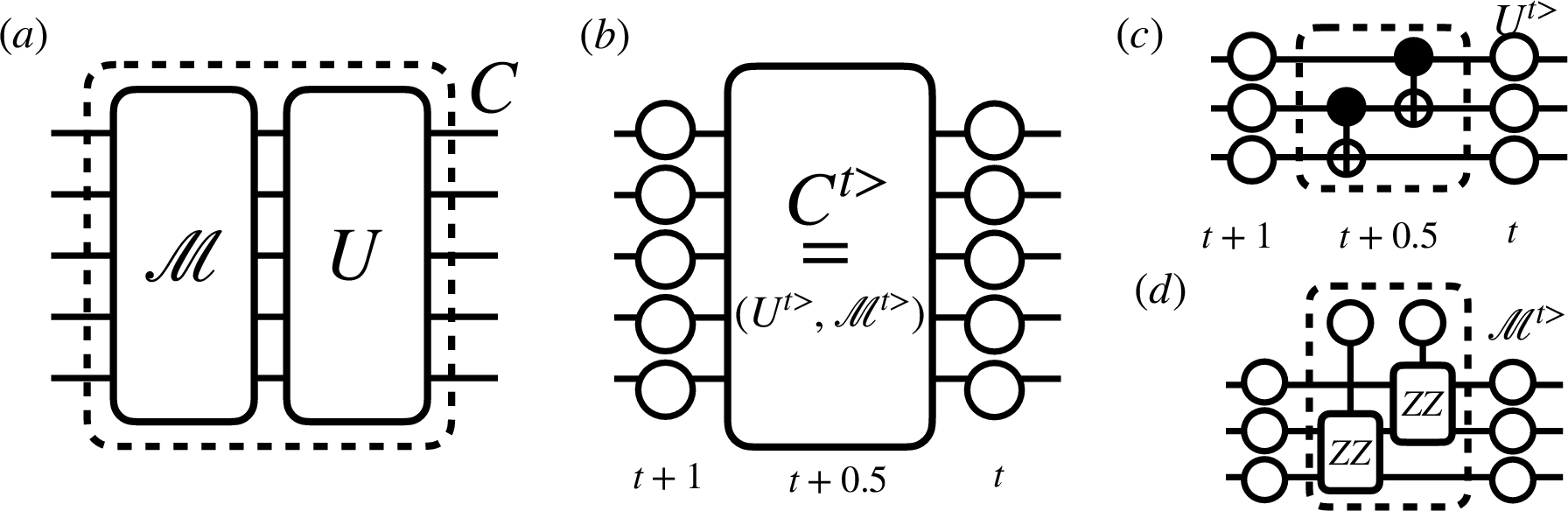
Figure 1: Schematic illustrating the circuit conventions, with Clifford unitaries, measurement layers, and discretized spacetime locations (time proceeds right to left).
Gauging the Subsystem Spacetime Code
The central technical innovation is the “gauging” of the SSC. The procedure is conceptually analogous to minimal coupling in lattice gauge theory, and proceeds as follows:
- Gauge Field Introduction: Each ECO is associated with a gauge field (classical bit/variable), and each physical spacetime location is associated with a matter field.
- Gauss Laws: Local constraints generated by the rows of the ECO matrix (or its transpose), interpreted as enforcing physical equivalence of gauge configurations differing by the action of SSC gauge transformations. These constraints realize fault equivalence at the gauge field level.
- Wilson Loops / Redundancies: The kernel (redundancies) of the ECO matrix corresponds to gauge-invariant Wilson loops, which are in bijection with the circuit’s detectors. These are the true “physical observables,” both in the gauge theory and in practical fault tolerance.
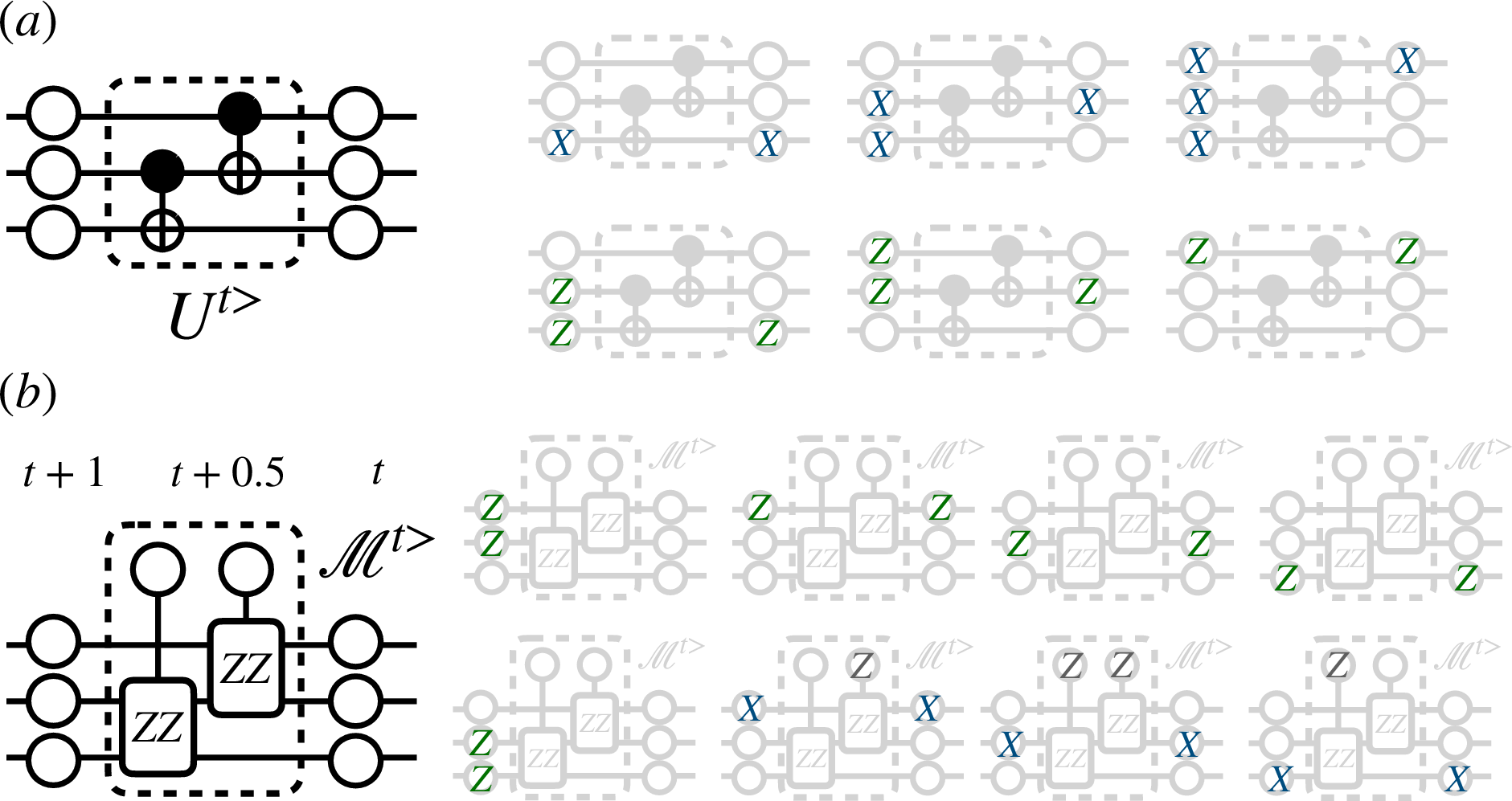
Figure 3: Examples of elementary circuit operators (propagators and measurement slices) associated with circuit elements and their graphical representation in the gauged code.
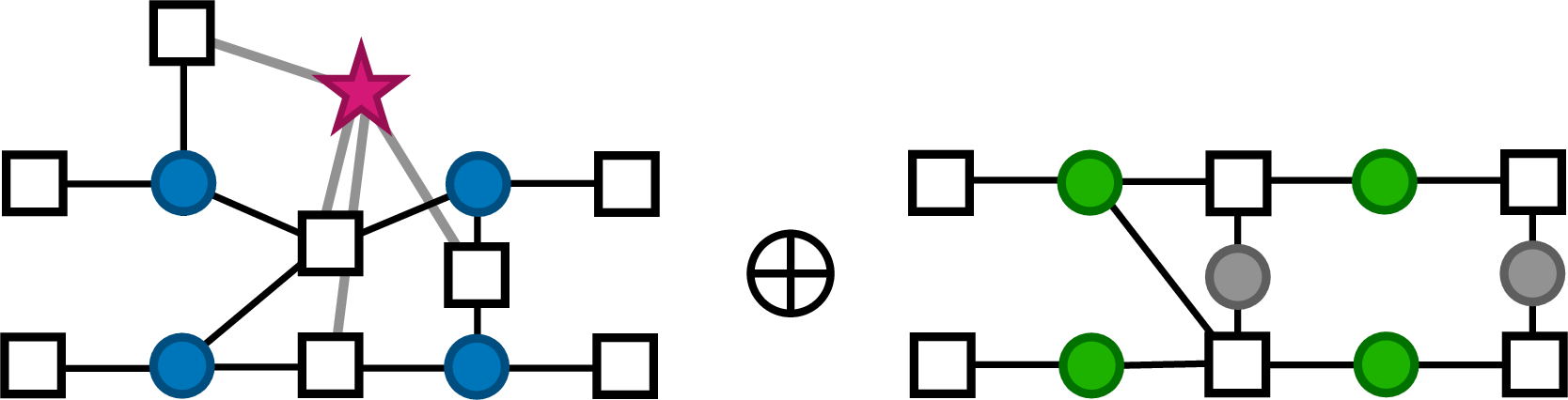
Figure 2: Schematic depiction of the gauge theory from a minimal circuit, with matter fields (circles), gauge fields (squares), Gauss law connections (black), and redundancy/loop structure (magenta).
The result is a hypergraph-based Z2 lattice gauge theory capturing the error equivalence structure and detector observables of the underlying circuit. The duality is manifest: the new gauge fields precisely track physically distinct error configurations modulo the action of Gauss laws.
Gauge Theory Topology, Boundaries, and Logical Structure
A careful treatment of circuit boundaries enables precise correspondence with various QEC experiments:
- Open boundaries (OBC), as in standard logical memory experiments, are realized by fixing (gauge fixing) the boundary gauge fields, analogously to fixing physical qubits before/after the circuit.
- Periodic boundaries correspond naturally to entanglement fidelity/RB protocols, with global Wilson loops emerging as observables for logical operators.
- Rough boundaries and syndrome measurement gadgets are mapped to appropriate boundary choices, which modify the structure of allowable detectors and logical subspaces.
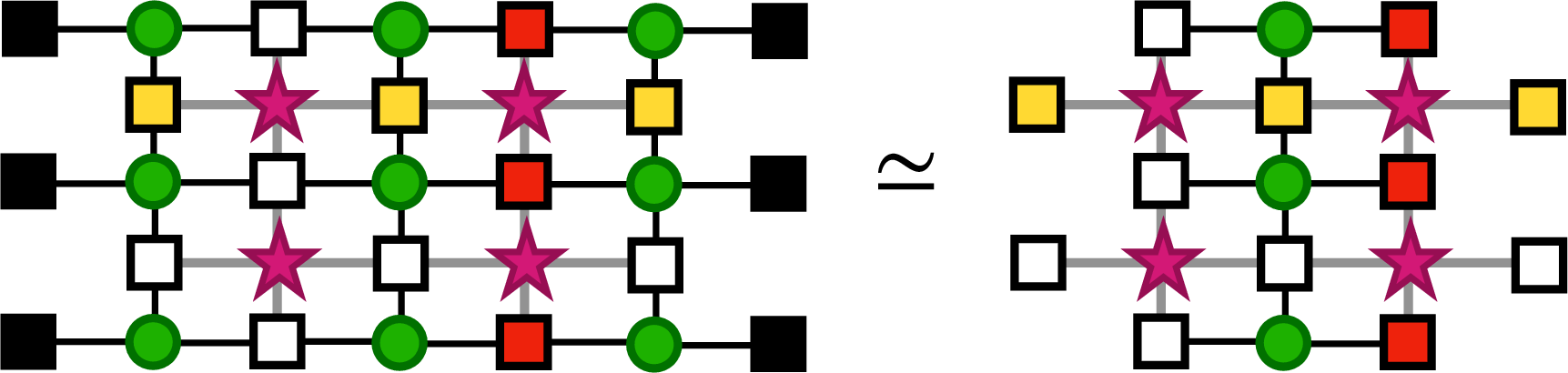
Figure 6: Gauge theory for repeated measurement of a three-qubit repetition code, with OBC; only Z-type matter fields are shown.
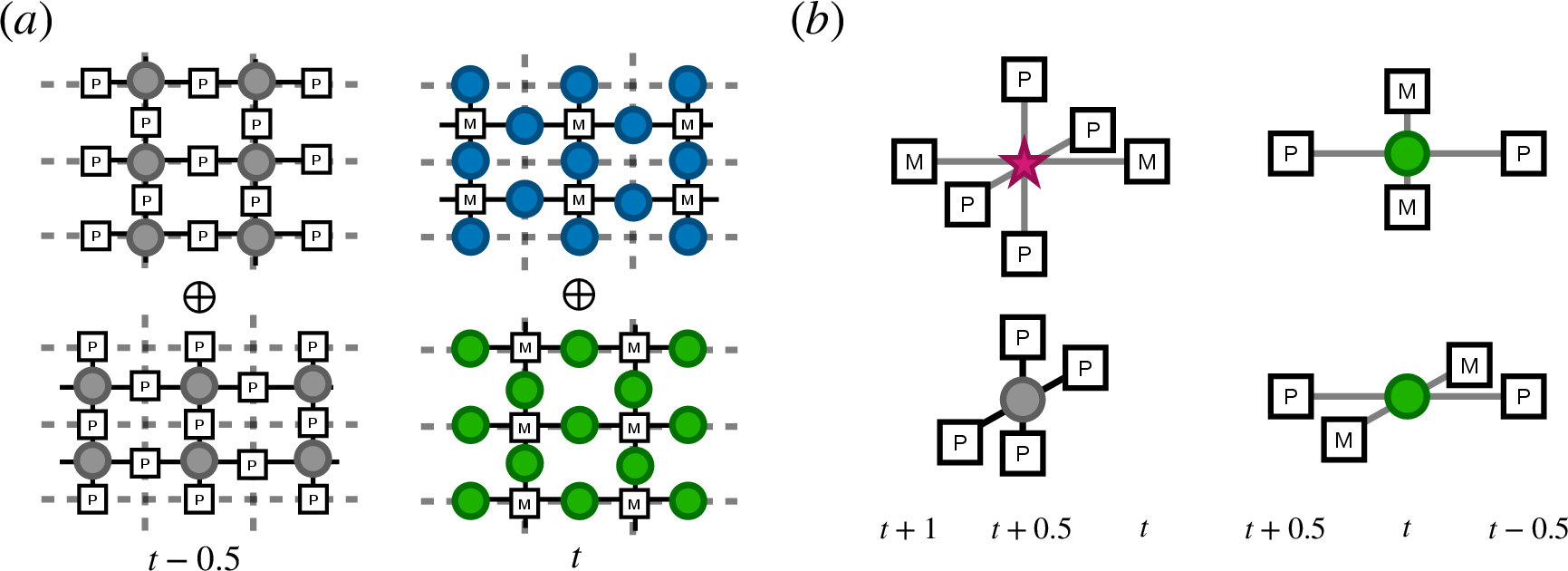
Figure 8: The 3D gauge structure for a repeated-measurement surface code in the phenomenological model, showing matter and gauge fields, detector cubes, and Gauss law faces.
An explicit homological formula for the circuit’s internal distance—i.e., the minimal weight undetectable error (modulo boundaries)—is derived in terms of the first homology group of the chain complex associated with the gauged SSC.
Logical degrees of freedom are clarified in the presence of boundaries: global redundancies (support spanning all times) correspond to logical operators and should be excluded from the detector set if one does not wish to treat them as gauge-invariant (thus physically observable) quantities.
Examples and Applications
The framework captures a wide variety of QEC constructions:
- Data-syndrome codes: The classical code appearing in data-syndrome codes arises directly as the code of redundancies in the gauged SSC (see Figure 9).
- MBQC and Foliation: For CSS-like Clifford circuits, the X and Z-type sectors of the gauged theory are dual, and one sector constitutes a “foliated computation”—a resource state (cluster state) whose stabilizer/gauss law structure matches detectors and logical propagation of the original circuit.
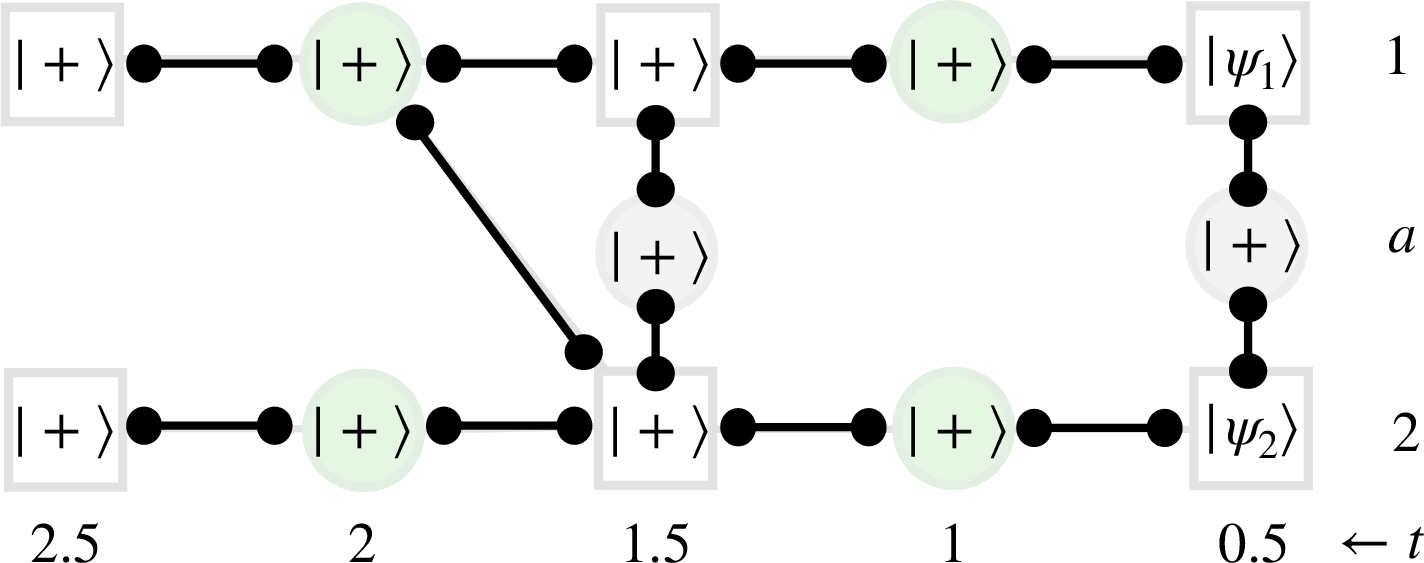
Figure 4: Resource state for foliated computation generated from the underlying circuit, supporting measurement-based implementation of the desired logical action.
- Mixed-state order: By dephasing all matter fields in the resource state except for the output layer, a classical memory is established, with detectors as classical checks—directly connecting with recent results on topological order in mixed states.
- Learning Theory: There is an isomorphism between the detector set (redundancies) of the gauged SSC and the learnable degrees of freedom of general Pauli noise channels, as captured by the pattern transfer graph (PTG) formalism [Chen PRXQ]. Each physically measurable redundancy (Wilson loop) corresponds to a combination of noise parameters that is operationally estimable from output statistics.
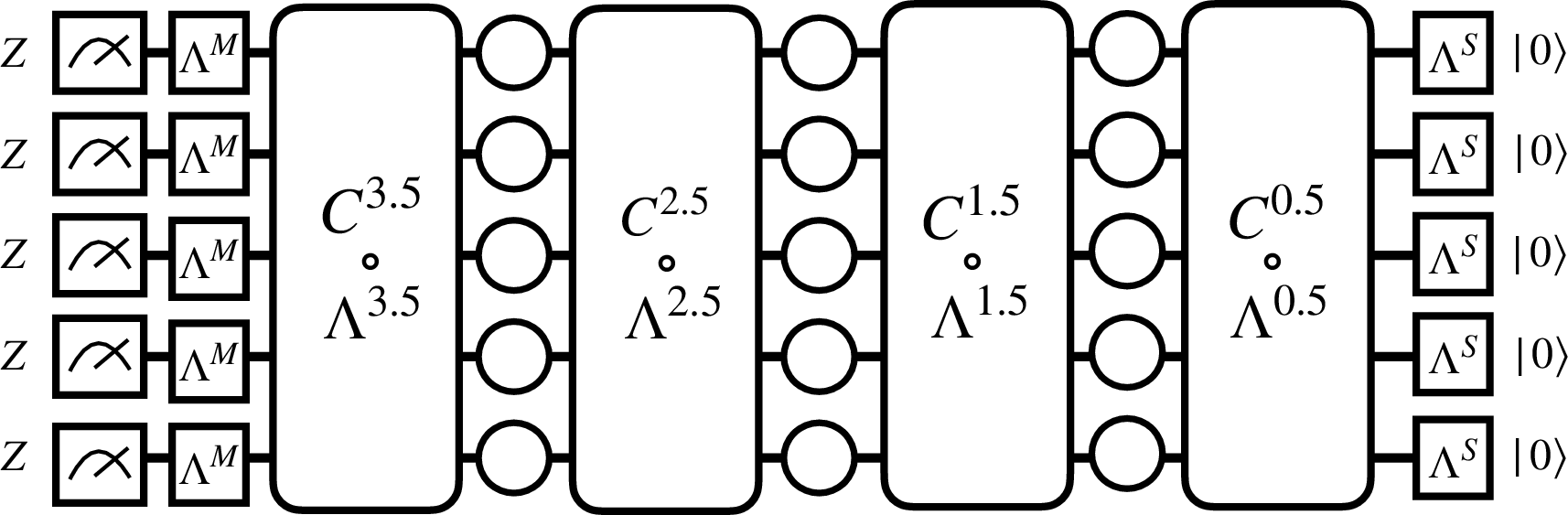
Figure 12: A benchmarking Clifford circuit with interleaved Clifford gates and measurement, tailored for self-consistent learning of Pauli noise via the observed Wilson loop/ redundancy structure.
Implications and Outlook
Practical implications:
This gauged perspective provides a principled method to analyze and optimize fault tolerance beyond stabilizer codes, tracking all logically distinct error configurations and their observability as gauge-invariant quantities. It brings new clarity to the notion of detector design, the structure of data-syndrome and subsystem codes, the treatment of arbitrary boundary/measurement conditions, and the analysis of finite-circuit QEC schemes. The explicit connection to pattern transfer graphs formalizes the limitations and possibilities of tomography and self-consistent noise learning in near-term devices.
Theoretical implications and future development:
By encoding the operational elements of QEC—fault equivalence, detector observable structure, and logical boundary conditions—as a chain complex arising from a concrete gauge theory, the work both unifies previously disparate perspectives and enables extension to richer settings. Open directions include:
- Extending beyond Clifford circuits (and relating to adaptivity in MBQC).
- Investigating the emergence of exotic gauge theoretic phenomena (such as topological charge and anyon braiding) in the space of fault-tolerant circuits and QEC gadgets.
- Systematic synthesis of fault-tolerant protocols by designing lattice gauge theories with desired redundancy/logical features.
Conclusion
By “gauging the spacetime code,” the paper provides a dual lattice gauge theory directly encoding the essential elements of quantum circuit fault tolerance. The mapping is exact for Clifford circuits (including arbitrary multi-qubit and mid-circuit measurement structure), with manifest correspondence between operationally defined detectors and gauge-invariant Wilson loops. The approach simultaneously clarifies the geometry and topology of error correction schemes, serves as a constructive toolbox for learning and benchmarking scenarios, and forms a basis for the study and construction of new QEC phases of matter.