- The paper demonstrates that LLMs rely on affix heuristics to overgeneralize drug names, leading to misclassification of fictitious drugs.
- It introduces a diagnostic framework quantifying affix, stem, and holistic contributions to LLM predictions in pharmacology.
- Mechanistic analysis pinpoints shortcut integration to early-mid transformer layers, suggesting targeted mitigation strategies for safer medical applications.
Morphological Shortcuts in LLMs: Behavioral and Mechanistic Insights in Pharmacology
Introduction
LLMs demonstrate notable proficiency in extracting and applying morphological cues, particularly in specialized domains reliant on nomenclature conventions such as pharmacology. However, reliance on surface-form heuristics can drive overgeneralization, posing substantial safety risks. The paper "What's in a Name? Morphological Shortcuts by LLMs in Pharmacology" (2606.05616) undertakes a systematic investigation into the behavioral and mechanistic underpinnings of affix-based heuristics in LLMs, focusing on medical drug names and the consequences of morphological shortcuts that may bypass genuine factual knowledge.
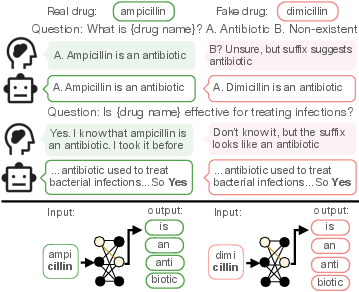
Figure 1: Example of morphology-driven inference; both humans and LLMs use morphological cues, but LLMs often do so with unwarranted confidence even for fictitious drugs.
Behavioral Analysis: Affix Heuristics Drive Fictitious Drug Reasoning
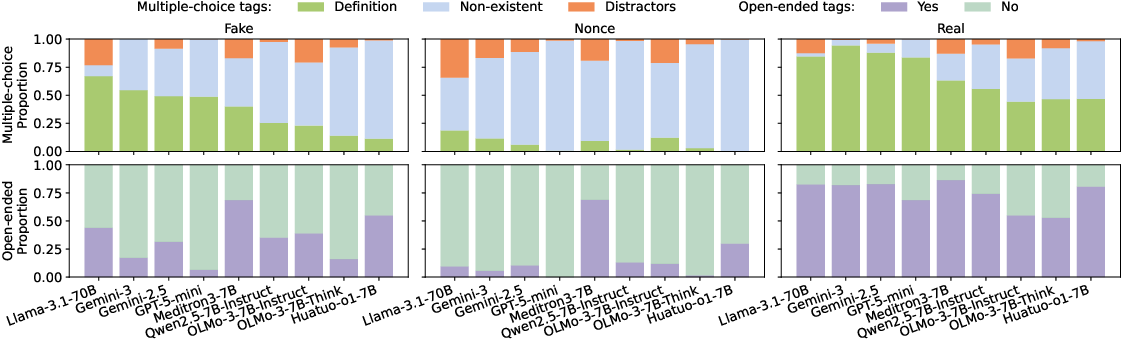
The study establishes a robust experimental paradigm isolating affix-driven behaviors. Using matched triplets—real drug names, nonce-stem plus real-affix "fake" drugs, and fully nonce forms—the authors evaluated nine LLMs (including general-purposes and medically-tuned models) on both multiple-choice (MC) and open-ended (OE) question-answering tasks.
Key findings are as follows:
Additional results (see Figures 6 and 7) demonstrate that models hallucinate pharmacological semantics even when morphological cues override strong semantic priors (e.g., "tablecillin" interpreted as an antibiotic). CoT prompting increases conservativeness, suppressing both false-positive and, slightly, true-positive drug recognitions (Figure 3).
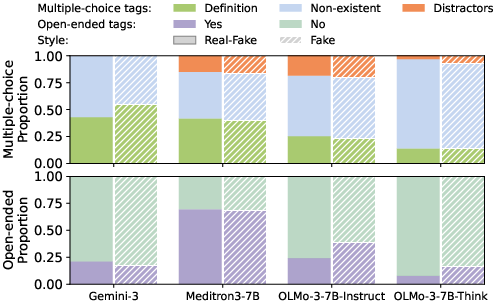
Figure 4: Model behavior under Real-Fake and Fake settings, showing overgeneralization even with everyday objects as stems.
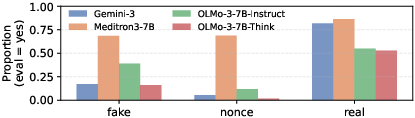
Figure 5: Results for bare-question setting, confirming models treat nonce-affix drugs as real medications independent of clinical prompting.
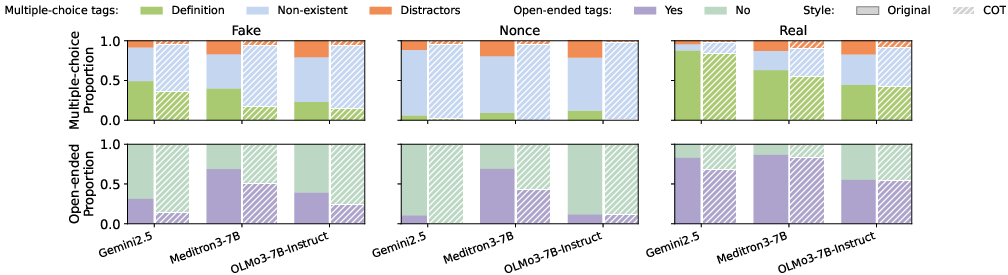
Figure 3: Chain-of-thought prompting reduces reliance on affix heuristics for fake drugs but also suppresses recognition of real drugs.
Diagnostic Framework: Disentangling Affix, Stem, and Holistic Knowledge
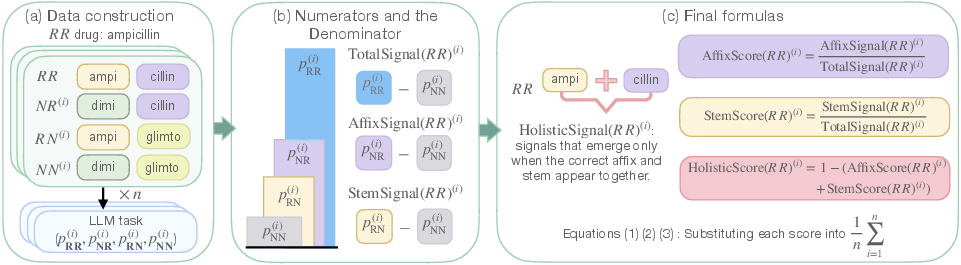
A formal framework is devised to decompose the relative contributions of affix, stem, and full-word (holistic) semantics to model predictions. For each real drug, a 2x2 morphological perturbation grid (RR, NR, RN, NN) allows the evaluation of:
Empirical analysis reveals:
- Prevalence of Affix Dependence: A substantial fraction of drugs are classified as Affix-dependent, whereby affix presence alone drives behavioral outputs equivalent to the full real drug.
- Knowledge Task Dependence: MC categorization is often affix-driven, whereas OE scenario behaviors trend toward holistic representations.
- Exposure Correlation: Drugs with higher training frequency favor holistic signals (positive Spearman correlation), while rare drugs are more likely to be resolved via morphological heuristics.
- Behavioral Reliability: Holistic drugs produce more reliable factual reasoning, whereas affix-based reasoning leads to higher risk of cross-drug confusion and factual conflation.
Qualitative Analysis: Silent Heuristics and Factual Conflation
Manual inspection of model outputs uncovers two frequent failure modes:
- Implicit Heuristic Use: LLMs make affix-driven predictions but offer explanations that omit any reference to the morphological basis, obfuscating detection of shortcut-based responses.
- Cross-Drug Conflation: For affix-class drugs, LLMs frequently transfer features, indications, or contraindications between unrelated drugs sharing an affix.
Such mismatches between generated content and underlying evidence sources represent latent safety risks, particularly in high-stakes medical applications.
Mechanistic Analysis: Localization and Causal Control of Affix Shortcuts
To precisely locate where morphological shortcuts emerge within the transformer computation, the authors employ activation patching and distributed alignment search (DAS). These analyses demonstrate:
- Early-Mid Layer Localization: The critical locus for affix-driven signal integration is in early-to-middle transformer layers (layers 7–10 in OLMo-3-7B-Instruct), where subject token representations encode affix information, and final token positions consolidate output behavior.
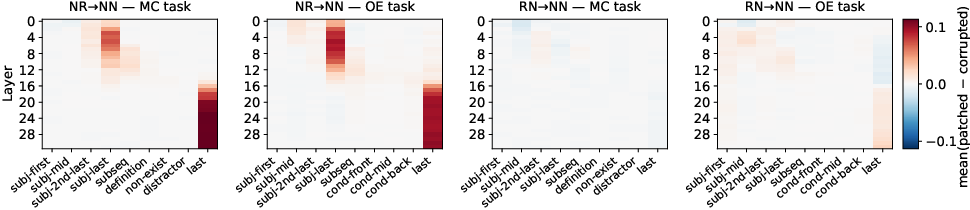
Figure 7: Layer- and position-wise activation patching effects; affix signal integration peaks in early-mid layers at drug name and final-token locations.
- Affix Information Sufficiency in Affix-Class Drugs: Patching the affix into a fully nonce prompt reproduces the full RR→NN effect for affix-dependent drugs, but not for holistic ones.

Figure 8: Last-token activation patching; NR→NN and RR→NN curves coincide for affix-class drugs, but diverge for holistic-class drugs, indicating distinct mechanistic bases.
- Low-rank Subspace Control: A learned rank-one direction via DAS enables bidirectional steering of affix-dependent outputs, offering causal evidence that shortcut reliance is both localized and control-enabled.
Implications and Future Directions
This work provides robust evidence that LLMs systematically leverage morphological shortcuts, particularly affix cues, to overgeneralize drug-class semantics in pharmacological contexts. These findings have several theoretical and practical implications:
- Interpretability and Trust: Standard output inspection is insufficient for identifying shortcut-driven reasoning; mechanistic probes are necessary for model auditing.
- Safety Risks: Overgeneralization from affix heuristics, especially in low-exposure drugs, may propagate clinical misinformation and cross-drug property conflation.
- Mechanism-based Mitigation: Causal localization in early-mid layers and demonstrated steerability via DAS suggest avenues for targeted mitigation—e.g., regularization, adversarial training, or mechanism-aware output calibration.
- Model Development: Future LLMs for medical environments should incorporate internal uncertainty quantification regarding evidence provenance (morphological heuristic vs parametric knowledge).
The results motivate expansion to larger models and other domains with high systematic morphology-meaning mappings, as well as integration into clinical risk assessment pipelines.
Conclusion
The paper provides a comprehensive behavioral and mechanistic dissection of morphological shortcuts in LLMs within pharmacology. By isolating affix-reliant behaviors, introducing quantification frameworks, and tracing shortcut emergence to specific model layers and subspaces, the work establishes morphological shortcuts as a subtle yet significant risk factor for safety, interpretability, and reliability of LLM-driven medical applications. The diagnostic and mechanistic tools presented offer a pathway for future safety interventions and for developing more robust, evidence-grounded neuro-symbolic reasoning in LLMs.