- The paper reveals that imposing finite Dirichlet boundaries in Einstein gravity generically triggers bulk singularities that abruptly terminate time evolution.
- It employs local Minkowski models and AdS cosmologies to derive analytic conditions for singularity formation based on wall size, genus, and conical deficits.
- The study demonstrates that these boundary-induced singularities, marked by positive Brown-York energy, challenge cosmic censorship and standard initial-boundary formulations.
Dirichlet Walls and the End of Time: A Technical Analysis
Conceptual Framework and Motivation
The study addresses the classical dynamics of Einstein-Hilbert gravity with Dirichlet boundary conditions imposed on a finite timelike surface—a so-called Dirichlet wall. Unlike conventional treatments that focus on asymptotic boundaries (e.g., asymptotically flat or AdS spacetimes), the imposition of Dirichlet boundary data on finite boundaries introduces qualitatively new causal and global properties for gravitational evolution. Notably, the work demonstrates that for generic classes of initial data, such spacetimes can develop bulk singularities that propagate out to and terminate on the Dirichlet wall, thereby halting time evolution throughout the entire spacetime. This "end-of-time" phenomenon stands in stark contrast to traditional scenarios where singularities are hidden behind event horizons.
Singularities Arising from Dirichlet Walls
Local Models of Wall Collisions
The analysis initiates with the junction geometry of two intersecting timelike Dirichlet planes in Minkowski spacetime, which provides a local model for generic interactions of Dirichlet walls:
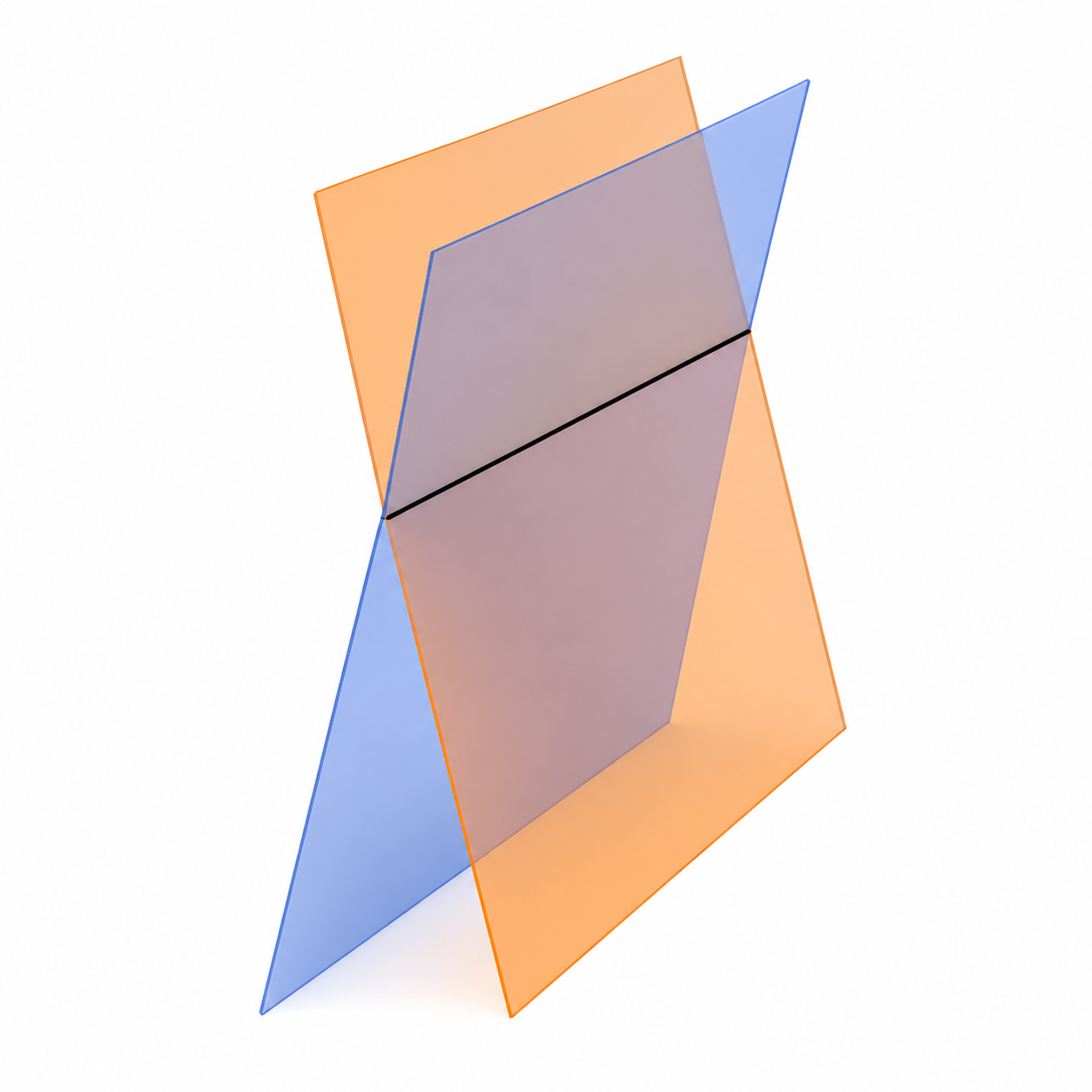
Figure 1: Unless they are precisely parallel, two timelike planes in Minkowski intersect along a straight line. The nature of the intersection (spacelike, null, or timelike) depends on their relative orientation.
For spacelike intersections—i.e., collisions induced by a boost—the intersection represents an unavoidable end-of-time singularity, with the spacetime volume between the walls terminated at the intersection. The genericity of this phenomenon is argued via stability under perturbations of wall orientation and the ability to remove unwanted asymptotic regions by compactification.
Dirichlet Cosmologies in AdS
The work then generalizes to AdS cosmologies, constructed by quotienting global AdS by discrete isometry groups to yield compact spatial sections. Dirichlet walls of the form Sd−2×R, embedded at constant r, are introduced into these compactified backgrounds. As the universe evolves (e.g., contracts in conformal time), these static Dirichlet walls invariably intersect with the shrinking fundamental domain, inducing singularities on the wall in finite time:
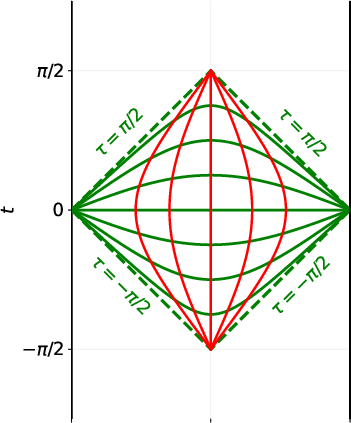
Figure 2: Constant τ (green) and constant χ (red) surfaces on the conformal diagram of global AdS2, showing how the Dirichlet wall approaches the shrinking fundamental domain at velocities approaching the speed of light.
A detailed construction in AdS3 yields analytic expressions for the onset time of singularity formation as a function of wall circumference L, genus g, and conical defect angle. In the limit of large genus and small boundary wall, the entire collision occurs at ultra-relativistic speeds near τ→π/2, rendering the singularity everywhere spacelike. Conversely, for large walls nearly saturating the fundamental domain, the singularity quickly becomes timelike.
Causal Structure and Energy Analysis
Explicit calculation of the singularity locus and its causal character is provided. The condition for the singularity to persist as everywhere spacelike is derived in terms of wall size, genus, and compactification parameters. Increasing genus or conical deficit delays the singularity and enlarges the region of parameter space with fully spacelike singularities:
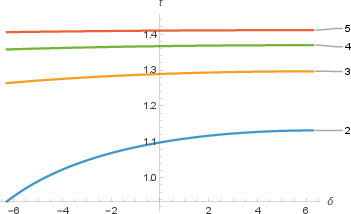
Figure 3: The time τ at which the singularity first forms, as a function of conical deficit, for various r0. Both larger genus and greater deficit postpone singularity formation.
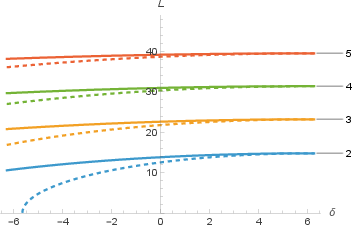
Figure 4: Phase diagram of wall size r1 versus conical deficit r2, showing regions with everywhere spacelike (below dashed) and partially timelike (above) singularities. For fixed r3, large enough genus always gives spacelike singularities.
The conserved energy, computed through the Brown-York tensor, is positive definite for these spacetime-filling singular cosmologies, distinguishing them from conventional boxed black holes, which have negative (regulated) energy outside horizons. The implication is that the space of Dirichlet wall solutions is not partitioned into dynamically disconnected sectors by energy sign: time-dependent boundary conditions, driven evolution, or inclusion of matter permit interpolations between positive and negative energy configurations, violating the convexity assumptions of the well-posedness results in (An et al., 11 May 2025).
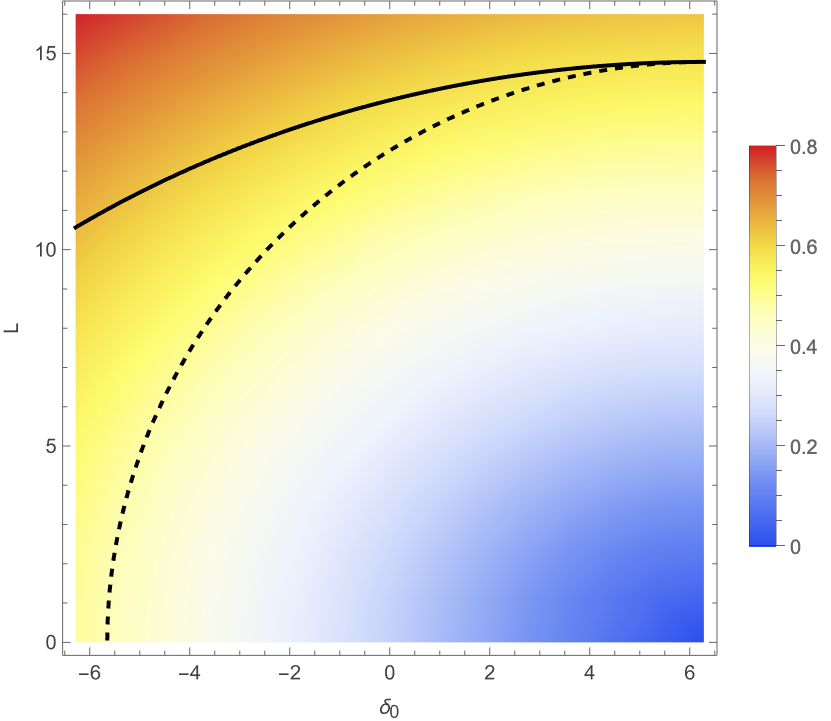
Figure 5: Contours of the conserved energy r4 as a function of deficit angle and wall circumference, with demarcations showing the threshold between purely spacelike and timelike singularity formation.
Dirichlet Walls in Black Hole Backgrounds
A major extension is the explicit construction, in 2+1D BTZ black hole spacetime, of timelike r5 Dirichlet walls whose evolution partially penetrates the event horizon. In this context, the entire Dirichlet wall eventually falls into the black hole, encountering the curvature singularity within finite proper time. This construction is explicitly realized by power-series expansion near the moment of tangency to the horizon, establishing that even configurations resembling standard boxed-black-hole initial data generically can lead to end-of-time singularities for the Dirichlet wall. The sign of the Brown-York energy density on the portion entering the horizon is positive, aligning again with the sign seen in singular Dirichlet cosmologies.
Generalization to higher dimensions reveals a critical distinction: the local dynamical degrees of freedom in r6 gravity preclude the direct tracing of wall-induced singularities using only initial geometry and constraints. Nevertheless, the analysis of high-energy shock collisions parallel to the wall (via Aichelburg-Sexl solutions and image charges) demonstrates that marginally trapped surfaces, which include a segment of the Dirichlet wall, form generically in collisions involving sufficiently large center-of-mass energy. Penrose-type constructions show that the appearance of such trapped surfaces is unaffected by the wall if the trapped region does not intersect the wall itself, implying the potential for horizon and singularity formation whose causal reach includes the wall.
Implications, Limitations, and Future Directions
The existence of generic, spacetime-filling end-of-time singularities in classical Einstein dynamics with Dirichlet walls has both practical and theoretical import. Practically, it signals that models of gravitational systems with finite boundaries—motivated by holographic cutoffs, r7 deformations, or gravitational observatories—exhibit pathologies in time evolution that cannot be excised by initial data selection within broad classes. This questions the completeness of the associated dual field theories and their quantum deformations.
Theoretically, the results challenge the universality of cosmic censorship and spacelike singularity localization when Dirichlet boundaries are imposed at finite distance. The failure of energy convexity conditions crucial to the well-posedness of the Einstein-Dirichlet initial-boundary-value problem (An et al., 11 May 2025)—especially under gravitational radiation backreaction—underscores the need for refined mathematical treatments or new boundary conditions.
Potential future directions include:
- Quantum and String Corrections: Whether quantum gravity effects or higher-derivative corrections can delay, regularize, or resolve these singularities is an open question, crucial for the fate of information in Dirichlet-bounded universes.
- Alternative Boundary Conditions: The exploration of Neumann, conformal, or mixed boundary conditions and their own (ill-)posedness properties, as well as stability under perturbations.
- Holographic Implications: Translation of the classical singularity structure into the language of dual field theories, especially those subjected to r8-like irrelevant deformations, and possible signatures of gravitational breakdown or scrambling.
Conclusion
This work provides a comprehensive, technical treatment of classical Einstein gravity with Dirichlet walls at finite boundaries, demonstrating that end-of-time singularities—both spacelike and timelike—arise generically in a wide class of cosmological and black hole spacetimes. The boundary-induced pathologies fundamentally challenge the viability of local evolution in such systems, with implications for both mathematical relativity and holographic dualities. The results motivate further investigation into boundary data posing, stability under radiation, and quantum resolutions of classically terminal behavior.