- The paper's main contribution is a numerical exploration revealing that finite-width Abelian-Higgs cosmic strings exhibit stronger confinement and a narrower curvature well compared to idealized models.
- It employs a Hamiltonian framework for photon geodesic calculations and derives a lens equation that demonstrates a unique triple-imaging regime along with central image demagnification.
- The study shows that optical phenomena such as Shapiro time delays vary with string parameters, offering potential observational probes for the internal structure of cosmic strings.
Optical Properties of Gravitating Abelian-Higgs Cosmic Strings
Gravitating String Solutions and Internal Structure
The optical behavior of cosmic strings is explored using the gravitating Abelian-Higgs model, which fundamentally differs from the idealized wire approximation by incorporating a finite core defined by the interplay between the scalar (Higgs) and gauge fields. The dimensionless parameters α=e2/λ and γ=8πGη2 control the ratio of gauge to scalar field masses and the symmetry-breaking energy scale, respectively. Numerical solutions reveal that increasing either α or γ results in stronger confinement and a narrower, deeper curvature well at the string core.
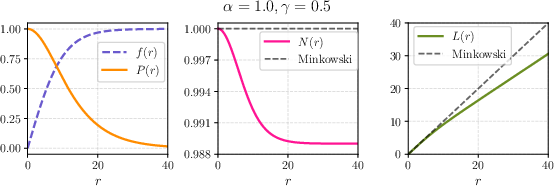
Figure 1: Radial profiles of scalar and gauge fields with associated metric functions N(r) and L(r) characterizing the spacetime geometry of cosmic string solutions.
Classification in the (α,γ) parameter space yields critical curves delimiting globally regular "string branch" solutions from closed spacetime configurations.
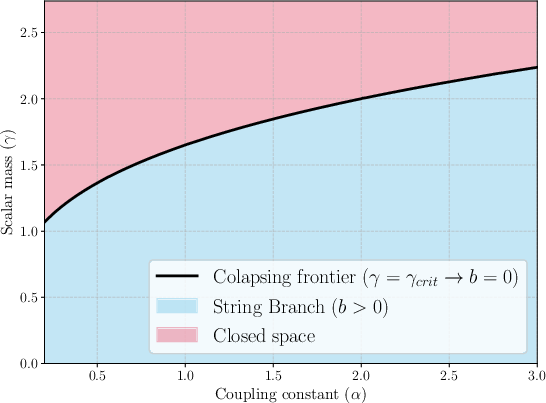
Figure 2: The critical curve γcrit(α) separates open string solutions from closed spacetimes, with allowed γ increasing monotonically in α.
The local negative Ricci curvature at the string core, which is absent in ideal cosmic strings, is a direct probe of the finite-width structure and increases with both γ=8πGη20 and γ=8πGη21.
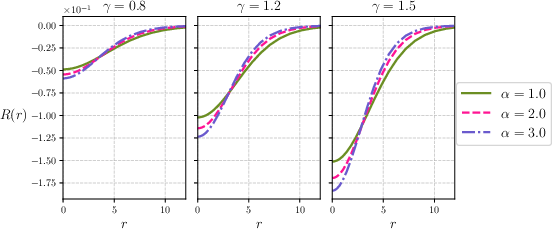
Figure 3: Curvature profiles as functions of γ=8πGη22 and γ=8πGη23, demonstrating the enhancement of central negative curvature with stronger gauge and gravitational coupling.
The vortex radius γ=8πGη24, defined via the decay of the curvature, decreases monotonically with both parameters, indicating increased core localization.
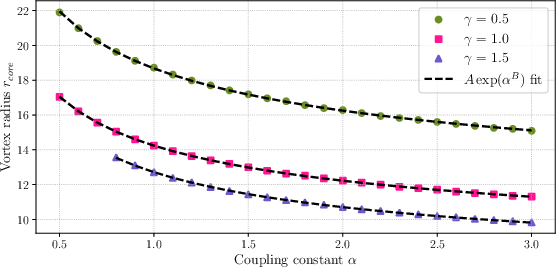
Figure 4: Variation of vortex radius with γ=8πGη25 for different γ=8πGη26, highlighting the narrowing of the core with stronger coupling.
Central curvature γ=8πGη27 demonstrates power-exponential scaling with γ=8πGη28 modulated by γ=8πGη29.
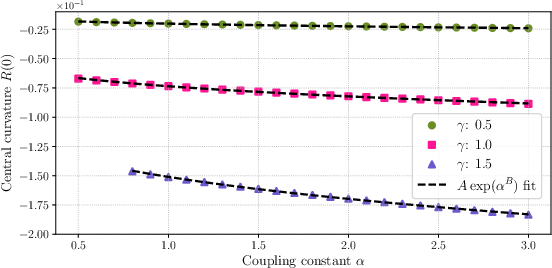
Figure 5: Central Ricci curvature α0 as a function of α1 and α2, mapping the evolution of curvature wells across parameter space.
Geodesics are computed in Cartesian coordinates using a Hamiltonian framework to avoid coordinate singularities, allowing accurate tracking of photon trajectories through the finite-width spacetime. The lens equation, derived in the thin-screen approximation for cosmological settings, relates impact parameter, deflection angle, and projected source position, forming the basis for multiple-image analysis.
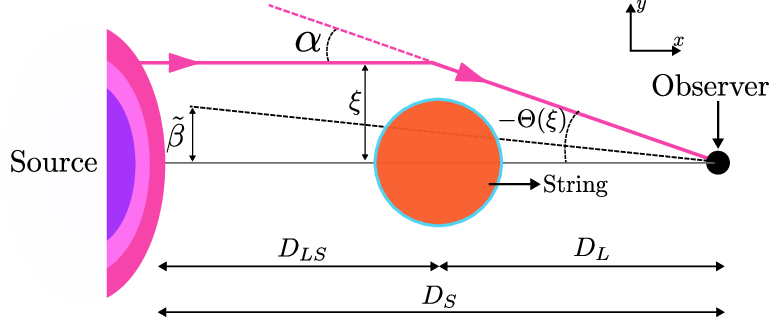
Figure 6: Top view schematic of the cosmological lensing setup with a cosmic string between observer and source.
Triple Imaging and Image Multiplicity
The finite core induces a characteristic triple-imaging regime not possible for ideal strings, which only produce double images due to a conical topology. The lens mapping α3 admits three distinct impact parameters for a range of source positions α4, yielding three observable images: two external (passing outside the core) and one central (passing through).
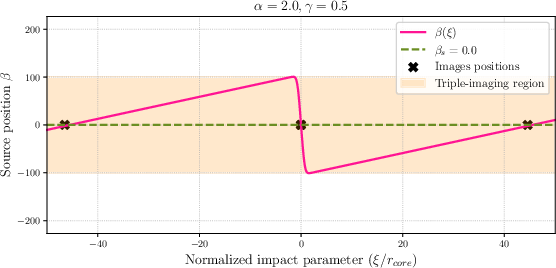
Figure 7: Lens mapping α5 demonstrating triple-image formation for α6, α7 with symmetric external and central image positions.
The interval α8 defines the projected source range supporting triple imaging, with α9 increasing with γ0 (string mass).
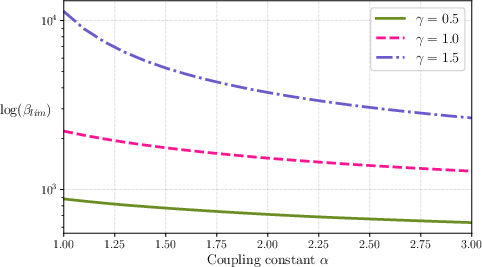
Figure 8: Source position range for triple imaging as a function of γ1 at various γ2. Higher symmetry-breaking scales yield broader triple-imaging domains.
Magnification and Demagnification Characteristics
The magnification γ3 is determined by the Jacobian of the lens mapping, with external images preserving their flux (topologically induced, γ4), while the central image is strongly demagnified due to rapid variation in the deflection angle close to the core. The demagnification increases as γ5, with the central image nearly disappearing in the ideal string limit; conversely, broad vortices at γ6 produce brighter central images.
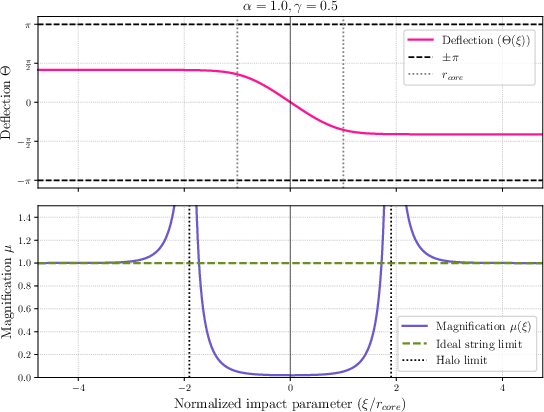
Figure 9: Deflection angle and magnification profiles across normalized impact parameter, with demagnification peaking at the core.
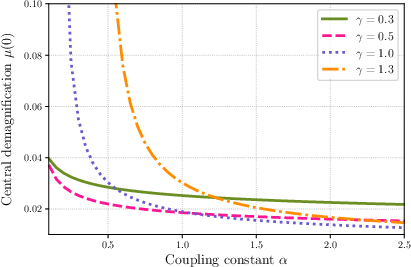
Figure 10: Central image magnification γ7 versus γ8 and γ9, showing decay with increasing confinement and enhancement near the minimal N(r)0.
Shapiro Time Delay and Temporal Shortcuts
The internal structure of the string modifies the local metric, imparting a nontrivial Shapiro time delay that depends on both ray trajectory and string parameters. The sign and magnitude of the delay between central and external images are governed by N(r)1: for N(r)2, the core acts as a temporal shortcut (N(r)3), while for N(r)4, as a temporal barrier (N(r)5). At the self-dual point (N(r)6), the time delay vanishes.
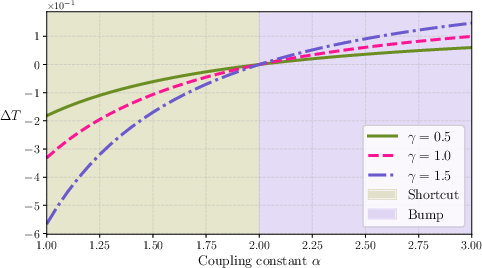
Figure 11: Time delay difference N(r)7 between central and external images, with sign reversal regulated by N(r)8.
Implications and Future Outlook
The numerical results establish that finite-width Abelian-Higgs strings produce richer lensing phenomenology than ideal strings, with triple-imaging, strong demagnification of the central image, and a coupling-dependent time-delay per image. These optical features encode direct information about the internal structure—core width, curvature, and field ratios—providing possible observational signatures that could distinguish realistic cosmic strings from idealized wire models.
Practically, the detection of triple-image lensing or anomalous Shapiro delays in astronomical surveys could constrain the microscopic parameters of cosmic string models, including the gauge/Higgs mass ratio and the symmetry-breaking scale. Theoretically, these results clarify the convergence to ideal string behavior and emphasize the sensitivity of lensing observables to underlying field-theoretic structure. The extension to self-interacting or non-Abelian defects, as well as the inclusion of wave-optical and inclined geometries, warrants further investigation.
Conclusion
Systematic analysis demonstrates that gravitating Abelian-Higgs cosmic strings possess quantitative distinctions from idealized models—finite core effects manifest in multiple image formation, central image demagnification, and coupling-controlled time delays. Gravitational lensing by cosmic strings thus has the potential to probe field-theoretic parameters and defect internal structure, offering stringent tests for cosmological models and observational searches.

