- The paper introduces a unified spatio-temporal graph-based model, CausalPOI, that achieves up to 57.8% RMSE reduction over baselines for cold-start POI forecasting.
- It integrates dynamic spatial and semantic interactions through a Spatio-Temporal Functional Interaction Graph and a causal inference module for treatment effect estimation.
- Extensive experiments on SafeGraph data validate the model's robustness, generalizability, and practical implications for urban planning and policy simulation.
CausalPOI: Spatio-Temporal Graph-Based Causal Modeling for Cold-Start POI Check-in Forecasting
CausalPOI addresses the cold-start POI check-in forecasting problem, focusing on the prediction of future check-in sequences for newly introduced Points of Interest (POIs) in urban environments. The formulation requires not only accurate forecasting of activity for the cold-start POI but also estimation of individual treatment effect (ITE), quantifying the causal impact of introducing the POI on local urban mobility patterns. The task is inherently challenging due to the absence of historical behavioral data, the necessity of capturing both spatial and semantic interactions, and the requirement to disentangle causal effects from correlations in highly structured, dynamic urban contexts.
Framework Overview
CausalPOI proposes a unified spatio-temporal causal representation learning approach. The architecture is composed of two main modules: the Spatio-Temporal Functional Interaction Graph (ST-FIG) and the Causal Inference Module. The ST-FIG module encodes both spatial proximity and semantic-functional relations among POIs, establishing a dynamically evolving local graph for each week post-intervention. The Causal Inference Module enforces a counterfactual modeling structure by constructing aligned treatment and control graphs. Outcomes with and without the introduced POI are estimated using parameter-shared neural encoders, yielding interpretable local ITE estimates.
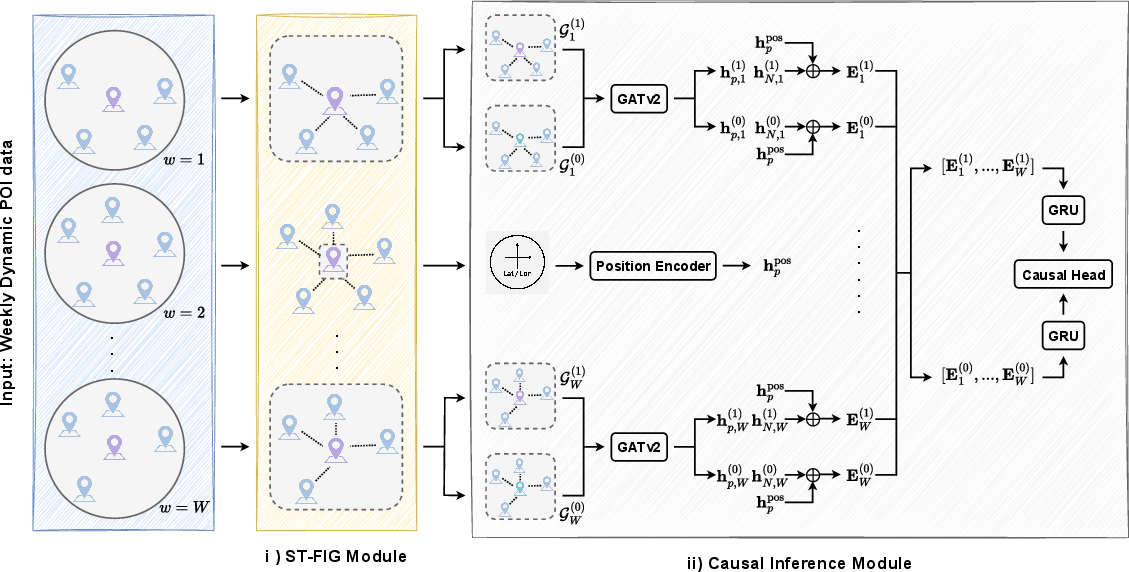
Figure 1: Architectural overview of CausalPOI, showing construction of temporal functional graphs and treatment-control graph pairs for causal effect estimation.
ST-FIG sets the foundation by encoding both geography-dependent and functional interaction strengths, incorporating semantic relationships via contrastive pretraining on category embeddings. Dynamic neighborhood selection and edge weighting account for week-specific activity and spatial attenuation, with competitive and complementary functions explicitly modeled. This approach fundamentally extends proximity-based urban forecasting by integrating latent functional semantics directly into the graph structure.
Causal Effect Estimation via Structured Temporal Graph Alignment
The Causal Inference Module formalizes the intervention scenario as a networked partial interference model. Treatment is defined as the presence of the new POI, and the local spatial neighborhood forms the exposure context. For each cold-start POI, two structurally aligned temporal graphs are constructed: the treatment graph includes the POI with full semantic features, while the control graph replaces the POI representation with zeros, suppressing functional influence but preserving topology. Crucially, edge weights in the control graph omit the functional interaction term, isolating semantic effects while controlling for spatial structure.
Both graphs, over a horizon of several weeks post-introduction, are fed through shared GATv2 graph encoders. Output embeddings, concatenated with high-dimensional sinusoidal positional encodings for geolocation, are temporally aggregated via a GRU. Final outcome decoders then predict weekly check-in volumes under both treatment and control, allowing for direct estimation of uplift (ITE) at the POI level.
Experimental Validation and Ablation
CausalPOI is validated on SafeGraph POI datasets, covering diverse U.S. regions, with over 70 weeks of temporal coverage. The study benchmarks against an extensive suite of baselines, including time-series GNNs (DCRNN, GraphWaveNet, AGCRN, LightST), generative models (TrafficStream, KGDiff), statistical methods (SVGP, LCFM), LLM-based forecasters (TIME-LLM, TimeCMA), and causal spatio-temporal models (GCIM). Baseline adaptation to the cold-start scenario involves careful attenuation of neighbor activity to avoid overestimation.
CausalPOI demonstrates robust improvements, achieving up to 57.8% RMSE and 34.3% MAE reduction over the best-performing baseline in the most challenging region. Performance gains are consistent across all regions, indicating strong generalizability and robustness under urban cold-start conditions. Ablation analysis confirms substantial degradation upon removal of the ST-FIG or causal module, validating the importance of functional semantic modeling and explicit counterfactual reasoning.
Parameter Sensitivity Analysis
Parameter sensitivity studies show stable performance across a practical range of causal loss weighting (γ), spatial decay bandwidth (σ), and neighborhood radius (maxdist). Optimal performance is achieved within moderate values, with extremely small or large parameters leading to expected underfitting (insufficient interaction modeling) or over-smoothing (excess inclusion of irrelevant POIs), respectively.
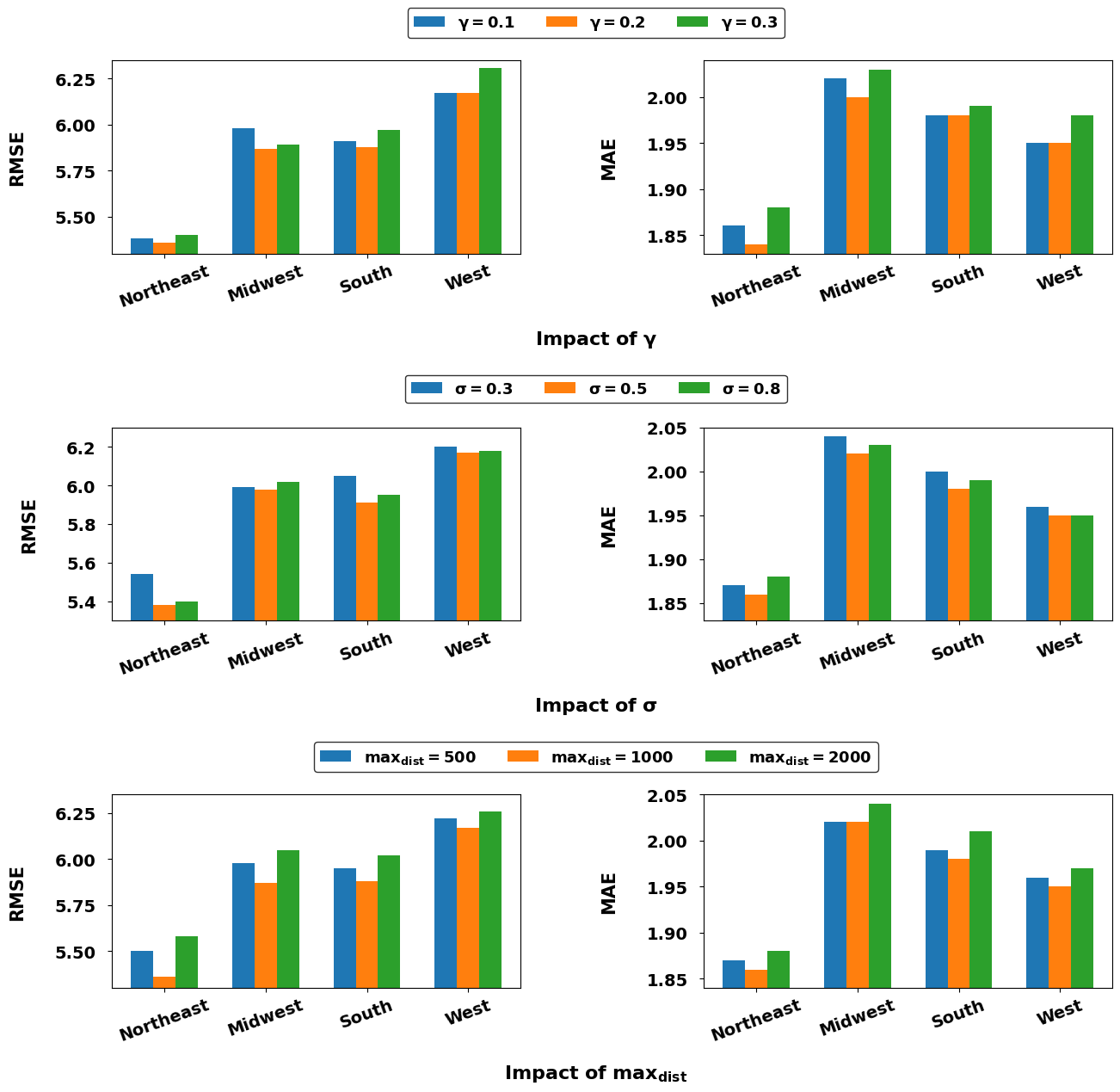
Figure 2: Parameter sensitivity analysis showing the effect of key hyperparameters on forecasting accuracy.
Sanity Checks, Placebo Testing, and Uplift Interpretation
CausalPOI’s estimated uplift exhibits expected sensitivity to competition level: POIs embedded in highly competitive neighborhoods show reduced causal uplift, consistent with economic and behavioral intuition. Further placebo and shifted intervention tests reinforce the intervention-specificity of the model, with near-zero estimated uplift for false interventions and measurable decrease when the true intervention is temporally shifted, verifying the reliability of the causal estimation framework.
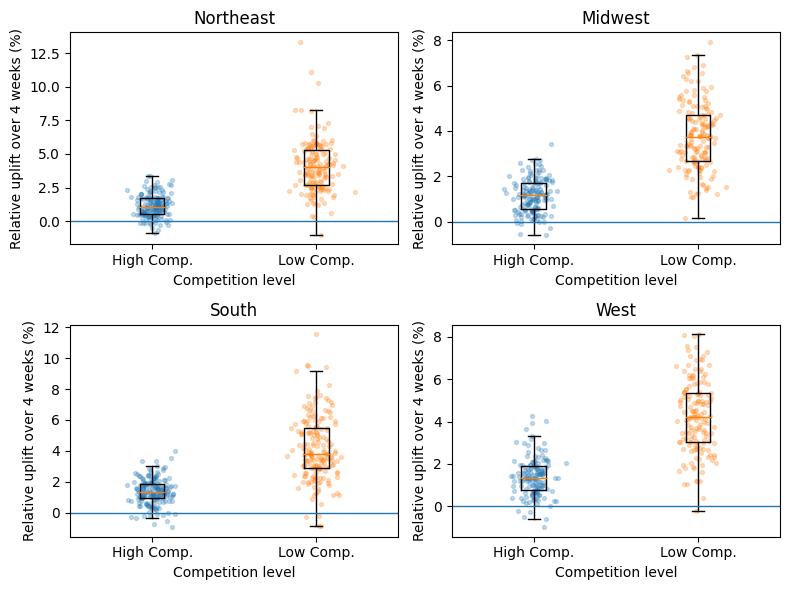
Figure 3: Distributional analysis of estimated uplift, confirming model discrimination between high and low competition environments.
Theoretical and Practical Implications
CausalPOI formalizes a counterfactual approach to POI-level urban forecasting, moving beyond region-level aggregations and static graph assumptions. The explicit alignment of treatment and control graphs over temporally dynamic, semantically annotated neighborhoods is key to isolating intervention effects relevant for downstream urban planning, site selection, and policy simulation. This formulation mitigates, though does not entirely eliminate, potential biases from unobserved confounders, but achieves substantial advance in interpretable causal effect estimation in non-experimental urban environments.
The framework’s extensibility is notable: future research directions include expansion to higher-order or non-local interference models, integration of richer textual and multimodal signals, and applications to other cold-start decision-making domains (e.g., urban event impact, infrastructure roll-out).
Conclusion
CausalPOI establishes a scalable causal graph learning paradigm for cold-start POI forecasting, integrating semantic functional dependency, spatio-temporal alignment, and structural counterfactual estimation within a unified neural framework. Through extensive empirical validation, the approach demonstrates consistent gains in predictive accuracy and actionable causal inference, representing a step forward in fine-grained urban informatics and decision support.