- The paper presents LACIA, an AI workflow that systematically partitions theoretical physics derivations into ideation, actualization, verification, and inspection to mitigate errors.
- The paper achieves a systematic construction of Carrollian conformal bases for tachyonic and massive states using a Poincare-Carrollian intertwiner method that reconciles bulk-boundary symmetry differences.
- The paper demonstrates that a real mass in the bulk corresponds to an imaginary, complex-shifted momentum on the boundary, fundamentally resolving a gap in Carrollian holography.
LACIA: Verification-Driven Agentic AI Workflow for Theoretical Physics
The paper presents LACIA (Language-model Agent Cycle for Ideation and Actualization), a structured agentic AI workflow designed to mitigate hallucinated derivations and deceptive verifications in theoretical physics computations. LACIA partitions the research pipeline into four distinct layers: ideation (physical reasoning), actualization (technical/symbolic realization), verification (turning derivation steps into explicit machine-verifiable checks), and inspection (independent human scrutiny of verification). The delineation of these layers is motivated by the high risk of undetected failure modes in long, formal manipulations, especially when leveraging generative code agents.
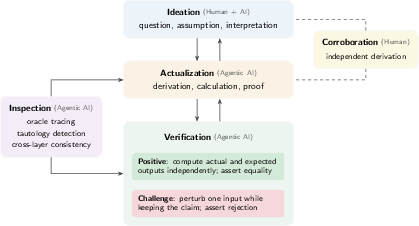
Figure 1: The LACIA workflow: ideation (reasoning), actualization (derivation), verification (symbolic checks), and human inspection as an external corroboration layer.
The workflow is instantiated using an advanced LLM (Codex GPT-5.5). Outputs contain both verification artifacts (~40 units) and an extensive codebase (~20k lines SymPy), subsequently corroborated by independent human calculations. This architecture aims to establish rigorous AI/human co-verification, introducing methodologies with broad implications in formalizing theoretical-physics calculation pipelines.
Carrollian and Celestial Holography: Intertwiner Construction
The paper addresses a central open problem in Carrollian holography: the absence of a local-operator description for massive particles, which precludes the explicit construction of boundary correlators for general momentum. Whereas celestial holography provides a well-understood basis for arbitrary spin/mass via Mellin transforms and Lorentz principal series representations, the Carrollian analogue was missing for nonzero mass or tachyonic cases. Existing constructions for massless particles rely on Mellin-Laplace techniques, corresponding to operator representations with fixed conformal weight and translation eigenvalues.
To systematically treat this problem, the authors develop a Poincare-Carrollian intertwiner method for constructing conformal bases. The central mathematical object is a linear map (the intertwiner), matching Poincare algebra representations (bulk) with Carrollian conformal modules (boundary). The intertwiner is constructed via an integral transform kernel Kh,ξ(z,u;λ′), whose exact structure is fixed by enforcing simultaneous covariance under both Lorentz and translation generators.
The paper carefully analyzes the representation-theoretic distinction: although bulk and boundary symmetry actions are isomorphic as algebras, their Hilbert space and conjugation structures are intrinsically different, notably in their adjoint operations. This implies the Carrollian "dictionary" is not just a change of basis, but a transformation between inequivalent quantum structures.
Analytical Results: Massless, Tachyonic, and Massive Carrollian Bases
Benchmarking Against Massless Solutions
For massless particles, imposing only Lorentz covariance recovers known celestial bases—the Mellin and shadow kernels—while imposing both Lorentz and translation covariance yields only distributional solutions (Mellin-Laplace type), with operator weights restricted to ξ=0. These results reproduce the standard massless Carrollian/Celestial constructions and validate the intertwiner ansatz on known ground.
Construction of Tachyonic and Massive Bases
The main technical strength is the systematic construction of Carrollian conformal bases for both tachyonic and massive cases:
- Tachyonic particles: The intertwiner kernel KT has support on real momentum (i.e., integration variables), with conformal weights fixed by matching bulk/boundary Casimir eigenvalues. The basis is explicitly constructed as a distributional transform, corresponding to unitary tachyonic Poincare representations.
- Massive particles: The massive basis cannot be supported on real values when both Lorentz and translation covariance are required. The intertwiner kernel KM thus involves a complex shift of the integrated momentum. The prescription uses the complex-support delta function (well-understood as an analytic functional in hyperfunction theory), thereby providing a mathematically precise way of realizing a boundary operator dictionary for massive scattering states. The resulting conformal basis requires h=1, ξ=±m, matching boundary-bulk Casimirs.
The paper emphasizes a bold structural claim: the Poincare-Carrollian intertwiner exchanges the reality properties of mass and momentum. In effect, a real mass in the bulk induces a Carrollian basis with imaginary (complex-shifted) momentum, while a tachyonic particle (imaginary mass) induces a basis with real support. This surprising relation is summarized by the provocative statement: "real mass is imaginary" in the Carrollian holographic framework.
Amplitude Construction and Theoretical Implications
The constructed basis allows the unambiguous definition of Carrollian amplitudes for a general class of momentum, given by integrating the bulk scattering amplitude Tn against the respective intertwiner kernels. For certain processes (e.g., one tachyonic, two massless) the resulting amplitude matches the standard Carrollian CFT three-point structures with expected covariance.
However, for processes involving only massive particles, the requirement of complex momentum support necessitates a more nuanced definition and likely a generalization of the integration contour/prescription, paralleling technical subtleties in celestial holography (e.g., Lorentzian-to-Euclidean analytic continuations and split representations).
The work also clarifies the massless limit: both tachyonic and massive bases limit to the Mellin-Laplace Carrollian basis, rendering the construction consistent with known soft sector results.
Beyond the technical construction, the LACIA workflow itself has implications for the automation and reliability of theoretical-physics derivation. By meticulously structuring derivations and verification as agentic AI sub-tasks, the workflow sets a methodology for future research that can mitigate unverified hallucination and enforce correctness, provided that a robust system of human inspection remains integral. The development signals a scalable approach to symbolic AI integration in mathematical physics and other formal sciences.
Directions for Future Work
- Scattering amplitudes for real-mass Carrollian states: Extension of amplitude definitions, including treatment of complex-momentum support for several particles, and elucidation of corresponding operator product expansions and conformal block decompositions.
- Extension to higher dimensions and spin: Construction of intertwiner modules for d=4 and for spinning representations, relying on the ongoing development of higher-dimensional Carrollian CFT modules.
- Benchmarking agentic AI workflows: Quantitative evaluation of LACIA against baseline workflows for technical derivations in physics, specifically focused on correctness and hallucination rates.
Conclusion
This work resolves a key conceptual gap in Carrollian holography by explicitly constructing conformal bases for massive and tachyonic states via a mathematically precise intertwiner approach. The findings not only complete the dictionary for Carrollian conformal representations but also reveal an intricate exchange between the reality properties of mass and momentum fundamental to the Carrollian framework. Methodologically, the LACIA workflow for agentic AI demonstrates a path forward for verifiable, AI-augmented research in formal theoretical physics, with broader implications for the automation of complex derivations and the architecture of human-AI scientific collaboration.

