- The paper introduces a first-principles QFT framework where the vacuum energy density runs with the Hubble parameter, unifying inflation and dark energy without a separate inflaton field.
- It employs off-shell renormalization with the adiabatic regularization prescription in FLRW backgrounds to eliminate quartic divergences and drive cosmic transitions naturally.
- The model yields improved fits for H0 and σ8 tensions while predicting mild dynamical dark energy and potential cosmological variations in fundamental constants.
Quantum Field Theory, Running Vacuum, and a Unified Cosmological Paradigm
Introduction and Motivation
The paper "Running Vacuum in the expanding Universe: a unified QFT paradigm for Inflation and Dark Energy" (2606.05352) synthesizes extensive theoretical advances in quantum field theory in curved spacetime (QFTCS) to construct a renormalization program for vacuum energy in cosmology. The principal aim is to provide a first-principles framework that addresses both early-universe inflation and late-time dark energy (DE), thereby offering a unified dynamical paradigm that supersedes the ad hoc separation of the cosmological constant (Λ) and inflation typically implemented in standard cosmology. The model, called the Running Vacuum Model (RVM), is sharply contrasted with the conventional ΛCDM, which assumes a static Λ throughout cosmic evolution.
The work asserts that the vacuum energy density (VED), ρvac, is a function of the Hubble parameter H and its derivatives, emerging naturally from QFT renormalization in FLRW backgrounds via the adiabatic regularization prescription (ARP) generalized to an off-shell renormalization scale. This perspective crucially escapes both the old and new cosmological constant problems, avoids fine-tuning, and can be phenomenologically tuned to reconcile the persistent H0 and σ8 tensions in late-time cosmological data.
QFT Analysis of the Running Vacuum
The central technical achievement of the paper is a rigorous, covariant off-shell renormalization of the vacuum energy-momentum tensor (EMT) for generic quantized fields non-minimally coupled to the FLRW background. Unlike most conventional treatments relying on minimal subtraction schemes in Minkowski spacetime—thereby lacking cosmological relevance and carrying arbitrary finite counterterms—the RVM approach operates directly in cosmological backgrounds, employing ARP and subtraction at an arbitrary physical scale M (later identified with H).
The vacuum EMT is composed of the classical vacuum term (bare ρΛ) and the ZPE of quantum fluctuations. The renormalized VED acquires the following explicit structure (neglecting higher-derivative and non-renormalizable contributions): ρvac(H)≈ρΛ+i∑(4π)2ci{H2mi2+O(H4)}
where mi are the physical field masses and ci are coefficients dependent on spin, coupling, and multiplicity. Crucially, quartic divergences H0 are eliminated in the renormalization difference between epochs, as demanded by general covariance and enforced by the off-shell ARP. The running emerges as a consequence of tracing the finite evolution between H1 and H2, avoiding unnaturally large vacuum masses.
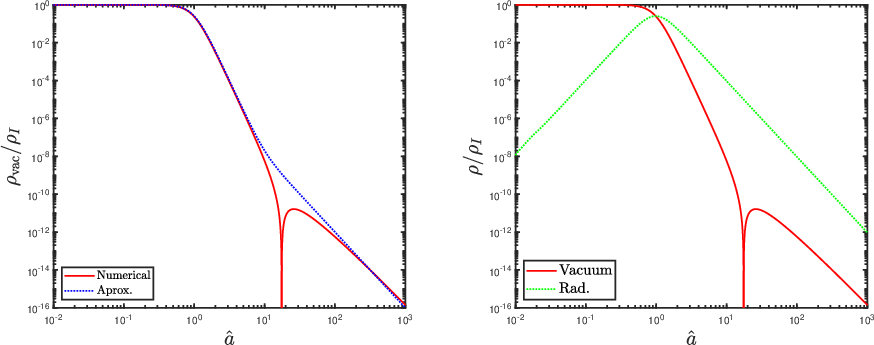
Figure 1: Transition from inflation to the radiation epoch. On the left, the numerical solution of the VED (solid line) versus the approximate analytical solution; on the right, the radiation energy is also shown, both with H3.
Inflation as Vacuum Dynamics: No Inflaton Required
One of the most forceful claims is that in the early universe, the running VED is dominated by the H4 term, naturally generating a period of quasi-de Sitter expansion with no need for a distinct inflaton scalar or engineered potential. This is a direct quantum effect from GUT-scale fields, with non-minimal couplings H5 required for positive inflation-driving coefficients.
H6
This mechanism enables a "graceful exit": as H7 decreases, the H8 term becomes dominant, automatically terminating inflation and commencing a radiation-dominated epoch. This dynamical transition, and the smooth decay of primordial VED into standard-model radiation, are confirmed both analytically and numerically.
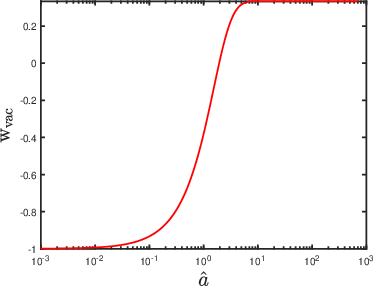
Figure 2: Equation of state parameter of the running vacuum in the very early universe as a function of normalized scale factor, H9. The EoS interpolates between H00 during inflation to H01 during radiation domination.
Late-time Cosmology, Fitting Data, and Cosmic Tensions
For H02 (all known masses), expanding the renormalized VED yields a leading linear running: H03
with H04 a calculable, softly suppressed parameter. The theory thus predicts a mild dynamical dark energy component. Observationally, fitting SNIa, BAO, LSS, and CMB data with RVM yields H05 in the range H06, well below limits from primordial nucleosynthesis and pulsar timing.
As highlighted by the paper, the RVM delivers improved fits to the H07 and H08 tensions, which plague the traditional ΛCDM—this is both statistically significant and robust to dataset choices.
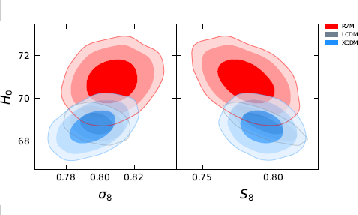
Figure 3: Easing the H09 and σ80 tensions in the (σ₈, H₀) and (σ81, σ82) planes. Contours at σ83, σ84, and σ85 confidence, with σ86, showing superior concordance for the RVM.
Equation-of-State and Theoretical Consistency
The RVM yields predictions for the vacuum EoS parameter σ87 that may deviate slightly from σ88 in the late universe, depending on σ89. At high M0, the EoS tracks the dominant component—a chameleonic feature distinguishing the RVM from simple scalar field models.
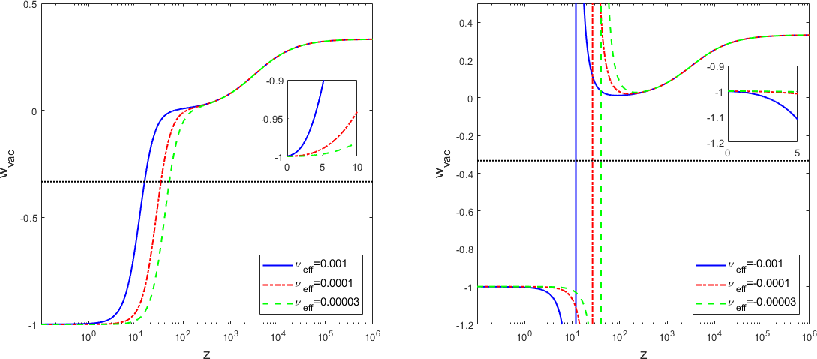
Figure 4: The running vacuum EoS as a function of redshift. RVM tracks quintessence or phantom-like DE for M1 or M2 depending on the sign of M3.
QFT Phenomena and Variation of Fundamental Constants
The paper discusses far-reaching implications: if all couplings and masses run with M4, the "constants" of physics may drift cosmologically, with RVM predicting explicit correlations between changes in M5, M6, and particle mass ratios—predictions connectable to atomic clocks and astrophysical bounds.
Resolution of Cosmological Problems
The smooth, non-fine-tuned evolution of the VED in RVM solves the entropy and horizon problems causally—no particle horizon forms, entropy production is linked directly to vacuum decay during inflation, and the present-day entropy budget of the observable universe is recovered quantitatively.
Theoretical Robustness and Future Outlook
The effective action formalism recapitulates all results directly from the heat kernel and DeWitt-Schwinger expansion, cross-validating the mode function approach. The dynamical running dictated by renormalization is thus structurally enforced, and deviations from their form would imply either a failure of QFTCS or breakage of covariance.
Potential future directions include coupling the RVM with string-based or anomaly-driven corrections, probing the possibility of observable cosmic drift in lab-based measurements, and developing non-perturbative frameworks to extend the results toward quantum gravity.
Conclusion
The Running Vacuum Model, formulated from first-principles QFT renormalization in curved cosmological backgrounds, provides a technically natural, dynamically consistent mechanism for both inflation and dark energy without recourse to fine-tuned parameters or hypothetical inflaton fields. Its softly evolving vacuum energy density, free from quartic mass hazards and robustly linked to the cosmic expansion, aligns with a wide set of empirical data and resolves outstanding cosmological anomalies. The link to the possible variation of physical 'constants' opens up intriguing connections across fundamental physics, cosmology, and experimental testability. The RVM thus stands as a theoretically mature, unifying paradigm for cosmic acceleration in all eras.