- The paper introduces PACT, a protocol that converts agent reasoning into structured action-state records, reducing token bloat.
- Experiments reveal that PACT reduces token usage by up to 38.7% while maintaining or improving MAS performance across varied configurations.
- PACT delineates private computation from public messaging, enabling efficient, scalable inter-agent communications without retraining.
Efficient Inter-Agent Communication in MAS: Protocolized Action-State Communication and Transmission (PACT)
Motivation: Communication Bottlenecks in Multi-Agent LLM Systems
Multi-agent systems (MAS) based on LLMs are increasingly dominant for complex task orchestration, especially where decomposition and cross-role collaboration is essential. While extensive research exists on role allocation and orchestration, little work systematically studies the content of inter-agent messages. Often, outputs are transferred in unconstrained natural language, resulting in rapid token inflation as verbose free-form dialogues accumulate in shared histories and force all downstream agents to reprocess large, often redundant contexts.
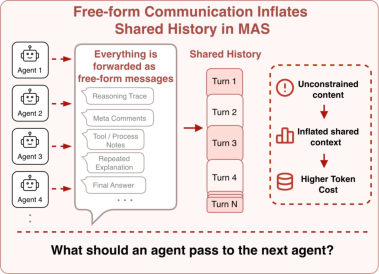
Figure 1: Free-form inter-agent messages accumulate in the shared history, forcing downstream agents to process unconstrained context and increasing token cost.
Empirical analysis reveals severe context bloat and inference cost as reasoning traces compound across dialogue. The efficiency loss is especially acute in multi-turn systems, where repeated exposure to irrelevant or redundant information can exhaust context limits and degrade performance. The central question, therefore, is: What content should be communicated between agents for maximal efficiency and effectiveness in MAS?
Diagnostic Analysis: Five Communication Strategies
To rigorously investigate the impact of message formulation, five mainstream communication strategies were benchmarked across two MAS configurations (split-evidence interaction and sequential pipeline):
- Full Content: Agents forward their entire generated reasoning.
- Concise Generation: Short direct responses without explicit reasoning.
- Conclusion Only: Only the final answer or decision is forwarded.
- Brief Summary: Condensed account in free-form summary.
- Artifact Only: Role artifact (e.g. plan, critique) alone.
Experiments across Qwen3-8B/14B/32B models and diverse reasoning benchmarks reveal that no fixed policy is universally optimal. Full Content is consistently inefficient and costly, while Conclusion Only and Brief Summary can omit critical state or evidence. Artifact Only transmits the effective core but suffers from missing closure signals and protocol ambiguity, especially in complex turn-taking or split-evidence scenarios.
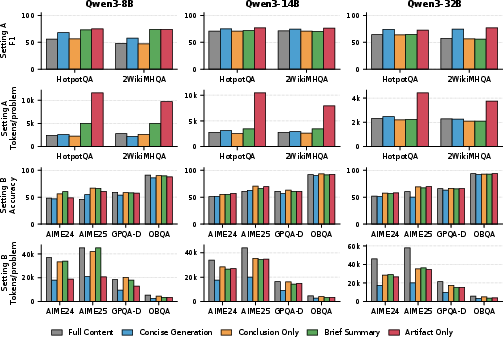
Figure 2: Five inter-agent communication strategies in two MAS settings at three model scales. Top two: split-evidence interaction (F1 and tokens). Bottom two: sequential pipeline (accuracy and tokens).
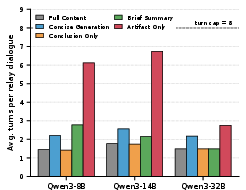
Figure 3: Artifact Only requires more dialogue turns, driving its ∼3× token cost, underscoring the inefficiency of underspecified handoffs.
These results substantiate that the useful signal in agent communication is typically action-centered, but must also expose actionable state. Generic strategies—whether verbose or concise—often fail to transmit what downstream agents need for robust continuation.
PACT: Protocolized Action-State Communication and Transmission
Motivated by these findings, the paper introduces PACT, a harness-agnostic communication protocol treating inter-agent messaging as a public state-update problem. Instead of unstructured outputs, each agent projects its generation into a minimal structured action-state record prior to inclusion in shared history. The protocol separates private internal computation from public communication, drastically limiting irrelevance and redundancy in the inter-agent channel.
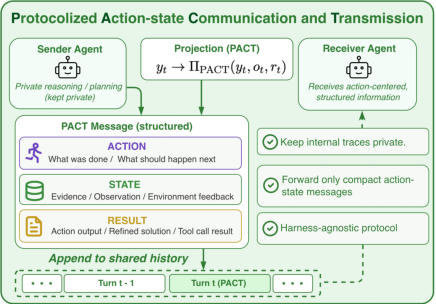
Figure 4: Overview of PACT: agent outputs are projected through a sender-side function into action-state messages before entering shared interface.
Protocol Schema
Each message under PACT comprises:
- Action: Explicit statement of performed or required action.
- State: Grounding evidence, environmental state, or relevant context for the action.
- Result: Concrete artifact or output necessary for downstream continuation.
This specification enforces a clear boundary: private agent deliberation and process traces are never appended to public history. Only the receiver-oriented action-state information is preserved.
Protocol Properties
- No constraints on private computation: Original model architecture and inner-loop reasoning are unaffected.
- Orthogonality to MAS design: Protocol can be deployed atop any MAS topology without architectural changes.
- Explicit, stable, compact handoffs: Action-centered messaging is robust across both pipeline and interaction settings.
Empirical Results
PACT was evaluated in depth against baselines (full-history TextMAS, Chain-of-Agents, and Multi-Agent Debate). Key findings include:
- Consistent reduction in token usage: PACT reduced average tokens by 38.7% across topologies and scales. On SWE-agent, PACT halved input tokens, and on OpenHands, tokens-per-resolved decreased by 10%.
- Parity or gains in performance: PACT preserved or outperformed baselines despite being significantly more context-efficient (e.g., mean accuracy increased while tokens fell, especially with stronger models).
- Effectiveness across real-world harnesses: When deployed as a proxy hook in agentic coding systems (OpenHands, SWE-agent), PACT delivered robust efficiency improvements, indicating high practicality and portability.
- Field ablations confirm all three fields—Action, State, Result—are synergistically necessary for optimal handoffs and overall performance.
Implications and Future Directions
Practical:
PACT provides an immediately actionable protocol for any LLM MAS, requiring no retraining or complex orchestration changes. Its proxy implementation demonstrates that existing systems can realize substantial resource savings and improved inference efficiency via communication protocol modifications alone.
Theoretical:
PACT precisely operationalizes the public/private boundary in agent reasoning, drawing a distinction between necessary, receiver-facing action-state information and superfluous context accumulation. This demarcation is central for further advances in scalable, robust large-scale agentic systems, especially as model sizes and deployment scenarios grow more complex.
Open problems include extending these findings to open-ended conversational, tool-centric pipelines or dynamic agent routing scenarios, and co-optimizing how much of the action-state record can be compressed or learned end-to-end without impairing downstream task solvability.
Conclusion
The study demonstrates that the content of inter-agent communication is a primary control point in LLM-based multi-agent systems. PACT, by enforcing explicit, minimal action-state messaging at the protocol level, consistently advances the efficiency--performance Pareto frontier, both in controlled experiments and in deployed agentic coding harnesses. Disciplining agent message content, rather than leaving it as unconstrained natural language, emerges as a decisive strategy for mitigating compound context window bloat and optimizing real-world agentic deployments.
Reference:
"What Should Agents Say? Action-state Communication for Efficient Multi-Agent Systems" (2606.05304)