- The paper proposes a novel use of ancient Pb-rich minerals as passive nuclear track detectors to probe inelastic Higgsino dark matter, extending mass splitting sensitivity to ~920 keV.
- It employs detailed modeling of dark matter-nucleus interactions and high-velocity astrophysical distributions, notably from the LMC, to overcome kinematic limits of current xenon-based detectors.
- Advanced imaging techniques like SAXs and HIBM enable effective signal-background separation, reducing exposure needs while maintaining sensitivity in a low-background geological environment.
Heavy-Element Paleodetectors for Higgsino Dark Matter
Introduction and Motivation
The detection of dark matter (DM), particularly weakly interacting massive particles (WIMPs), remains a critical open problem at the interface of particle physics and cosmology. While direct detection experiments utilizing noble liquid targets (e.g., Xe, Ar) have set increasingly stringent limits on elastic WIMP-nucleon cross sections, large mass splitting scenarios—particularly those compatible with the supersymmetric Higgsino—are essentially unconstrained due to kinematic thresholds of available targets. The presented study proposes "heavy-element paleodetectors," specifically minerals with significant content of heavy nuclei like lead (Pb), as a new direction to address this gap. This approach targets inelastic DM, exploiting both the enhanced momentum reach of heavy targets and the unique long-term integration properties of paleodetectors.
Inelastic Dark Matter and Kinematic Access
The inelastic DM scenario postulates a splitting δ between two nearly degenerate mass states such that scattering through weak (Z-mediated) channels is off-diagonal and hence forbidden below a kinematic threshold set by δ. The maximum accessible δ increases with both nucleus mass and incident DM velocity. For conventional xenon-based detectors, the target mass number limits sensitivity to δ≲350 keV, while the heaviest existing paleodetector targets (iron) fare even worse. Figure 1 systematically maps the accessible recoil phase space for various mass splittings, highlighting the rapid kinematic closure as δ increases.
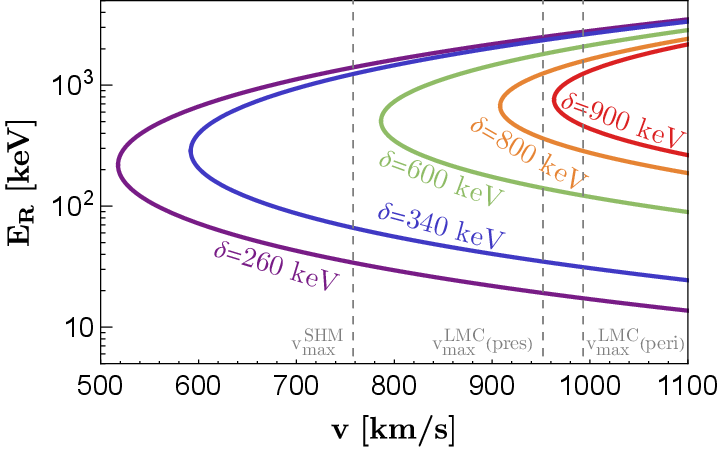
Figure 1: Contours of recoil energy ER for Pb nuclei as a function of DM velocity for various mass splittings δ, with vertical dashed lines indicating maximal DM velocities for different astrophysical models.
To systematically push δ beyond this frontier, two avenues emerge: the use of heavier targets (Pb, Bi), and leveraging DM populations with higher velocities than the standard halo model (SHM) predicts.
Astrophysical Models and the Large Magellanic Cloud's Role
Direct detection projections are sensitive to the highest-velocity DM particles present locally. While most analyses assume the SHM (truncated Maxwell-Boltzmann), recent simulations [LMC] indicate the Milky Way's interaction with the Large Magellanic Cloud (LMC) ∼50 Myr ago could have populated the high-velocity tail with transient excesses, enhancing detector reach for large Z0. Figure 2 juxtaposes the halo integrals for both SHM and LMC-motivated distributions, illustrating the extended velocity support in the latter.
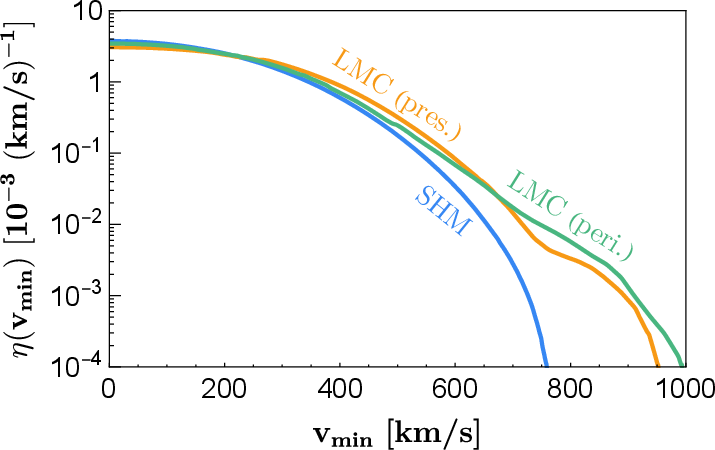
Figure 2: Halo integrals for SHM and LMC models at present and pericenter, showing enhanced high-velocity tail under LMC influence.
This historicity implies that maximizing detection probability for large Z1 does not generically prefer the oldest minerals: instead, exposures coinciding with recent high-velocity epochs are optimal.
Paleodetector Concept and Heavy-Element Target Materials
Paleodetectors are ancient minerals used as passive track detectors: over geological timescales, nuclear recoils from rare events (WIMPs, neutrinos) can create persistent track structures in the material lattice, detectable a posteriori with high-resolution imaging techniques (e.g., SAXs, HIBM). To enable sensitivity to inelastic DM at high Z2, the study introduces Pb-rich minerals, with a focus on Laurionite (PbClOH), as candidate hosts. Laurionite satisfies stringent electrical resistivity requirements for track retention and contains a high mass fraction of Pb (Z3). Geological sources such as brine precipitates in deep radiopure aquifers are identified, and uranium concentrations as low as Z4 g/g are documented, maintaining sufficiently low track backgrounds.
Signal and Background Modeling
The DM-induced recoils are calculated, accounting for the full nuclear form factor, stopping power, and track length mappings. For recoiling Pb nuclei in Laurionite, pronounced Helm form factor features are evident in both the recoil spectrum and the track-length space. These features are largely washed out after accounting for experimental resolution, especially under SAXs readout (15 nm), but preserve some discriminatory power with HIBM (1 nm).
Backgrounds are dominated by irreducible contributions from Z5U chain Z6-decay (single-step recoils), fast neutrons from both spontaneous fission and Z7 reactions, and solar/atmospheric neutrinos. The required radiopurity and mineral age considerations are carefully analyzed. Notably, for the largest cross section of Z8-mediated Higgsinos (Z9), the signal far exceeds those backgrounds, enabling the relaxation of sample purity and depth constraints over traditional elastically-targeted searches.
Projected Sensitivity and Numerical Results
The principal results assert that heavy-element paleodetectors using Pb-rich minerals with benchmark radiopurity and δ0 exposure can probe Higgsino dark matter with mass splittings up to δ1 keV (LMC-driven maximum), far surpassing the δ2 keV limit from current xenon targets. Figure 3 details the projected exclusion limits as a function of δ3 for different mineral ages and astrophysical scenarios.
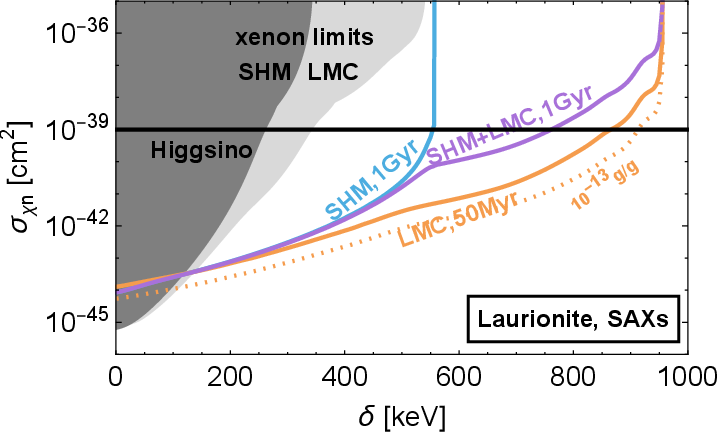
Figure 3: Projected limit on DM-nucleon cross section as a function of mass splitting δ4 for a δ5 Laurionite sample, contrasting SHM and LMC scenarios and marking the Higgsino benchmark.
Key numerical findings include:
- Under the standard halo model with Gyr-old minerals, maximal accessible δ6 is δ7 keV.
- Incorporating the LMC high-velocity population for a 50 Myr-old sample extends reach to δ8 keV.
- Even samples with uranium background typical of the Earth's upper crust or obtained from as shallow as δ9 depth remain sensitive to previously unconstrained Higgsino parameter space, a regime unreachable by previous paleodetector proposals.
- Exposure and data storage demands for SAXs-based readout can be relaxed by factors up to δ0 while still surpassing elastic search limits, further broadening practical applicability.
Implications and Future Directions
The study demonstrates that heavy-element paleodetectors offer an immediately actionable path to extend direct detection sensitivity to the last unconstrained regions of supersymmetric WIMP parameter space, specifically relevant for inelastic Higgsino DM. The method's unique sensitivity to the history of the local DM velocity distribution motivates further interdisciplinary engagement with galactic dynamics and merger simulations, to refine the optimal target mineral age and possible sensitivity to even earlier high-velocity events. The proposal also lays the groundwork for efficient searches utilizing accessible geological samples and reduced data handling, potentially democratizing exposure access beyond deep-mine infrastructure.
Theoretically, the approach can be translated to various inelastic DM scenarios beyond the minimal Higgsino, including other electroweak multiplets, dark photon-mediated models, and those with electromagnetic dipole transitions.
Conclusion
This work establishes heavy-element paleodetectors as a potent probe for inelastic dark matter, especially the supersymmetric Higgsino, enabling direct sensitivity to DM mass splittings up to δ1 keV—well beyond the reach of current direct detection technologies. Leveraging the combined advances in materials geoscience, nuclear track detection, and galactic archaeology, this framework substantially expands the experimental reach for the remaining parameter space of classic WIMP models and motivates key astrophysical inquiries into the temporal evolution of DM velocity substructure.