- The paper presents AdaKoop, a streaming framework that integrates Koopman operator theory and RKHS regression to model nonstationary, nonlinear dynamics.
- It employs a dual-view state-space model with online regime switching based on statistical hypothesis testing to ensure robust, real-time forecasting.
- Extensive experiments demonstrate that AdaKoop outperforms state-of-the-art methods by achieving constant-time updates and superior accuracy in chaotic environments.
Efficient Modeling of Nonlinear Dynamics in Nonstationary Data Streams via Koopman Operator Regression
Introduction
The modeling and real-time forecasting of nonlinear, nonstationary time series is a fundamental challenge across multiple domains, such as climate informatics, physiological monitoring, and industrial process control. "AdaKoop: Efficient Modeling of Nonlinear Dynamics from Nonstationary Data Streams with Koopman Operator Regression" (2606.04930) proposes a scalable, statistically principled approach for the sequential estimation of complex and time-varying nonlinear dynamical systems. The framework unifies Koopman operator theoretic modeling, kernel methods in RKHS, state-space inference, and adaptive statistical hypothesis testing into an efficient streaming algorithm (henceforth, AdaKoop).
Methodological Framework
AdaKoop addresses the estimation of time-varying nonlinear operator-valued dynamics xt+1=ft(xt)+ϵt from semi-infinite, multivariate, nonstationary data streams. The central methodological innovation is the dual-view probabilistic state-space model (DKS), in which both the raw observations xt and their nonlinear RKHS feature mappings ψ(xt) are jointly modeled as emissions from a low-dimensional latent Markovian linear system. This construction is rigorously motivated by Koopman operator theory, which linearizes the evolution of nonlinear dynamical systems via infinite-dimensional function lifts. The RKHS embedding enables utilizing universal kernels (e.g., RBF) for increased expressivity.
Model estimation proceeds by (1) feature-space basis orthogonalization to produce a compact, numerically stable dictionary for the kernel expansion (satisfying an incremental linear independence threshold ν); (2) reduced-rank regression for Koopman operator initialization, yielding coarse spectral estimators; and (3) EM-based refinement for consistent inference and noise robustness. This workflow provides closed-form updates and avoids costly nonlinear optimization and particle-based inference.
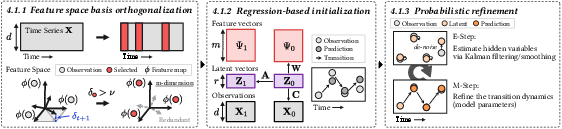
Figure 1: Static optimization framework for parameter estimation, including feature space basis construction, spectral regression, and probabilistic EM refinement.
For nonstationary streams, AdaKoop implements a switching model architecture, where distinct dynamical regimes are maintained and selected online. Statistical switching is governed by a CUSUM test on the normalized innovation squared (NIS) of the Kalman filter, adapting the model set via statistical hypothesis testing. When an abrupt regime change is detected and no existing model yields sufficient likelihood under the new data window, AdaKoop dynamically estimates and adds a new local model.
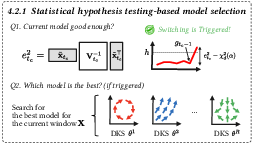
Figure 2: Online regime switching via statistical hypothesis testing: new data are monitored for distributional shift in NIS, and new models are estimated as necessary.
To ensure bounded memory and per-update computational cost, AdaKoop incorporates online basis pruning and sufficient statistic updating using forgetting factors. The rolling dictionary is managed via block-wise update and Schur complement analysis, maintaining an orthogonal, minimal kernel basis.
Scalability and Computational Characteristics
AdaKoop achieves constant amortized update time per data point, independent of stream length Tc, due to the basis orthogonalization and closed-form state-space updates. The theoretical analysis bounds per-update computation as O(m2+r2(d+m)), where m is the kernel dictionary size and r the latent dimension.
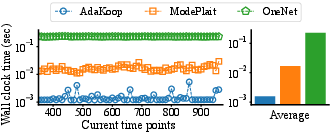
Figure 3: Empirical wall-clock time and average time consumption as a function of data stream length, demonstrating constant-time scalability.
Experimental Analysis
Experiments on the dysts benchmark—composed of 71 chaotic nonlinear systems spanning diverse scientific domains—demonstrate AdaKoop's empirical superiority. Across forecasting window sizes (h=20 to h=30), AdaKoop achieves lower mean squared error (MSE) and mean absolute error (MAE) than SOTA baselines such as ModePlait, WPMixer, PAttn, OneNet, Koopa, and sKAF. Results are statistically significant across all metrics.
AdaKoop’s performance gain is especially pronounced in environments with frequent or nontrivial nonstationarity, where batch deep-learning approaches are handicapped by their lack of continual adaptation.

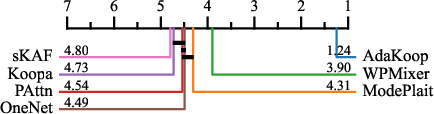
Figure 4: Critical difference diagrams over 71 datasets, showing AdaKoop's statistical ranking in forecasting accuracy.
Nonlinearity and Kernel Sensitivity
Kernel ablation studies indicate that the RBF kernel outperforms polynomial, sigmoid, and linear choices, corroborating the theoretical motivation for using universal, positive definite kernels in Koopman operator regression. The model’s ability to accurately forecast in the presence of strong nonlinearities diminishes with kernels that limit feature space expressivity or violate positive definiteness.


Figure 5: Kernel ablation: forecasting accuracy as a function of kernel choice, with the RBF kernel achieving superior results.
Hyperparameter Sensitivity
AdaKoop’s main hyperparameters (dictionary sparsity threshold xt0, EM forgetting factor xt1) were subjected to sensitivity analysis. Moderate xt2 and xt3 values optimize the tradeoff between tracking agility and robustness to noise, establishing practical guidance for deployment.
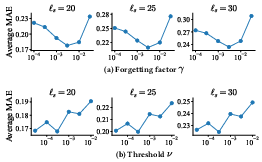
Figure 6: Forecasting performance sensitivity to dictionary sparsity threshold and EM forgetting factor.
Implications and Future Directions
Practical Impact: AdaKoop’s streaming, operating-point agnostic architecture enables deployment in latency-constrained, real-time edge analysis. Its regime-switching logic and memory-efficient basis management enable robust operation in multi-pattern or drifting environments, e.g., wearable monitoring and industrial anomaly detection.
Theoretical Impact: AdaKoop demonstrates the viability of combining operator/regression-theoretic models with statistical inference and adaptive processing for high-complexity nonlinear systems in the streaming setting. The formal linking of EM-based latent inference, RKHS embeddings, and online model selection extends the analytical tractability of state-space models to a broader nonstationary, nonlinear regime.
Possible Extensions
- Controlled/Exogenous Input Handling: While current models are fully autonomous, future work may integrate control-theoretic constructs or explicit exogenous input modeling, broadening applicability to closed-loop systems and intervention forecasting.
- Tensor-valued Data: Explicitly handling structured tensor streams without matricization could exploit multi-aspect data correlations.
- Robust Filtering: Replacing the linear-Gaussian assumptions with robust or heavy-tailed inference procedures (e.g., Student’s xt4, generalized Bayes) could improve resilience to outliers and distributional contamination.
- Online Kernel Learning: Adapting or learning kernels dynamically may address cases where the optimal feature space changes over time.
Conclusion
AdaKoop provides a computationally efficient, statistically rigorous solution for the online modeling of nonlinear, nonstationary dynamical streams. By leveraging Koopman operator regression, RKHS embeddings, dual-view state-space models, and adaptive regime switching, AdaKoop yields strong empirical and theoretical performance guarantees relative to the forecasting error, scalability, and handling of abrupt and gradual nonstationarity (2606.04930). This framework establishes a foundation for scalable operator-theoretic modeling in real-time AI systems.

