- The paper leverages Fisher forecasting on bright siren data from IMBBHs and BNSs to achieve percent-level H0 and Omega_m constraints.
- It demonstrates that enhanced sky localization from detectors like LGWA significantly improves EM follow-up for host galaxy identification.
- Although GW-derived Omega_k constraints remain looser than those from CMB+BAO, they provide crucial, systematics-independent cross-checks for cosmology.
Shape of U: Measuring the Curvature of the Universe with Gravitational Waves
Motivation and Context
The Lambda-CDM model underpins contemporary cosmology, but persistent tensions in parameter estimates—particularly H0 and S8—have prompted interest in independent probes. Gravitational wave (GW) standard sirens, leveraging compact binary merger events, offer a calibration-independent means of measuring cosmic distances and expansion. Direct redshift measurements are accessible when electromagnetic (EM) counterparts are identified, yielding "bright sirens" as opposed to statistical ("dark") sirens. This work quantitatively investigates the constraining power of future GW observatories, focusing on the spatial curvature parameter Ωk within non-flat Lambda-CDM, utilizing both intermediate-mass binary black holes (IMBBHs) and binary neutron stars (BNSs) as bright sirens.
Detectors and GW Source Populations
The study considers advanced terrestrial GW detectors—two Cosmic Explorer (CE) sites and Einstein Telescope (ET)—with prospective sensitivity extending to z∼10 due to improved low-frequency performance. Non-terrestrial detectors, LISA and the Lunar Gravitational Wave Antenna (LGWA), augment observational coverage in sub-Hz bands, facilitating multiband analysis for IMBBHs, whose inspiral phases persist at low frequencies.
IMBBHs, exemplified by GW231123 (∼236M⊙ at z∼0.4), are chosen for their merger rate uncertainty and detectability. Three merger rate density models—uniform in comoving volume (pragmatic), Madau-Dickinson-Belczynski-Ng (optimistic), and Fragione+ (pessimistic)—parameterize population scenarios. BNSs are modeled with a double Gaussian mass distribution and the Madau-Dickinson redshift evolution, constrained to z<5 and inclination <30∘ to reflect EM counterpart visibility.
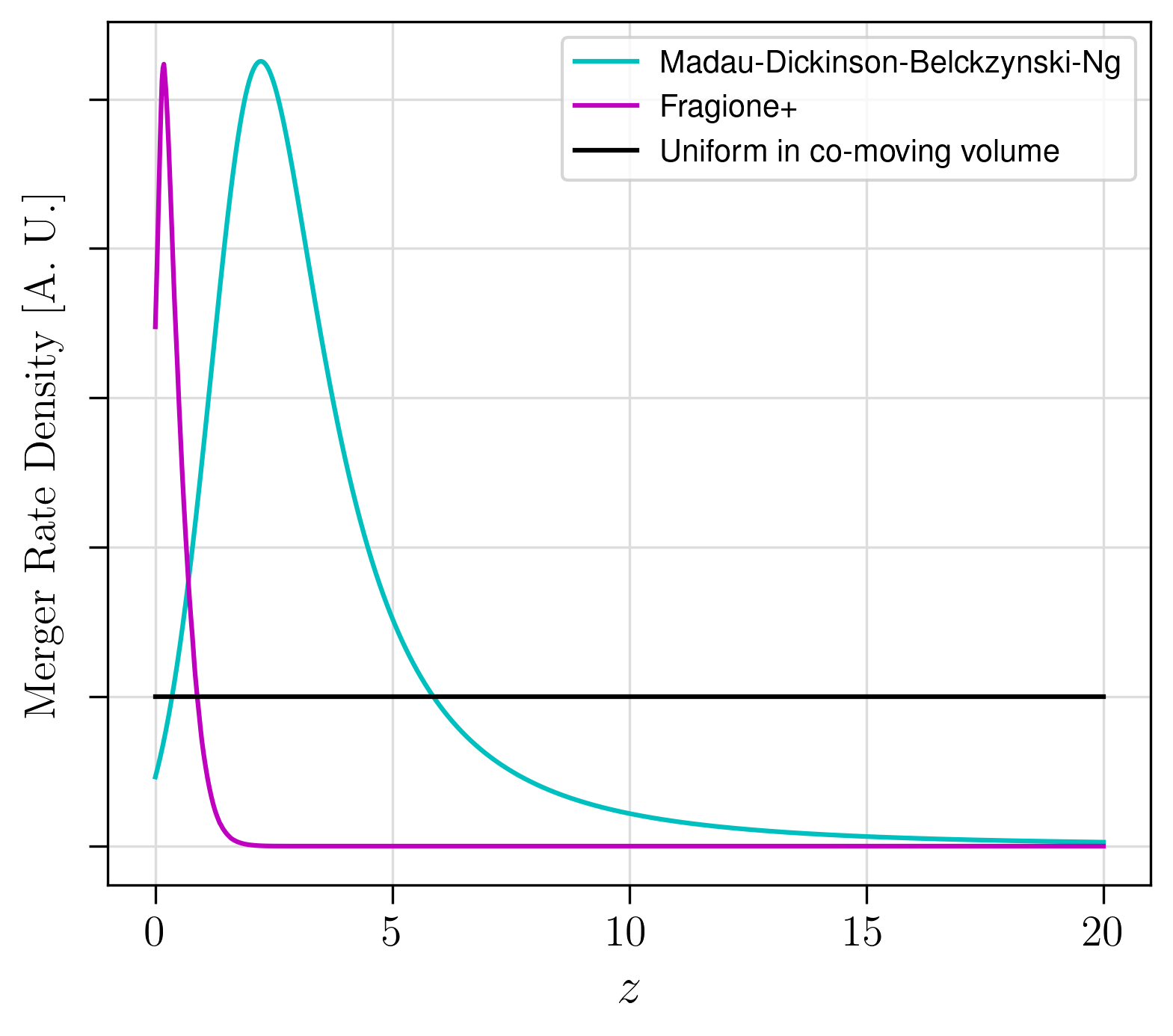
Figure 1: Merger rate densities for IMBBH populations across pragmatic, optimistic, and pessimistic scenarios.
EM counterparts for IMBBHs are plausible in AGN environments, through post-merger flares, jets, and disk interactions, enabling unique host identification as bright sirens. However, their realistic occurrence rate remains speculative; the association of GW190521 with ZTF19abanrhr demonstrates only marginal evidence. BNS mergers robustly produce EM signals (sGRB, kilonova, afterglows), enabling accurate redshift determination.
Methodology: Forecasting Cosmological Constraints
The primary analytic tool is Fisher information forecasting, estimating 1σ uncertainties in binary parameters (luminosity distance DL, masses, spins, extrinsic properties) propagated to cosmological parameters (S80, S81, S82). SNR computation employs IMRPhenomXPHM and IMRPhenomPv2_NRtidalv2 approximants for IMBBHs and BNSs, respectively; events with ground-based SNR S83 are selected. Multiband detectability requires SNR S84 in LISA/LGWA.
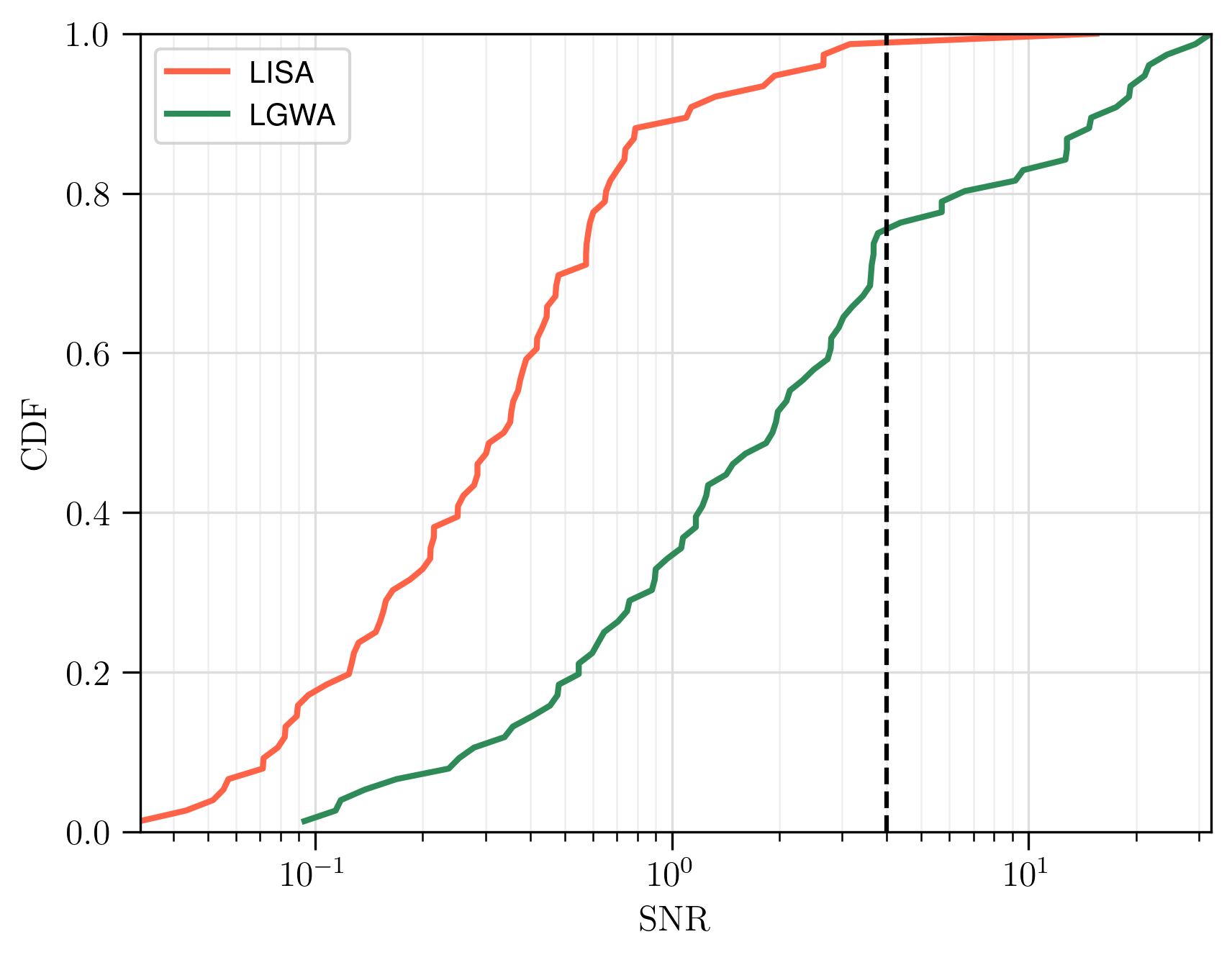
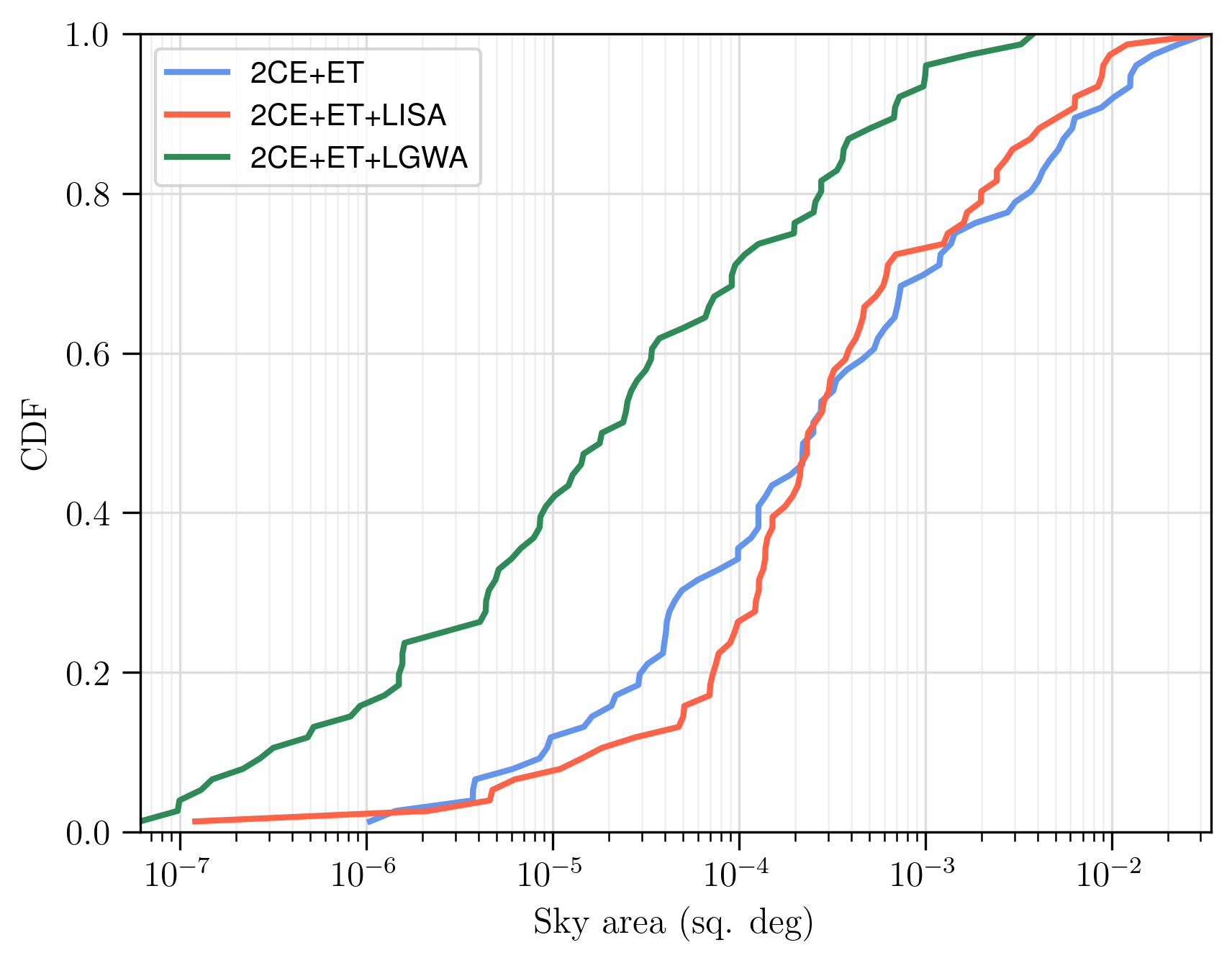
Figure 2: Left: Cumulative SNR distribution of IMBBH events in LISA and LGWA; Right: Cumulative sky localization errors for 2CE+ET, 2CE+ET+LISA, and 2CE+ET+LGWA networks.
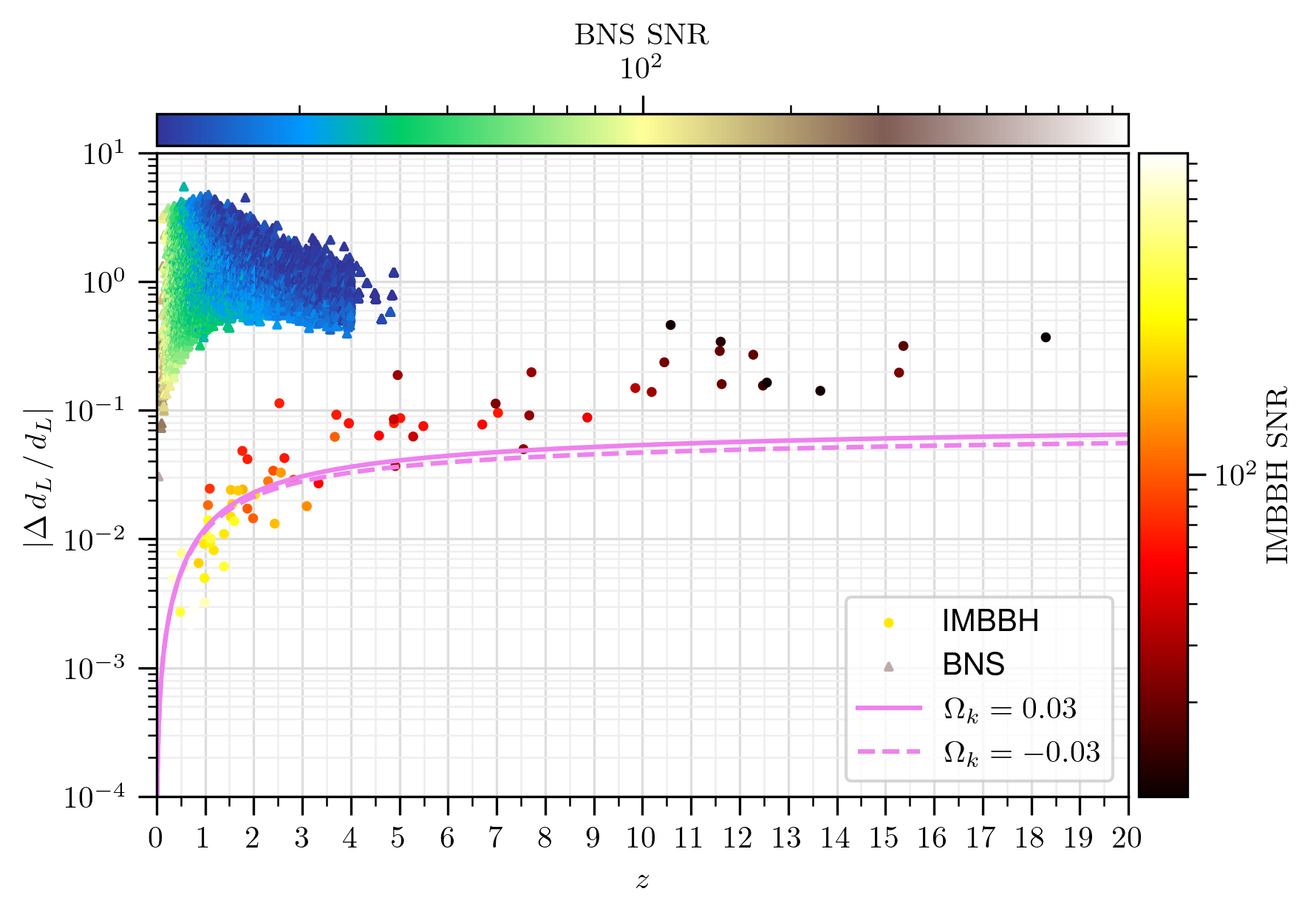
Figure 3: Relative luminosity distance errors versus redshift for IMBBH and BNS populations in a 2CE+ET network.
Cosmological parameter constraints are synthesized for IMBBH and BNS cohorts, utilizing realistic redshift distributions and propagation of S85 uncertainties. The analysis also explores multiband enhancements and the additional benefit of LGWA for sky localization in EM follow-up.
Numerical Results and Comparative Analysis
For one year of GW observation with 2CE+ET, S86 IMBBH bright sirens (pragmatic case) yield S87 uncertainties of S88 in S89, Ωk0 in Ωk1, and Ωk2 in Ωk3; BNS bright sirens provide Ωk4, Ωk5, and Ωk6, respectively. Even in the optimistic scenario (Ωk7 annual IMBBHs), the forecasted Ωk8 uncertainty is an order of magnitude larger than CMB+BAO constraints (Planck 2018: Ωk9).

Figure 4: z∼100 corner plots for cosmological parameters comparing IMBBH and BNS populations across detector networks.
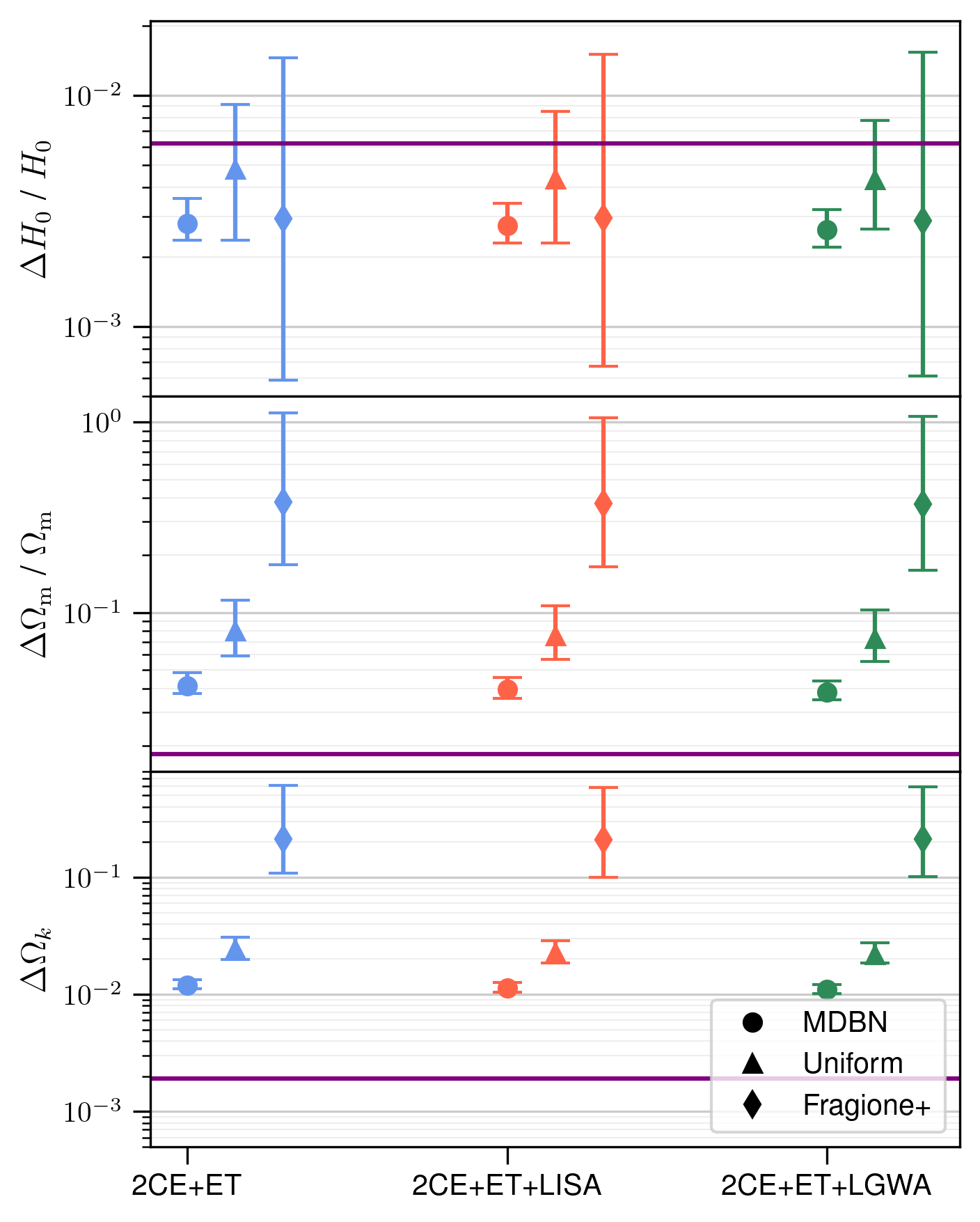
Figure 5: Median fractional errors in z∼101 and z∼102; median absolute error in z∼103 for three detector networks, under different merger rates.
Multiband inclusion of LISA or LGWA confers only modest gains in SNRs and cosmological parameter uncertainties; improvement is limited due to low SNRs in non-terrestrial bands for GW231123-like IMBBHs. However, LGWA yields up to two orders of magnitude enhancement in sky localization (median z∼104 area z∼105 degz∼106), critically useful for EM counterpart identification.
Combined IMBBH+BNS data marginally tightens cosmological constraints, with IMBBH dominance due to superior SNRs and distance accuracy. High-redshift events contribute less to parameter constraints due to increased z∼107 uncertainty; most constraining power derives from low-z∼108, high-SNR mergers.
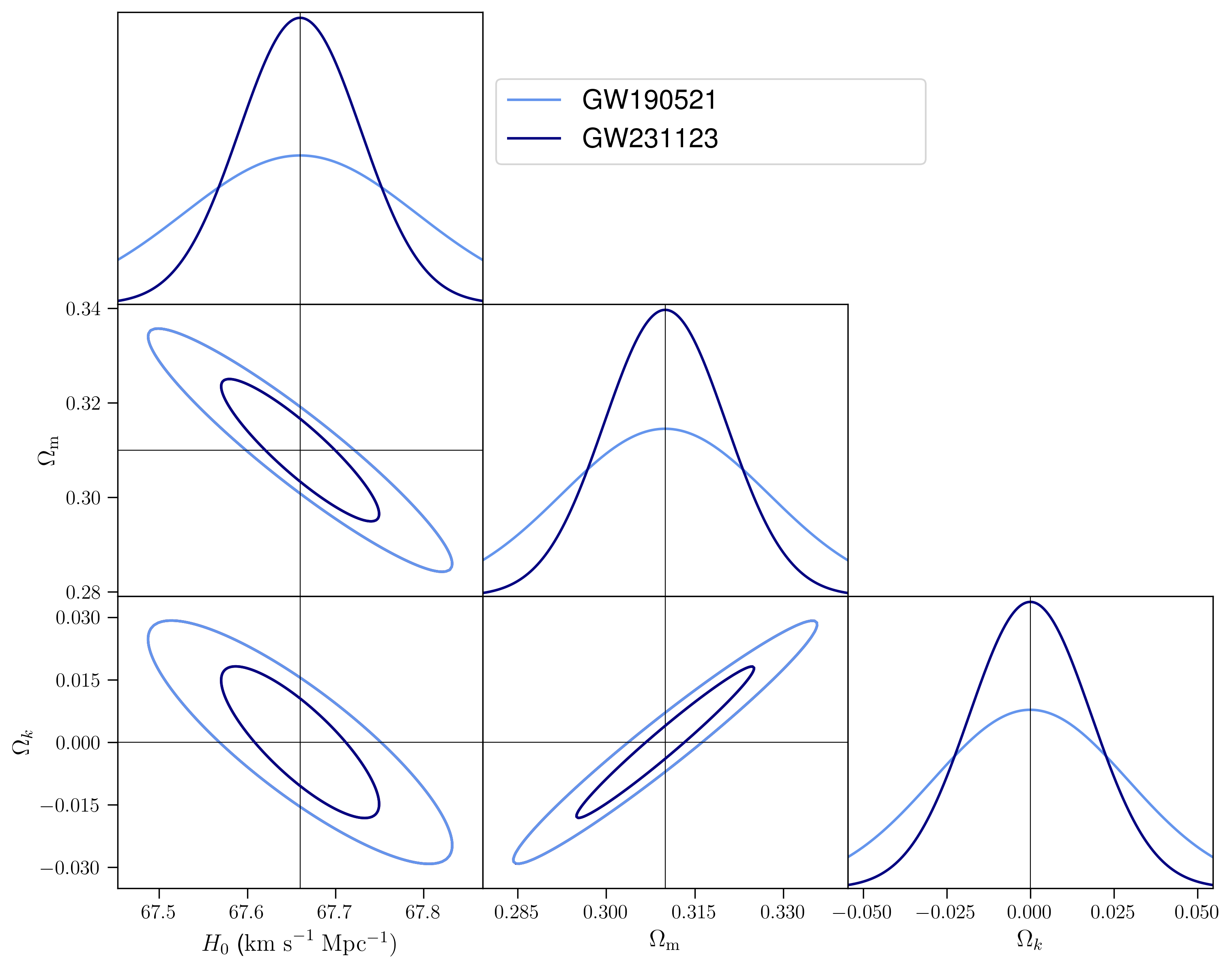
Figure 6: z∼109 corner plots for cosmological parameters with GW231123-like and GW190521-like IMBBH populations sampled from a uniform in comoving volume merger rate.
Theoretical and Practical Implications
The forecasted constraints show that GW bright siren cosmology will not surpass current EM-based bounds (CMB+BAO) on ∼236M⊙0 in precision, even with optimistic IMBBH merger rates and network coverage. Nevertheless, these sirens provide systematics-distinct measurements, valuable for cross-validating flatness and probing beyond-Lambda-CDM scenarios. Strong parameter degeneracy, especially between ∼236M⊙1 and ∼236M⊙2, accentuates sensitivity to population composition and source parameter estimation.
Improvement in sky localization with LGWA or similar lunar/space detectors will substantially increase the fraction of uniquely identified bright sirens, facilitating host galaxy assignment and redshift measurement—crucial for expanding the cosmological utility of GW observations. Population uncertainties for IMBBHs and realistic EM counterpart rates remain a limiting factor; future work should characterize population-averaged IMBBH properties and merger environments more robustly.
Future Directions
To further constrain cosmological parameters, particularly in extended cosmological models (e.g., ∼236M⊙3CDM, ∼236M⊙4CDM), incorporation of next-generation global networks—LIGO-India, TianQin, Taiji, B-DECIGO—and improved source modeling (including lensing and calibration systematics) will be essential. Enhanced multiband strategies with higher-mass IMBBHs or improved low-frequency detector capabilities could potentially yield tighter bounds. Integration of GW cosmology with EM observations will remain critical for resolving parameter tensions and investigating new physics.
Conclusion
This study demonstrates that future GW detector networks, especially through IMBBH bright sirens, can provide percent-level constraints on ∼236M⊙5 and ∼236M⊙6, with spatial curvature limits several times weaker than current CMB+BAO measurements. LGWA enhances practical utility via improved sky localization. While GW-based cosmological parameter estimation will not supersede EM probes in precision, it will supply valuable, independent constraints and cross-checks, particularly relevant in the context of persistent cosmological tensions and prospective deviations from the standard model.

