- The paper demonstrates that OTOCs exhibit bounded, oscillatory behavior in the unbroken phase and exponential growth in the broken phase due to non-Hermitian instability.
- It applies biorthogonal formalism and numerical diagonalization to analyze the dynamics and elucidates critical scaling of OTOCs at exceptional points.
- Incorporating Kerr nonlinearity and parametric drive, the study distinguishes genuine quantum chaos from nonlinear dephasing and parametric instabilities.
Out-of-Time-Order Correlators in Swanson Hamiltonians with Interactions
Introduction and Motivation
This paper systematically investigates the behavior of out-of-time-order correlators (OTOCs) in a family of non-Hermitian oscillator systems based on the Swanson Hamiltonian, its nonlinear Kerr extension, and parametrically driven variants. OTOCs play a central role in diagnosing quantum chaos, information scrambling, and the sensitivity of operator dynamics under Hamiltonian evolution. While OTOCs have been extensively studied in Hermitian and many-body contexts, their behavior in non-Hermitian, particularly PT-symmetric, systems remains largely unexplored.
The Swanson Hamiltonian, a paradigmatic non-Hermitian quadratic model, manifests exact PT-symmetry and real spectra in its unbroken phase, while supporting exceptional points (EPs) where the spectrum becomes complex and eigenmode coalescence occurs. Interrogating OTOCs in such systems elucidates the interplay of non-Hermiticity, criticality, nonlinearity, and driving in the dynamics of quantum information.
The Swanson Hamiltonian and Its Extensions
The canonical Swanson Hamiltonian is formulated as
H=ωa†a+αa2+β(a†)2,
where a,a† are bosonic ladder operators and the parameter choice β=α∗ enforces PT symmetry. Despite non-Hermiticity (α=β), the model admits a real spectrum in the regime ω2>4∣α∣2 (unbroken phase), transitioning to complex eigenvalues with EPs at the threshold.
Relevant extensions considered are:
- The Kerr–Swanson model, with additional nonlinearity χ(a†a)2
- Parametric driving, via a time-dependent term εcos(ωdt)(a2+(a†)2)
- The driven Kerr–Swanson model, combining both effects
Analysis employs the biorthogonal (pseudo-Hermitian) formalism, ensuring the correct definition of physical observables and thermal states under non-Hermitian dynamics.
OTOC Dynamics in Quadratic and Interacting Regimes
For the quadratic Swanson Hamiltonian (PT0), the OTOC for canonical operators PT1, PT2 is analytically tractable:
- In the unbroken PT3-symmetric regime, PT4 remains a PT5-number, leading to bounded, strictly oscillatory OTOC dynamics:
PT6
The corresponding Lyapunov exponent vanishes, indicating the absence of quantum chaos.
- In the broken phase, PT7 becomes purely imaginary, yielding exponentially growing OTOCs:
PT8
This exponential growth is not associated with chaos but with parametric instability induced by non-Hermiticity.
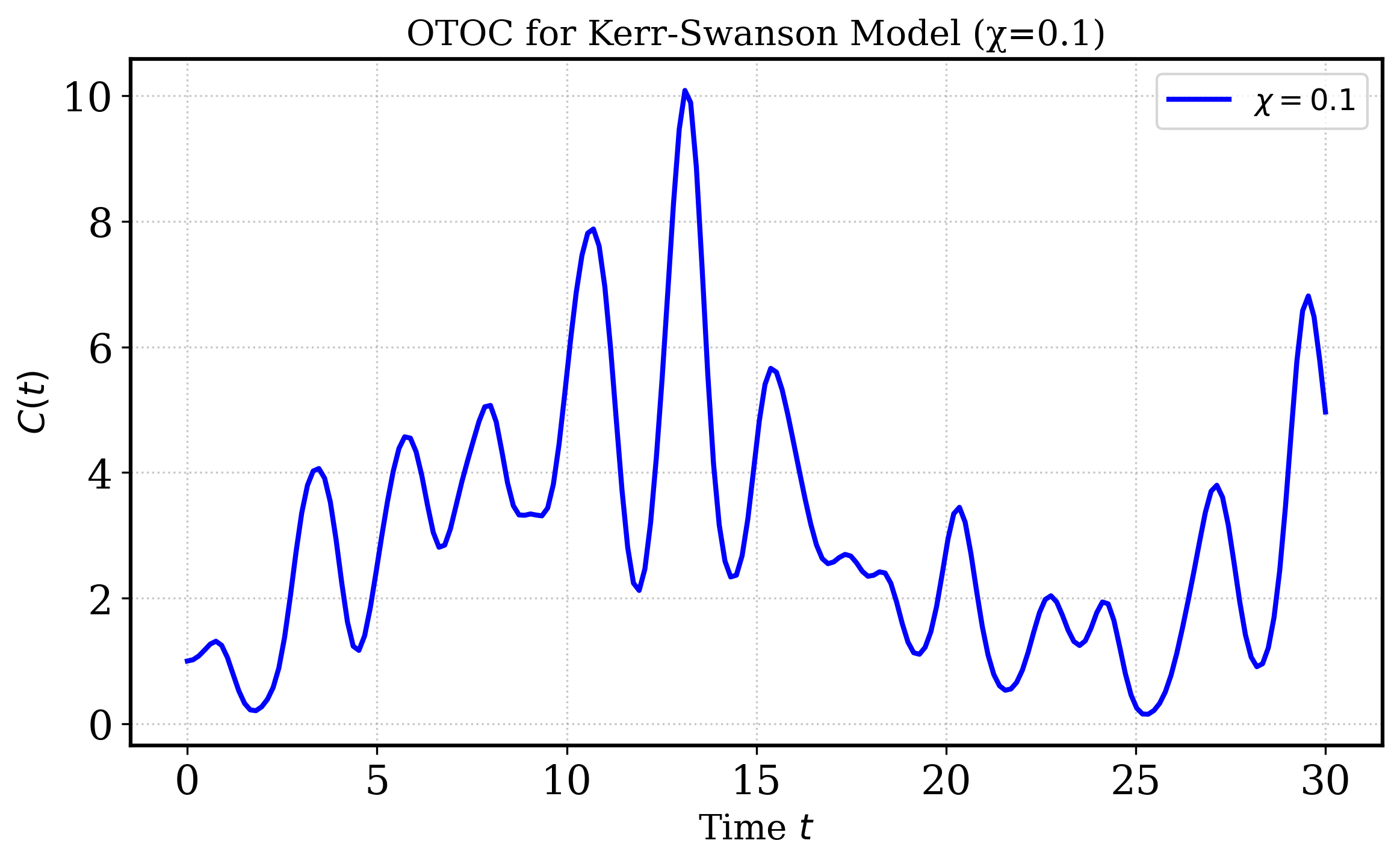
Figure 1: Out-of-time-order correlator PT9 in time for the quadratic Swanson oscillator, contrasting bounded oscillations in the unbroken phase with exponential growth in the broken phase.
Inclusion of Kerr-type nonlinearity (H=ωa†a+αa2+β(a†)2,0) breaks integrability but does not induce chaos for a single mode: OTOCs remain quasi-periodic and bounded, with a slow envelope growth H=ωa†a+αa2+β(a†)2,1 characteristic of nonlinear dephasing. Numerically exact diagonalization within the biorthogonal framework confirms persistent absence of exponential sensitivity even for finite temperature and weak anharmonicity.
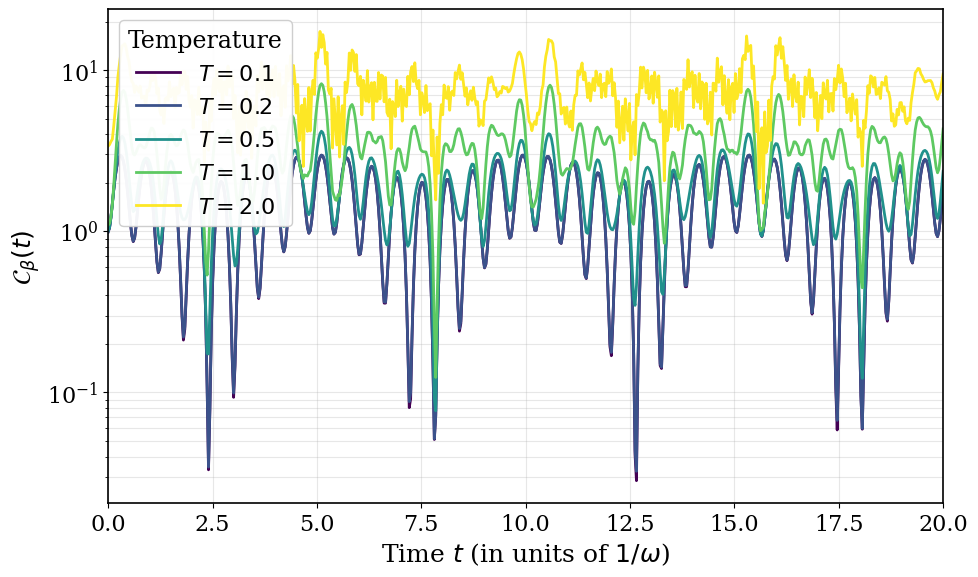
Figure 2: Thermal out-of-time-order correlator H=ωa†a+αa2+β(a†)2,2 for the nonlinear model, accentuating temperature-dependent quasi-periodicity without exponential growth.
The addition of parametric driving (H=ωa†a+αa2+β(a†)2,3) also does not lead to quantum chaos in the single-mode regime; the effective dynamics can be captured via Floquet–Magnus expansion and remain nonergodic, with OTOCs exhibiting only renormalized oscillatory behavior. Importantly, even in the presence of both drive and nonlinearity, exponential OTOC growth does not materialize for real spectra.
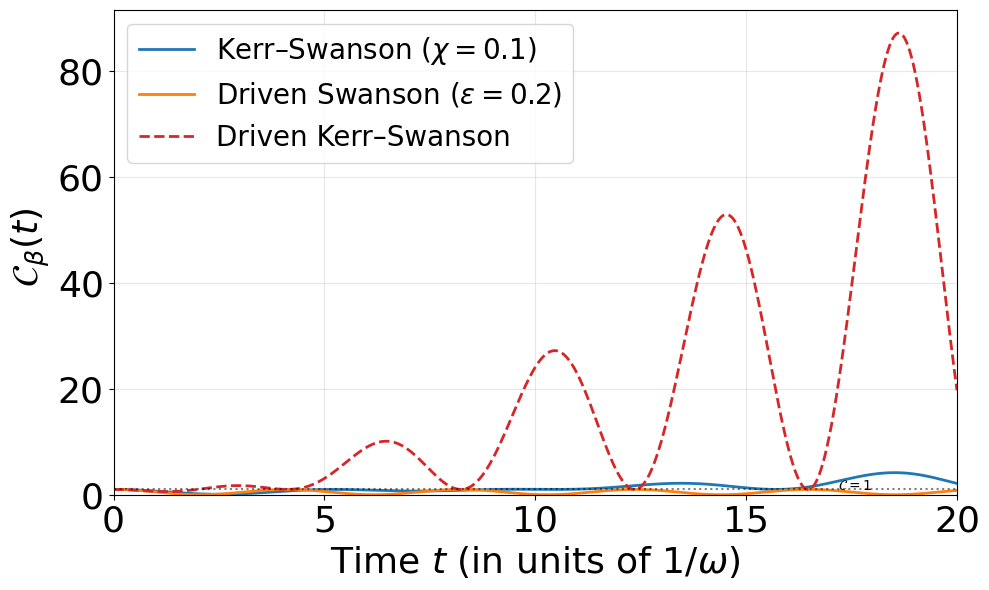
Figure 3: OTOC H=ωa†a+αa2+β(a†)2,4 for the driven nonlinear model, showing frequency renormalization by the drive and nonlinear dephasing envelopes, without signatures of sustained chaos.
Exceptional Points and Critical OTOC Scaling
Approaching the exceptional point (EP), where the effective normal-mode frequency H=ωa†a+αa2+β(a†)2,5 vanishes, the OTOC exhibits critical behavior. The enhancement factor for nonlinear dephasing diverges as H=ωa†a+αa2+β(a†)2,6 with H=ωa†a+αa2+β(a†)2,7, resulting in a model-dependent critical exponent H=ωa†a+αa2+β(a†)2,8. This scaling is distinct from previously observed exponents in other non-Hermitian models and is attributed to the singular amplification of interaction effects near the EP via the Bogoliubov transformation.
Thus, the OTOC provides direct information on quantum sensitivity enhancement near non-Hermitian criticality, with finite-time OTOC amplitude serving as an experimentally accessible probe of proximity to EPs.
Experimental Realizations and Theoretical Implications
The predicted OTOC dynamics and critical scaling are accessible in a range of engineered non-Hermitian quantum systems:
- Photonic platforms with controllable gain/loss can realize the Swanson Hamiltonian and measure OTOCs via optical homodyne tomography.
- Circuit-QED architectures allow implementation of effective Swanson/Kerr models and measurement protocols for forward–backward OTOC dynamics using cavity-qubit systems.
- Trapped ions with engineered dissipation realize bosonic modes with balanced gain and loss, with high-fidelity quadrature readout.
The synergistic use of non-Hermitian control (tuning towards EPs), parametric drive, and weak nonlinearity enables systematic exploration of operator spreading and critical OTOC dynamics—including divergence of dephasing amplitude and transition to non-unitary instability.
From a theoretical perspective, these results establish several robust claims:
- Exponential OTOC growth is universally absent in single-mode Swanson-type models with real spectra, even with weak nonlinearity and drive; only linear instabilities in the broken H=ωa†a+αa2+β(a†)2,9 regime support such growth.
- Critical enhancement of OTOC amplitudes via divergence of the non-Hermitian metric occurs near EPs, providing a new avenue for probing non-Hermitian quantum phase transitions and the response of information-theoretic quantities to non-Hermitian criticality.
- Truly chaotic OTOC dynamics (with positive Lyapunov exponents) require multimode coupling and are non-generic for single-mode bosonic systems, highlighting the limitations of analogy with classical chaos.
Conclusion
This work systematizes the computation of OTOCs in the Swanson Hamiltonian hierarchy, integrating non-Hermitian quantum mechanics, nonlinear dynamics, and critical phenomena. The analysis delineates the boundaries between linear instability, nonlinear dephasing, and true quantum chaos—resolving that exponential OTOC growth in these systems directly signals a,a†0-symmetry breaking, rather than chaotic scrambling. The identification of critical OTOC scaling exponents at EPs and the explicit connection to experimental observables chart a concrete path for future investigation of quantum information dynamics and non-Hermitian critical points in photonic, circuit-QED, and atomic platforms.
Further studies may expand to multimode systems, nontrivial topology, and the role of coupling and measurement, allowing for the investigation of genuine quantum chaos and complex OTOC growth patterns beyond quadratic non-Hermitian models.

