- The paper introduces a novel unpaired training paradigm using flow matching that leverages pretrained T2I models as implicit editing supervisors without paired datasets.
- It employs directional losses, cycle consistency, and gradient routing to maintain input structure while executing accurate visual style transfer.
- Experimental results demonstrate significant improvements, with up to an 85% user preference win rate in video and long-tail style image editing tasks.
Bootstrap Your Generator: An Expert Analysis
Overview and Motivation
"Bootstrap Your Generator: Unpaired Visual Editing with Flow Matching" (2606.03911) presents a novel, fully unpaired training paradigm for flow-matching-based visual editing models. The approach sidesteps the typical reliance on massive paired datasets or external supervision, which are formidable obstacles for scalable image and especially video editing. The core technical innovation uses the latent capabilities of large, pretrained generative models as both implicit editing supervisors and sources of content structure, achieved via a blend of directionally informed prior losses, cycle consistency, and a scheme for gradient routing through noisy and clean states.
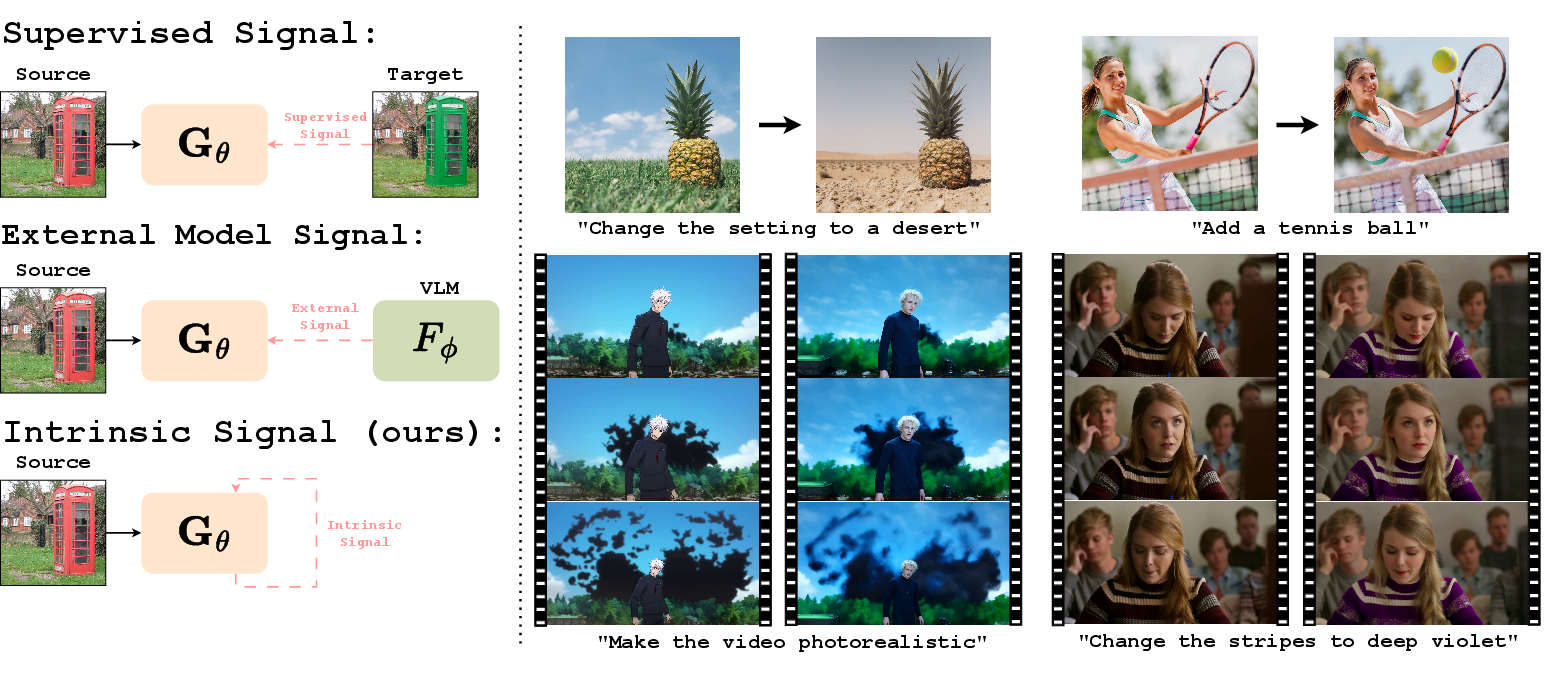
Figure 1: Comparison of traditional supervised, externally-guided, and the proposed intrinsic-signal-based (ByG) training, alongside qualitative editing results from the unpaired approach.
Methodology
Flow Matching with Unpaired Data
The method adapts pretrained text-to-image (T2I) and text-to-video generative models into flow-matching conditional editors, integrating the following mechanisms:
- Model Bootstrapping: Noisy pseudo-targets are generated using an exponential moving average (EMA) of the editor network, providing valid training inputs in the absence of ground truth pairs.
- Instruction-Following Signal via Directional Loss: Rather than directly mimicking the output of the frozen T2I model conditioned on the target prompt, the loss aligns only the direction in velocity space induced by the semantic shift between source and target text. This cosine-similarity-based directionality regularizes the learning signal to focus on the edit, not wholesale regurgitation of target content.
- Cycle Consistency for Source Preservation: By enforcing that application of the inverse edit reconstructs the original input, the model is penalized for undesired destruction of input structure—analogous to unpaired image translation frameworks but within the flow-matching, denoising-dynamics context.
- Gradient Routing (STE): A key technical adjustment—conditioning the reverse-cycle pass on clean, EMA-denoised samples while backpropagating gradients via the one-step predictions. This bridges the gap between noisy training-time inputs and clean inference conditions, preventing exposure bias and signal attenuation.
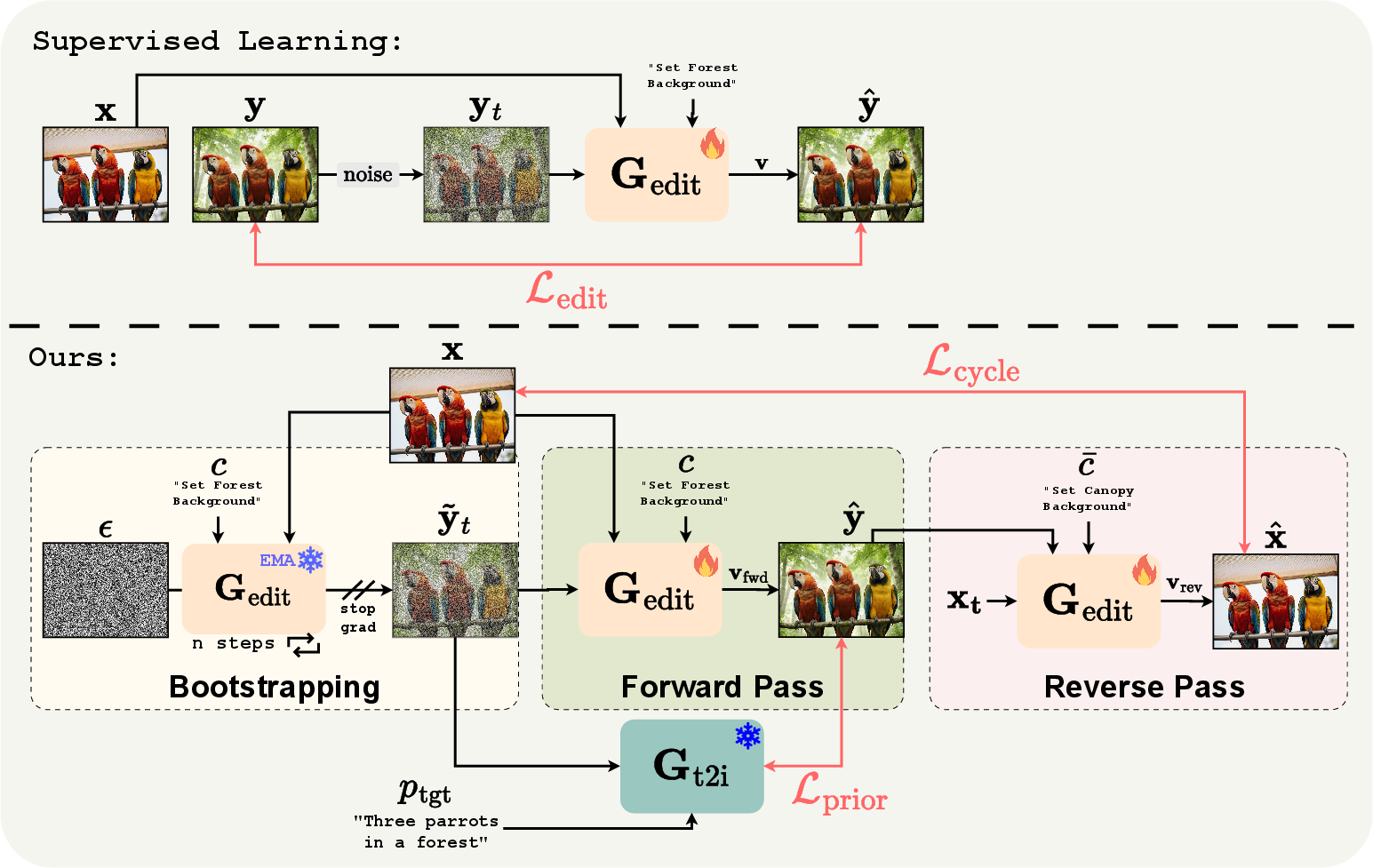
Figure 2: Schematic of the unpaired training loop, illustrating how pseudo-targets and guidance cues are produced intrinsically, with cycle and prior losses supervised by model rollouts and the T2I backbone.
Experimental Results
Unpaired Video Editing
The model demonstrates significant improvements on paired and out-of-domain video editing tasks versus strong baselines like Ditto, which depend on one million paired samples. On a user study for style transfer (cartoon ↔ photorealistic), the approach achieves 75.3% mean win rate overall, with particularly large margins on out-of-distribution 3D-CGI inputs (85% preference).
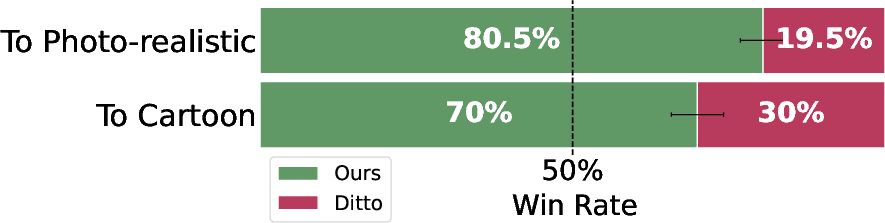
Figure 3: User preference on video style editing—ByG wins both cartoon-to-photo and photo-to-cartoon edits, outperforming supervised baselines on both in-domain and out-of-domain samples.
Quantitative metrics (CLIP directional similarity, DINO frame similarity, motion and aesthetic scores) corroborate user preference, with ByG outperforming supervised models on edit success and source/motion preservation.
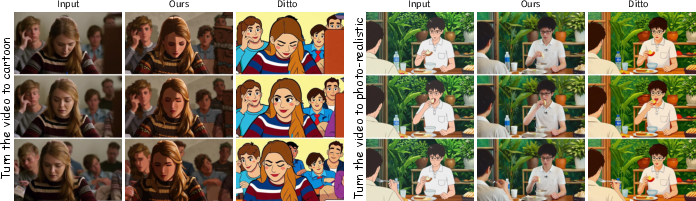
Figure 4: Qualitative video editing results, showing robust target-style transfer while retaining spatiotemporal consistency.
Long-Tail Style Image Editing
On benchmarks where paired data collection is infeasible (e.g., GTA, Minecraft, Lego style), ByG edges out both supervised and zero-shot baselines in semantic consistency and overall perceptual scores—despite never having seen these styles in training.
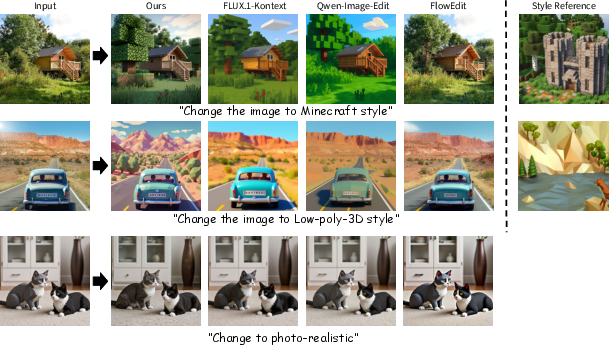
Figure 5: Long-tail style-editing qualitative benchmark: ByG aligns style more accurately while preserving object identity, even on unseen domains.
General-Purpose Image Editing
For classically diverse edit tasks (GEdit-Bench), ByG approaches or surpasses supervised flow-matching editors in human-centric, style, and motion-related edits. Weaknesses are noted in subject removal and precise text changes, directly traceable to the limitations of text-prompt supervision in providing strong removal signals.
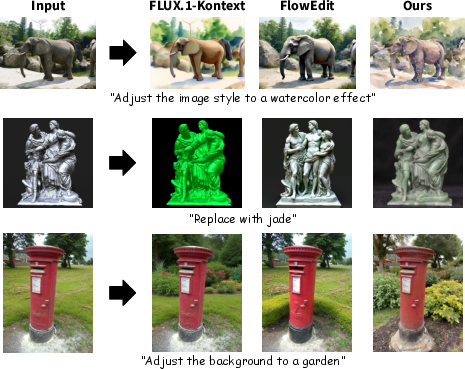
Figure 6: Diverse image editing comparisons; ByG avoids certain supervised artifacts and better follows complex instructions vs. both zero-shot and large-scale-paired methods.
Ablations and Analysis
Comprehensive ablation demonstrates:
- Gradient Routing: Removing it degrades source preservation owing to conditioning mismatch during training vs. inference.
- Cycle Loss: Prevents over-editing and content drift.
- Directional Regularization: Avoids MSE-induced drift to target at the cost of input structure.
- Bootstrapping: Essential for usable gradients; its absence destabilizes training and degrades both edit success and fidelity.
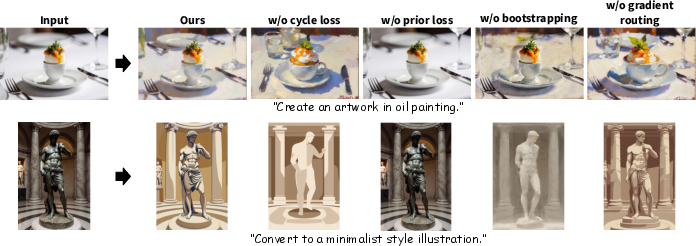
Figure 7: Systematic ablation reveals the contribution of each method component; cycle loss and gradient routing are key for content preservation.
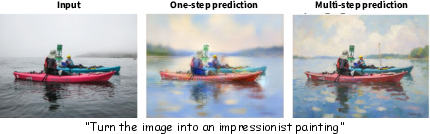
Figure 8: Analysis of one-step versus multi-step predictions; gradient routing enables training on clean, detailed outputs rather than noisy, ambiguous ones.
Theoretical and Practical Implications
This work establishes that flow-matching-based editing, when correctly regularized, is feasible without pairs or external discriminators, provided a strong enough base T2I prior exists. This has deep implications:
- Scalability: Methods can be rapidly adapted to novel, open-ended edit types and uncurated, unpaired datasets, bypassing manual labeling and synthetic pipelines.
- Generalization: Transfer to domains unseen in base pretraining, suggesting utility for emergent or rare styles in both images and video.
- Editing as Denoising Directionality: The directional prior loss offers a subtle but powerful reframing of edit supervision, likely applicable to other conditional generative settings.
- Exposure Bias Mitigation: Gradient routing via STE is a robust solution for denoising models, potentially benefiting image-to-image and video-to-video translation beyond editing.
Limitations and Future Directions
- Base Model Dependence: Capabilities are contingent on the prior’s knowledge graph. Unknown styles or objects are out of scope unless the base has prior exposure.
- Object Removal Weakness: Prompt-based directionality is less suited for removals; explicit negative-instruction modeling or multi-instruction setups may be needed.
- Scalability to Higher Dimensions: Preliminary validation is in 2D/3D (video) contexts; extension to 3D shape, 4D material, or general simulation remains open.
Anticipated areas for development include: adaptation of the framework to multimodal domains (e.g., audio, 3D), augmentation with dynamic or context-aware prior construction, and exploration of hybrid supervision—blending minimal pairwise or weak supervised elements for hardest edit categories.
Conclusion
"Bootstrap Your Generator" (2606.03911) demonstrates that unpaired, flow-matching-based training can match or exceed large-scale supervised editing pipelines for both images and video, through a combination of intrinsic knowledge bootstrapping, directional priors, and cycle consistency, enabled by principled gradient routing. The method’s ability to generalize to uncurated and out-of-domain edits—without external reward models—sets a new benchmark for scalable conditional generation and editing.

