- The paper introduces a framework combining ensemble consensus filtering, trust-calibrated arbitration, and cycle repair to improve causal graph recovery.
- It leverages selective LLM querying for disputed edges, empirically calibrating trust weights to reduce token costs and mitigate error propagation.
- Empirical evaluations demonstrate superior performance on diverse benchmarks, with marked improvements in SHD, F1, and SID over baseline methods.
CauTion: Trust-Calibrated Ensemble Framework for LLM-Augmented Causal Discovery
Motivation and Limitations of Prior Work
Existing causal discovery methodologies based on statistical approaches—constraint-based (e.g., PC, FCI), score-based (e.g., GES, BOSS, CAMML), and continuous optimization (e.g., NOTEARS-MLP, DAGMA)—suffer from fundamental limitations: ambiguity within Markov equivalence classes, sensitivity to sample sizes, reliance on brittle statistical tests, incapacity to globally orient edges, and algorithm-specific bias. LLMs, trained on massive corpora, encode domain knowledge and offer auxiliary semantic priors, yet LLM-augmented causal discovery methods are vulnerable to LLM hallucination, incur excessive token costs, and amplify errors due to indiscriminate querying or reliance on a single algorithmic source.
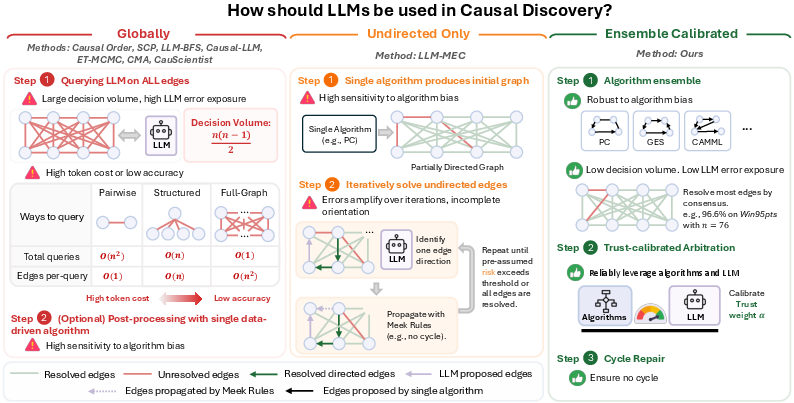
Figure 1: Comparative overview illustrating the excessive LLM query volume, error sensitivity, and algorithmic bias exposure in prior methods versus selective, trust-calibrated integration in CauTion.
LLM-only or global LLM-augmented strategies query O(n2) variable pairs (where n is the number of variables), leading to high risk of error amplification and impractical scaling for large graphical structures. Undirected-only strategies restrict LLM queries but propagate errors sequentially, with a single LLM error potentially corrupting the orientation of a large fraction of the graph. These approaches lack explicit, empirical calibration of LLM reliability and fail to mitigate single-algorithm bias.
CauTion: Framework Architecture
CauTion systematically integrates statistical causal algorithms with LLM knowledge via a three-stage pipeline: ensemble consensus filtering, trust-calibrated arbitration, and cycle repair.
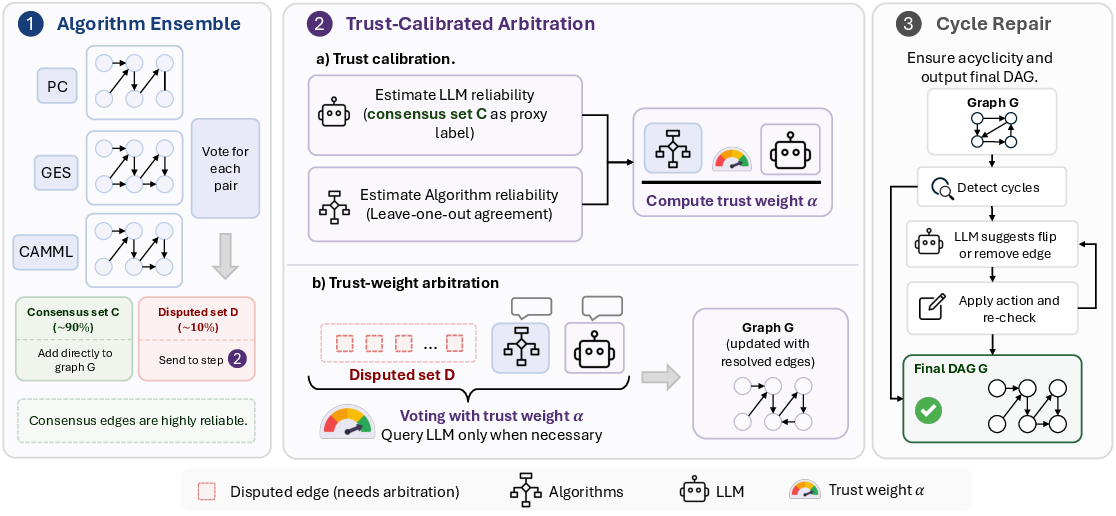
Figure 2: CauTion pipeline: ensemble consensus filtering, LLM reliability calibration using proxy labels, trust-weighted arbitration on disputed edges, and cycle repair for acyclicity.
Ensemble Consensus Filtering
Multiple statistical causal discovery algorithms (PC, GES, CAMML) independently vote on edge existence and direction. Variable pairs with unanimous agreement are resolved directly, mitigating individual algorithm bias and substantially reducing the decision volume subjected to downstream LLM arbitration. In large graphs (e.g., Win95pts, n=76), consensus filters >96% of edges with >99% accuracy, supporting the use of consensus edges as pseudo-ground truth for calibration.
Trust-Calibrated Arbitration
On disputed pairs, CauTion empirically calibrates both algorithm ensemble and LLM reliability using annotation-free procedures. LLM calibration exploits consensus edge resolutions as proxy ground truth, stratified by edge existence and direction, while algorithm accuracy leverages leave-one-out majority vote. Trust weights (per task: existence and direction) are computed via power-ratio contrasts, sharply differentiating between sources based on above-chance empirical accuracy.
For each disputed pair, the voting process is governed by these calibrated trust weights. The LLM is queried only when ensemble algorithmic evidence is unreliable or ambiguous, further reducing unnecessary token expenditure and limiting error amplification. Margins quantifying decisiveness in votes are compared to trust thresholds, ensuring that LLM responses only arbitrate genuinely uncertain relationships.
Cycle Repair
CauTion applies post-hoc cycle repair to guarantee acyclicity. Cycle edges with low algorithmic margin are selected as candidates for LLM arbitration; the LLM can propose edge reversal or removal. Remaining cycles, if any, are resolved by removing edges with minimum existence scores.
CauTion demonstrates consistent outperformance of both data-centric and LLM-augmented baselines across six diverse benchmarks (Cancer, Insurance, Water, Alarm, Barley, Win95pts), measured by SHD, F1, and SID. Performance gains scale with graph size due to increased leverage from consensus filtering and selective LLM querying. On Win95pts (n=76), CauTion achieves SHD 27 vs. 63 for the next-best LLM-augmented competitor, with corresponding improvements in F1/SID.
Ablation Analysis
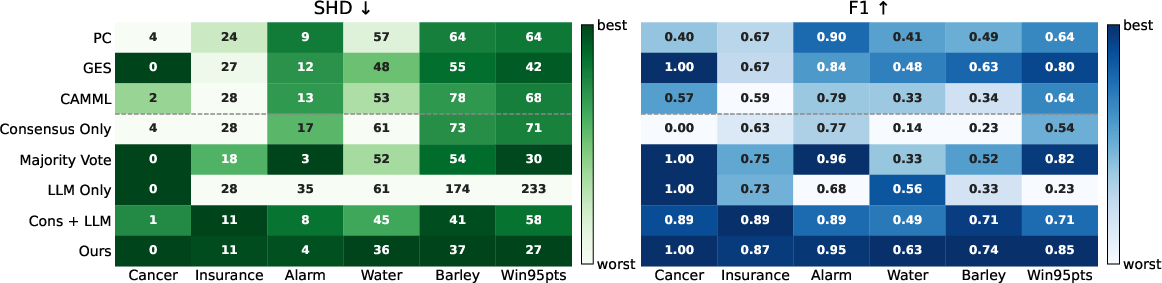
Figure 3: Ablation analysis of edge decision strategies, demonstrating contribution of consensus, LLM-only, majority vote, and the full trust-calibrated ensemble framework.
Ablation studies show that consensus alone is insufficient, LLM-only approaches degrade rapidly on larger graphs, and majority vote reduces algorithm bias but cannot resolve equivalence class ambiguity. The calibrated arbitration strategy in CauTion yields optimal tradeoffs.
Robustness to LLM Backend
CauTion is robust across LLM backends (Claude-Sonnet-4.6, GPT-5.2, Llama-3.3-70B-Instruct, DeepSeek-V3.2, Qwen3-8B, Llama-3.1-8B-Instruct). Performance variance in SHD and F1 is minimal across all datasets, indicating that trust calibration effectively insulates against LLM-specific error propagation.
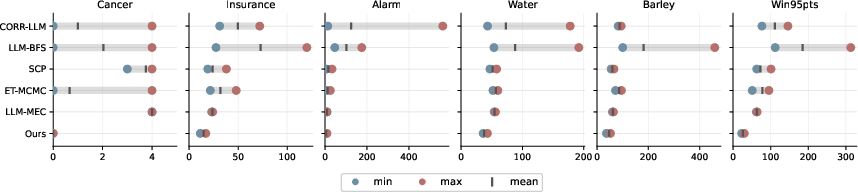
Figure 4: Cross-model robustness (SHD) for LLM-augmented methods; CauTion exhibits the narrowest performance span across LLM backends.
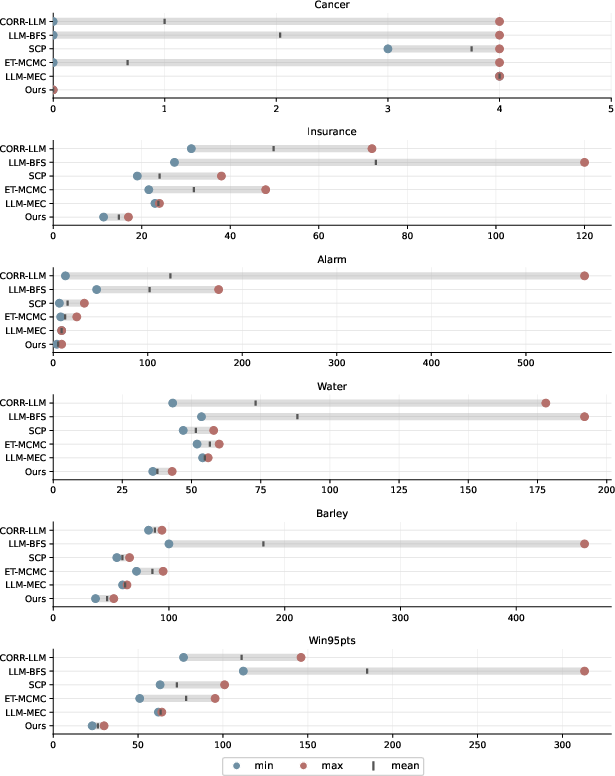
Figure 5: Dataset-level robustness in SHD across LLM backends; CauTion minimizes variance and error exposure.
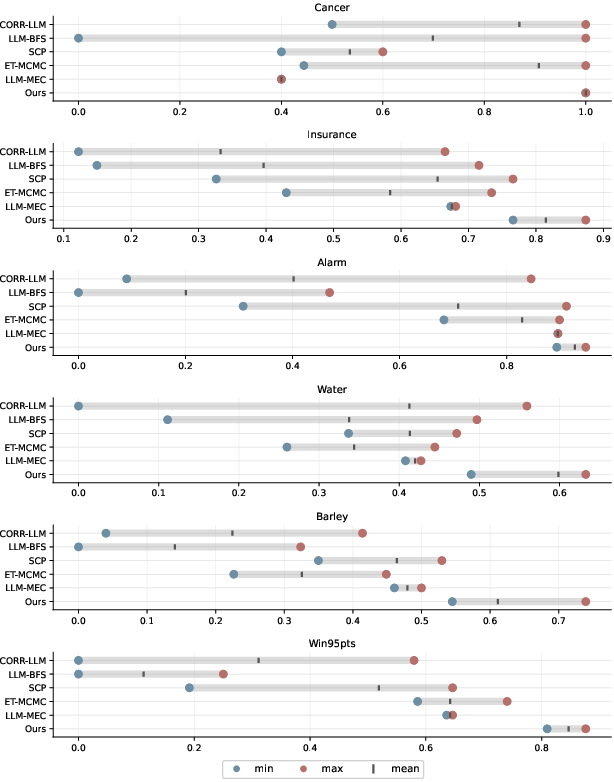
Figure 6: F1 cross-model variance; negligible sensitivity in CauTion contrasted with strong variance in LLM-only baselines.
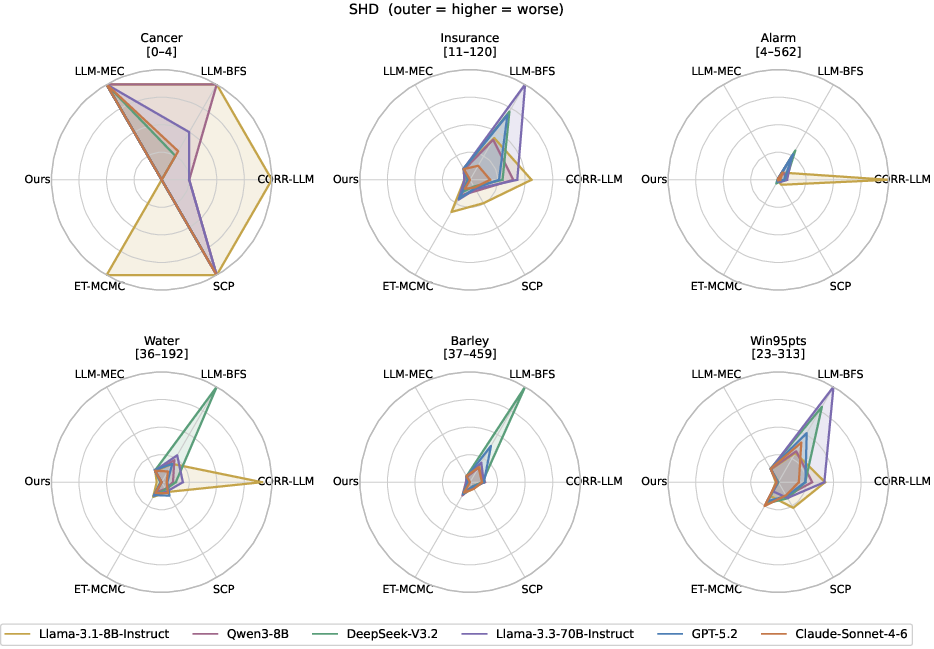
Figure 7: Radar plots showing cross-model SHD robustness for all datasets and LLMs.
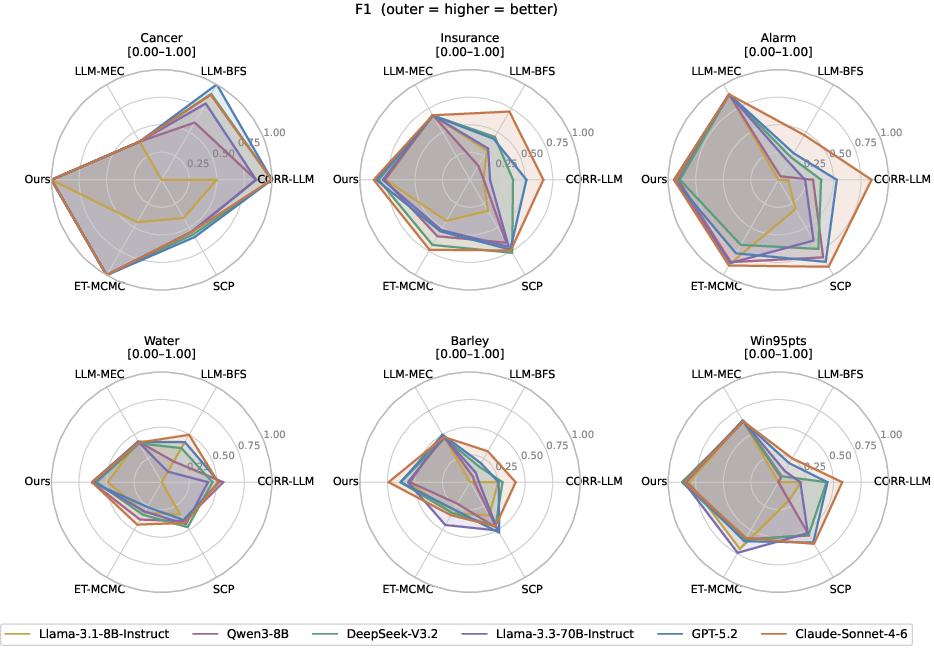
Figure 8: Radar plots showing cross-model F1 robustness for all datasets and LLMs.
Practical and Theoretical Implications
CauTion sets a new technical standard for LLM-augmented statistical causal discovery:
- Reduced token cost and error exposure: By limiting LLM arbitration to contested pairs and calibrating trust weights based on empirical accuracy, CauTion achieves high efficiency and robust structure recovery.
- Mitigation of algorithmic bias: Ensemble consensus filtering circumvents single-algorithm limitations, leveraging diverse statistical perspectives.
- Scalability: Consensus filtering and selective LLM arbitration enable reliable inference in large graphs.
- Robustness: Trust-calibration stabilizes performance across backend heterogeneity and LLM capability spectrum, supporting practical deployment.
- Generality: The ensemble arbitration paradigm can be extended to richer algorithm sets, including future LLM-integrated causal learners or neural causal discovery models.
In scientific domains where reliable structure recovery enables downstream inference—medicine, economics, epidemiology—CauTion's paradigm facilitates actionable causal graph learning with bounded error rates.
Future Directions
Further directions include integration of broader ensembles, validation on continuous/mixed-type graphical models, and expansion to include LLM-augmented statistical algorithms. The trust-calibrated arbitration protocol is generalizable to hybrid systems incorporating foundation models and statistical approaches for causal inference.
Conclusion
CauTion addresses critical failure modes inherent in LLM-augmented and purely algorithmic causal discovery, establishing a robust, scalable, and empirically grounded system for DAG learning that attains superior structural recovery and practical reliability across datasets and LLM backends (2606.03602).

