- The paper presents a closed-form analytical framework that rigorously characterizes DCA convergence in Gaussian RBF-SVR models by establishing explicit bounds on strong convexity and smoothness.
- The methodology decomposes the nonconvex SVR prediction function into convex components using the RBF kernel structure, ensuring diagnostic and tuning capabilities via analytical bounds.
- Empirical results demonstrate that the composite quantity Cαρ, governed by SVR hyperparameters, predicts convergence speed and iteration counts across various benchmark functions.
Analytical Convergence Characterization of DCA for RBF-SVR Surrogate Optimization
Introduction
The paper "Analytical Evaluation of DCA Convergence Properties for Minimizing Prediction Functions of Gaussian RBF Support Vector Regression" (2606.03559) rigorously develops a closed-form analytical framework for characterizing the convergence properties of the Difference of Convex (DC) algorithm (DCA) when the target is the prediction function of a trained Support Vector Regression (SVR) model with a Gaussian Radial Basis Function (RBF) kernel. The authors exploit the analytical structure of the RBF kernel to establish explicit bounds on the strong convexity and gradient Lipschitz constants of the convex components in the DC decomposition of the SVR objective, both before and after training. Through extensive numerical experimentation, they demonstrate that a single composite quantity, Cαρ, fully characterizes the convergence behavior of DCA, where Cα is the sum of dual coefficients after SVR training, ρ is the DC decomposition parameter (explicitly bounded via kernel structure), and both are tightly governed by SVR hyperparameters.
DC Decomposition of RBF-SVR Prediction Functions
The SVR prediction function with a Gaussian RBF kernel is given by: f^(x)=i=1∑n(αi−αi∗)k(xi,x),
where k(xi,x) is the RBF kernel and (αi,αi∗) are dual coefficients from SVR training. The function is nonconvex and conventionally optimized via metaheuristics, which ignore algebraic structure and lack convergence guarantees.
Applying DC programming, the prediction function is decomposed as f^=G−H, where both G and H are convex functions constructed analytically by leveraging the RBF kernel's Hessian properties. The decomposition relies on a parameter ρ, linked to the kernel width Cα0, and is structured so that convexity of the subproblems at every iteration is guaranteed when Cα1 exceeds explicit lower bounds derived from operator theory.
Analytical Bounds: Strong Convexity and Smoothness
The key technical results are the closed-form expressions:
- Strong convexity lower bound: Cα2,
- Lipschitz upper bound: Cα3.
Both constants depend on only the sum of SVR duals Cα4, the kernel width Cα5, and the DC decomposition parameter Cα6, and share leading order dependence on the product Cα7. Thus, the convergence guarantees for DCA (descent at each step, criticality of accumulation points) can be evaluated a priori using these quantities, enabling both pre-training estimation (from hyperparameters) and post-training exact calculation.
Subproblem Structure and Convergence Quantification
The DCA subproblem each iteration is a convex optimization comprising a quadratic proximal term and a kernel-weighted sum, whose geometry is precisely controlled via Cα8. The explicit completion-of-squares allows full characterization of search dynamics. The evolution of iterates exhibits strong monotone descent, with step sizes and convergence speed quantitatively dictated by Cα9.
Numerical Verification and Empirical Convergence
Across six benchmark functions with diverse multimodal landscapes:
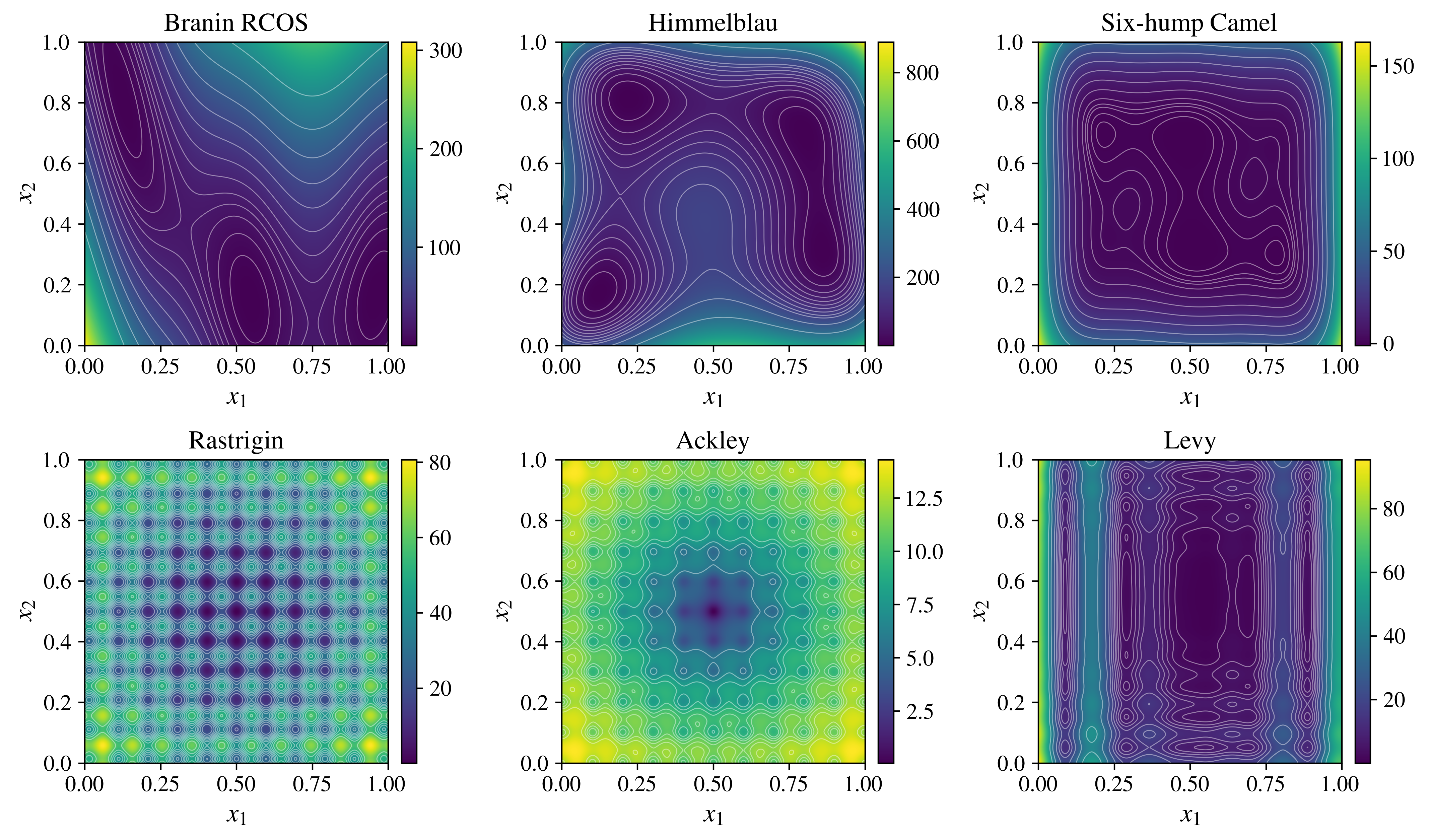
Figure 1: Heatmap visualizations of Branin, Himmelblau, Rastrigin, Ackley, Levy, and Six-hump Camel functions, illustrating varying degrees of nonconvexity and ridge structure.
Statistical analysis over thousands of SVR models trained with systematically varied ρ0 demonstrates:
- Median and variance of DCA iteration counts are monotonic in ρ1.
- The dependence of DCA convergence on the initial point is amplified at high ρ2.
- The quantity ρ3 decomposes into two independent pathways: ρ4 controls ρ5 (strong rank correlation ρ6); ρ7 directly influences ρ8, confirming the analytic separation.
- Empirical convergence curves exhibit linear (exponential) decay in normalized residuals regardless of underlying objective multimodality.
Practical Implications
The results offer both theoretical and practical implications:
- Theoretical rigor: Closed-form bounds ground DC optimization analysis for nonconvex surrogate functions, bridging function-structure-specific and generic DC theory.
- Optimization protocol design: Convergence properties can be diagnosed, and smoothness parameters selected, at both the model-design (hyperparameter selection) and post-training stages.
- Surrogate modeling: Hyperparameter choices for SVR can be tuned not only for prediction quality but also for optimization tractability, avoiding pathological regimes where DCA converges slowly or is highly sensitive to initial conditions.
- Algorithmic extension: The explicit Lipschitz bound ρ9 provides an analytically justified smoothness constant for Frank-Wolfe-based DC optimization variants (DC-FW, Blended Pairwise Conditional Gradients), facilitating scalable and constrained nonconvex optimization (Maskan et al., 11 Mar 2025, Pokutta, 23 Jul 2025).
Figure 1 provides the landscape context; additional empirical plots (scatter of f^(x)=i=1∑n(αi−αi∗)k(xi,x),0 versus f^(x)=i=1∑n(αi−αi∗)k(xi,x),1, heatmaps over f^(x)=i=1∑n(αi−αi∗)k(xi,x),2, normalized convergence trajectories) support the claims quantitatively.
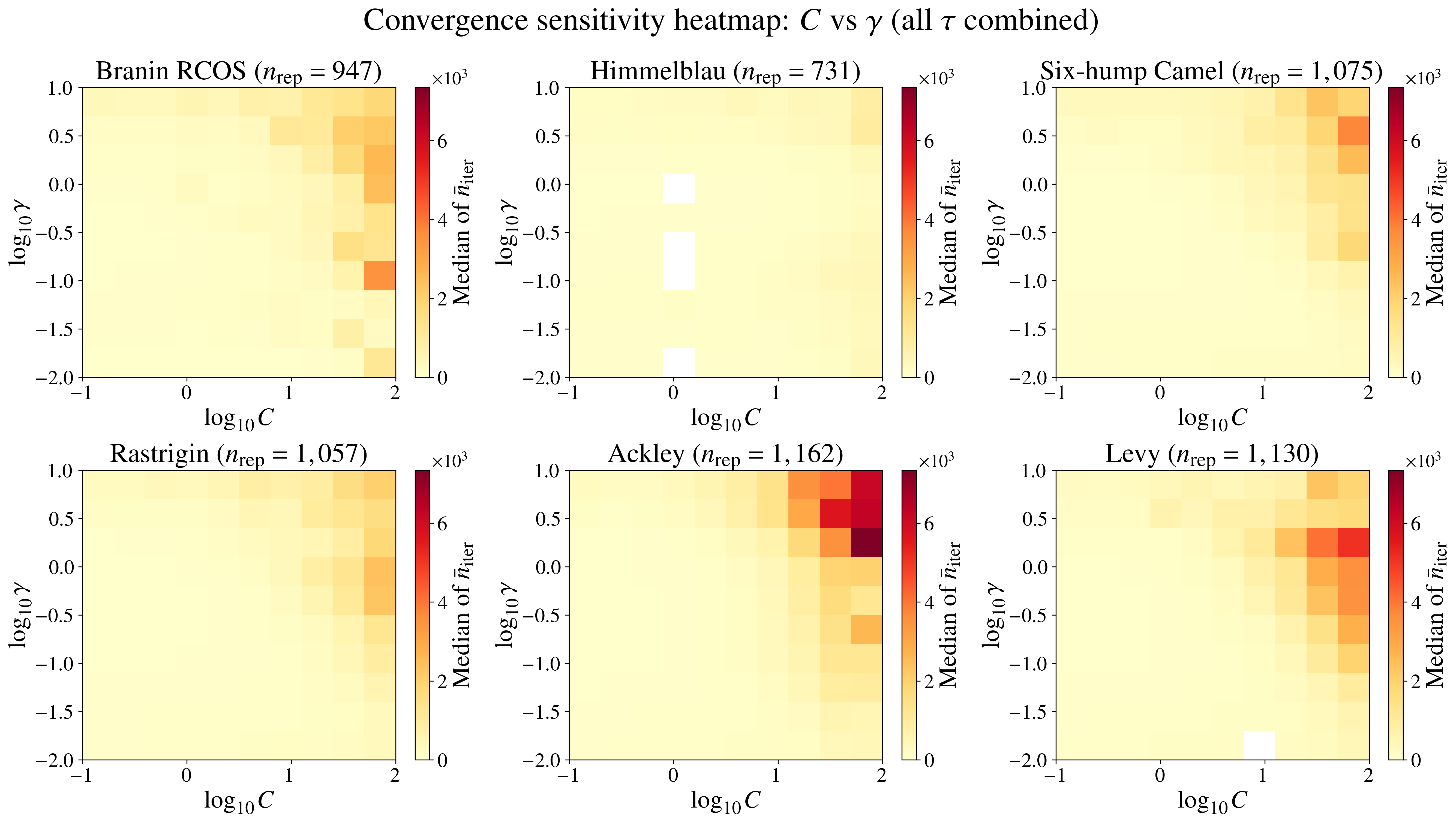
Figure 2: Median of f^(x)=i=1∑n(αi−αi∗)k(xi,x),3 in the f^(x)=i=1∑n(αi−αi∗)k(xi,x),4 space illustrating how excess in both hyperparameters leads to challenging optimization.
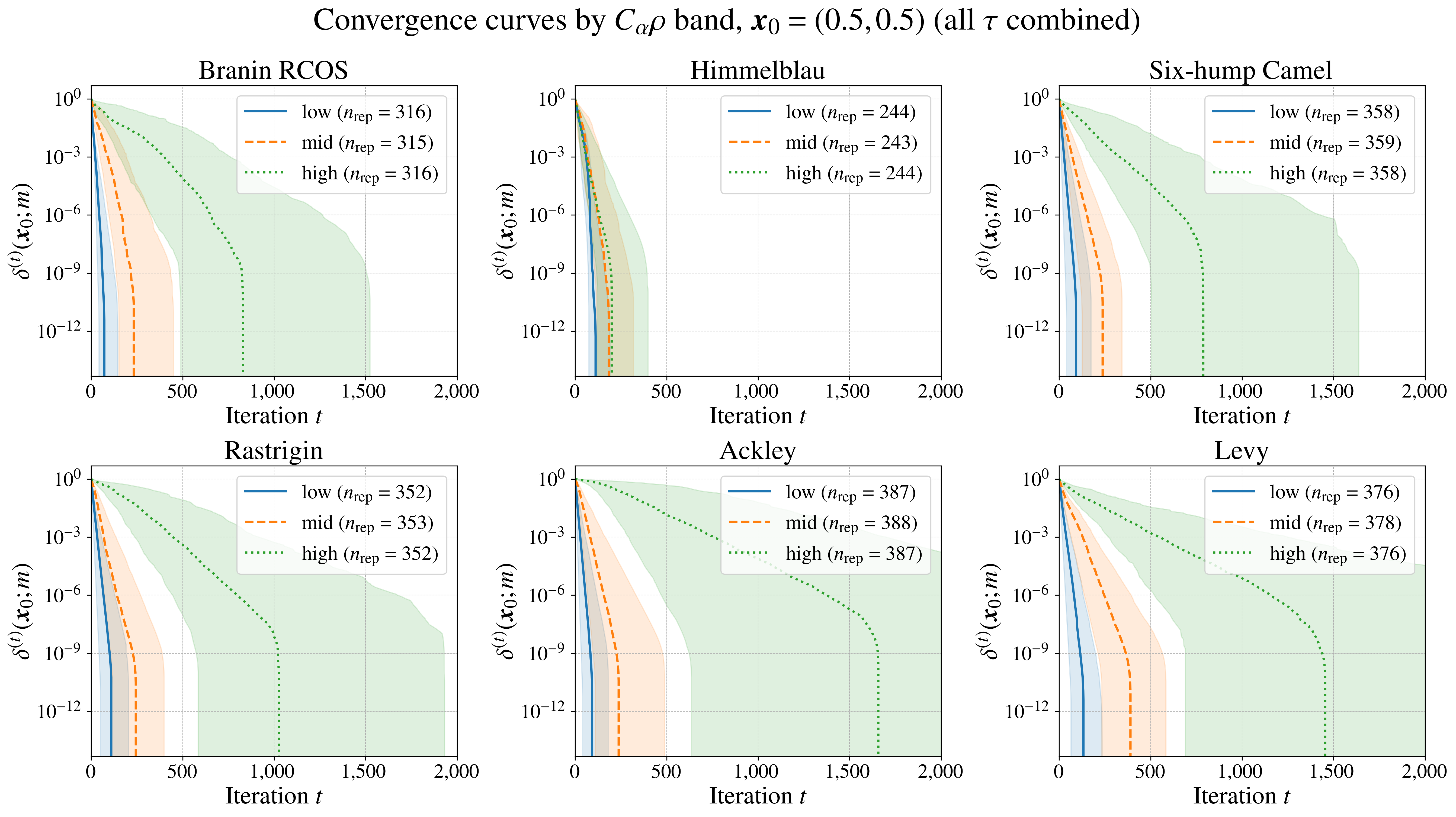
Figure 3: Evolution of the normalized residual f^(x)=i=1∑n(αi−αi∗)k(xi,x),5, showing linear convergence behavior for DCA across SVR models grouped by f^(x)=i=1∑n(αi−αi∗)k(xi,x),6.
Conclusion
This work formally characterizes and empirically validates the convergence properties of DCA applied to RBF-SVR surrogate minimization via a unified closed-form index, f^(x)=i=1∑n(αi−αi∗)k(xi,x),7. The analytic structure provides direct diagnostic and tuning capabilities for surrogate-based optimization protocols using SVR, as well as principled selection of smoothness constants for modern scalable DC optimization algorithms. The methodology and results are extensible to other kernel-based surrogates and offer a blueprint for bridging machine learning-based surrogate modeling and mathematical programming in engineering design and simulation-driven optimization.
Future Directions
Further empirical assessment of advanced DC-FW variants using these analytical constants, exploration of higher-dimensional settings, and extensions to other smooth kernel architectures remain open avenues. The integration of this analysis with uncertainty-quantified surrogate optimization (e.g., Bayesian acquisition functions) is also a promising direction.