Energy-selective quantum search with Ising Hamiltonian phase oracles
Published 2 Jun 2026 in quant-ph and cond-mat.dis-nn | (2606.03380v1)
Abstract: Ising Hamiltonians are basic models of disordered magnets and a standard language for quantum and classical optimization. We study an energy-selective quantum search primitive in which the physical evolution (\exp(-\mathrm{i} T H)) is used directly as a Hamiltonian phase oracle. Unlike a Boolean oracle, this oracle marks configurations continuously by their phases and selects a finite resonance band rather than a preassigned marked set. We show that alternating it with the Grover diffusion operator nevertheless produces a Grover-type amplification peak. An exact spectral recurrence and a generating-function representation determine the peak position, width, and height. For an annealed Gaussian density of states, target energies in a high-density tail require (Θ(\sqrt{2n/M})) oracle calls when the resonance contains (M) configurations. For random Ising spectra, overlap-induced correlations shift and distort the peak; spectral symmetrization and iterative calibration remove this detuning for prescribed-energy targeting.
The paper introduces a novel quantum search algorithm using Ising Hamiltonian phase oracles to achieve energy-selective amplification and quadratic speedup.
It utilizes resonance conditions and spectral analysis to calibrate target energy bands while compensating for spin-glass induced phase shifts.
The study demonstrates resource scaling and iterative calibration strategies, offering a diagnostic approach for complex disordered systems.
Energy-Selective Quantum Search via Ising Hamiltonian Phase Oracles
Algorithmic Framework and Oracle Construction
The paper "Energy-selective quantum search with Ising Hamiltonian phase oracles" (2606.03380) develops a quantum search algorithm leveraging the Ising Hamiltonian as a physical phase oracle. Unlike the paradigmatic Grover search, which employs a Boolean oracle to mark a discrete set, the Hamiltonian oracle here assigns energy-dependent phases to all computational basis configurations, thereby marking a continuum (an energy neighborhood) rather than a discrete set.
In each iteration, the algorithm alternates between the Ising phase oracle UT=e−TH and Grover diffusion operator Dξ=2∣ξ⟩⟨ξ∣−I. The evolution time T is a tunable control parameter selecting the target energy via the phase condition TEs≈π(mod 2π). Consequently, configurations near a prescribed energy E∗ are coherently amplified, conditional on their phase resonance.
Spectral Dynamics and Resonance Response
The spectral theory is developed through an exact recurrence for amplitude evolution and a generating-function formalism that captures resonance peak properties. Amplitude amplification is shown to produce a Grover-type amplification peak, where the spectral response Cr(φ)=2G(−rφ)−1 encodes both the position and magnitude of amplification. The physical kernel dynamically selects a finite energy window, determined intrinsically by spectral density and phase resolution.
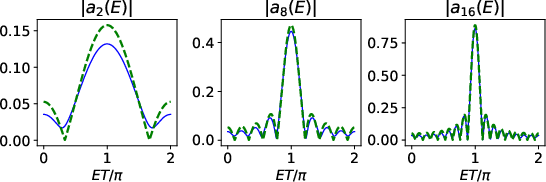
Figure 1: Amplification profile for an annealed Gaussian spectrum near the principal phase resonance ET=π, illustrating growth and narrowing of the resonance with increasing iterations.
For a smooth, annealed Gaussian spectrum (mean-field approximation), resonance amplification exhibits quadratic speedup. Precisely, for a target-energy band containing M configurations in the high-density spectral tail, oracle query complexity is Θ(2n/M), matching Grover's scaling yet with self-generated marked bands.
Correlated Ising Spectra and Resonance Calibration
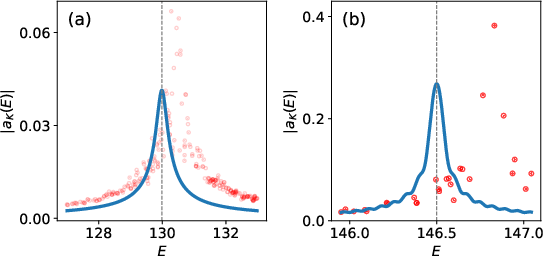
The core technical distinction arises in realistic Ising ensembles, where spin overlaps induce spectral correlations, leading to a realization-dependent phase shift φ0=O(n−3) in the resonance center. While negligible in total spectral bandwidth (Dξ=2∣ξ⟩⟨ξ∣−I0), this shift is significant vis-à-vis the exponentially narrow resonance width (Dξ=2∣ξ⟩⟨ξ∣−I1), thus affecting targeting precision and necessitating calibration for exact prescribed-energy amplification.
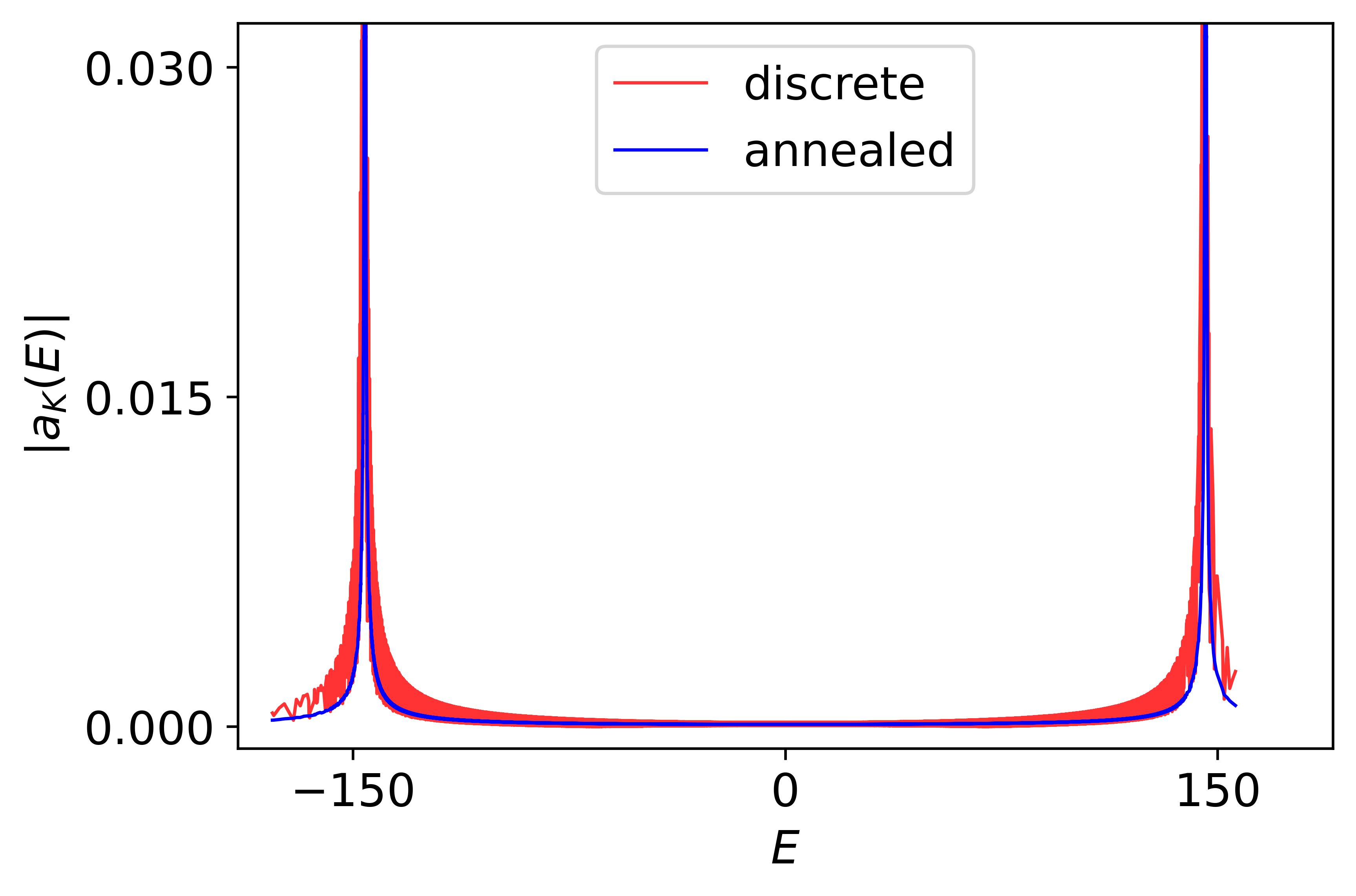
Figure 2: Amplification profile comparison between a random Ising instance and the annealed Gaussian prediction, evidencing correlation-induced peak displacement in the Ising spectrum.
Figure 3: Zoom on resonance peaks for zero-field random Ising spectra at Dξ=2∣ξ⟩⟨ξ∣−I2, showing realization-dependent displacement and peak height modulation.
This phase shift represents a coherent signature of spin-glass correlations, directly measurable via the algorithm's output. It transforms energy-selective quantum search from mere sampling into a diagnostic tool for probing complex-temperature spectral structure.
Targeting Strategies and Resource Scaling
The paper addresses resonance calibration via two principal methods:
Spectral Symmetrization: Introduction of an ancilla to symmetrize the spectrum, rendering the phase response odd and relocating the resonance center unambiguously to Dξ=2∣ξ⟩⟨ξ∣−I3, at the cost of converting two-body Ising interactions to three-body terms.
Iterative Time Calibration: Feedback protocol wherein output bitstring energies guide adjustment of Dξ=2∣ξ⟩⟨ξ∣−I4, compensating for Dξ=2∣ξ⟩⟨ξ∣−I5 with polynomial overhead in calibration steps. This approach is experimentally tangible and does not demand full spectral reconstruction.
Resource analysis reveals that, for dense two-body Ising Hamiltonians, gate complexity per oracle call is Dξ=2∣ξ⟩⟨ξ∣−I6, leading to total gate-level cost Dξ=2∣ξ⟩⟨ξ∣−I7 in the controlled regime. Importantly, while the scaling remains exponential for Dξ=2∣ξ⟩⟨ξ∣−I8, the square-root query reduction is physically significant where spectral density supports a rare yet non-empty energy neighborhood.
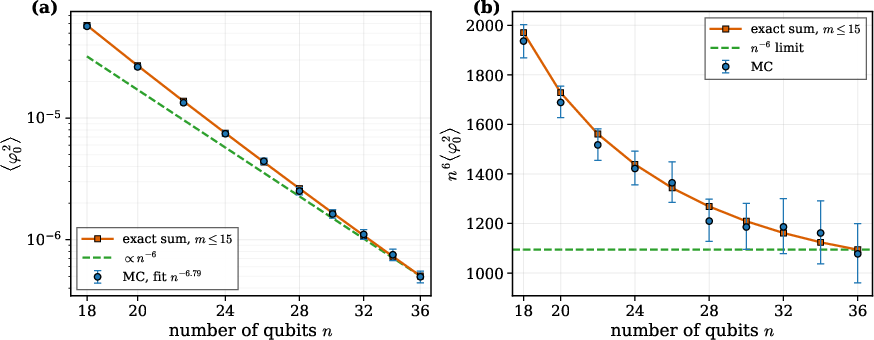
Figure 4: Scaling of the correlation-induced resonance displacement in random Ising instances, confirming Dξ=2∣ξ⟩⟨ξ∣−I9 rms decay with increasing T0.
Numerical Validation and Physical Implications
Numerical simulations validate theoretical predictions: amplification peaks align with Gaussian theory in the mean, but realization-dependent shifts are evident and scale as predicted. The peak height corrections, while analytically derived, do not manifest strongly at accessible system sizes but remain conceptually crucial for asymptotics.
The practical and theoretical implications are multifold:
The Hamiltonian phase-oracle algorithm provides a physically natural quantum search primitive applicable to energy-selective tasks within high-density spectral tails of complex disordered systems, such as spin glasses and analog Ising machines.
The continuous phase marking expands quantum search from Boolean oracles to spectrally defined marked bands, facilitating quadratic speedup in new classes of optimization and sampling problems.
The resonance shift acts as a spectroscopic probe of landscape correlations, opening avenues for quantum diagnostics and calibration of physical Ising machines.
Conclusion
The study establishes that Grover-type quantum speedup is not restricted to Boolean oracles but extends to energy-dependent Hamiltonian phase marking in Ising models. The resonance mechanism, spectral theory, and calibration protocols collectively enable energy-selective amplification in correlated landscapes, provided the target band lies within controlled high-density spectral tails. The interplay between amplification, spectral correlations, and diagnostic shifts underscores the broader utility of Hamiltonian phase oracles in quantum search, optimization, and quantum device benchmarking.
“Emergent Mind helps me see which AI papers have caught fire online.”
Philip
Creator, AI Explained on YouTube
Sign up for free to explore the frontiers of research
Discover trending papers, chat with arXiv, and track the latest research shaping the future of science and technology.Discover trending papers, chat with arXiv, and more.