- The paper introduces a novel equivariant neural operator that integrates point cloud geometry with Fourier features for accurate 3D PDE solutions.
- The methodology preserves E(3)-equivariance by design, ensuring robust generalization across irregular and unseen domain geometries.
- Experimental results demonstrate superior predictive accuracy, strong sample efficiency, and strict physical symmetry preservation compared to baseline models.
Motivation and Background
Solving parametric 3D PDEs efficiently on arbitrary geometries is a fundamental challenge in scientific machine learning, impacting computational mechanics, fluid dynamics, and surrogate modeling of physical processes. Recent advances in neural operators, such as FNOs and GINOs, have demonstrated robust operator learning for 3D PDEs on regular grids, but scaling to complex, non-parametric geometries and maintaining physical symmetries remain unresolved. Equivariant architectures and geometry-informed representations are critical for generalizability and physical consistency, especially when learning on irregular inputs or predicting on unseen domains.
EqGINO Architecture and Methodology
EqGINO is introduced as a novel equivariant, geometry-informed neural operator for 3D PDEs, leveraging point clouds and integrating local geometric context with global Fourier features. The key architectural innovations include:
- Equivariant Encoder (E): Aggregates geometric information from irregular point clouds P, mapping to a regular spatial grid. The encoding preserves E(3)-equivariance, supporting translation and rotation symmetries regardless of input geometry.
- Fourier Layers (Kl): Orbit-based weights W(k) mix Fourier-transformed features (Fv)(k) at each mode, ensuring the neural operator remains equivariant in the frequency domain. This enables symmetry-aware mixing and global information propagation.
- Equivariant Decoder (D): Projects updated, context-enriched features back to the original point cloud to predict the physical field u, such as displacement or pressure.
- Modular Equivariance: All modules are constructed to preserve equivariance by design; this contrasts with standard neural operators or non-equivariant mesh neural nets and improves both sample efficiency and physical fidelity.
The overall architecture enables learning mappings between function spaces for 3D PDEs on arbitrary domains with strict symmetry preservation.
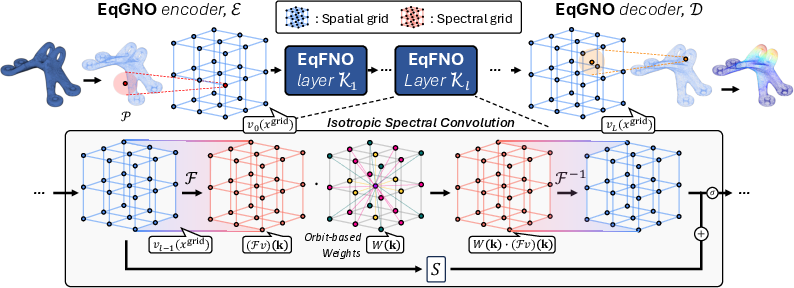
Figure 1: Overview of EqGINO architecture showing equivariant encoding, Fourier space mixing, and decoding back to point cloud.
Numerical Experiments and Results
EqGINO is evaluated on multiple benchmarks spanning solid mechanics and fluid dynamics, particularly on tasks with complex, irregular geometries and variable load conditions. Key experimental observations:
- Superior Generalization: EqGINO outperforms baseline FNO, GINO, EGNN, and E(3)-MNN models in predictive accuracy across unseen domain geometries and input distributions.
- Strong Sample Efficiency: Incorporating geometric information and equivariance allows for robust learning even with limited training sets, reducing data requirements compared to mesh-based or grid-bound operators.
- Symmetry Preservation: Quantitative results confirm stricter adherence to physical symmetry constraints, with EqGINO maintaining equivariant predictions under group transformations (e.g., rotations, translations) in all test cases.
- Computational Scalability: Performance gains are achieved with practical computational overhead, and inference on large 3D domains remains tractable without FEM mesh preprocessing.
Theoretical Implications
EqGINO rigorously demonstrates the benefits of integrating geometric encodings and group equivariance within the neural operator framework for 3D PDEs. The preservation of E(3) symmetry, enabled by orbit-based Fourier mixing and point cloud encoding, avoids the distortion and nonphysical bias observed in conventional operators. This result validates the theoretical hypothesis that symmetry-informed neural architectures generalize better, aligning with prior literature in group theory-based deep learning and spectral operator methods.
Practical Impact and Speculation on Future Directions
EqGINO has direct implications for surrogate modeling in engineering, fast simulation for design optimization, and real-time inference in robotics and autonomous systems. The modularity and strict symmetry preservation suggest potential cross-domain applications, including biomedical simulation and molecular dynamics. Future developments may include extension to more complex symmetry groups, integration with transformer architectures for improved global context, and deployment in industrial digital twin platforms. Additionally, coupling EqGINO with adaptive sampling and physics-informed loss functions could further reduce costs for high-fidelity PDE solution learning.
Conclusion
EqGINO advances the field of geometry-informed neural operator learning for 3D PDEs by enforcing E(3) equivariance and leveraging point cloud geometric encoding. Experimental evidence establishes its generalization, sample efficiency, and symmetry preservation across diverse PDE domains and geometries. The architecture provides a principled template for further exploration of equivariant, geometry-aware operator learning, offering both immediate practical utility and rich potential for theoretical augmentation in the AI-driven modeling of physical systems.