- The paper reveals that periodic driving generates both 0- and anomalous π-Majorana flat edge modes, establishing dynamic Floquet-induced topological phases.
- It utilizes a combination of real-space tight-binding models, LDOS analysis, and time-evolution studies to robustly characterize the edge mode dynamics.
- The study highlights the limitations of perturbative methods at low frequencies and outlines feasible experimental setups for observing tunable Majorana modes.
Anomalous Floquet Majorana Flat Edge Modes in 2D Non-Collinear Magnet-Superconductor Heterostructures
Introduction
The study rigorously explores the generation, stability, and dynamical/topological characterization of gapless Floquet topological superconducting phases in two-dimensional non-collinear magnet-superconductor heterostructures subjected to periodic driving of the onsite chemical potential. The primary focus is the emergence of both $0$- and anomalous π-Floquet Majorana flat edge modes (FMFEMs) in a 2D Shiba lattice and their response to time-periodic perturbations. This work presents a comprehensive treatment using real-space tight-binding formalism, local density of states (LDOS) analysis, time-evolution studies, and an overview of analytical and numerical methods, culminating in a full characterization of the Floquet-induced gapless edge modes.
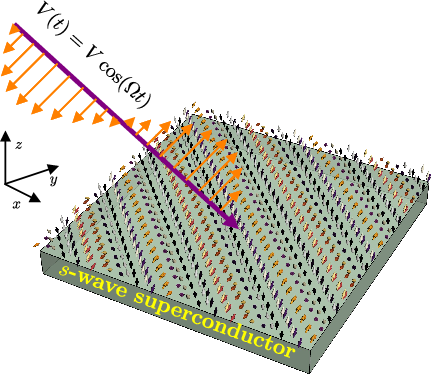
Figure 1: Schematic of a 2D non-collinear spin texture on a square lattice, deposited on an s-wave superconductor and subjected to a harmonic drive in chemical potential, enabling the realization of $0$- and anomalous π-FMFEMs.
Model and Floquet Engineering
The system is modeled as a 2D square lattice of magnetic adatoms with a non-collinear spin texture on an s-wave superconducting substrate. The effective Bogoliubov-de-Gennes Hamiltonian incorporates nearest-neighbor hopping, exchange with local spins, superconducting pairing, and a time-dependent chemical potential: H(t)=H0+Vcos(Ωt)Γ1. The non-collinear (spiral) magnetic structure generates synthetic spin-orbit and Zeeman terms, mapping the lattice to a system with effective SOC and topological superconducting behavior.
A periodic drive is imposed via harmonic modulation of the onsite chemical potential, with amplitude V and frequency Ω, enabling Floquet engineering of the system's topology. The time-evolution operator and Floquet formalism are employed to extract the quasi-energy spectrum and associated FMFEMs.
Numerical Results: Emergence and Dynamics of FMFEMs
Exact diagonalization of the Floquet operator under OBC reveals robust generation of both $0$- and π-FMFEMs localized at the system's edges, with their existence and nature strongly dependent on the driving frequency regime.
At low frequencies (e.g., Ω=5Δ0), only π0-FMFEMs are observed, which do not correspond to any static-state analog, thus these are labeled anomalous. Intermediate frequencies (e.g., π1) enable coexistence of π2- and π3-FMFEMs, while the high-frequency regime (π4) supports exclusively π5-FMFEMs.

Figure 2: Floquet quasi-energy spectra for various π6; LDOS plots confirm edge localization of anomalous π7- and π8-FMFEMs at different driving frequencies.
Time-resolved spectra obtained from the evolution operator π9 across a full period corroborate that $0$0-FMFEMs nucleate and evolve distinctly compared to their $0$1 counterparts. Analysis of the time-resolved LDOS at characteristic points within the drive period demonstrates persistent spatial edge localization for both types of FMFEMs.
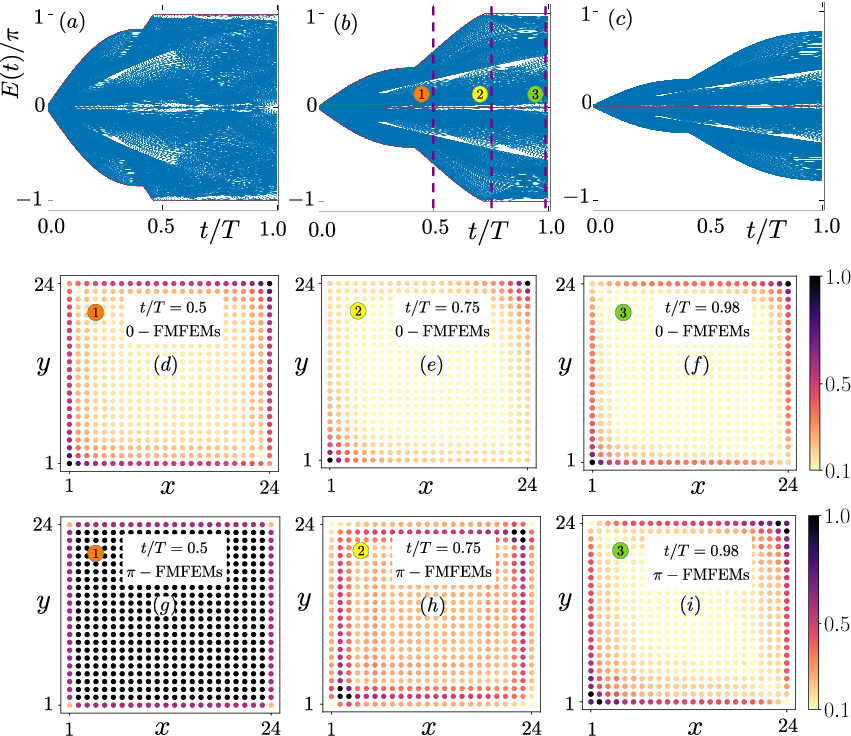
Figure 3: Time evolution of the quasi-energy spectrum over a period and corresponding LDOS maps at different time instants for both $0$2- and $0$3-FMFEMs.
Topological Characterization
Due to the gapless nature of the underlying static spectrum, the Chern number is inapplicable. Instead, the topological invariant is computed as a dynamical winding number, accessible via block-off-diagonalization in the chiral basis. The system Hamiltonian preserves chiral symmetry under the drive, thus justifying the use of a $0$4-resolved winding number $0$5.
Calculation of the quasi-energy edge spectra under mixed PBC-OBC conditions directly connects the appearance of $0$6- and $0$7-FMFEMs with quantized jumps in $0$8 for corresponding $0$9 sectors. Individual regions in parameter space exhibit integer winding numbers proportional to the number of localized FMFEM branches in the spectrum.
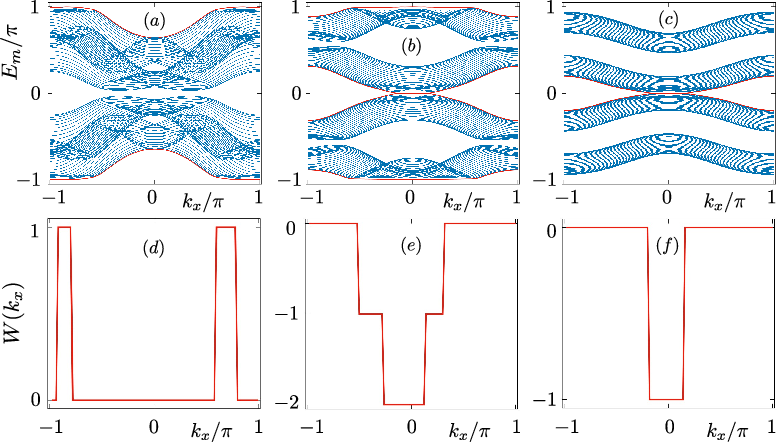
Figure 4: Quasi-energy edge spectra and winding number π0 for three driving frequencies, evidencing the bulk-boundary correspondence for Floquet phases.
A phase diagram constructed in the π1 plane shows induced topological phases, even for initial static configurations that are trivial (zero winding). The drive can nucleate regions with finite π2, while the static topological phase is prone to multiple drive-induced transitions, supporting higher winding sectors and multiple FMFEMs depending on parameter choices.
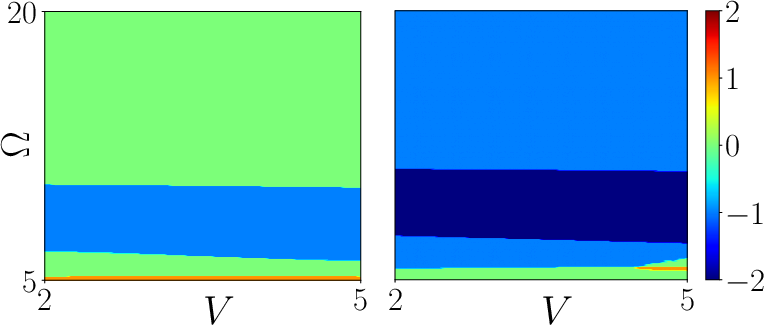
Figure 5: Phase diagrams of winding number π3 as functions of drive amplitude and frequency, revealing drive-induced topological transitions and high-winding phases.
Perturbative Analysis: Brillouin-Wigner and Floquet Methods
Analytical insight into the Floquet spectrum is provided by Brillouin-Wigner (BW) and Floquet perturbation theory (FPT) expansions. Both approaches yield effective time-independent Hamiltonians up to π4 corrections or leading-order Bessel function renormalizations. Numeric spectra derived from these analytical Floquet Hamiltonians are quantitatively consistent with exact numerics for high and intermediate-frequency regimes, especially regarding π5-FMFEM properties.
Notably, both perturbative schemes systematically fail to capture π6-FMFEMs or anomalous gap closings in the low-frequency regime, underlining the necessity of non-perturbative treatment for anomalous Floquet topological features.
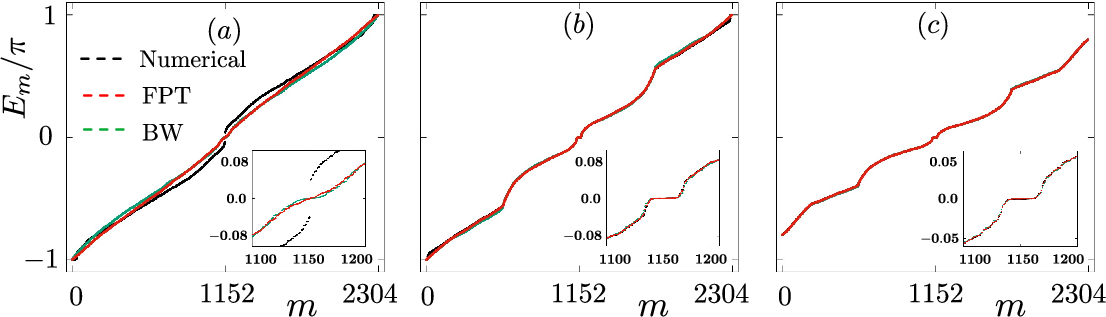
Figure 6: Comparison of quasi-energy spectra from BW, FPT, and exact numerical results for varying π7, highlighting substantial agreement for π8-FMFEMs and discrepancies for π9-FMFEMs at low frequency.
Experimental Feasibility and Implications
Hybrid platforms such as Mn/Nb(110) exhibit concurrent antiferromagnetism and superconductivity, offering a realistic testbed for these theoretical predictions. Deposition of a magnetic adatom monolayer (e.g., Mn, Cr) on an s-wave superconductor, combined with AC gating to modulate the chemical potential, constitutes an experimentally accessible route to realize the proposed Floquet TSC phases and to probe dynamical Majorana flat bands.
Practically, the presence of robust H(t)=H0+Vcos(Ωt)Γ10-FMFEMs due to Floquet engineering suggests possible routes to controlled manipulation of Majorana modes beyond equilibrium constraints. This has notable implications for topological strategies in quantum computation, particularly for architectures leveraging dynamical control over edge state populations.
Theoretically, these results underscore the richness of 2D Floquet superconductivity—most notably the possibility of purely dynamical anomalous flat band excitations—beyond the reach of static topological invariants, demanding new tools and perspectives for classifying and controlling quantum matter far from equilibrium.
Conclusion
This study systematically characterizes the generation, evolution, and topological signatures of Floquet Majorana flat edge modes in periodically driven 2D non-collinear magnet-superconductor heterostructures. It establishes the conditional emergence of anomalous H(t)=H0+Vcos(Ωt)Γ11-FMFEMs unique to the Floquet regime, maps their dynamical and topological fingerprints, and delineates the parameter space of their stability. Perturbative methods, while adequate for conventional (H(t)=H0+Vcos(Ωt)Γ12-)FMFEMs in certain regimes, do not capture the full phenomenology of the anomalous sector, emphasizing the need for exact, non-perturbative approaches. The results have direct experimental relevance for the engineering of tunable topological superconductors and inform future efforts in dynamical quantum control of edge Majorana modes.
Reference:
"Generation and time evolution of anomalous Floquet Majorana flat edge modes in two-dimensional noncolinear magnet-superconductor heterostructures" (2606.03193)

