- The paper introduces a feature-level analysis revealing that knowledge distillation suppresses low-frequency features to promote a compact, reusable feature set.
- It employs Interaction Tensor methods to quantify feature activations, demonstrating that student models mimic teacher behavior by reducing total features while boosting reuse frequency.
- The study proposes confusion distillation, a teacher-free self-distillation method that improves accuracy on CIFAR-100 by combining soft targets from confusion matrices with hard labels.
Feature-Level Structure and Self-Distillation via Confusion Matrices
Introduction
The paper delivers a feature-level analysis of Knowledge Distillation (KD) by leveraging the Interaction Tensor framework to decode the mechanisms by which student models acquire and utilize features under distillation. The authors show that KD introduces a regularization effect that suppresses low-frequency, highly sample-specific features, promoting a compact, highly reusable feature set. Further, they reveal a strong structural resemblance between the dataset-level confusion matrix and the teacher's "dark knowledge," leading to the development of Confusion Distillation (CD)—an efficient, teacher-free self-distillation method that improves performance compared to state-of-the-art self-distillation strategies.
Feature Usage Under Distillation: Interaction Tensor Analysis
The study applies the Interaction Tensor to decompose and compare feature activations across baseline, student, and teacher models on CIFAR-100 using various ResNet architectures. This analysis demonstrates that baseline models trained only with hard labels learn a large number of low-frequency, data-specific features, resulting in a long-tailed activation distribution. Teachers, in contrast, suppress these low-frequency features, instead activating a smaller, more generalizable feature set with higher reuse across samples. Students trained with KD mirror the teacher's behavior, reducing overall feature count and increasing average feature activation frequency significantly compared to baselines.
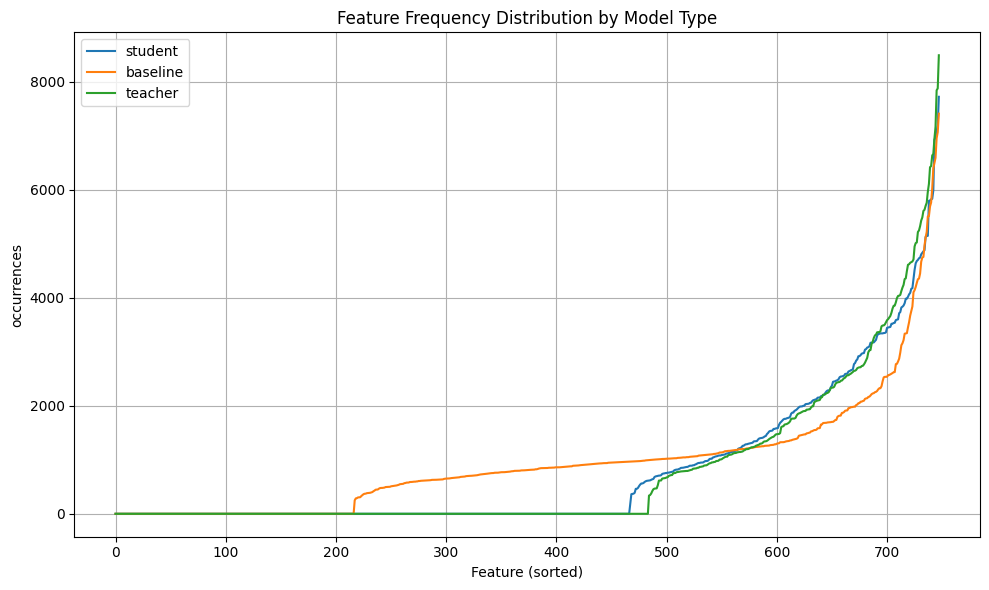
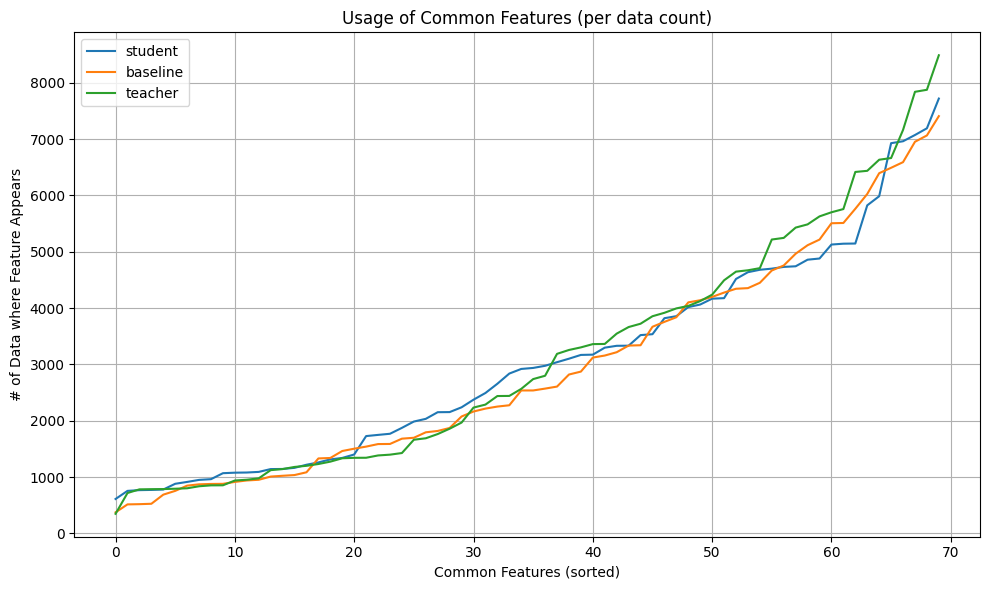
Figure 1: (a) Sorted feature frequency distributions across baseline, student, and teacher; (b) Feature frequency distributions among features shared by all models, illustrating the similarity between student and teacher.
Quantitatively, the number of features learned by the baseline is 531, while the student and teacher models use only 281 and 264, respectively. The student and teacher models' overlap in feature usage is substantially higher than the baseline's (170 shared features versus 96–132 for other pairs). These results demonstrate that distillation aligns student representations with those of the teacher, primarily via feature selection and efficient reuse rather than creation of novel features.
Feature-Evidence Dynamics and Predictive Confidence
By mapping the relationship between model confidence and the number of features activated per data point, the paper finds, contrary to previous work on CIFAR-10, that on CIFAR-100 high-confidence predictions require the activation of more, not fewer, features. This is attributed to the complexity and fine-grained nature of CIFAR-100, necessitating evidence accumulation from multiple complementary features to discriminate between similar classes.
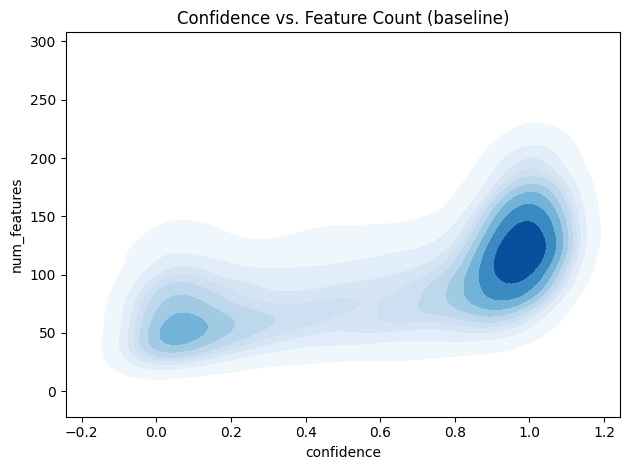
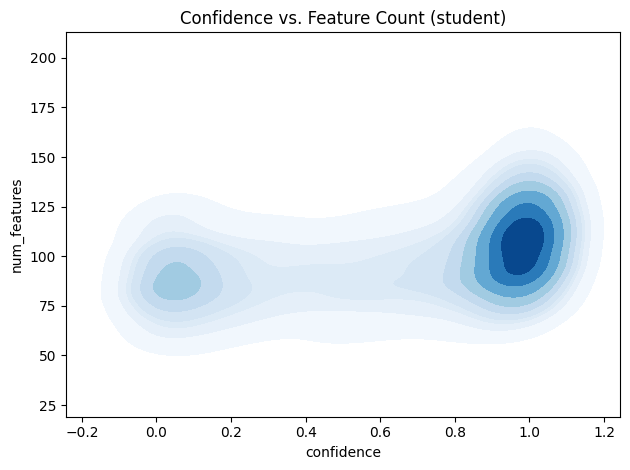
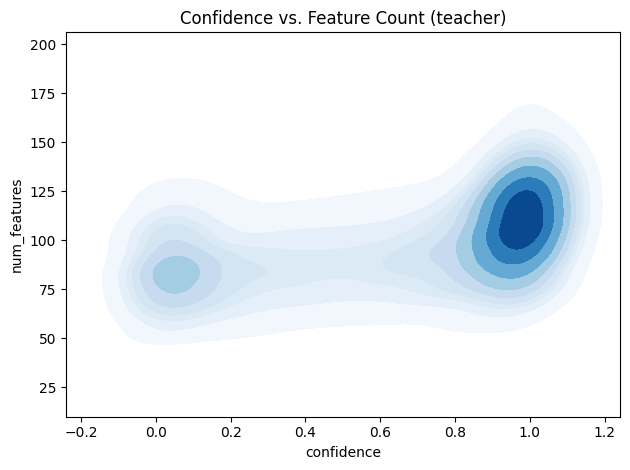
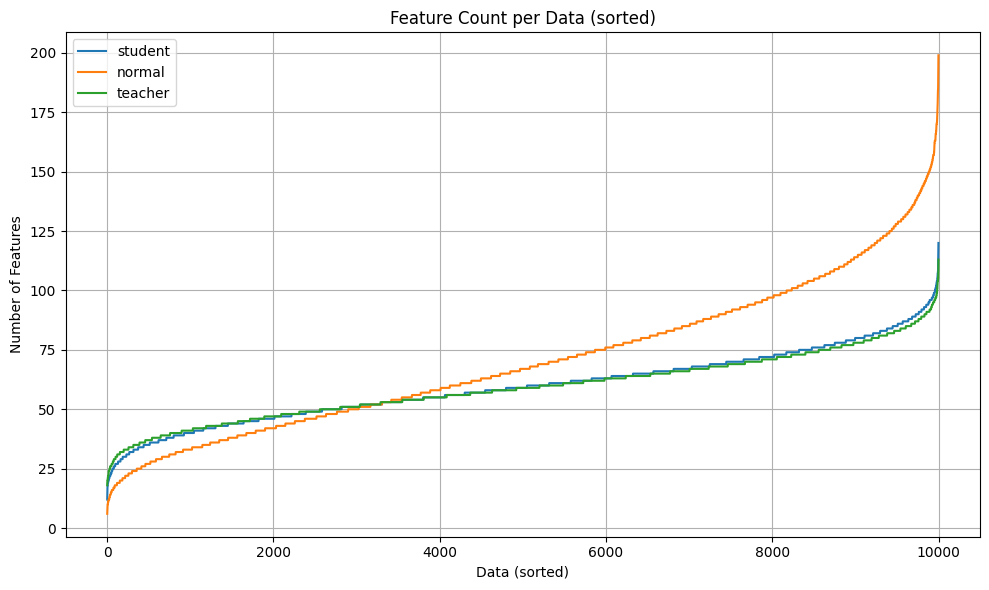
Figure 2: (a–c) 2D KDE plots of the joint distribution of softmax confidence and number of active features for baseline, student, and teacher models; (d) Sorted feature usage per data point across models.
Furthermore, the distillation process yields student models that maintain confidence with a fewer number of highly informative features and dynamically adjust feature usage for harder examples. Average features per sample classified decline from 71 (baseline) to 60 (student) and 59 (teacher). This efficiency cannot be reached through standard training alone, emphasizing the representational guidance provided by KD.
From Dark Knowledge to Confusion Distillation
The authors probe the nature and content of "dark knowledge" in KD, focusing on the class-conditional structure encoded in output probabilities. They quantitatively assess the similarity between the teacher's average class-wise softmax outputs and the student's confusion ratio, finding a mean cosine similarity of 0.76 and Pearson correlation of 0.85 (excluding diagonal elements). Jaccard similarity is approximately 0.38, showing partial but meaningful overlap, suggesting that the confusion matrix encodes teacher-independent inter-class relations serving as valid soft targets.
Based on these findings, Confusion Distillation (CD) is proposed. In CD, a student model first trains using cross-entropy, then switches to a mixed objective that incorporates soft labels generated from an exponential moving average (EMA) of its own confusion matrix. This EMA is initialized with a smoothed prior to avoid early-stage instability. The combined loss uses both KL divergence to the confusion-derived soft target and the standard hard-target loss, with the mixing ratio and transition schedule being crucial for optimal performance.
Empirical Effects of Confusion Distillation
The representational effects of CD, as evaluated with the Interaction Tensor, mirror those of classical KD: suppression of low-frequency features, reduction in overall feature count, and increased frequency and reuse of the remaining, more generalizable features.
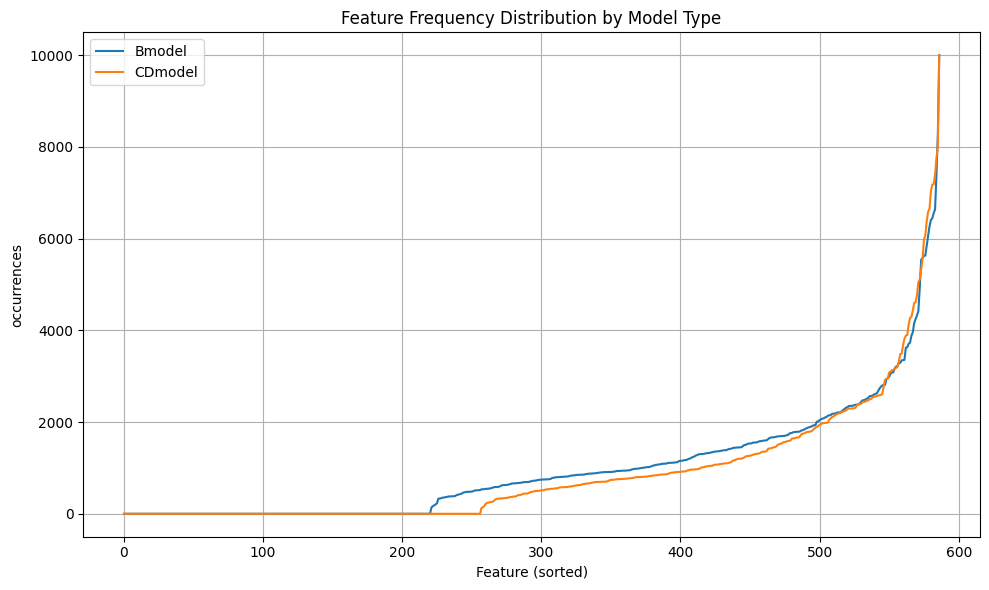
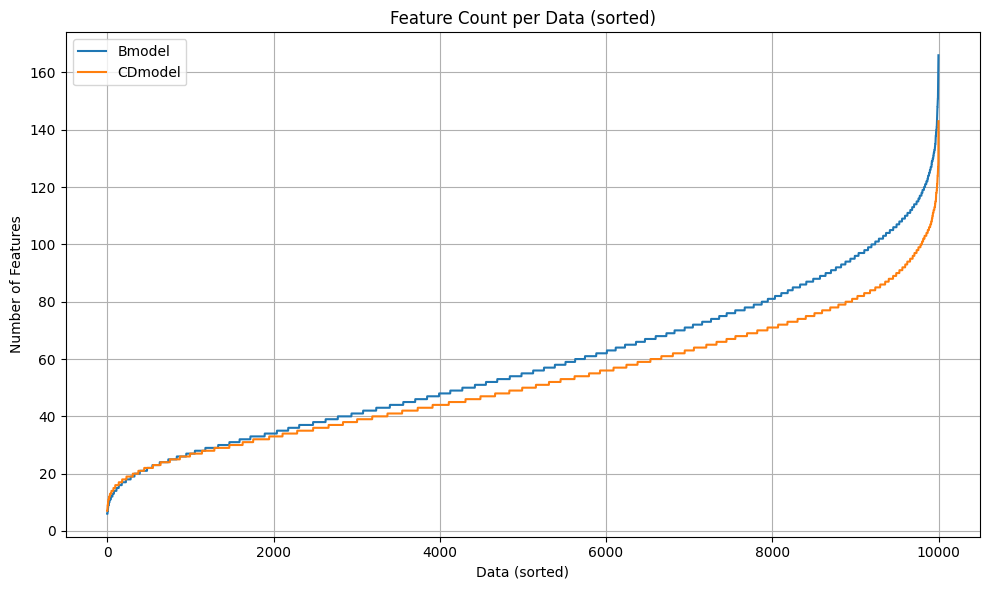
Figure 3: (a) Feature frequency distributions under baseline and CD models; (b) Number of features activated per data point, showing compression and reuse in CD.
CD affords consistent gains over strong baselines and other self-distillation methods (CS-KD, PS-KD) on ResNet-18/34/50. On CIFAR-100, CD improves top-1 accuracy by 1.2% over these methods with less training (e.g., 78.53% vs. 77.41% on ResNet-34 and 300 epochs). The paper also highlights that excessive reliance on confusion signal can be detrimental, and careful alternation with hard-label phases is essential for stability and maximal generalization.
Implications and Future Directions
The study establishes that feature-level supervision—whether provided by a large model ("teacher") or self-supervised via the confusion structure—regularizes and compresses network representations, enforcing a compact, highly reused feature basis. This provides a mechanistic explanation for the empirical gains of distillation and documents the representational advantage over independent training with hard labels alone.
Practical implications include the design of high-performing, computationally efficient self-distillation protocols that do not require a pretrained teacher, and the strategic use of confusion-derived signals in broader distillation and regularization frameworks. Theoretically, the equivalence between dark knowledge and dataset-induced confusion structures opens up new directions for unsupervised and semi-supervised representation shaping. Extensions to larger-scale datasets, transformer architectures, and tasks beyond image classification, such as NLP, are promising avenues for further advances.
Conclusion
This work provides a rigorous, feature-level account of how knowledge distillation shapes student models and introduces confusion distillation as a principled, teacher-free approach for self-supervised regularization. Through Interaction Tensor-based measurement and strong quantitative evidence, it is shown that both KD and CD enforce compact, efficient representations and deliver superior generalization by optimizing the structure and reuse of learned features. Further research will likely generalize these insights across models, data regimes, and problem domains, potentially informing both the design and theoretical analysis of future distillation techniques.

