- The paper introduces a predictive control pipeline using a multi-step Khatri-Rao kernel regression to minimize error accumulation over finite horizons.
- It employs a structured SVD-based model reduction to decouple and compress high-dimensional state and input dictionaries for enhanced computational efficiency.
- Empirical validation on the Lorenz system shows sub-1% decoded-state error in open-loop rollouts and stable closed-loop MPC performance across diverse initial conditions.
Koopman Operator Learning for Predictive Control via Khatri-Rao Kernel Regression
Overview
This work introduces a refined pipeline for data-driven learning and model reduction of generalized Koopman operator (GeKo) models for predictive control of nonlinear systems with inputs. The approach leverages a time-sequenced multi-step Khatri–Rao kernel regression that minimizes error accumulation on finite horizons, paired with a novel structured SVD-based model reduction that decouples and compresses the lifted state and input dictionaries. This pipeline is instantiated using random Fourier features and is empirically validated on the chaotic Lorenz system, demonstrating both high model predictive accuracy and closed-loop control capability.
Generalized Koopman Operator for Control and Khatri-Rao Realization
The paper begins by recalling the GeKo framework, which generalizes the Koopman operator to controlled nonlinear dynamics by constructing a separable linear operator on the tensor product Hilbert space of state and input observables. For a system xt+1=F(xt,ut), the GeKo is realized in finite dimensions as:
zt+1=K(zt⊙vt)
where zt and vt are lifted embeddings of the state and input, and K is estimated from data via regression on the Khatri–Rao (column-wise Kronecker) product. This realization strictly subsumes both linear and bilinear-in-control Koopman forms, with superior expressivity for capturing nonlinear input effects.
Multi-step Khatri-Rao Kernel Regression
One-step fitting of Koopman models is known to lead to severe model error accumulation in rollouts, especially for bilinear or input-state coupled systems. The presented method directly addresses this by fitting K using a multi-step trajectory-centric kernel regression formulation: windowed, time-shifted snapshot pairs from system trajectories are stacked for regression, yielding a multi-step loss with respect to the true system evolution. This imposes exposure of the learned Koopman model to dynamics on relevant finite horizons, thereby reducing the compounding open-loop prediction error. The estimator possesses a closed-form ridge regression solution, which avoids the nonconvex optimization typical of deep Koopman approaches.
The multi-step prediction profile is formally quantified via two metrics: one in the lifted feature space, and one in the decoded state space (via a trained linear decoder). The decoded state-space metric robustly guides the selection of the MPC prediction horizon, ensuring trajectory accuracy at the operational level.
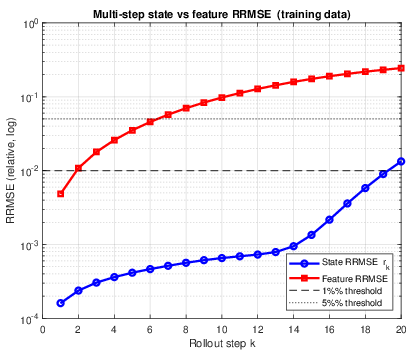
Figure 1: Relative Frobenius norm error profiles ("lifted" and "decoded" states) for multi-step prediction under the reduced GeKo model for the Lorenz system, used for model and horizon validation.
Structured SVD-based Model Reduction
Random or kernel-derived feature dictionaries are typically over-complete relative to the intrinsic system manifold, leading to ill-conditioned regression and unnecessarily high computational burden. The paper introduces a kernel-agnostic, structured SVD reduction that independently compresses the lifted state and input dictionaries to their effective ranks. This is performed via SVD on the concatenated trajectory data (both present and successor states), yielding orthonormal projection matrices and truncated liftings that preserve the Khatri-Rao structure. The reduced operator is then re-fit in the compressed coordinates, which, under this construction, is statistically optimal and computationally efficient. This procedure is fully generic and can be applied with arbitrary lifting bases, including neural or delay-coordinate dictionaries.
Predictive Control Pipeline with Random Fourier Feature Realization
The identification and MPC workflow is instantiated with random Fourier features (RFFs), which approximate Gaussian RBF kernels and allow scalable, differentiable embeddings of the state and input spaces. The learning pipeline proceeds with the following key steps:
- Generate data via rich, saturating multi-frequency input excitation over a broad set of initial conditions.
- Construct high-dimensional random Fourier dictionaries, then reduce them by SVD according to error-based thresholds.
- Form representative multi-step windows from trajectory data via clustering, followed by time-sequenced Khatri–Rao kernel regression to estimate the reduced Koopman operator.
- Learn a state decoder for control/reference tracking.
- Validate the model by open-loop multi-step rollouts and set the MPC horizon based on the decoded-state error profile.
Model Predictive Control is then formulated using the reduced GeKo bilinear model over the selected horizon, with box and rate input constraints, and an input/trajectory cost that penalizes both state deviation (in the decoded space) and input magnitudes/changes.
Empirical Validation on the Lorenz System
The capabilities of the proposed GeKo-MPC pipeline are validated on the controlled Lorenz system, a canonical nonlinear chaotic benchmark. Using only 8 training trajectories with multi-frequency excitation, the model is able to compress 400-dimensional RFF state liftings to 150 principal components and input features from 20 to 13, with negligible predictive loss as quantified by the decoded-state rollout error.
Open-loop validation shows consistently low error (sub-1% decoded-state error) over 20-step rollouts, supporting the chosen MPC horizon of 12. Closed-loop MPC is tested on 10 diverse initial conditions (sampling both attractor lobes and off-attractor states), with all trajectories reliably stabilized to the desired equilibrium.
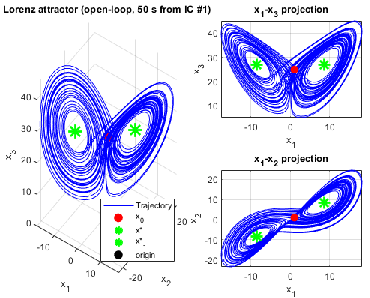
Figure 2: Uncontrolled (u=0) Lorenz trajectory, demonstrating chaotic attractor behavior and the target equilibrium x⋆.
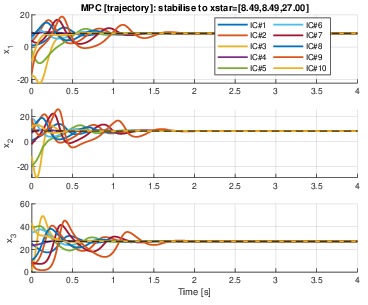
Figure 3: Closed-loop state trajectories under GeKo-MPC from 10 distinct initial conditions, all converging to the target x⋆.
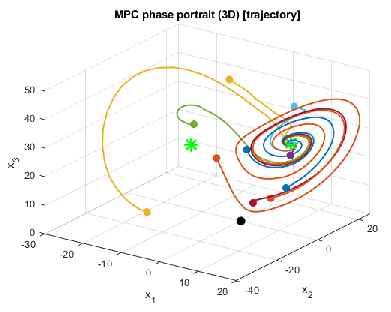
Figure 4: Phase-space representation of closed-loop trajectories, illustrating convergence properties and attractor stabilization.
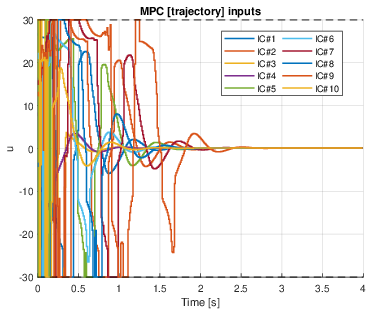
Figure 5: MPC control input sequences corresponding to each closed-loop rollout, demonstrating bounded, smooth actuation.
Strong numerical results are reported: final state errors of ∼8×10⁻³ (in Euclidean norm) and consistent adherence to input constraints. The mean per-step MPC solve time is 101 ms, indicating practical tractability (while not strictly real-time at the 10 ms sampling interval, this is a MATLAB baseline for the nonlinear program).
Implications and Future Directions
The presented structured GeKo learning framework addresses critical bottlenecks in Koopman-based model identification for control: it provides systematic reduction of compounding rollout error via multi-step regression, enforces model parsimony and interpretability via structured SVD, and retains the operator form needed for recursive rollouts and feedback control. The pipeline's modularity permits plug-and-play with different kernels, liftings, and dictionary types.
Theoretically, the method clarifies the connections and distinctions among Koopman generalizations for control—specifically, by providing a unified operator-theoretic realization that strictly includes prior linear and bilinear structures.
Potential avenues for future advances include algorithmic acceleration for real-time MPC, systematic comparisons with alternative data-driven control paradigms (e.g., SINDy-MPC, neural ODE controllers), and further theoretical analysis on nonconvexity and convergence in finite-data scenarios.
Conclusion
This paper delivers an effective, interpretable, and numerically robust methodology for data-driven Koopman operator learning tailored to predictive control tasks. By integrating multi-step kernel regression, structured SVD model reduction, and random feature realization within a closed-loop MPC design, the approach attains high open- and closed-loop accuracy on strongly nonlinear systems such as the Lorenz attractor, substantiating its suitability for practical nonlinear control applications.
Reference: "Koopman operator learning for predictive control via Khatri-Rao kernel regression" (2606.02938)

